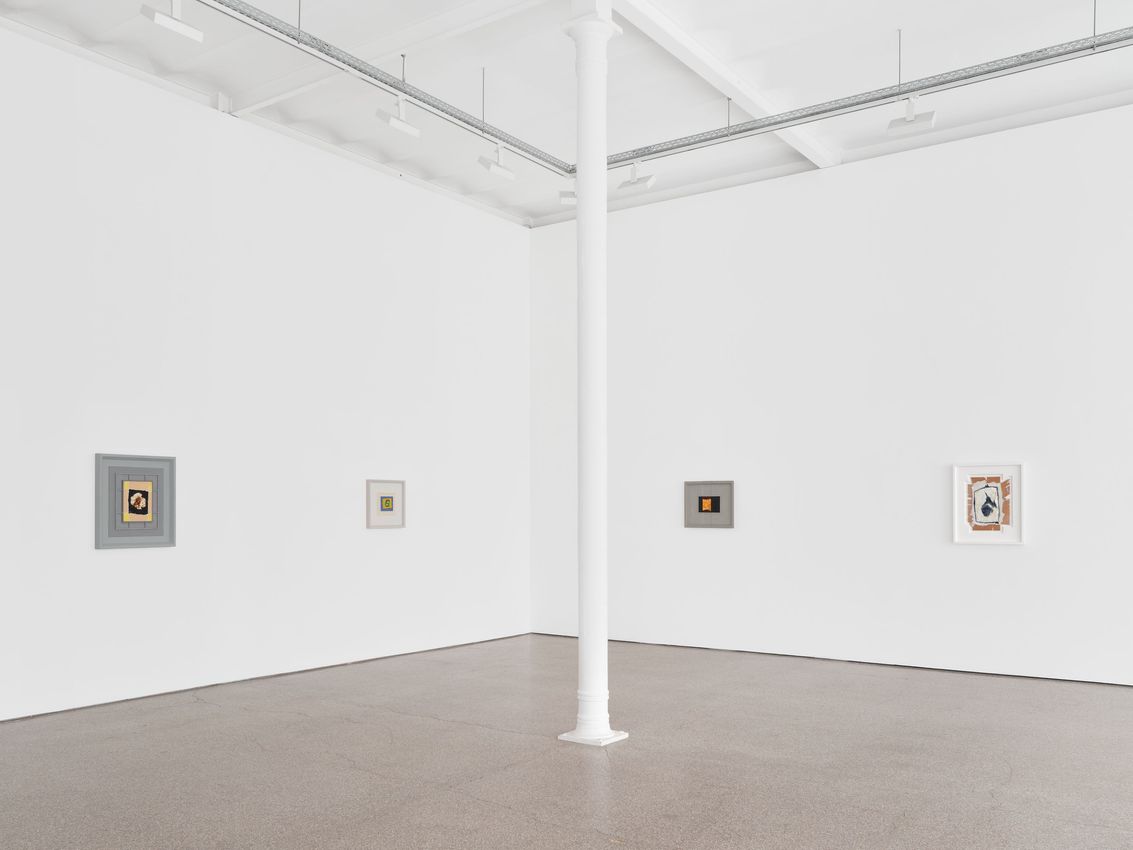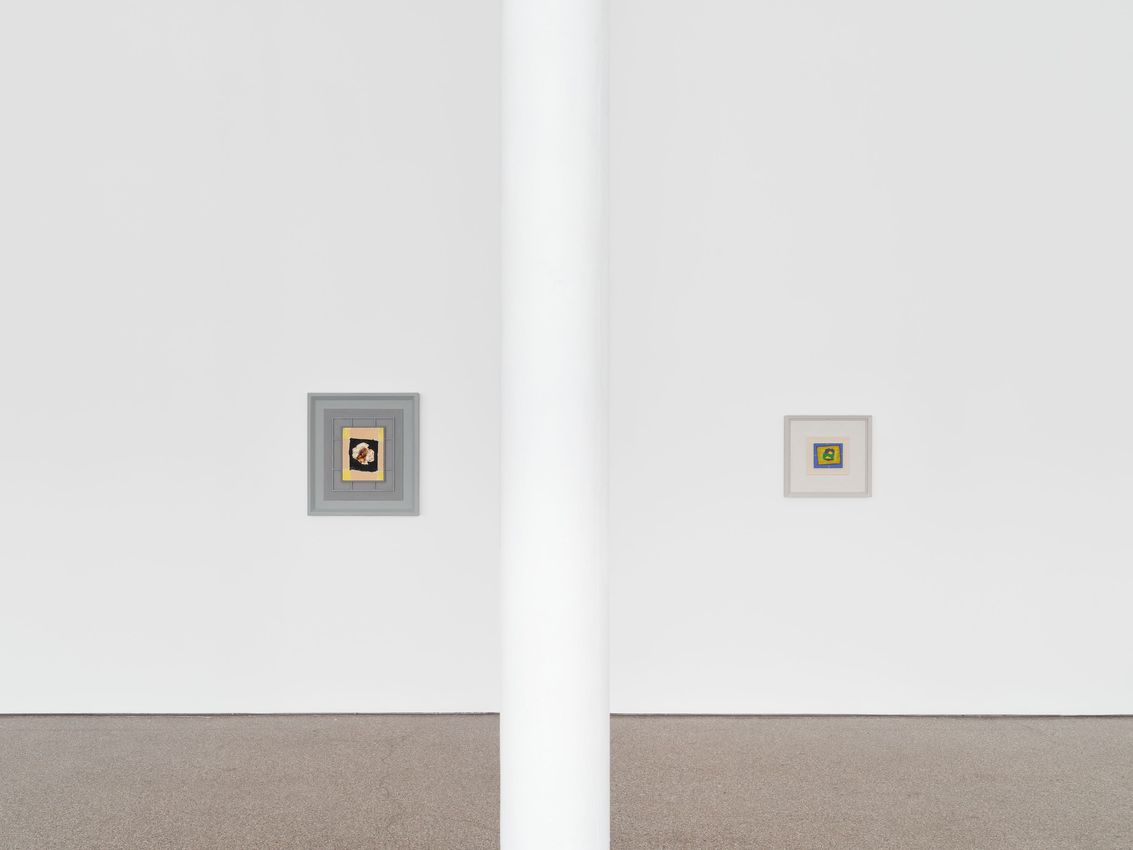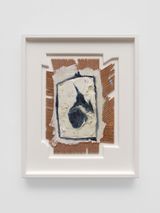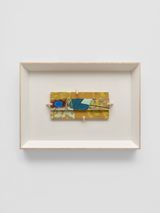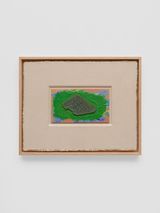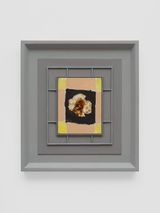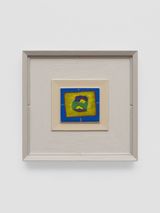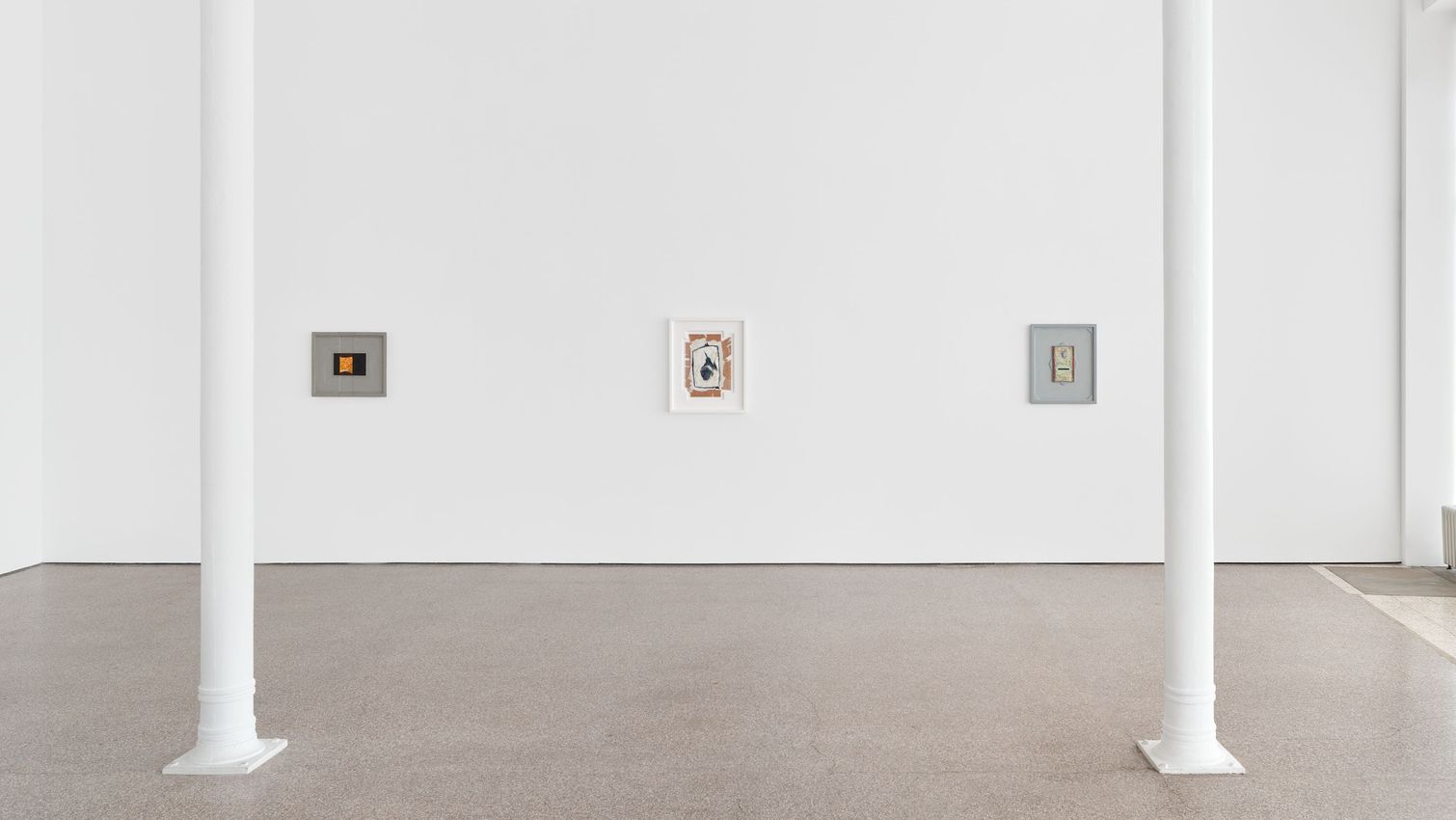
Galerie Greta Meert is delighted to present the first solo exhibition in Brussels by the American artist Noam Rappaport. Titled TEN, the exhibition brings together a series of recent works on the gallery’s ground floor that, while sharing a common sensibility, each maintain a strong individual presence. The title itself resists exact quantification; the number is approximate, suggesting possibility rather than fixed count. From the outset, the exhibition invites viewers to look without feeling compelled to decipher.
Rappaport’s works rarely begin with a preconceived plan. They emerge instead through material experimentation: impulsive markings, fragments from the studio, and unstructured drawing produced between other projects. As the artist notes, there is often not even a clear intention to make a painting. An initial gesture, accidental, spontaneous, offhand, determines the work’s direction.
Some paintings resolve themselves quickly; others take months or years to settle. What matters is not a predetermined outcome, but allowing the work to arrive at its own form, without obligation or fixed meaning. Whether one painting resembles another is of little concern; each follows its own internal logic.
This openness gives the works a curious relationship to time. They resist easy placement within a specific canon or historical moment, appearing at once aged and remarkably fresh. The playful use of color in the central field, open, ambiguous, and outward-facing, gives each work a distinct character, while an underlying sensibility binds them together as a group.
In an earlier context, Matthew Higgs described Rappaport’s works as ‘discrete yet related’, a phrase that resonates here, capturing both the singularity of each piece and their quiet kinship.
Contrast serves as a central principle throughout the series. Color, material, form, and composition continually shift between opposites rather than resolving them. Bright passages meet muted tones; hard edges dissolve into softer expanses; deliberate marks sit beside accidental residue. This dynamic is especially evident in the relationship between painting and frame. While the paintings themselves resist fixed obligation, the frames assume a supporting role: they enclose, stabilise, and amplify what unfolds at the centre.
At once sculptural and graphic, the frames remain understated yet unmistakably present. They function as containers that allow the paintings to assert themselves while retaining an autonomy of their own. In the artist’s view, they sometimes resemble self-contained paintings: spatial and material echoes of what they surround. The frame monumentalises without dominating; it anchors without imposing, extending the work outward as a quiet counterbalance to the impulsive interior.
This relationship between centre and edge gives the exhibition its understated structural coherence. The paintings remain open- ended; the frames provide structure. Each pairing operates as a small economy in which improvisation and structure hold one another in balance. The often-noted idiosyncrasy of Rappaport’s practice emerges here not as eccentricity, but as the natural consequence of a process that resists predetermination.
Painting by painting, TEN unfolds as a meditation on containment and revelation, impulse and care, singularity and cohesion. Each work inhabits its own temporality, yet together they form a shared space. It is within this tension between the individual gesture and the collective framework that the exhibition finds its coherence.
The title functions less as a count than as an anchor, suggesting both the completion of a cycle and the beginning of another. Rappaport’s exhibition rewards sustained looking rather than being deciphered, and offers the viewer precisely what an exhibition at its best affords: an open field in which the act of looking itself rediscovers its openness and repose.
Noam Rappaport lives and works in Grass Valley, California, USA.


Over the past 30 years, Galerie Greta Meert established itself as one of Brussels’ leading contemporary art galleries. Founded in 1988 as Galerie Meert Rihoux, it was subsequently renamed after its founding director Greta Meert in 2006. Located in the center of Brussels, the gallery occupies a five-story Art Nouveau building designed by Louis Bral and renovated for the gallery by renowned Belgian architects Hilde Daem and Paul Robbrecht. Since 2012 three floors of the building are dedicated to exhibitions, making it possible to maintain an expanded exhibition schedule.

A respected voice in contemporary art discourse.
Focusing on ambitious storytelling and insightful art-world commentary. Ocula Magazine publishes in-depth interviews, critical essays and timely analysis on the artists, exhibitions and ideas driving the global art world.
Learn more about Ocula Magazine
Showcasing the best of the art world.
Ocula partners with galleries from around the world to highlight their artists, artworks and exhibitions. Gallery membership is by application and invitation, with each member vetted by an independent panel.
Learn more about Ocula Membership

Specialises in the sale of major artworks.
Led by a team with deep ties to the world’s leading auction houses, galleries and collectors. Ocula’s advisory team offers bespoke services to high-net-worth clients from around the world who are looking to acquire the best of contemporary and modern art.
Learn more about our team and services