The art world in focus
Subscribe to our newsletter for news and insights on artists, galleries and exhibitions.
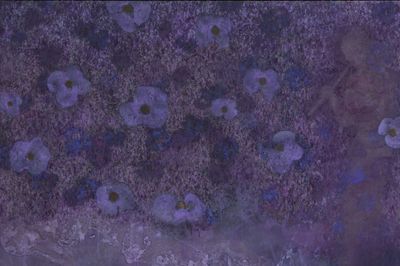
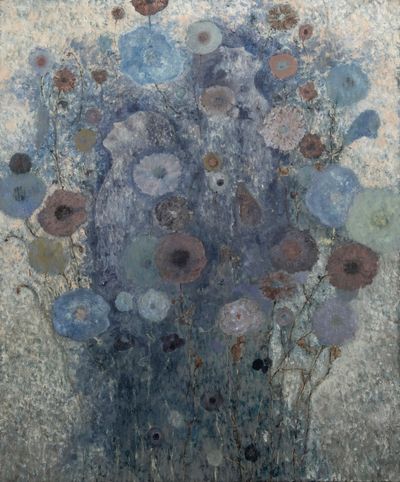
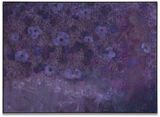
Oliver Bak, Violets Banquet (2024) (detail). Oil and wax on linen. 177 x 246 x 2.6 cm. © Oliver Bak. Courtesy Sprüth Magers, Berlin. Photo: Timo Ohler.
‘The actor is an athlete of the heart’ wrote the legendary French poet and playwright Antonin Artaud—who, for a period, was closely associated with the Surrealists—in The Theatre and its Double (1938). Oliver Bak‘s paintings place him in a similar vein, emotion being his preferred currency.
The young Danish painter has quoted Artaud in the title of his first solo exhibition at Sprüth Magers in Berlin, Ghost Driver, or The Crowned Anarchist (14 September–2 November 2024).
Bak read Artaud’s 1934 biography of the infamous Roman Emperor Heliogabalus after becoming fascinated with the Victorian painting by Sir Lawrence Alma-Tadema, The Roses of Heliogabalus (1888), which depicts the young Emperor hosting a banquet with guests literally drowning in rose petals.
It’s a preposterous image dominated by a sea of pink petals fluttering across the canvas, delighting with its sheer beauty as much as the absurdity of the scene. Flowers—along with various other figures, animals, and motifs from ancient myths—seep into Bak’s paintings, acting as vessels to transport the mind.
Speaking to me on Zoom from his Copenhagen studio, Bak—in his early 30s—cuts a relaxed figure albeit one who is passionate to discuss the exhibition he has been working on over the last few months.
‘Painting is related to dreaming’ he tells me, ‘dreams have to start somewhere, then they evolve and take you on their own journey. And I feel that it is very much the same process in painting. At some point, you lose track of things or you go with the painting itself and you just try to follow what it says to you or you have this little battle with it.’
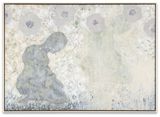
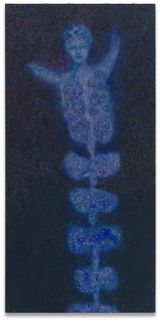
To be faced with one of Bak’s canvases is to experience a sensation akin to an oneiric state. Layers of oil paint are worked over, removed, and reapplied, enabling imagery slowly to reveal itself from deep within the composition. Figures and animals are delicately rendered in chiaroscuro reminiscent of another era, but this is often activated by a layer of small, more lively brushstrokes of vivid colour that shimmer and dance across the surface. You become lost in the paint, searching for clues until eventually submitting to this strange environment that feels unnervingly familiar.
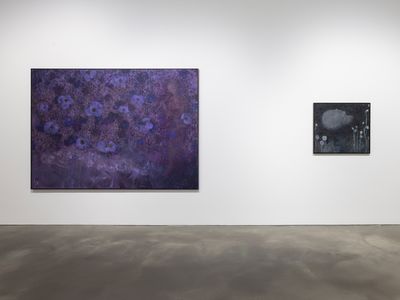
Bak tells me that he can always sense when a painter has erased or worked over the top of a figure or motif that’s no longer visible, and this layering is a vital part of his own practice. He reveals that his work is ‘very driven by ghosts and imagining the past’, adding that he is ‘trying to expose the ghost inside paintings’. There is a misty and ethereal quality present in much of his oeuvre, encouraging this notion of characters resurfacing to haunt us.
Painters from art history also emerge at times. Bak’s obsession with flowers and his abstract—albeit emotive—treatment of them bring to mind the work of Cy Twombly.
While in Violets Banquet (2024) and Children of the Sun (2024) the combination of floral motifs and figures floating in space recalls the French Symbolist painter Odilon Redon but I sense that Bak draws from these artists in a similar manner to how he envisages the historical figures that influence his paintings.
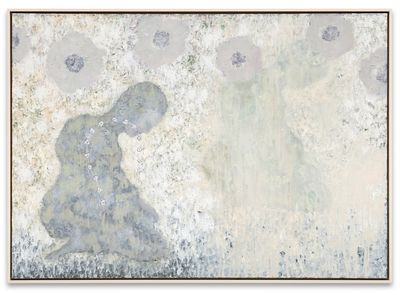
Tellingly he mentions, ‘I heard someone on the radio say, “The past is always something you imagine right now, so it’s very much constructed by the now.” I think that’s an interesting idea and a nice way to try to flatten, or even dissolve, time.’
‘Painting is a very emotional thing,’ he tells me. ‘I think of [my paintings] as windows holding layers of emotion, stacked up on top of each other.’ Touchingly, the artist started drawing at a young age sitting beside his father, who drew orchids in his downtime from his day job as a biologist.
The image leaves me feeling that, despite the scent of the past that permeates much of his work, it’s Bak’s ability to paint his own reality that really sings. In this way, he’s a kindred spirit with some of the most enduring painters from the past. —[O]
Selected Artworks






A respected voice in contemporary art discourse.
Focusing on ambitious storytelling and insightful art-world commentary. Ocula Magazine publishes in-depth interviews, critical essays and timely analysis on the artists, exhibitions and ideas driving the global art world.
Learn more about Ocula Magazine
Showcasing the best of the art world.
Ocula partners with galleries from around the world to highlight their artists, artworks and exhibitions. Gallery membership is by application and invitation, with each member vetted by an independent panel.
Learn more about Ocula Membership
Specialises in the sale of major artworks.
Led by a team with deep ties to the world’s leading auction houses, galleries and collectors. Ocula’s advisory team offers bespoke services to high-net-worth clients from around the world who are looking to acquire the best of contemporary and modern art.
Learn more about our team and services