



Acquavella Galleries is pleased to present Calder: Composing Motion, an exhibition of mobiles, stabiles, standing mobiles, and works on paper by the celebrated American artist (1898–1976). Opening February 15, 2024, the presentation explores Calder’s mastery of abstraction and movement across a range of media. The objects shown in this exhibition represent over three decades of Calder’s practice, primarily composed of works from the latter half of his career.
Emerging in 1920s Paris, Calder was a disruptor who challenged established boundaries in art by collapsing mass and setting sculpture in motion. In 1931, he pioneered an entirely new type of art with his invention of the mobile, or kinetic abstract compositions, which continue to influence generations of artists today. Composing Motion explores how movement remained central to Calder’s oeuvre throughout his career not only in his kinetic sculptures, but also in his stabiles, or stationary objects, and his paintings. The show draws its title drawn from a 1933 statement in which Calder asserted, “Just as one can compose colors, or forms, so one can compose motions.”
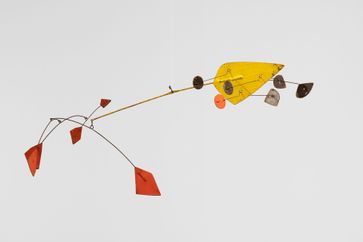
Ordered and unpredictable, random and controlled, sparse and full, Calder’s work embraces these contradictions, as is evidenced by Le Petit croissant (1963), a 4 ½-foot-wide hanging mobile consisting of red-and black-painted sheet metal and wire. When animated, the metal elements oscillate on their wire axes. The work exemplifies how Calder’s artistic language is articulated, both in stillness and in flux. Combining physical forces–gravity, motion, and balance–with aesthetic intuitions, Calder’s mobiles come to life with subtle changes in the environment, undulating in response to air currents in a way that activates the surrounding space.
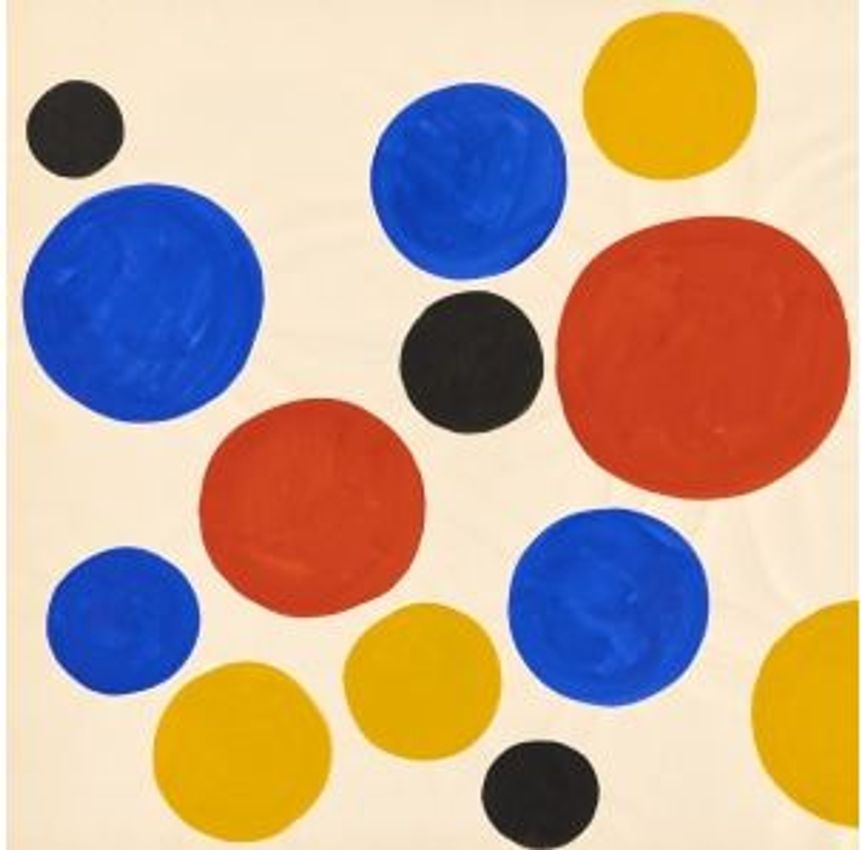
Whereas Calder’s mobiles continuously carve new forms by way of their movement, it is the anticipation and suggestion of motion that figure into the artist’s stationary works. Even when motion is not literally present, it is implied through Calder’s compositions. In the artist’s works on paper from the 1960s and 1970s, of which there are fifteen in Composing Motion, vividly colored circular forms fill the two-dimensional plane. Red, yellow, blue, and black spheres circulate throughout an untitled work on paper from 1963, as if the dynamic energies of his mobiles were translated directly to paper. A stabile such as The Wave (maquette) (1966) embodies both stasis and flux, its curled ends giving a sensation of motion. This work is the original model for a monumental counterpart that stands over eight feet tall. Although it is intimate in scale, it implies immensities, with an unpainted surface reflecting light and energy.
Calder: Composing Motion will be accompanied by a hard-cover catalogue featuring an essay by art historian and Professor at the Institute of Fine Arts, New York University, Robert Slifkin.
Alexander Calder is an iconic American sculptor whose career, spanning much of the 20th century and across continents is said to have profoundly changed the course of modern art.

Acquavella Galleries is distinguished for its expertise in the fields of 19th, 20th and 21st century art. The gallery, founded by Nicholas Acquavella in the early 1920s, is now a three-generation, family-owned business: Bill Acquavella joined his father in 1960, Bill’s daughter Eleanor joined in 1997, and his sons Nick and Alexander joined in 2000 and 2003 respectively. The gallery first specialized in works of the Italian Renaissance and old master paintings, but Bill expanded the focus to include the masters of Impressionism, Post-Impressionism, Cubism, and Surrealism. In the late 1980s, the gallery also began dealing in postwar and contemporary art. Today, the gallery regularly exhibits works by artists such as Paul Cézanne, Claude Monet, Edgar Degas, Amedeo Modigliani, Pablo Picasso, Henri Matisse, Pierre Bonnard, Joan Miró, Fernand Léger, Paul Klee, Alberto Giacometti, Willem de Kooning, Franz Kline, Mark Rothko, Jean Paul Riopelle, Jean Dubuffet, Jasper Johns, Andy Warhol, Cy Twombly, Jean-Michel Basquiat, and Lucian Freud. On the primary market, the gallery represents Miquel Barceló, Jacob El Hanani, Damian Loeb, Tom Sachs, and Wayne Thiebaud.
A respected voice in contemporary art discourse.
Focusing on ambitious storytelling and insightful art-world commentary. Ocula Magazine publishes in-depth interviews, critical essays and timely analysis on the artists, exhibitions and ideas driving the global art world.
Learn more about Ocula Magazine
Showcasing the best of the art world.
Ocula partners with galleries from around the world to highlight their artists, artworks and exhibitions. Gallery membership is by application and invitation, with each member vetted by an independent panel.
Learn more about Ocula Membership

Specialises in the sale of major artworks.
Led by a team with deep ties to the world’s leading auction houses, galleries and collectors. Ocula’s advisory team offers bespoke services to high-net-worth clients from around the world who are looking to acquire the best of contemporary and modern art.
Learn more about our team and services