Press Release

Gladstone and Richard Nagy Ltd. Present Gustav Klimt: Women

The exhibition features rare studies and drawings on view this May in New York

I never painted a self-portrait. I am not interested in myself as a subject; rather, I am drawn to other people, especially women. Whoever wishes to understand me as an artist - which is the only remarkable aspect - should look at my paintings and discern through them who I am and what I seek to express. Gustav Klimt.

If Klimt’s paintings offer a way to understand the artist, his drawings bring us closer still— distilling his vision into its most direct and intimate form.

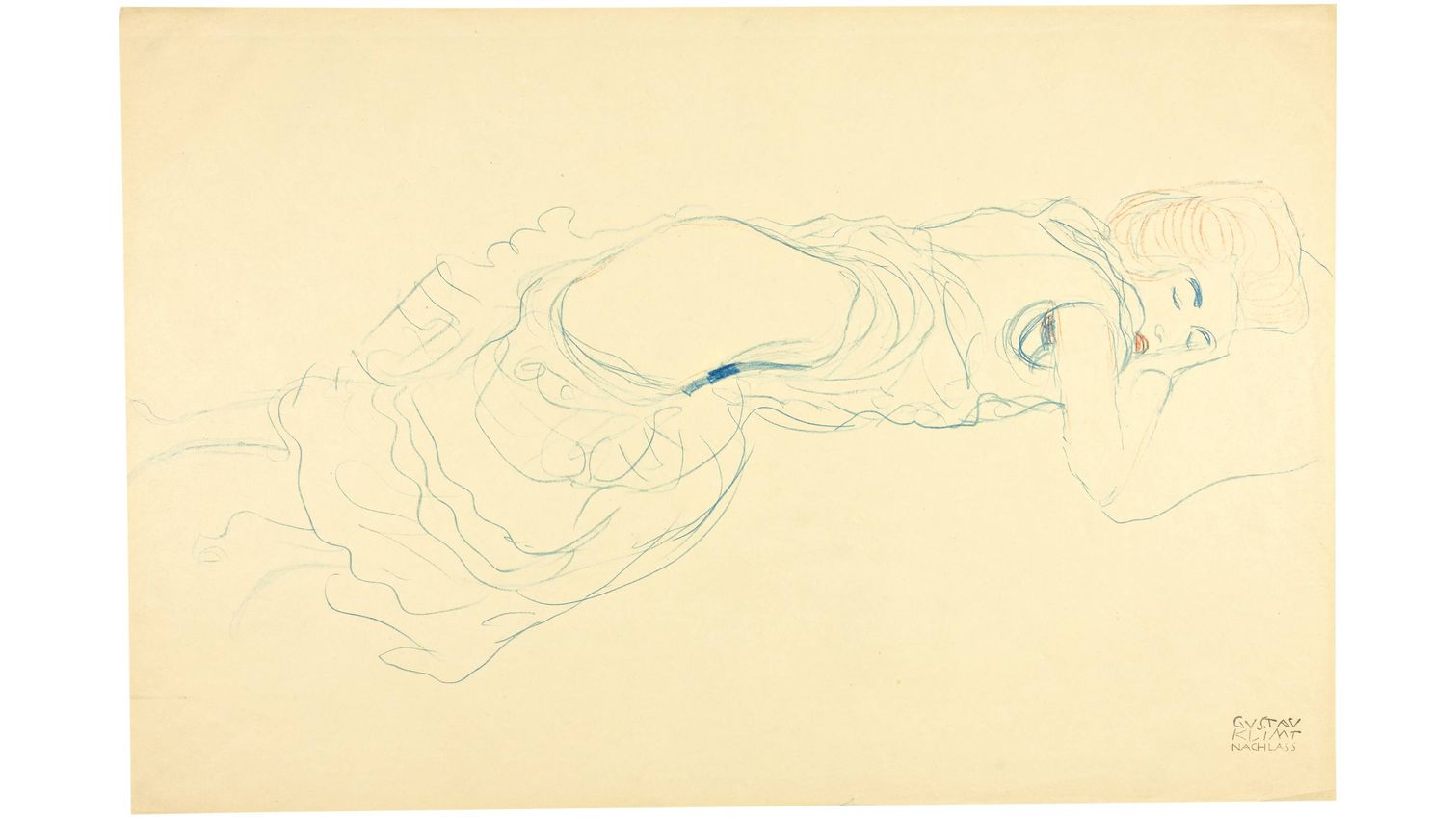
Gladstone and Richard Nagy Ltd. present Women, an exhibition of studies and drawings by Gustav Klimt. Both sublimely sensual and modern, the exhibition is an overview of Klimt’s mature style of drawing, one that owes more to the Austrian artistic movement Jugendstil than the academic. Notably, Klimt’s extensive collection of erotic drawings, which sparked controversy both during his lifetime and after, remains a significant aspect of his oeuvre. Today, the preparatory drawings related to his paintings are regarded as some of Klimt’s finest works. Women is on view at Gladstone’s East 64th Street space May 15 through June 17.

The start of the exhibition is a study for the Beethoven Frieze (1902), a turning point between his academic work and his mature period.

It was at this time, circa 1902/3, (the so-called golden style), when Klimt began producing drawings not necessarily linked to his paintings, allowing them to be appreciated as stand-alone works of art. By 1905, his drawings evolved further, and he began to use a refined Japan paper of slightly larger dimensions, seen in Reclining Semi-Nude Lying on Her Front (1910).

Klimt’s late period, beginning around 1912, is characterised by bolder lines, daring perspectives, and an intensified focus on physical and psychological expression — particularly in his studies of the nude. His genius as a draughtsman lay in his ability to convey a striking immediacy through minimal yet expressive lines. The power of his drawings stems, in part, from their complete spontaneity.

While his paintings epitomised Jugendstil, his drawings possess a modernity that transcends their era and speaks to us in a contemporary voice, seen in Reclining Nude to the Right, with Right Knee pulled up (circa 1912) and Reclining Nude with Splayed Legs circa (1913).

Notably, his extensive collection of erotic drawings, often controversial both during his lifetime and beyond, remains a significant facet of his oeuvre. Klimt’s faculty paintings, intended for the University of Vienna, provoked public outcry, leading to their rejection. Today, the related preparatory drawings are regarded as some of his finest works, including Study for Jurisprudence, (1902).

As a financially independent artist, Klimt had the freedom to devote time to drawings he never intended for public display. Few of his drawings were exhibited during his lifetime, which include his erotic works. They are frank and unpretentious, lacking the detachment seen in Toulouse-Lautrec’s works. He had a unique rapport with his models, who often were lovers and therefore at ease in his presence. He saw no part of the human body as shameful or ignoble.

Over a century after his death, numerous exhibitions have illuminated this deeply private side of Klimt, often subjecting his work to fashionable critiques and pop-psychological interpretations. Nevertheless, to fully grasp the essence of the artist and his legacy, one must consider not only his celebrated paintings but also his preparatory sketches and private drawings.

About Gustav Klimt

Born on 14th July 1862, Gustav Klimt was the second of seven children. In 1876, Klimt was recognised as an exceptional talent and awarded a scholarship to the Kunstgewerbeschule des Österreichischen Museums. As a result, Klimt, alongside his brother Ernst and Franz Matsch, was commissioned in 1894 to decorate the ceiling of the Great Hall of the Vienna University with allegorical faculty paintings, Medicine, Philosophy, and Jurisprudence. Klimt ultimately rejected the university commission in 1905. The paintings were never installed at the university. In 1902, his Beethoven Frieze depicted the triumph of happiness over dark forces through the power of the arts. A pivotal moment in Klimt’s artistic evolution came in 1903 when he visited Ravenna. Inspired by Byzantine mosaics, he incorporated a rich, golden aesthetic into his paintings. Adele Bloch-Bauer I (1907), and The Kiss (1907) - hallmarks of what is now known as his Golden Style. It was also in 1907 that Klimt met the young Egon Schiele. Recognising Schiele’s prodigious talent, Klimt encouraged him but advised against formal study under him, believing Schiele’s raw genius needed no intervention. By 1909 Klimt increasingly felt disconnected from the modernist movement and withdrew from public life. He spent long periods painting landscapes around the Attersee and creating intimate portraits. In his final years, Klimt’s artistic output remained prolific, yet with his withdrawal from his public life came an abandonment of the grand allegorical works. In 1915, Klimt was finally nominated for an honorary professorship at the Vienna Academy - a long-overdue recognition. Upon returning from a trip to Romania in early 1918, Klimt suffered a stroke. He died, aged 56, in Vienna on 6th February 1918, leaving behind an extraordinary body of work, some of which would remain unfinished but nonetheless influential. Today, Klimt is celebrated as a visionary who bridged the gap between tradition and modernity. Once dismissed as decorative and controversial, his art now stands among the most revered and valuable in the world.

Read More
About the Artist

Gustav Klimt (1862–1918) was an Austrian painter celebrated for his symbolic, sensual, and ornate contributions to modern art. As a co-founder of the Vienna Secession, Klimt departed from the established academic traditions of his time to explore more poetic themes of love, life, and mortality. His most famous paintings, The Kiss (1908) and Portrait of Adele Bloch-Bauer I (1907) continue to enchant audiences worldwide.

View Artist Profile

Also Exhibiting at Gladstone

About the Gallery
Gladstone is known for its commitment to artists whose prescient approaches and experimental practices have defined the contours of contemporary art. The gallery has long been an active partner in the cultivation of iconoclastic careers, fostering a roster of artists recognized for their ground-breaking contributions. Headquartered in New York and including outposts in both Brussels and Seoul, Gladstone’s impact extends globally, enabling both the presentation of new bodies of work, and an amplification of the international reach of its artists. Alongside its work with contemporary artists, the gallery is steward to the legacies of pivotal historical artists and serves as an advocate for the enduring power of art. Gladstone is led by a team of partners who spearhead its long-term vision and program, building on the values of its founder Barbara Gladstone.
View Gallery Profile
Address
and Richard Nagy Ltd. present

130 East 64th Street,

New York, NY 10065

(1)
New York 130 East 64th Street
Gladstone
130 East 64th Street, New York, United States
+1 212 753 2200
http://gladstonegallery.com

Opening hours
Tuesday - Saturday
10am - 6pm
The art world in focus