



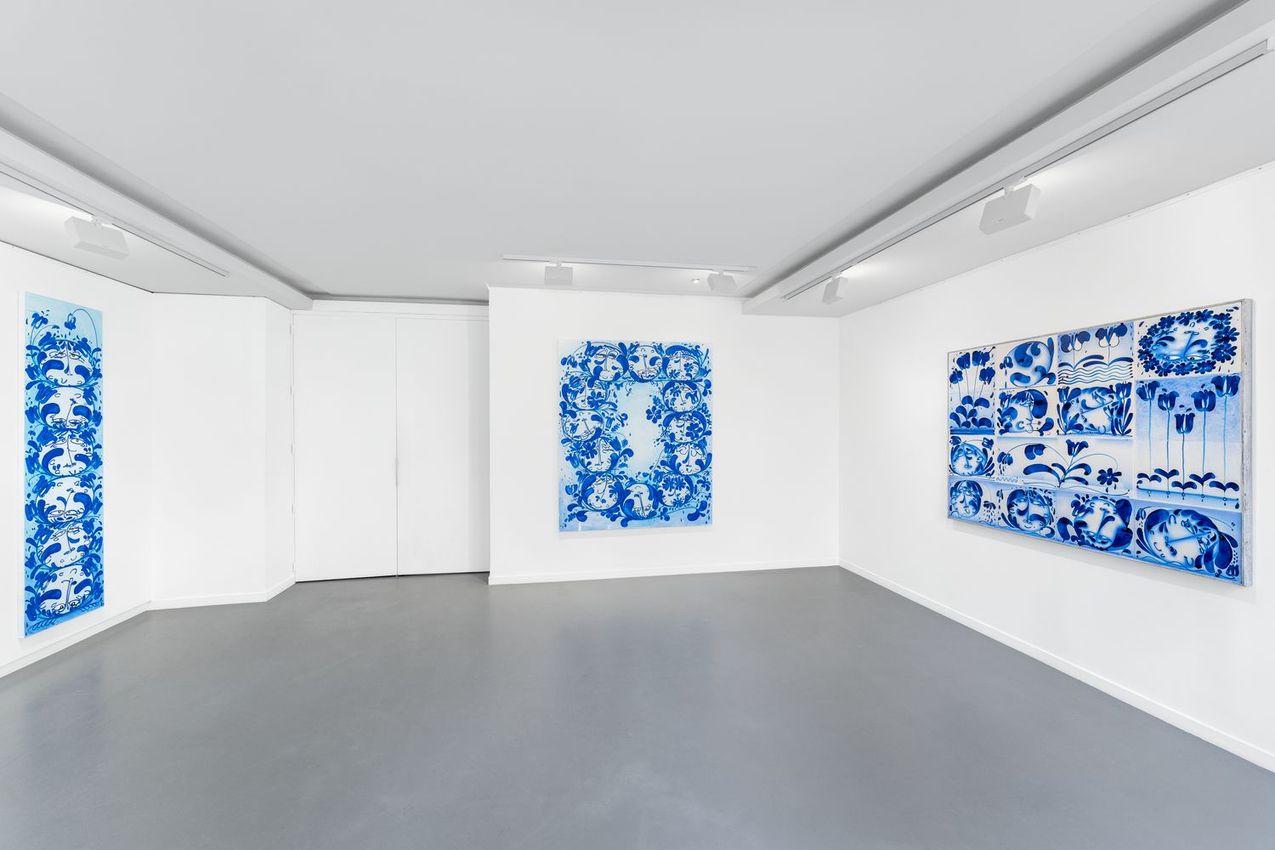
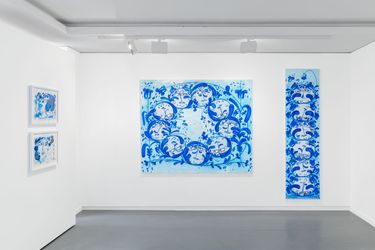
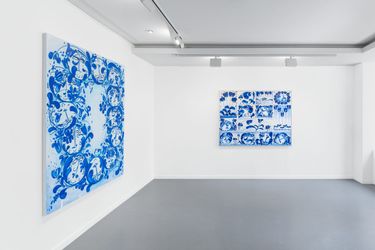
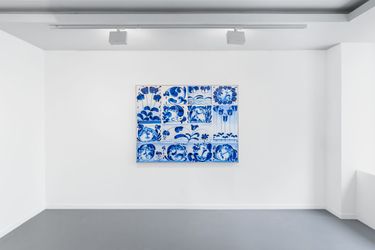
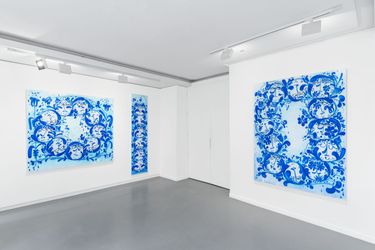
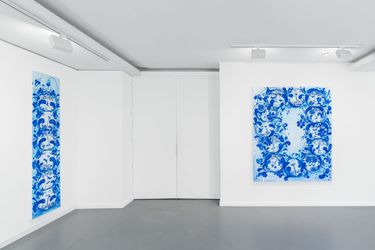
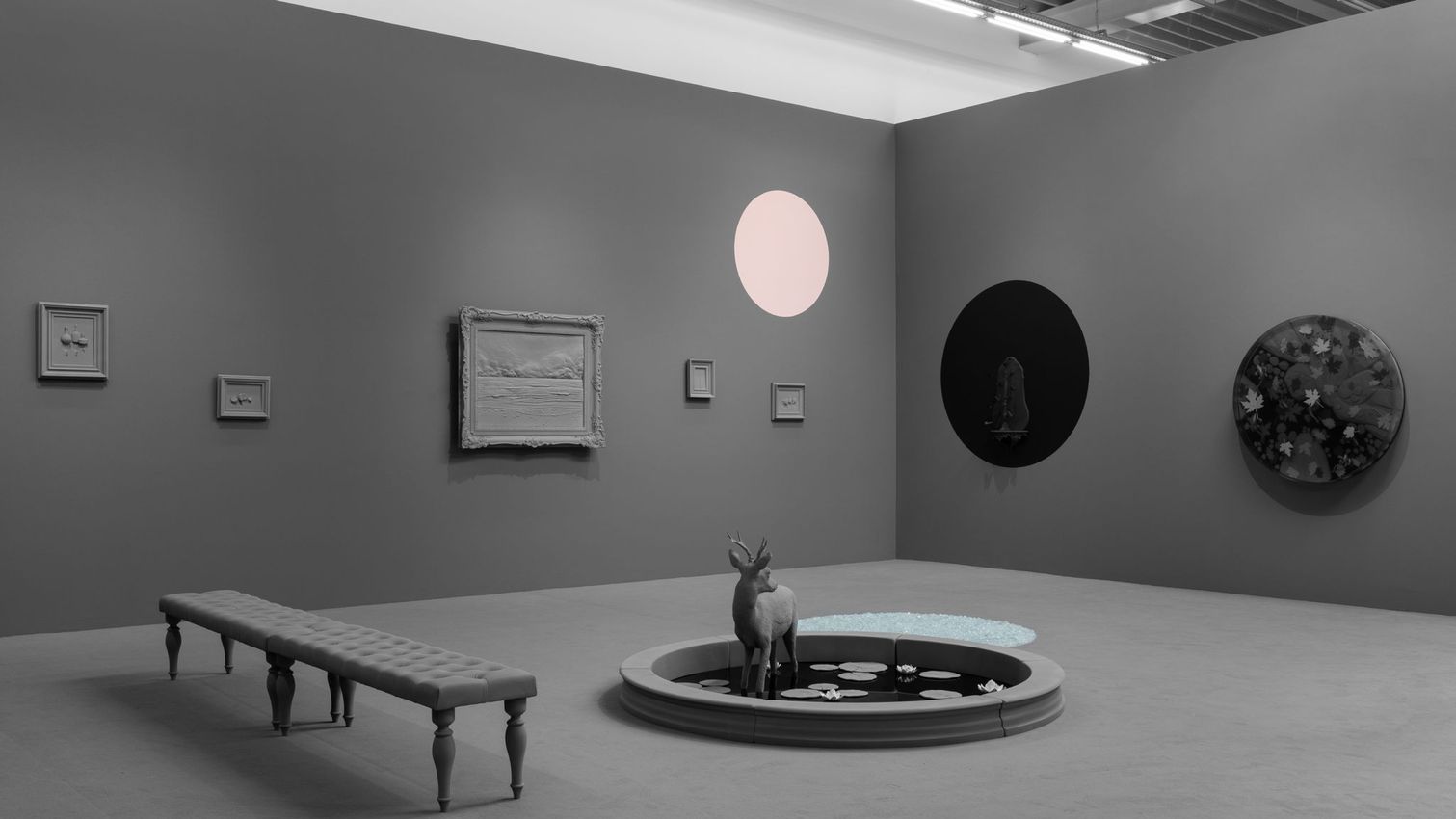
Almine Rech Gallery is proud to present Self-Watering Flowers, a Paris solo show by Timothy Curtis, his first with the gallery.
‘I’m getting to a place where I can feel free’, the self-taught artist said during a studio visit, ‘and I’m making the best work I can make.’
Freedom and its opposite are very concrete for the Philadelphia native, who was in state prison from 2008 to 2015. He made the best of his time, studying art history and involved with a mural painting program. Curtis was previously a graffiti artist, and while his new works may not obviously resemble graffiti-style imagery, the work is connected to that tradition via a seemingly unlikely link with another art form.
In accounting for the origins of Philadelphia graffiti writing, which he describes as ‘identifiable across the whole planet,’ he connects its characteristic style with the tradition of Pennsylvania stoneware, which, along with cobalt blue renditions of a ‘man in the moon’ motif, frequently features images of tulips that are, it struck the artist, stylised in a manner similar to the way Philadelphia graffiti writers treat text.
And why not, he thought? Pennsylvania stoneware is ubiquitous in the region, and the originators of Philadelphia graffiti surely saw it all around them. The artist himself feels a personal link to the tradition: the Remmey stoneware-making family came from the neighbourhood of Kensington, where the artist spent part of his childhood.
Curtis has lately built a substantial collection of such stoneware; a room in his studio is lined with examples. He thus surrounds himself with what he feels is a key to graffiti art, which in turn has been massively influential on contemporary artists. And the City of Brotherly Love is key to the art form’s history, he maintains: ‘Philadelphia graffiti was already going on for fifteen years before Basquiat and Haring.’
What’s more, he says, considering that the Pennsylvania stoneware artists were drawing on European art and craft traditions, he is, in turn, pleased to bring works inspired by this unique American tradition back to Europe in this show.
The ‘starting point and guiding light for the exhibition,’ says Curtis, is the painting House of Tomorrow, which features man in the moon and tulip motifs in cobalt blue and is framed with recycled wood from a Philadelphia row house. It pays tribute to his daughter Nassia and her mother Haelinn, whose birthdays occur during the month of the exhibition. At the time of Nassia’s birth, Haelinn gave him Khalil Gibran’s book The Prophet, which includes the poem On Children, featuring the lines, ‘Your children are not your children. / They are the sons and daughters of Life’s longing for itself. / They come through you but not from you, / And though they are with you yet they belong not to you.’ And perhaps they live in the house of tomorrow.
As his daughter begins college and Curtis looks forward to a possible end to his time on parole, this show marks a bright chapter, symbolised by the notion of a self-watering flower: a self-nourishing thing of beauty. Bright faces continue a longstanding motif of Curtis’s inspired by the smiley motif, created by artist Harvey Ross Ball but popularised by Philadelphia brothers Bernard and Murray Spain. Here, they also refer to the stoneware man in the moon.
Past works have dealt with much darker themes. Kensington has been hit hard by the opioid epidemic, and the artist’s brother died from opioids in prison. Pills and pill bottles have been a frequent motif. Juxtapoz magazine described his 2020 Armory Show presentation as ‘a personal Guernica of the opioid crisis and the corruption of our prison system.’ Bicycles, a symbol of freedom, have appeared often, but frequently were damaged or locked up, and thus denied movement. Along with tally marks and prison bars, they alluded to his time in confinement.
Even while on parole, Curtis has forged an impressive early career. He has had solo exhibitions at Takashi Murakami’s Kaikai Kiki Hidari Zingaro, Tokyo, and Albertz Benda, New York. He has appeared in group exhibitions including The Pencil is a Key: Drawings by Incarcerated Artists, at the Drawing Center, New York; Coney Island is Still a Dreamland (To a Seagull) at the Brooklyn Museum; and Negotiating Grids at the Pennsylvania Academy of Fine Arts, Philadelphia. In 2023, he appears in Echoes of Picasso at the Museo Picasso Málaga, Andalusia, Spain; City as Studio curated by Jeffrey Deitch at K11, Hong Kong; and Beyond the Streets, Saatchi Gallery, London. His drawing practice is highlighted in Claire Gilman and Roger Malbert’s new book Drawing in the Present Tense (Thames & Hudson), and in 2024, he will open a solo show at Atlanta Contemporary.
Press release courtesy Almine Rech. Text: Brian Boucher.


Timothy Curtis is a self-taught artist from Philadelphia, where he was first introduced to the arts via graffiti writing as a young child. Following his release from a lengthy prison sentence Curtis moved to New York City where he established a focused studio practice in 2015. While incarcerated he threw himself into studying art history, drawing, and painting and was able to use his studies to form a mural painting crew consisting of artists sentenced to life in prison, painting educational murals around the prison campus to teach, motivate and add colour to the otherwise drab environment.


Almine Rech opened its doors on April 1st, 1997 in the 13th arrondissement in Paris. The gallery was founded on an axis of California Minimal, Perceptual art and Conceptual art, representing artists such as James Turrell, John McCracken and Joseph Kosuth.

A respected voice in contemporary art discourse.
Focusing on ambitious storytelling and insightful art-world commentary. Ocula Magazine publishes in-depth interviews, critical essays and timely analysis on the artists, exhibitions and ideas driving the global art world.
Learn more about Ocula Magazine
Showcasing the best of the art world.
Ocula partners with galleries from around the world to highlight their artists, artworks and exhibitions. Gallery membership is by application and invitation, with each member vetted by an independent panel.
Learn more about Ocula Membership

Specialises in the sale of major artworks.
Led by a team with deep ties to the world’s leading auction houses, galleries and collectors. Ocula’s advisory team offers bespoke services to high-net-worth clients from around the world who are looking to acquire the best of contemporary and modern art.
Learn more about our team and services