




PIERRE SOULAGES
1919-2022, FrancePierre Soulages was a pioneering French artist known for his distinctive abstract paintings characterised by deep black brushwork, or noir-lumière—a practice he termed Outrenoir, or ‘beyond black’, which redefined the role of light in contemporary art.
Early Years
Born in Rodez in southern France, Soulages was drawn to prehistoric and Romanesque art from a young age. He studied briefly at École des Beaux-Arts in Paris before leaving due to its rigid academic approach. His formative influences came not from modernist circles, but from the solemnity of Romanesque architecture and the simplicity of ancient forms.
Soulages lived and worked primarily in Paris and Sète, France. He gained international acclaim in the mid-20th century and became one of the most celebrated abstract artists of his generation.
Artworks
Pierre Soulages’ artworks are renowned for their meditative exploration of black as both a colour and a medium of light. His practice, which spanned over eight decades, redefined the possibilities of abstraction in contemporary art through a consistent, innovative investigation of surface, texture, and luminosity.
Early Abstractions
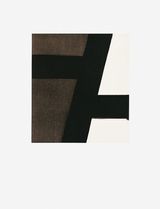
In the late 1940s, Soulages gained recognition for abstract artworks featuring broad, gestural black strokes across light grounds. Rejecting figuration early in his career, he exhibited in the Salon des Surindépendants in 1947 alongside Hans Hartung and Gérard Schneider. His use of walnut stain and ink on paper exemplified his commitment to material honesty and compositional rhythm. These early works caught the attention of curators and critics internationally and were soon included in exhibitions such as Younger European Painters at the Guggenheim Museum, New York, in 1953.
Calligraphic Forms and Modernist Gestures
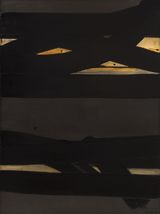
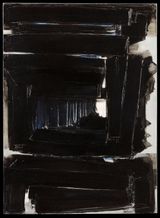
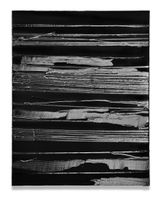
By the 1950s and 60s, Soulages developed a visual language of assertive black forms layered on raw or white backgrounds. Influenced by calligraphy and prehistoric carvings, he applied thick black lines using house-painting brushes, knives, and even window wipers. Works like Peinture 162 x 114 cm, 14 avril 1962 reveal his mastery of visual tension and negative space. Though often associated with Art Informel and Abstract Expressionism, Soulages’ paintings maintained a distinctly European restraint, reflecting his interest in Romanesque architecture and prehistoric art.
Outrenoir–Beyond Black
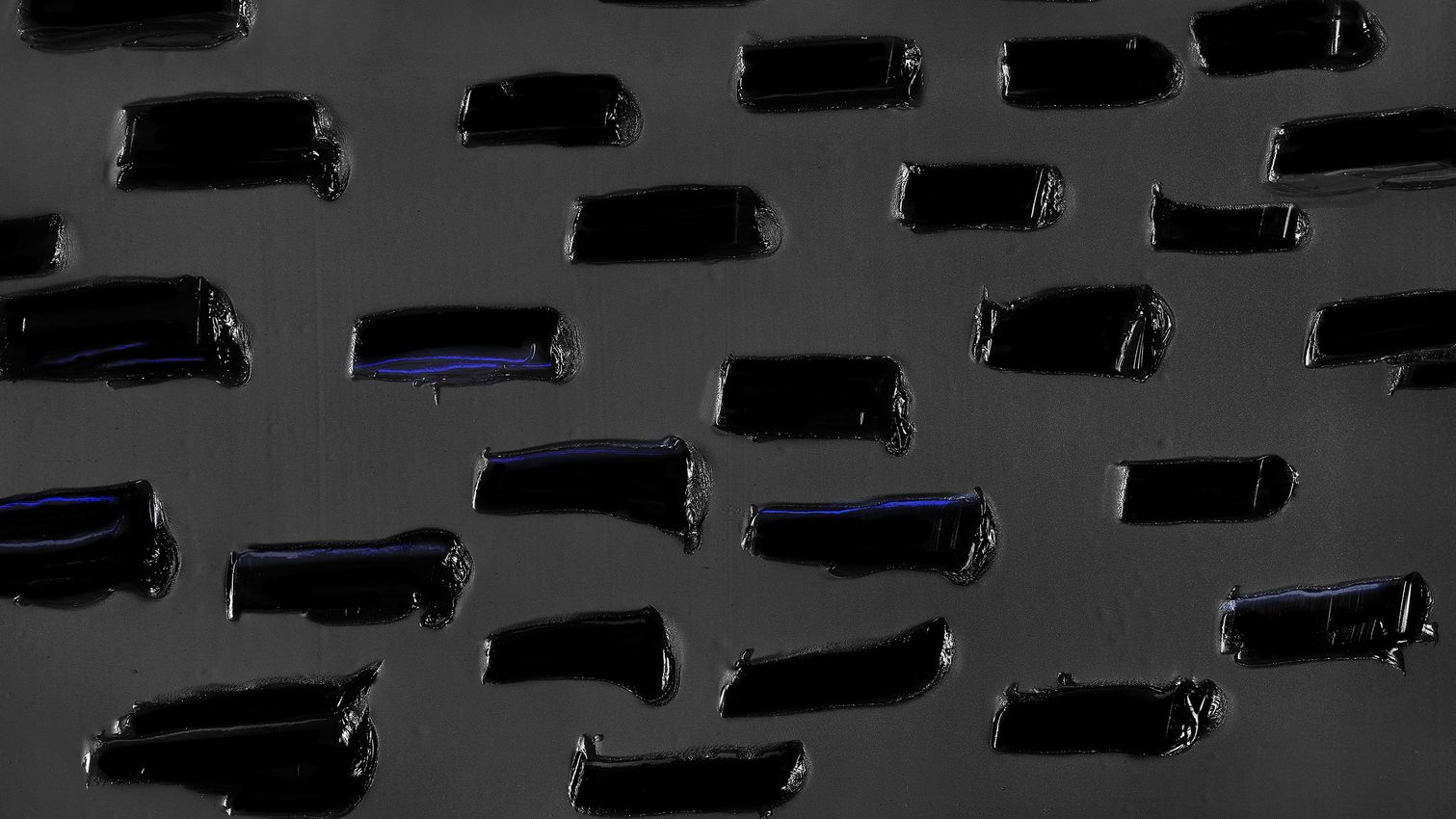
In 1979, Soulages experienced a pivotal shift that would define the remainder of his career. While working on a painting, he noticed that dense layers of black paint, when manipulated with brushes and blades, reflected light in unexpected ways. This led to the development of his Outrenoir series—a term coined by the artist to describe a state ‘beyond black’, where black is no longer merely a colour but a source of light itself.
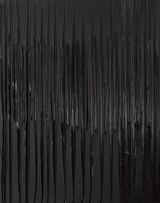
His Outrenoir paintings—such as Peinture 202 x 143 cm, 12 mai 1986—employ sculptural brushwork on large-scale canvases, creating reflective textures that change with ambient light and viewer movement. Soulages often applied paint with blades, creating ridges and striations that fragment and redirect light. These monochromatic artworks became his signature contribution to contemporary art and were exhibited globally, including in retrospectives at the Centre Pompidou (2009–2010) and Musée Soulages in Rodez.
Late Works and Vitrines (1987–2022)
Into his 90s, Soulages continued to innovate. In addition to large-scale canvases, he worked on works on paper and glass. His stained-glass windows for the Abbey Church of Sainte-Foy in Conques (1987–1994) brought his engagement with black and light into the realm of sacred architecture. Using handmade glass and subtle variations in opacity, Soulages transformed the church’s interior with a contemplative, ambient glow, merging contemporary abstraction with medieval spirituality.
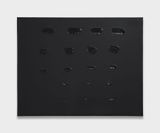
Even in his late years, Soulages’ commitment to material exploration remained undiminished. His final paintings—created past his 100th birthday—emphasised matte-black pigment and minimal brush intervention, heightening the physical presence of the artwork itself. These late works are often described as meditative, evoking both solemnity and transcendence.
Public Commissions
- Stained glass windows for the Abbey Church of Sainte-Foy in Conques, France (1986–1994)
- Murals for the One Bank of New York, commissioned in the 1960s
Awards and Accolades
- Praemium Imperiale for Painting, Japan Art Association (1992)
- Grand Cross of the Legion of Honour, France (2015)
- Elected to the Académie des Beaux-Arts (2019)
Exhibitions
Pierre Soulages has been the subject of both solo exhibitions and group exhibitions at important institutions. A selection of important exhibitions is provided below.
Solo Exhibitions
- Soulages, Musée du Louvre, Paris (2019–2020)
- Noir/Lumière, Ludwig Museum Koblenz, Koblenz (2018)
- Soulages. Papiers., Musée Picasso, Antibes (2016)
- Pierre Soulages: Les Outrenoir(s), Musée Soulages, Rodez (2014)
- Soulages XXIe siècle, Musée des Beaux-Arts de Lyon, Lyon (2012)
- Pierre Soulages, Museo de La Ciudad de México, Mexico City (2010)
- Pierre Soulages: A Retrospective, Centre Pompidou, Paris (2009)
- Soulages: Outrenoir in the USA, The Phillips Collection, Washington, D.C. (2001)
Group Exhibitions
- The New World of Charlotte Perriand, Fondation Louis Vuitton, Paris (2019)
- Rendezvous: Masterpieces from the Centre Georges Pompidou and the Guggenheim Museums, Solomon R. Guggenheim Museum, New York (1988)
- Paris-New York, Centre Georges Pompidou, Paris (1977)
- Younger European Painters, Solomon R. Guggenheim Museum, New York (1953)
Critical Reception
Soulages’ practice has been covered in major art publications including The Guardian, The Financial Times, and The New York Times.
Pierre Soulages FAQs
What is Pierre Soulages’ most preeminent series?
Pierre Soulages’ most celebrated and influential body of work is his Outrenoir series, initiated in 1979. Translating to ‘beyond black’, Outrenoir redefined the use of black in contemporary art—not as a void or absence, but as a source of light. These abstract paintings feature thick, textured black surfaces manipulated with blades and brushes to reflect ambient light, producing dynamic, shifting impressions as viewers move. The Outrenoir works marked a profound evolution in Soulages’ practice, making black not merely a colour, but the subject of the artwork itself. This series became his artistic signature and legacy.
What are Pierre Soulages’ contributions to contemporary art?
Pierre Soulages contributed to contemporary art by transforming black into a medium of light and a conceptual tool for abstraction. His development of Outrenoir offered a radical reimagining of monochrome painting and challenged traditional understandings of colour and space. Soulages also bridged the material experimentation of Art Informel with the visual purity of Minimalism, influencing generations of abstract artists. He rejected narrative and symbolism, instead inviting viewers to engage with light, surface, and sensation. His long career and consistent innovation earned him exhibitions at institutions like the Louvre, affirming his enduring impact on the history of modern art.
How did Pierre Soulages influence the use of light in art?
Pierre Soulages revolutionised the role of light in painting by creating artworks where the light is not painted but revealed through black surfaces. In his Outrenoir series, Soulages applied layers of black acrylic with knives and tools, creating textures that catch and reflect light. The result is a dynamic surface that changes depending on the viewer’s perspective and the surrounding light. This optical effect means that black, in Soulages’ hands, emits light rather than absorbs it. His innovative approach redefined black as a luminous, experiential colour and has influenced contemporary artists working with materiality, perception, and minimalism.
Ocula | 2025













Explore and Follow Artists Shaping Contemporary Art
A respected voice in contemporary art discourse.
Focusing on ambitious storytelling and insightful art-world commentary. Ocula Magazine publishes in-depth interviews, critical essays and timely analysis on the artists, exhibitions and ideas driving the global art world.
Learn more about Ocula Magazine
Showcasing the best of the art world.
Ocula partners with galleries from around the world to highlight their artists, artworks and exhibitions. Gallery membership is by application and invitation, with each member vetted by an independent panel.
Learn more about Ocula Membership
Specialises in the sale of major artworks.
Led by a team with deep ties to the world’s leading auction houses, galleries and collectors. Ocula’s advisory team offers bespoke services to high-net-worth clients from around the world who are looking to acquire the best of contemporary and modern art.
Learn more about our team and services