



Raimund Girke (1930–2002) is regarded as one of the leading German abstract painters of the post-war period. Linked to the broader European ZERO network, although never part of the movement itself, he developed a radical pictorial language in which white, rhythm, and brushstroke became central. For Girke, painting was a way to approach silence through movement, a practice where clarity, balance, and intensity came together.
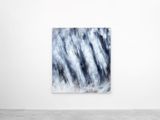
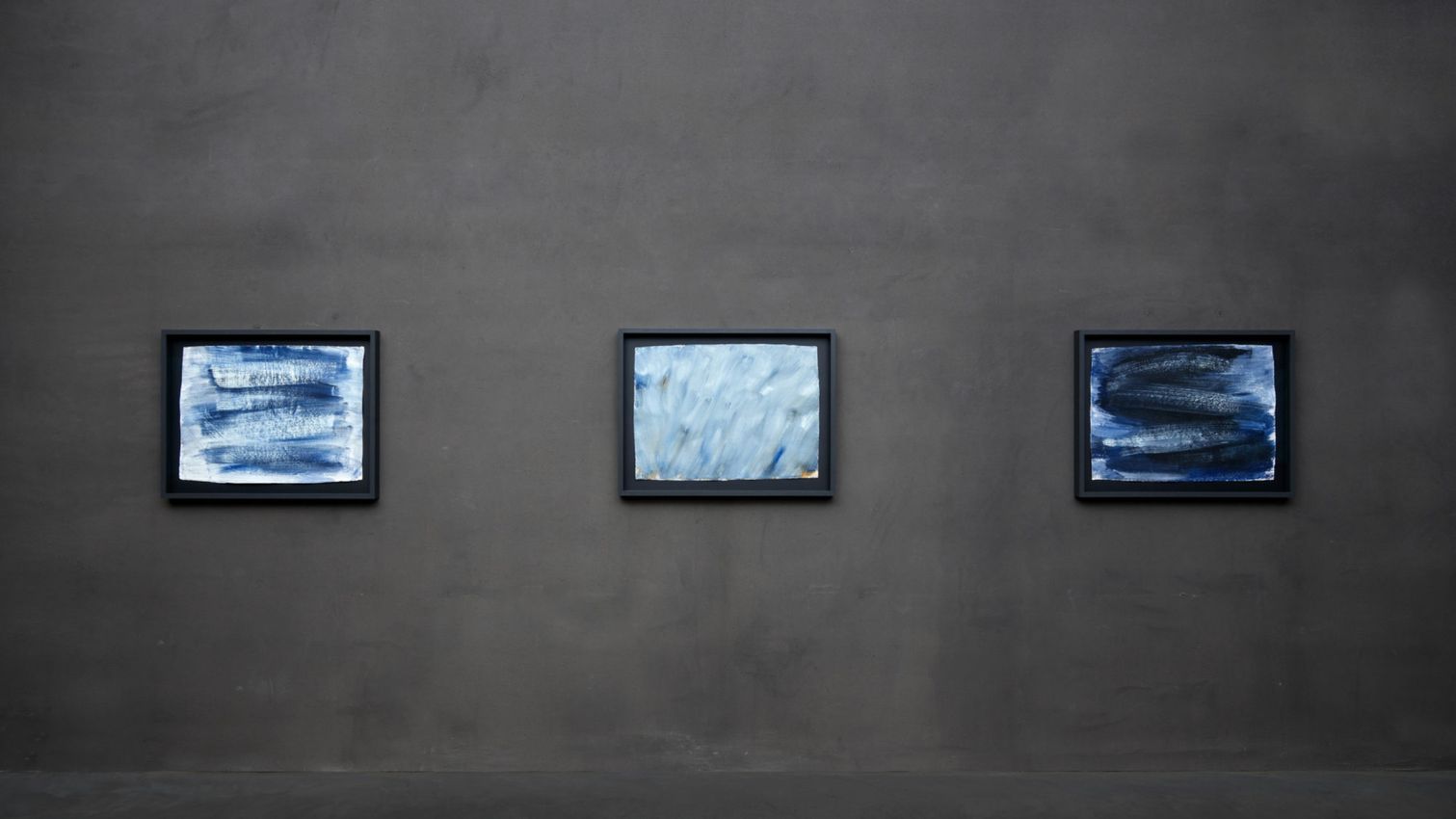
This exhibition presents seven works on paper from the 1990s, shown here for the first time, directly from the artist’s estate.
Their freshness underlines the continuing relevance of Girke’s practice and highlights the independence of his works on paper within his oeuvre.
The paper provided a direct, flexible surface for testing ideas and opening new directions, often revealing developments.
The catalogue Raimund Girke. Arbeiten auf Papier, published in conjunction with the eponymous 2024 exhibition at the Josef Albers Museum Quadrat Bottrop, underscores the significance of this medium. It notes how Girke often reversed his usual process on paper: rather than building from dark to light, he worked from light to dark. This created layered fields where translucency and density shift continuously. As early as the 1960s, his focus on modulating a single colour became evident: expanses of white disrupted by subtle touches of blue or grey.
Girke’s works on paper form a fully independent domain within his oeuvre, developed with equal intensity alongside and beyond his canvas painting. In the 1990s works, blue takes on a prominent role, entering into dialogue with Girke’s whites. It sometimes lies beneath the surface, sometimes cuts across the field, creating tonal shifts that suggest both depth and light. The brushwork, structured yet free, animates each sheet with a quiet, insistent rhythm, holding it in a tension between stillness and motion.
Three smaller canvases from the same decade echo these works on paper. In oil, the dialogue between white and blue acquires greater material weight, translating immediacy into density. Both formats reveal Girke’s ongoing search for balance between order and openness, discipline and gesture. His works from the 1990s show how reduction can lead to resonance. As one of his poems reads: White is not nothing. It is fullness, waiting to begin.
Together, these works demonstrate how Girke transformed minimal means into a field of endless variation.The works on paper embody the essence of his practice: colour pushed to its limit, gesture rendered as vibration, silence realised through movement. In their restraint, they reveal a concentrated, present, and enduring art.
Girke’s works on paper are also represented in several major museum collections, including the Josef Albers Museum Quadrat Bottrop, Kunstmuseum Bonn, and Staatliche Museen zu Berlin, affirming their central place within his artistic legacy.
In the late 1950s, Girke belonged to the generation of young European artists that overcame the Subjectivism of Abstract Expressionism and searched for new objective reductive expressions. Since then, Girke left out modes of traditional composition and concentrated on putting the colour in order according a line schedule. Indeed, he took the colour and ‘wrote it’ onto the canvas. Many of his works’ titles symbolise these characteristics. At the same time, Girke reduced the colours evident in his work to white accompanied with blue and brown tones, formative qualities which have always characterised his paintings.


The Axel Vervoordt Company and Axel Vervoordt Gallery are located at a site known as Kanaal–a converted industrial distillery that has become a cultural and residential community.

A respected voice in contemporary art discourse.
Focusing on ambitious storytelling and insightful art-world commentary. Ocula Magazine publishes in-depth interviews, critical essays and timely analysis on the artists, exhibitions and ideas driving the global art world.
Learn more about Ocula Magazine
Showcasing the best of the art world.
Ocula partners with galleries from around the world to highlight their artists, artworks and exhibitions. Gallery membership is by application and invitation, with each member vetted by an independent panel.
Learn more about Ocula Membership

Specialises in the sale of major artworks.
Led by a team with deep ties to the world’s leading auction houses, galleries and collectors. Ocula’s advisory team offers bespoke services to high-net-worth clients from around the world who are looking to acquire the best of contemporary and modern art.
Learn more about our team and services