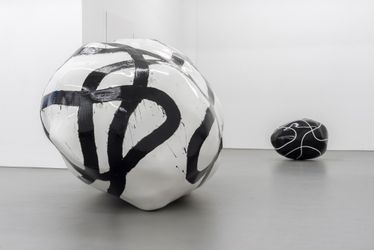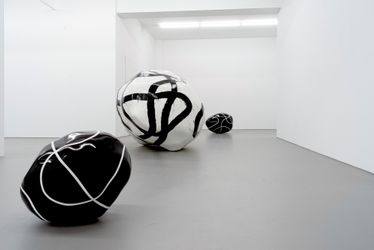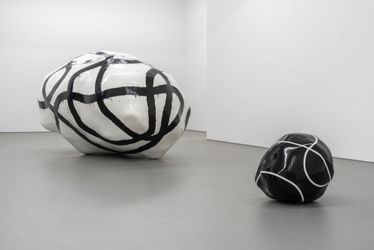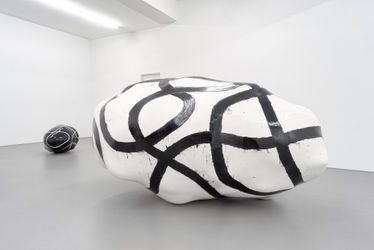
The Buchmann Galerie is pleased to announce an exhibition by Wilhelm Mundt. The exhibition, titled Areit ist das halbe Leben, misspelled deliberately, presents a cross-section of the current production of the German sculptor.
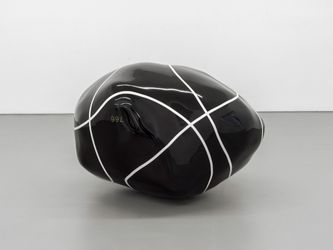
In his extensive body of work, Wilhemlm Mundt (b. 1959, Grevenbroich) deals with distinctly sculptural themes that negotiate some the most pressing issues of our times. In his best-known group of works—the elegant biomorphic sculptures named ‘Trashstones’—form is determined by their content. The sculptures’ interiors consist of studio waste, which the artist artfully wraps in coloured polyester, aluminium or bronze.
Thus, the end form of each Trashstone only hints at its interior content; the wrapped up waste and trash remain visible only in their determination of the final form, the works in themselves containing more in their biomorphic beauty than the eye can see. Essential components of the work—the form-giving interior, its material as well as their metaphorical content—remain hidden from view. The discrepancy between the visible, the shiny, colourful and softly modulated outer form and their interior lends these sculptures their daunting quality.
With their immediate sensual form, combining aesthetics and ethics, irony and seriousness, the sculptures, formally reminiscent of erratic boulders, address the problem of sustainability. The Trashstones can thus be read as a cryptic commentary on one of the most pressing ecological issues of today—whilst also constituting a radical development of abstract sculpture the inspiration for which can be traced to artists such as Hans Arp and Barbara Hepworth.
Since their first appearance in 1989, individual Trashstones have been numbered in three digits, with the total number of works in the series having grown to more than 750. Each Trashstone is thus embedded in a continuous series—a procedure reminiscent of serial and industrial production processes—but nonetheless, they retain a uniqueness in shape and colour.
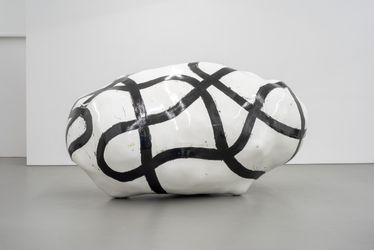
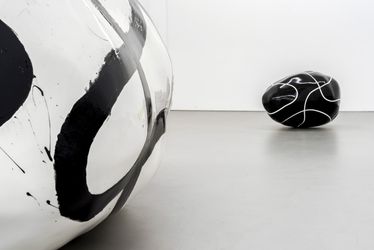
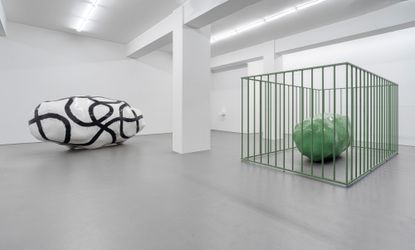
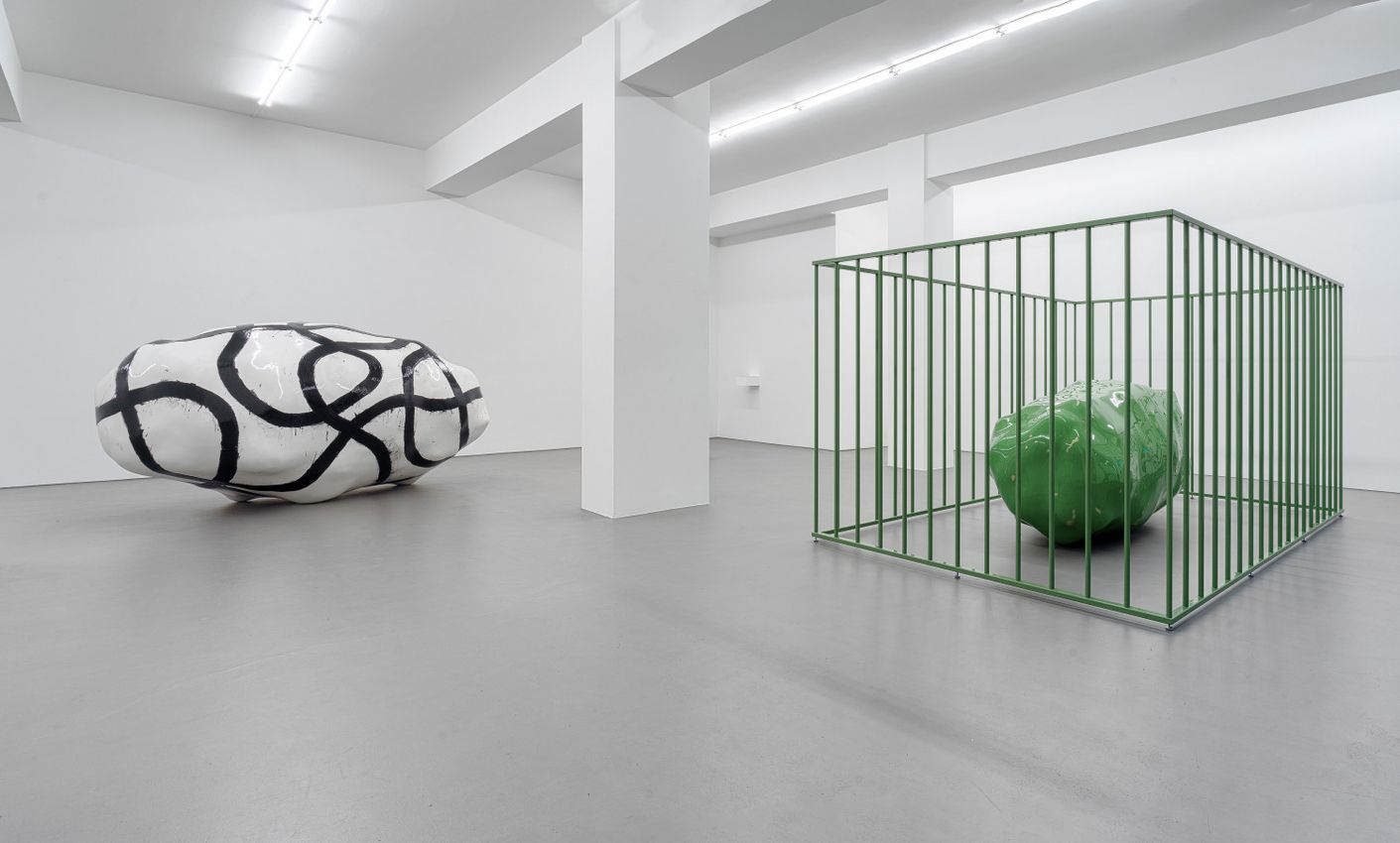
Some of the current works in the exhibition explore, through a painterly line on the surface of the sculpture, another dimension: that is, the border between painting and sculpture. The soft form of the plastic stone is circumscribed by an endless line embedded in the surface. Like a ball of wool, a line wraps itself around the stone, invoking the question of its beginning and end. The form is also complicated by this ‘inscription’ on the surface, which is most evident in the largest work in this exhibition, weighing a considerable 1.3 tons. This white stone is inscribed with a circular marking, the painterly-looking ductus of which is also conditioned by its production process. Once again, the artist plays with the viewer’s perception.
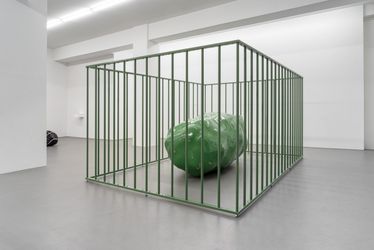
Another new work, a large green Trashstone enclosed in a green prison-like cage, creates a room within a room and breaks through one’s view of the object, framing the sculpture anew.
Parallel to the exhibition at the Buchmann Gallery, the Guardini Foundation, Berlin, is showing a solo exhibition by Wilhelm Mundt, opening on 5 November.
Wilhelm Mundt’s work has been shown amongst others at the Fondation Villa Datris, the Kunstmuseum Bonn, Fondation Arp Museum Bahnhof Rolandseck, Remagen, Lehmbruck Museum, Duisburg, Museum Kunstpalast, Düsseldorf and K20 Grabbeplatz, Düsseldorf. His works are in the collections of several museums and institutions, including Kunstmuseum St. Gallen, Margulies Collection Miami, Lehmbruck Museum Duisburg, University of Bayreuth, MunichRE, BNP Paribas and Vestas Aarhus.
For further information on the artist and the exhibition, as well as for images, please do not hesitate to contact the gallery.


Wilhelm Mundt is most widely known for his iconic series of biomorphic sculptures called Trashstones. The base material for these works is waste from the sculptor’s studio which is been covered in multiple layers of brightly glass-fiber reinforced plastic (GRP). The form of the sculptures is shaped through the production waste which is inside the works. In bypassing the two ways to shape sculptures, neither adding nor removing matter but recycling literally the means of production the works not only reflect on consumer culture but also on the long tradition of sculpture. From the very outset the artist meticulously numbered each piece with a sequential triple-digit number. Each Trashstone is part of a consecutive series, conjuring up visions of serial production processes. The group of works, which now comprises nearly 700 individual pieces, is testimony to the artist’s consistent will to explore forms and colours, which makes each Trashstone a unique, one-of-a-kind item.
Buchmann Galerie is a contemporary art gallery in Berlin with a focus on painting , sculpture, drawing and photography.

A respected voice in contemporary art discourse.
Focusing on ambitious storytelling and insightful art-world commentary. Ocula Magazine publishes in-depth interviews, critical essays and timely analysis on the artists, exhibitions and ideas driving the global art world.
Learn more about Ocula Magazine
Showcasing the best of the art world.
Ocula partners with galleries from around the world to highlight their artists, artworks and exhibitions. Gallery membership is by application and invitation, with each member vetted by an independent panel.
Learn more about Ocula Membership

Specialises in the sale of major artworks.
Led by a team with deep ties to the world’s leading auction houses, galleries and collectors. Ocula’s advisory team offers bespoke services to high-net-worth clients from around the world who are looking to acquire the best of contemporary and modern art.
Learn more about our team and services