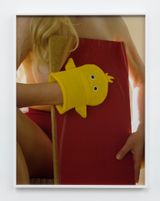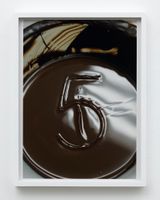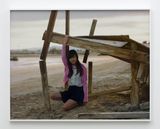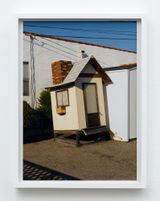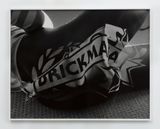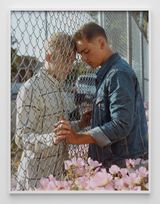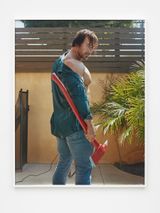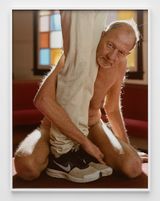
David Kordansky Gallery is pleased to announce Pain in the Shell, an exhibition of recent photographs by Torbjørn Rødland. The exhibition will be on view March 26 through May 7, 2022. An opening reception will take place on Saturday, March 26 from 6 to 8 PM.
As one of the most prescient and critically minded of artists employing analogue photographic techniques, Torbjørn Rødland has developed a constantly evolving, carefully interwoven project in which images brim with interpretive potential and physical immediacy alike. Rødland’s willingness to explore the symbolic dimension—as it pertains to the biological, cultural, and spiritual facets of life, to name a few—means that his work resonates on numerous levels at once, provoking thought and feeling in equal measure, as well as confrontation with underlying and inexplicable mysteries of human experience.
Pain in the Shell features a group of photographs in which this symbolic engagement is squarely in the foreground. While human subjects and narratives make appearances, many of the works focus on interactions between objects, substances, and light. Rødland here emphasises the largest of his preferred print sizes, allowing the painterly qualities of colour and texture that characterise the images to appear in newly vivid and immersive ways. He demonstrates how distinctions between surfaces and interiors are often made at a viewer’s interpretive peril: inanimate forms appear pregnant with life and even a kind of consciousness, and superficiality contains inner lives brimming with complexity, chaos, and creative potential.
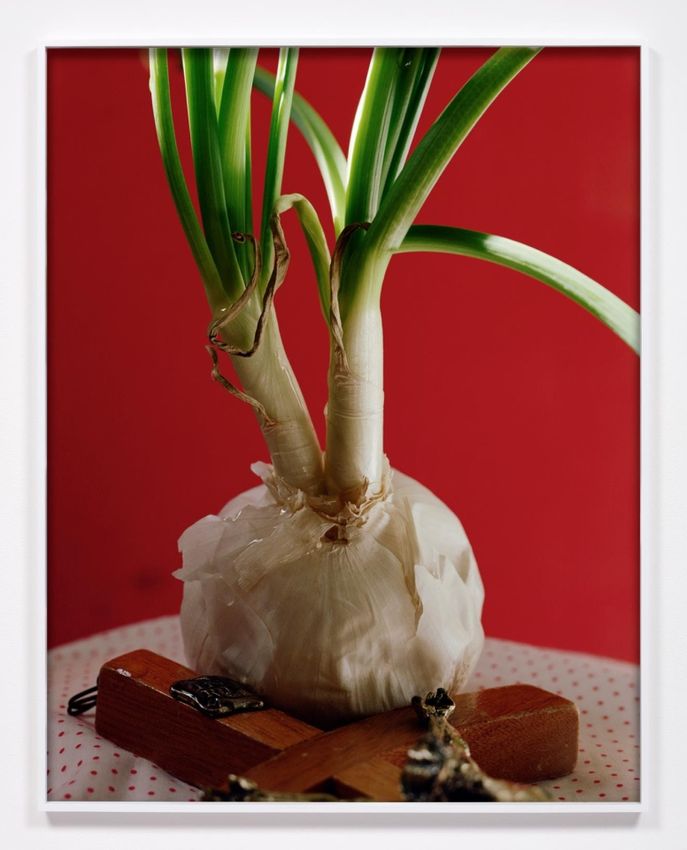
In keeping with this many-layered approach, these themes appear in numerous registers. While a photograph like Sprouting Onion, in which green shoots press out from a bulb positioned in the crux of a crucifix, opens the space for unmistakably religious allegorical speculation, one like Red, White and Ink, in which the tattooed word ‘AMERICA’ peeks out from the waistband of a woman’s sweatpants and red Band-Aids stake out the terrain around her navel, invites meditation on an entire world of political identities and projections. Despite the potentially discursive, content-based elements that reside on the surfaces of these images, their depth becomes immediately apparent as each is filled with details that complicate and, in some cases, contradict purely topical-based readings.
In part because he remains dedicated to non-digital photographic processes and darkroom work, Rødland’s prints are themselves surfaces that are alive with the presence of the material world. This gives them an up-close-and-personal feel, even when the images they display are concerned with the syntax of contemporary life as it is experienced in the media. It also means that such images emerge in his work reinvigorated, charged with a humanity and sense of touch that tends to disappear when they are found in contexts of communication and commerce alone. As a result, the photographs also make emotional appeals to—or demands upon—their viewers, evoking uneasy combinations of pathos and humour that challenge preconceived notions about the ways in which power and vulnerability play out in the social and natural worlds.
Pain in the Shell finds Rødland probing further than ever into the core of what makes images exert their powerful effects on individual people. While he openly acknowledges the media- and information-saturated world that generates so much visual stimulus in contemporary life, he also presents tableaux in which signs of exchange—a barcode sticker on a hollowed-out apple filled with worms in Apple with Worms, for example—are overwhelmed by visceral, primal forces. In many cases, he achieves this by establishing compositions in which physical texture is a dominant factor, and by establishing relationships not only between animate and sentient beings, but also otherwise inert substances: the same apple contains a tightly wound evolutionary drama within its circumference while participating in a silent dialogue with the faceted mineral surface on which it sits—as well as with the variegated green background that looms behind it, beyond the field of focus.
The formal analysis that identifies such relationships reveals that elements of the photographic process itself often carry as much symbolic weight as images. While the abstract-leaning modernist tropes of twentieth-century art photography have lost much of their power of signification through overuse and the passage of time, Rødland shifts the emphasis to a different, more fluid set of compositional pleasures that keep his work in conversation with images encountered in advertising, on the Internet, and throughout the intersecting realms of the mediasphere. The photographs in _Pain in the Shel_l are disarming precisely because they acknowledge that surface-oriented strains of contemporary culture, even when they are reduced to memes or other fleeting vessels of convention, conceal reservoirs of living material.
In 2021, Torbjørn Rødland was the subject of a solo exhibition at The Contemporary Austin, Texas. Other solo exhibitions include Fifth Honeymoon, a traveling exhibition produced as a collaboration between Bergen Kunsthall, Norway, Bonniers Konsthall, Stockholm, and the Museum of Contemporary Art Kiasma, Helsinki (2018–2019); THE TOUCH THAT MADE YOU, Fondazione Prada, Milan (2018) and the Serpentine, London (2017); Back in Touch, C/O Berlin (2017); and Blue Portrait (Nokia N82), Whitney Museum of American Art, New York (2016). Notable group exhibitions include What People Do for Money, Manifesta 11, Zurich (2016); LIT, 9th Berlin Biennale for Contemporary Art (2016); and 48th Venice Biennale, Italy (1999). His work is in the permanent collections of museums including Albright-Knox Art Gallery, Buffalo, New York; Astrup Fearnley Museum of Modern Art, Oslo, Norway; Malmö Art Museum, Sweden; Museum of Contemporary Art Chicago; Stedelijk Museum, Amsterdam; and Museum of Modern Art, New York. Rødland lives and works in Los Angeles.


David Kordansky Gallery is one of the most dynamic venues for contemporary art, and is internationally regarded as a leading gallery of its generation.

A respected voice in contemporary art discourse.
Focusing on ambitious storytelling and insightful art-world commentary. Ocula Magazine publishes in-depth interviews, critical essays and timely analysis on the artists, exhibitions and ideas driving the global art world.
Learn more about Ocula Magazine
Showcasing the best of the art world.
Ocula partners with galleries from around the world to highlight their artists, artworks and exhibitions. Gallery membership is by application and invitation, with each member vetted by an independent panel.
Learn more about Ocula Membership

Specialises in the sale of major artworks.
Led by a team with deep ties to the world’s leading auction houses, galleries and collectors. Ocula’s advisory team offers bespoke services to high-net-worth clients from around the world who are looking to acquire the best of contemporary and modern art.
Learn more about our team and services