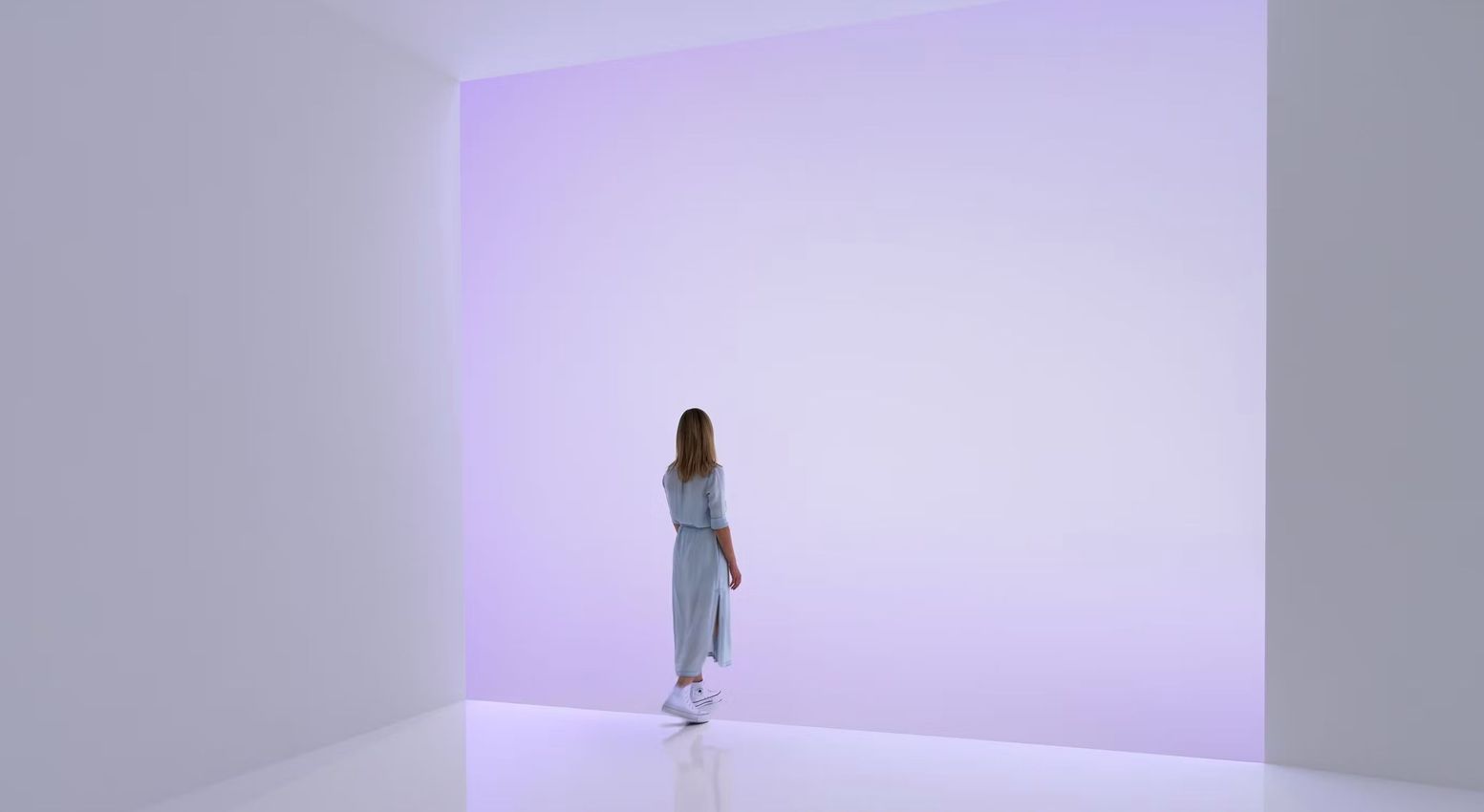
David Zwirner is pleased to present a new light installation by American artist Doug Wheeler at the gallery’s 537 West 20th Street location in New York. Over the past six decades, Wheeler has become known for his innovative constructions and installations that engage with the experience of light, space, and sound. On view will be an immersive environment by the artist that further expands on his groundbreaking investigations of the possibilities of luminous space. This will be Wheeler’s fifth solo exhibition with the gallery and the first major presentation in the United States of his work since his 2020 exhibition at David Zwirner New York.
The exhibition presents DN ND WD 180 EN - NY 24 (2024), which is among Wheeler’s most ambitious installations to date. Upon entering the gallery, the viewer first encounters two luminous, rectangular thresholds or “walls” of light, which function as points of entry into an expansive environment that produces the experience of limitless space, or a ‘ganzfeld,’ where light appears to shift from day to night and back again. The viewer’s perception is heightened to a degree in which, as the artist articulates, ‘space appears as a volume, almost as matter.’
Wheeler’s work draws directly from the artist’s own observations of natural and sensory phenomena, and DN ND WD 180 EN - NY 24 distills the singular phenomenon of perceiving day and night as simultaneously occurring over the expanse of the sky while in flight. The artist has described how, while flying an airplane at certain times of the day, he would see daytime light on the distant horizon in one direction, while if he turned his plane 180 degrees, the darkness of night would be visible on the opposite horizon. Wheeler’s experiences with flying go back to his childhood, when he would frequently travel by plane with his father, a doctor who cared for patients throughout remote areas of north-central Arizona, encompassing the Navajo, Hopi, and Apache reservations, where there were few specialised physicians. Wheeler was often allowed to fly his father’s small planes—experiences that made a lifelong impression on him and taught him about the qualities and effects of light. Of these formative experiences, he has noted, ‘I was very conscious of the sky, if it was daytime or nighttime.... I was conscious of the planet in the sense of light.’
The present work represents a continuation of Wheeler’s pioneering light installations. Although he began his career as a painter while studying at the Chouinard Art Institute (now the California Institute of the Arts) in Los Angeles in the early 1960s, his wall-mounted works soon began incorporating light as a medium, which quickly led to an art-historical breakthrough: the construction of an absolute light environment in his Venice Beach studio in 1967. The new installation has a lineage that traces back to the artist’s earliest light environments, including the first such work he presented outside of his studio, at the Stedelijk Museum in Amsterdam in 1969, which incorporated a ‘light wall’—a single row of daylight neon light embedded inside a viewing aperture that encompassed the entire dimension of the gallery wall within an enclosed space. He stretched a nylon scrim to create a luminous ‘ceiling’ that captured and reflected light and appeared to float above the room. Wheeler has continued to explore similar effects by manipulating architecture in distinct ways and with different types of lighting, creating installations, including DN ND WD 180 EN - NY 24, that explore the perceptual possibilities of light and space, and in which the viewer experiences the sensation of entering an infinite void.
As a pioneer of the so-called “Light and Space” movement that flourished in Southern California in the 1960s and 1970s, Doug Wheeler’s prolific and ground-breaking body of work encompasses drawing, painting, and installations that are characterized by a singular experimentation with the perception and experience of space, volume, and light. Raised in the high desert of Arizona, Wheeler began his career as a painter in the early 1960s while studying at the Chouinard Art Institute (now the California Institute of the Arts) in Los Angeles. According to critic and curator John Coplans, Wheeler’s “primary aim as [an artist] is to reshape or change the spectator’s perception of the seen world. In short, [his] medium is not light or new materials or technology, but perception.” 1


A respected voice in contemporary art discourse.
Focusing on ambitious storytelling and insightful art-world commentary. Ocula Magazine publishes in-depth interviews, critical essays and timely analysis on the artists, exhibitions and ideas driving the global art world.
Learn more about Ocula Magazine
Showcasing the best of the art world.
Ocula partners with galleries from around the world to highlight their artists, artworks and exhibitions. Gallery membership is by application and invitation, with each member vetted by an independent panel.
Learn more about Ocula Membership

Specialises in the sale of major artworks.
Led by a team with deep ties to the world’s leading auction houses, galleries and collectors. Ocula’s advisory team offers bespoke services to high-net-worth clients from around the world who are looking to acquire the best of contemporary and modern art.
Learn more about our team and services