





FERNAND LÉGER
1881-1955, FranceA pioneer of modern art, Fernand Léger fused the aesthetics of Cubism with the dynamism of industrial life, forging a visual language that bridged abstraction and the machine age.
Early Years
Fernand Léger was born in 1881 in Argentan, Normandy. Trained initially as an architectural draftsman, he moved to Paris in 1900, where he began studying at the École des Arts Décoratifs and later at the Académie Julian. While working as a photographic retoucher to support himself, Léger encountered the works of Paul Cézanne and the Cubists, which would radically reshape his approach to painting.
His time in Montparnasse exposed him to key figures of the Parisian avantgarde, including Robert Delaunay and Marc Chagall. Though associated with Cubism early in his career, Léger’s practice evolved its own distinctive course, characterised by bold colour, geometric simplification and a fascination with the modern world. He served in World War I, an experience that deeply influenced his later imagery and reinforced his admiration for everyday people and industrial forms.
Artworks
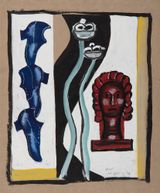
Fernand Léger’s artworks are defined by tubular forms, mechanised figures and rhythmic compositions that echo the structure of machines and architecture.
Tubism and Early Experiments
Between 1909 and 1914, Fernand Léger developed a personal variant of Cubism, later termed ‘Tubism’ for its emphasis on cylindrical forms. Distinct from the angular fragmentation of Georges Braque and Pablo Picasso, Léger’s approach embraced volume and spatial depth, visible in works like Nudes in the Forest (1909–10) and Contrast of Forms (1913). These artworks balance abstraction and figuration through bold colour, overlapping planes and sculptural shapes. His interest in the visual language of modern life and mechanical structure was already apparent, laying the groundwork for a lifelong dialogue between art, geometry and industrial design.
War and the Mechanisation of Man
Léger’s experience as a soldier in World War I was formative, reinforcing his fascination with machines and the rhythms of the factory. In works such as The City (1919), he captured the sensory overload of post-war urbanism—interweaving scaffolding, signage, gears and stylised human figures into frenetic yet structured compositions. His palette brightened, and he began using clearly delineated forms to reflect both the dehumanising and exhilarating aspects of mechanised society. The human body, once naturalistic, became stylised and robotic, echoing the repetition and order of machinery. These artworks helped position Léger as a central figure in modern art’s industrial turn.
Cinema, Collaboration and Political Art
In the 1920s, Léger expanded his practice beyond painting, engaging with cinema, architecture and book design. His film Ballet Mécanique (1924), created with Dudley Murphy and Man Ray, exemplifies his interest in rhythm, fragmentation and mechanical motion. Around this time, Léger began depicting working-class subjects with monumental clarity, as seen in Le Grand Déjeuner (1921) and The Mechanic (1920). His stylised figures, often set against flattened, decorative backdrops, reflected his growing belief that art should be accessible and rooted in daily life. Politically aligned with the French Left, Léger saw the worker as a modern icon and used his art to champion collective values.
Late Work and Colourful Optimism
After World War II, Léger’s art took on a brighter, more optimistic tone. Influenced by his time in the United States, where he taught at Yale University and mingled with American artists, his compositions became increasingly monumental and accessible. Works such as The Divers (1942) and The Builders (1950) show simplified, brightly coloured figures in unified, dynamic movement—symbols of solidarity and hope. His late paintings, murals and public commissions celebrate the vitality of reconstruction and everyday life. Léger believed that art should exist beyond the gallery and into the streets, and these works affirm his vision of art as both democratic and visionary.
Exhibitions
Fernand Léger has been the subject of both solo and group exhibitions at important institutions. A selection of key exhibitions is provided below.
Solo Exhibitions
- Fernand Léger, Musée Soulages, Rodez (2021)
- Fernand Léger: New Times, New Pleasures, Tate Liverpool (2019)
- Fernand Léger: Beauty is everywhere, BOZAR, Centre for Fine Arts in Brussels, Brussels (2018)
- Fernand Léger, Centre Pompidou – Metz, France (2017)
- Léger: Modern Art and the Metropolis, Philadelphia Museum of Art, Philadelphia (2013)
- Fernand Léger, Museum of Modern Art, New York (1998)
- In 1960, a museum devoted to his work opened in Biot, Alpes-Maritimes, France.
Critical Reception
Fernand Léger’s work has been widely reviewed in publications including Apollo, ARTnews, and The Financial Times,
Fernand Léger FAQs
What is Fernand Léger best known for?
Fernand Léger is best known for his bold, colourful artworks that blend Cubism with the energy of the machine age. His signature style features tubular forms, simplified figures and mechanistic compositions that reflect his fascination with industry and modern life. Unlike his Cubist peers, Léger embraced volume and vibrant colour to celebrate everyday people and urban rhythms. His pioneering approach to modern art helped redefine the relationship between art and the technological landscape of the 20th century.
How did Léger influence modern art?
Fernand Léger significantly influenced modern art by incorporating the aesthetics of machines and industrial society into his paintings. His work inspired later movements including Purism, Futurism and Pop Art. Léger’s vision extended beyond the gallery: he embraced cinema, mural painting and public art, believing that artworks should be accessible to all. His use of bold primary colours, mechanical shapes and working-class subjects helped shape a new visual language—one that echoed the collective spirit of modernity and mass culture.
Did Fernand Léger work in media other than painting?
Yes, Fernand Léger was a multidisciplinary artist who worked across painting, sculpture, cinema, illustration, set design and monumental public art. In 1924, he co-directed Ballet Mécanique, a landmark experimental film that fused mechanical rhythm with avantgarde aesthetics. He also designed stained glass windows, book illustrations and large-scale murals for public buildings. Léger believed in breaking the boundaries between art and everyday life, and his multi-media output reflected his commitment to bringing art into public and social spaces.
Ocula | 2025













Explore and Follow Artists Shaping Contemporary Art
A respected voice in contemporary art discourse.
Focusing on ambitious storytelling and insightful art-world commentary. Ocula Magazine publishes in-depth interviews, critical essays and timely analysis on the artists, exhibitions and ideas driving the global art world.
Learn more about Ocula Magazine
Showcasing the best of the art world.
Ocula partners with galleries from around the world to highlight their artists, artworks and exhibitions. Gallery membership is by application and invitation, with each member vetted by an independent panel.
Learn more about Ocula Membership
Specialises in the sale of major artworks.
Led by a team with deep ties to the world’s leading auction houses, galleries and collectors. Ocula’s advisory team offers bespoke services to high-net-worth clients from around the world who are looking to acquire the best of contemporary and modern art.
Learn more about our team and services