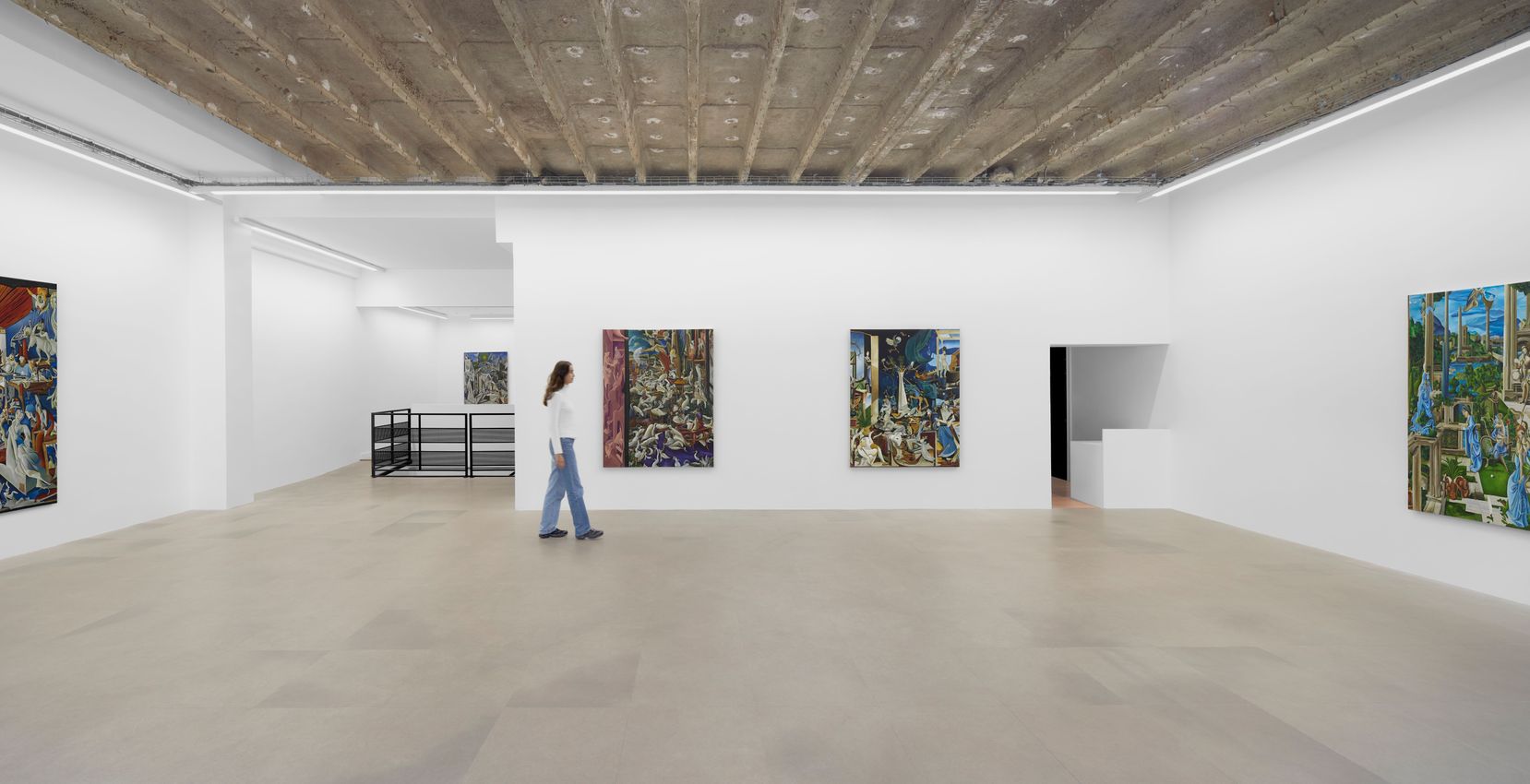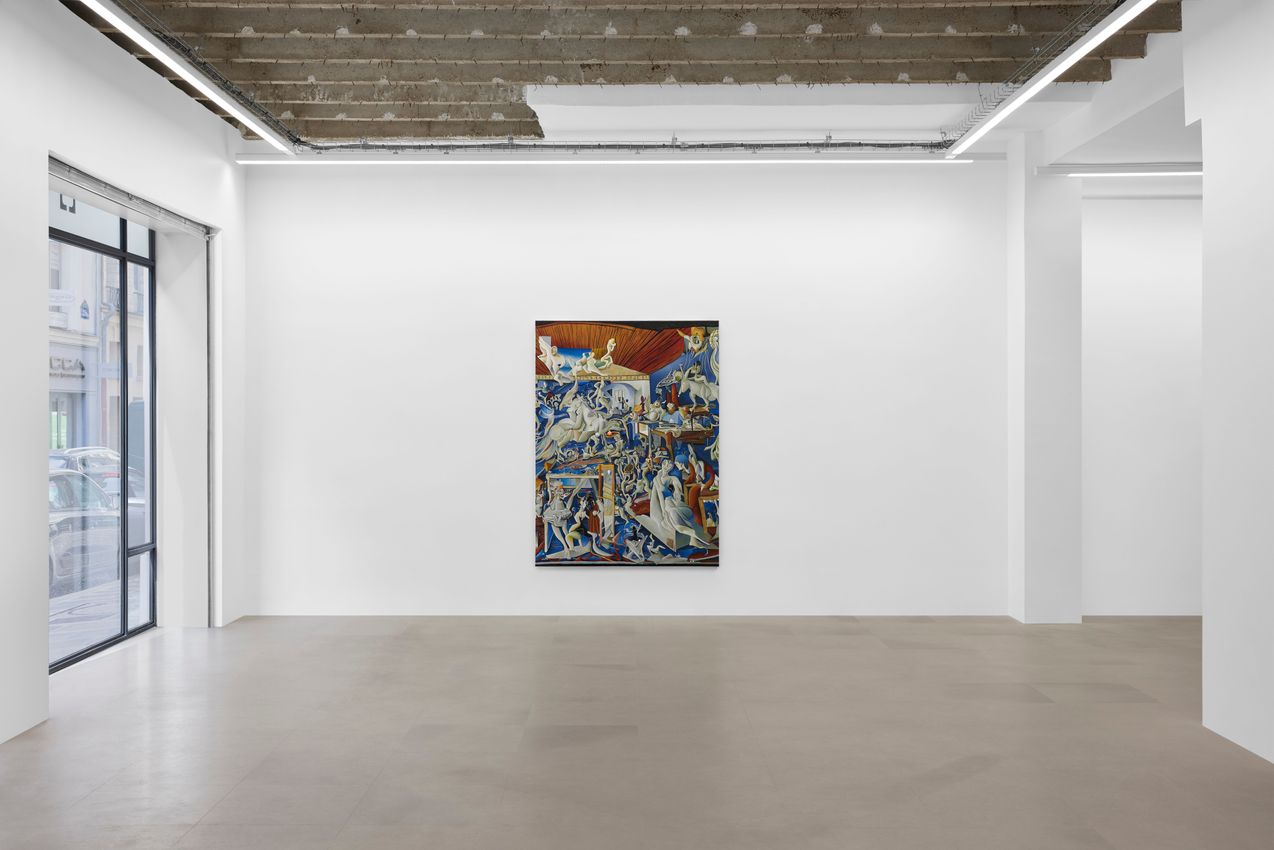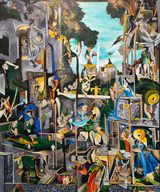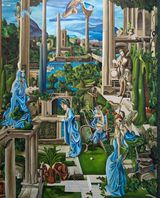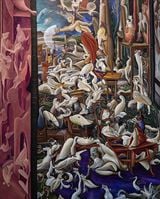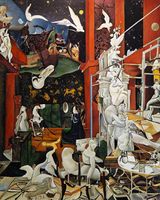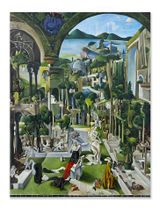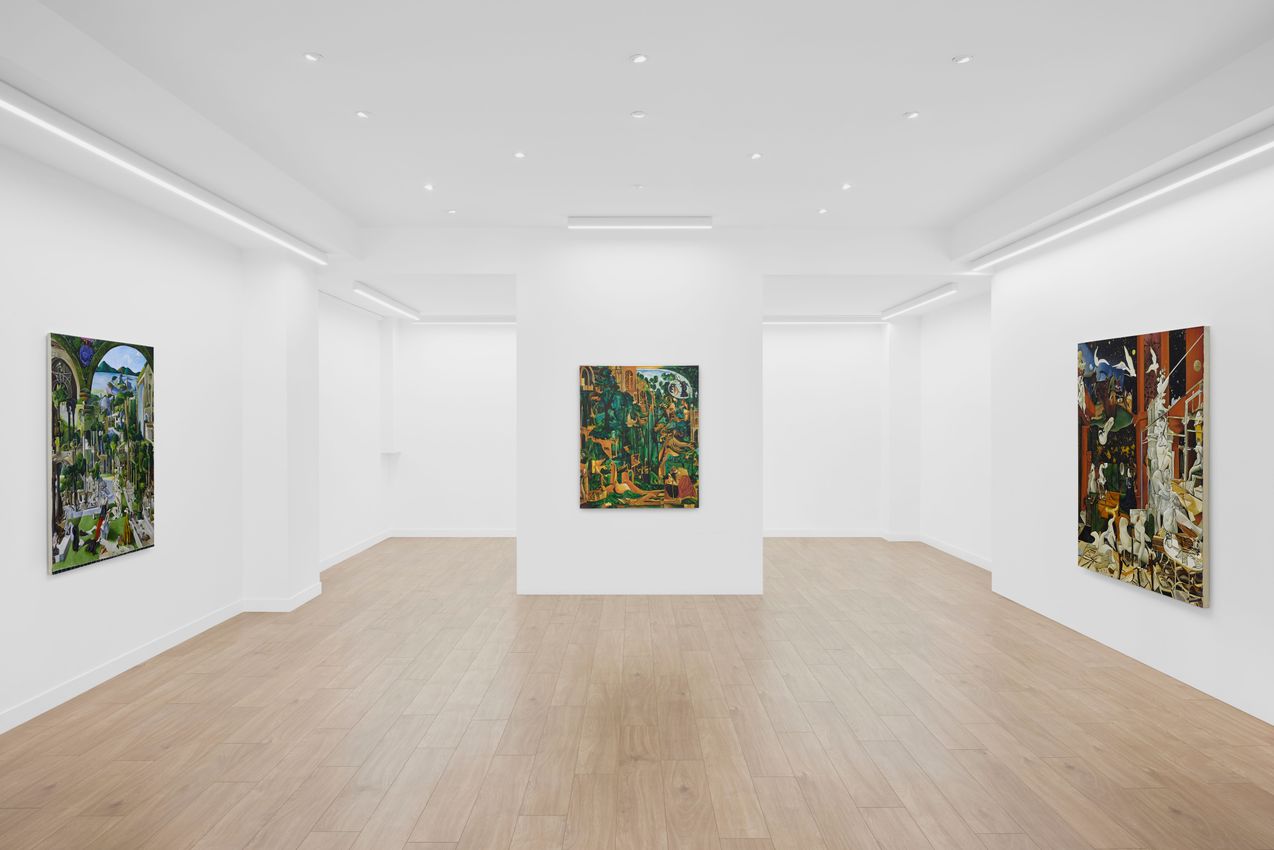
DUMONTEIL Contemporary is pleased to present Nisky’s fifth solo exhibition with the gallery. Nisky has divided this series into three parts. In fact, they are all interconnected as a whole, but each part has its own focus. This exhibition features works reflecting the exile of the heart, the imagination of the heart, and the longing of the heart. They present Nisky’s thoughts on imagination, history, and life; they form this exploratory process and perhaps represent the journey every person might experience in their life.
Mountains, the Collective Imaginations of Humanity
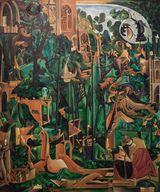
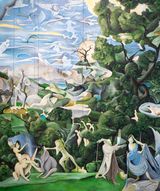
In the four works “The So-called Life,” “Yesterday’s Letter,” “Intransitive Garden,” and “Ancestors in the Bamboo Grove,” Nisky emphasises his contemplation and experimentation with integrating traditional Chinese landscape painting (shan shui) elements. The compositions primarily merge the green-blue landscape painting of the Tang and Song dynasties with the mountainous structures from the Renaissance. In terms of texture, influences from Ernst’s frottage technique and the heavy textures of artists like Zao Wou-Ki and Anselm Kiefer can also be seen.
At the beginning of his creation process, Nisky uses different shades of green acrylic combined with materials like cloth, needles, scrapers, and gloss gel, which are then scratched and printed on the canvas surface. This creates a granular and randomly varied texture. Nisky sees this creation process as a form of refinement, akin to reasoning or myth-busting; from these seemingly random strokes and textures, he slowly extracts a glance, a profile silhouette... until the image of a reclining scholar, a wandering singer, or a mysterious, ancient-like creature emerges. In this process, which tests insight, Nisky also infuses his collective imagination into these various forms of mountains and trees.
In “The Fear of Life,” the composition references Li Zhaodao’s “The Emperor Minghuang’s Journey to Shu” and Benozzo Gozzoli’s “The Journey of the Magi” frescoes. Nisky aims to narrate a grand and layered story within the limited space of the painting: from the gods overlooking the earth in the upper left corner to the multitude of beings appearing continuously in the lower parts of the painting. Their stories, with their individual joys and sorrows, are sublimated into a kind of permanence among the immortal mountains and trees, entering our view as an observer, eliciting a primal awe and reverence for life.
In “Yesterday’s Letter,” the upper left also features a watcher whose gaze reveals a sense of reluctance and a sorrow borne from past memories. The Rococo tones are tinged with a faint melancholy (which Nisky subtly conveys through the use of transparent sepia glazing). On the lower left side, one can faintly discern a kitchen shed stripped to its skeleton, a pavilion... a garden of ruins and broken walls, a courtyard barely supported by a few broken pillars. These remnants of the past are surrounded by beautiful greenery, perhaps much like our lives: absurd, yet still hopeful.
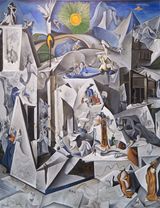
In “Intransitive Garden,” there is no passive form, no object to the actions, merely a state... Nisky finds the concept of intransitive verbs to be very fitting for this work. He also integrates various styles and techniques from his previous creative career: from the Renaissance to Cubism, and the use of frottage and airbrushing. In the Intransitive Garden, there are two parallel narratives: the grand world represented by figures in blue robes and the small world represented by the little figures in the green mountains. They coexist but seem unable to perceive each other, making each other’s existence an “inaccessible thing.”
In “Ancestors in the Bamboo Grove,” Nisky invites the ancestors from his “Our Ancestors” series, in terracotta colors, to join in and continue new stories within the fresh context of the bamboo grove. For the main color palette of these four works, Nisky primarily chose five greens: The vitality of Sap Green, the melancholy of Olive Green, the depth of Perylene Green, the penetrating power of Phthalo Green, and the tranquility of Chromium Oxide Green. These greens, like the five tones of a musical scale, blend, combine, stretch, and diffuse, together forming a world of mountains, trees, and imagination in Nisky’s works.
Weight, Relief, Sense of Space
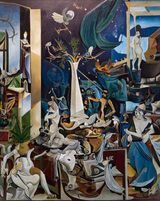
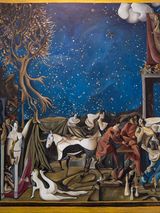
In the works “Star of the Warring States,” “The Measure of Exile,” and “Records of Searching for the Gods,” Nisky explores the sense of space by heavily layering paint. The figures in these paintings, exuding a “Cubist” vibe, appear more “three-dimensional” than ever before. He also simulates various relief details to enrich the levels and depth of the composition.
“Star of the Warring States” and “The Measure of Exile”
While creating these two works, Nisky read several historical books and novels about the Spring and Autumn and Warring States periods, which inspired him. On the right side of “Star of the Warring States,” he constructed a “Hero Column” filled with relief-like figures of varying expressions: enlightened rulers, loyal strategists, expedition generals, and, of course, treacherous villains. It is these diverse characters that illuminate the galaxy of history. In the starry sky of the painting, Nisky marks the capitals of the Seven Warring States against the black background as “Easter eggs” for viewers to discover.
If “Star of the Warring States” is an “action drama” performed outdoors, then “The Measure of Exile” is an “intellectual drama” staged indoors. In an interior filled with ancient artifacts, a central king seems to be discussing grand strategies with his ministers. During the intricate power struggles of the Spring and Autumn and Warring States periods, exile was commonplace. Nisky considers himself an exile in his creation, yearning to organically integrate different artistic styles from various periods into his cultural context and the blood of his homeland, ultimately blending them into a cohesive whole.
“Records of Searching for the Gods”
Our gaze shifts from the Warring States period to the world of gods. The scene resembles a grand galactic ball, a chronicle composed of interconnected little stories. Nisky freely arranges the gods, who fly, wander, converse, or meditate, within the composition. The gods, draped in attire resembling enamel and jade, and the deep blue background add a touch of antiquity to the entire painting.
Discourse of Life
A discourse refers to an actual unit of language in use, comprising a series of continuous segments or sentences formed during the communication process. It can be a single paragraph or multiple paragraphs, such as a short poem, an essay, an email, a news report, or a research paper, all considered as a complete discourse. The components within a discourse are formally cohesive and semantically coherent.
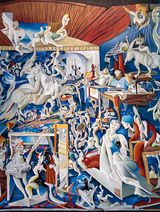
Every person’s life can be viewed as a discourse; it can be as short as a few sentences or as long as a lengthy manuscript... Whether an ordinary or extraordinary life, it comprises a few crucial turning points and special “bright” or “dark” moments. In “Discourse of Life,” various figures constructed with different techniques appear. They can be understood as parallel lives in different times and spaces or as different stages in a single person’s life.
“Theater of Consciousness”
“Theater of Consciousness” is the sister piece to “Discourse of Life.” In the light gray theater building, a subtle sense of flow suggests the free movement of consciousness, constructing a unique storyline within each person’s mind.
“Where is Home?”
Inspired by Giotto’s frescoes in the Scrovegni Chapel in Padua, “Where is Home?” features guidance and hidden temptations on both sides of the painting. The hesitant traveler in the middle wonders where to go.
“Heart United in the Rain of Light”
In this surreal Noah’s Ark, the creatures seem to be undergoing an exile. The ancient pink wall painting on the left might represent their once peaceful abode, while the upheaval of reality forces them into a voyage of exile. A leader- like figure uses his magic wand to distribute his “rain of light.” Is this the only hope in their voyage, or merely an illusion? The deep and mysterious purple at the bottom of the painting seems to provide a silent answer... Regardless, amid the turbulence of reality, devout faith is undoubtedly the best solace for the heart.
NISKY (b.1989, Shanghai) has always been exploring in both realms of painting and music. Nisky is an alias forged from the last letters of Federico Fellini and Krzysztof Kieslowski, as homage to the artist’s favorite filmmakers.


A respected voice in contemporary art discourse.
Focusing on ambitious storytelling and insightful art-world commentary. Ocula Magazine publishes in-depth interviews, critical essays and timely analysis on the artists, exhibitions and ideas driving the global art world.
Learn more about Ocula Magazine
Showcasing the best of the art world.
Ocula partners with galleries from around the world to highlight their artists, artworks and exhibitions. Gallery membership is by application and invitation, with each member vetted by an independent panel.
Learn more about Ocula Membership

Specialises in the sale of major artworks.
Led by a team with deep ties to the world’s leading auction houses, galleries and collectors. Ocula’s advisory team offers bespoke services to high-net-worth clients from around the world who are looking to acquire the best of contemporary and modern art.
Learn more about our team and services