Esther Schipper is pleased to announce Let them know your scarlet heat, let them glisten, a presentation by Julia Scher who has had six solo exhibitions with the gallery. On view will be two important historical works from her iconic Surveillance Beds series, sculptural works integrating technological and surveillance equipment. The title, a quotation from Walt Whitman’s Leaves of Grass in which the poet writes of bloody drops of desire and confession, refers to a central ambivalence in Scher’s work between pleasure, pain, and intimacy.
Emerging in the mid 1980s as a precise but playful analyst of social and technological changes, Julia Scher has been working with video surveillance for over 40 years. She addresses surveillance both as a concrete phenomenon of control, including its apparatus and architecture, as well as its impact on private and public spheres. Her performances and installations drew attention to the effects of omnipresent cameras and monitors, anticipating our surveillance-saturated society decades before it had fully arrived.
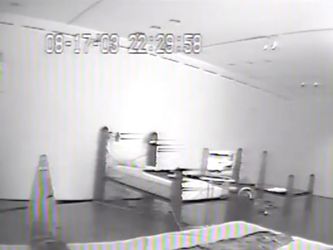
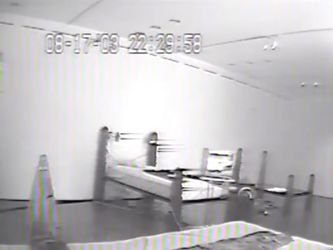
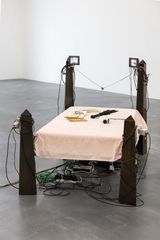
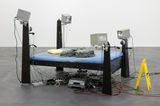
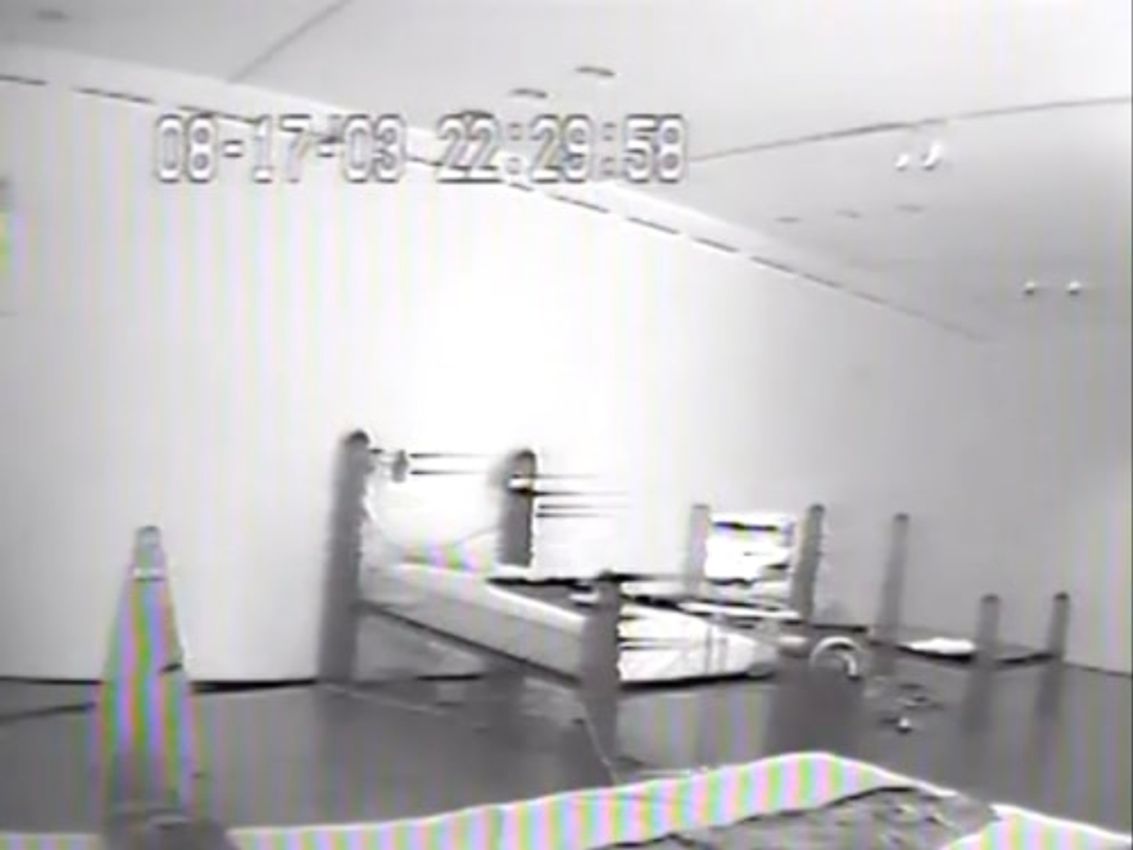
The artist’s focus on the regulation and control of our private sphere is exemplified by her central works Mama Bed andPapa Bed, 2003. Mama Bed and Papa Bed are two of three installation works (Mama Bed, Papa Bed andBaby Bed) that made up the work Embedded (2003), which debuted in Max Hollein’s era-defining exhibition At Your Own Risk at the Schirn Kunsthalle, Frankfurt. They are also part of theSurveillance Beds series that Julia Scher created between 1994 and 2003. Another work from this series, Surveillance Bed IV, will be shown at Centre Pompidou in early 2025 as part of their collection presentation celebrating the seminal French collector Jean Chatelus, who passed away earlier this year. Each workconsists of four steel poles, a flat surface in the middle and various electronic components: cameras, monitors, microphones and cabling. Specific components of Mama Bed include children picture books (namely Goldilocks and the Three Bears) as well as a leather whip, common in BDSM practice, displayed on top of the bed. Specific components of the Papa Bed include uniforms of the US army, folded and placed on the bed. The original constellation of three works vaguely referenced Goldilocks, a fairytale in which three bear protagonists (the bear-father, the bear-mother and the bear-child) find their beds unmade by an unwanted human girl, a metaphor for the violence and trespassing that can occur even in the most intimate spaces.
Both works have functioning cameras that record what is happening in the exhibition space and send the live feed to monitors mounted on the steel poles. Mama Bed and Papa Bed have VHS and media players connected to switcher devices that interlace the live feed from the cameras with the pre-recorded ‘fake live footage.’ Some of the cameras and other electronic components are, however, non-functioning, incorporated into the work for the sake of deceit or disguise.
Created in the years directly following the Al-Qaeda attack on the twin towers on September 11, 2001 and in the early years of personal computing and reality television, the pieces speak to the tension between surveillance as a means of protection, exhibitionism, and state violence. While photojournalism during the Vietnam War was enough to incite the American public to protest and push the military to remove its troops, Scher argues that we have since become inured to the violence of war that we see on TV and phone screens. Restaging the piece today serves as a reminder of our contradicting desires and fears: to be safely tucked into bed and be sheltered from the world, to use screens to stage ourselves and reveal intimate moments of our lives, to watch and be surveilled.


For the last twenty years, Julia Scher’s research has explored social control dynamics in the public sphere, focusing especially on themes of surveillance. The art projects have taken the form of interactive installations, reformulated surveillance, site tours, interventions, performances, photography, writing, online projects, linear video, and sound.


Esther Schipper founded the gallery in 1989 in Cologne. In 1997 the gallery relocated to Berlin. Through more than three decades of continuous exhibition practice, the gallery has established itself as a major force not only in Germany but in an international context, with offices in Paris and Seoul and representatives in France, Spain, the United States, Latin America, South Korea, Taiwan and China. The gallery holds up to ten gallery exhibitions as well as multiple off-site projects each year and participates in leading art fairs across the globe.

A respected voice in contemporary art discourse.
Focusing on ambitious storytelling and insightful art-world commentary. Ocula Magazine publishes in-depth interviews, critical essays and timely analysis on the artists, exhibitions and ideas driving the global art world.
Learn more about Ocula Magazine
Showcasing the best of the art world.
Ocula partners with galleries from around the world to highlight their artists, artworks and exhibitions. Gallery membership is by application and invitation, with each member vetted by an independent panel.
Learn more about Ocula Membership

Specialises in the sale of major artworks.
Led by a team with deep ties to the world’s leading auction houses, galleries and collectors. Ocula’s advisory team offers bespoke services to high-net-worth clients from around the world who are looking to acquire the best of contemporary and modern art.
Learn more about our team and services