It’s all about what you want to believe.
—Damien Hirst
Gagosian is pleased to present Forgiving and Forgetting, an exhibition of sculptures and new paintings by Damien Hirst. The presentation coincides with Archaeology Now, on view from June 8 to November 7, 2021, which intersperses more than eighty paintings and sculptures by Hirst among the historical collections of the Galleria Borghese in Rome.
Forgiving and Forgetting includes works from Hirst’s Treasures from the Wreck of the Unbelievable, a project that presented sculptural relics from a fictional shipwreck off the coast of East Africa, playing fast and loose with linear time, cultural origin, and perceptions of relative status and value. Foregrounding these sculptures against an intricately woven tale of seafaring exploits, marine excavation, and laborious research, Hirst aimed to invoke feelings of wonder at their meticulous physical and conceptual fabrication.
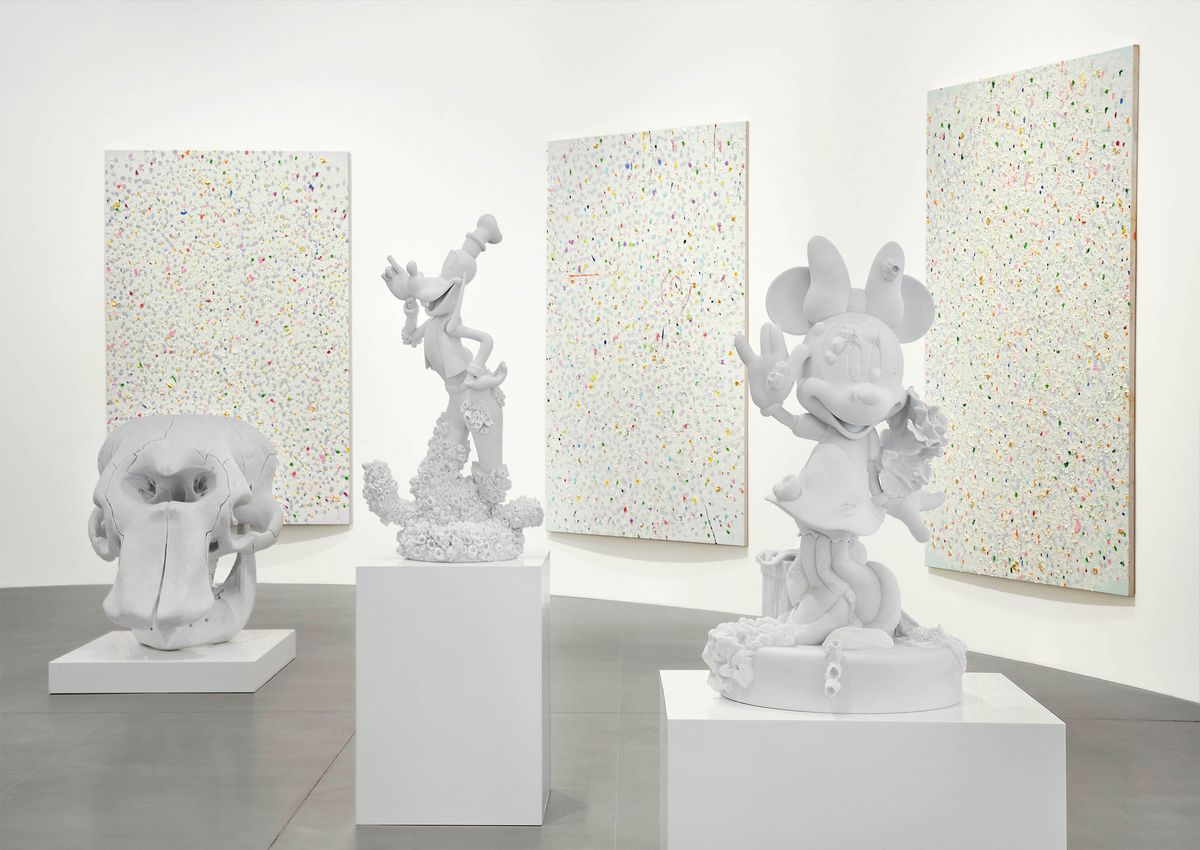
The series debuted in 2017 with a suite of ‘Treasures’—ranging from pastiches of ancient and classical busts, masks, and statues to representations of iconic Disney cartoon characters—rendered in an extraordinary array of materials, many encrusted with colourful blooms of skillfully painted barnacles, as if salvaged from the ocean floor. Forgiving and Forgetting marks an ambitious phase in Hirst’s body of work; these sculptures are carved out of pink Portuguese marble and white Carrara marble, immortalising each figure in one of the most storied materials in Western art history.
Each subject in its monochrome marble assumes the same gravitas; the playful wave of a coral-laden Minnie Mouse is echoed elsewhere in the gallery by the outstretched hand of the female centaur Hylonome, whose statuesque form conjures both Baroque corporeality and the stately symmetry of French Neoclassical sculpture. Sparking unexpected interactions between ancient and modern, Hirst’s ‘Treasures’ exemplify the idea of mythmaking that lies at the core of culture, both high and low.
Hirst will also reveal his latest series, the ‘Reverence Paintings’. Originally seeking to reimagine the vibrant ‘Cherry Blossoms’ in allover white, he began to overlay shifting dabs of colour and flecks of gold leaf across the otherwise monochrome canvases, allowing them to take on a vivid and shimmering dynamism. Covered with bright impasto dots that add both perspectival grounding and visual haze to each composition, the ‘Reverence Paintings’ underscore Hirst’s acute sense of colour, expanding upon the expressionistic and pointillist impulses that have inspired his recent bodies of work.
Damien Hirst first rose to public recognition in 1988 during his time studying at Goldsmiths College in London, when he conceived and curated Freeze, a group exhibition of his work and that of his contemporaries at Goldsmiths. In the near quarter century since that pivotal show, Hirst has become one of the most prominent artists of his generation. Through work that includes the iconic shark suspended in formeldahyde, The Physical Impossibility of Death in the Mind of Someone Living (1991), to the platinum cast of a human skull set with 8,601 flawless diamonds, For the Love of God (2007), Hirst takes a direct and challenging approach to ideas about existence. Of the latter, art historian Rudi Fuchs has said, ‘The skull is out of this world, celestial almost. At the same time, it represents death as something infinitely more relentless. Compared to the tearful sadness of a vanitas scene, the diamond skull is glory itself.’ His work calls into question our awareness and convictions about the boundaries that separate desire and fear, life and death, reason and faith, love and hate. Hirst uses the tools and iconography of science and religion, creating sculptures and paintings whose beauty and intensity offer the viewer insight into art that transcends our familiar understanding of those domains. ‘There [are] four important things in life: religion, love, art and science,’ the artist has said. ‘At their best, they’re all just tools to help you find a path through the darkness. None of them really work that well, but they help. Of them all, science seems to be the one right now. Like religion, it provides the glimmer of hope that maybe it will be all right in the end…’


A respected voice in contemporary art discourse.
Focusing on ambitious storytelling and insightful art-world commentary. Ocula Magazine publishes in-depth interviews, critical essays and timely analysis on the artists, exhibitions and ideas driving the global art world.
Learn more about Ocula Magazine
Showcasing the best of the art world.
Ocula partners with galleries from around the world to highlight their artists, artworks and exhibitions. Gallery membership is by application and invitation, with each member vetted by an independent panel.
Learn more about Ocula Membership

Specialises in the sale of major artworks.
Led by a team with deep ties to the world’s leading auction houses, galleries and collectors. Ocula’s advisory team offers bespoke services to high-net-worth clients from around the world who are looking to acquire the best of contemporary and modern art.
Learn more about our team and services