Abstraction has always been a part of my work.
—Y.Z. Kami
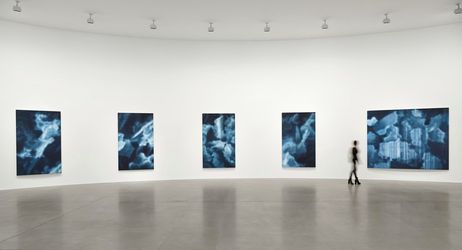
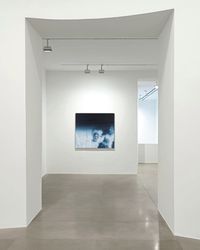
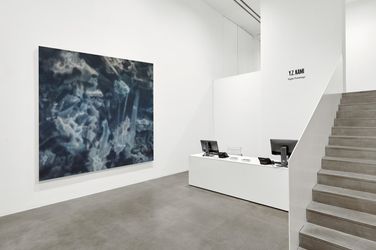
Gagosian is pleased to present Night Paintings, an exhibition of new works by Y.Z. Kami. This is his first solo exhibition in Italy, following his participation in The Spark Is You, a group exhibition organised by the Parasol unit foundation for contemporary art, London, in conjunction with the 58th Biennale di Venezia this year.
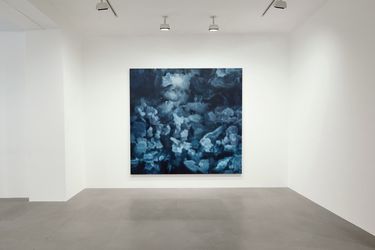
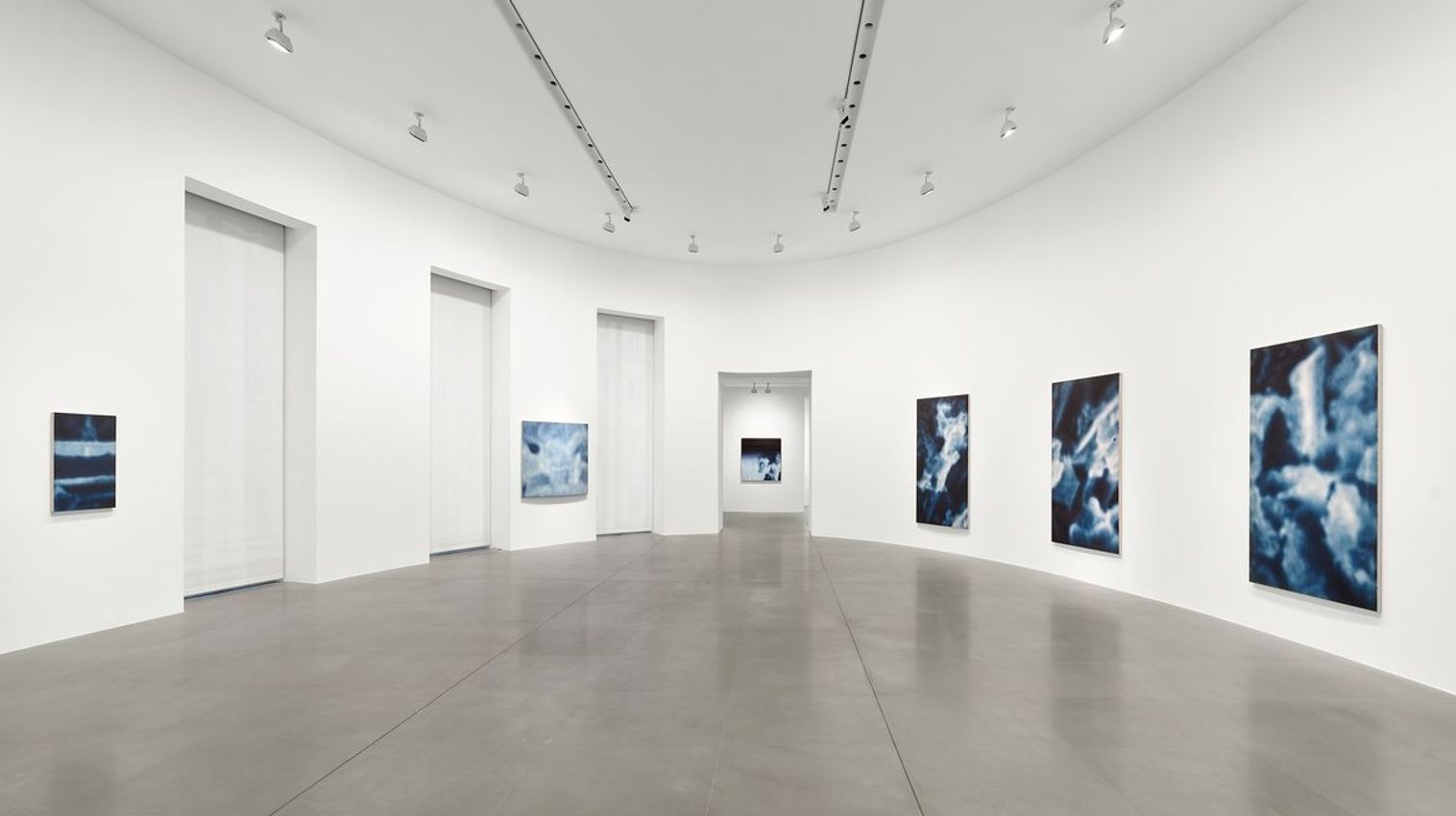
Kami’s tenebrous ‘Night Paintings_’(2017-) are composed largely from a single shade of indigo—said to be the colour of the night—mixed with various gradations of white. Each canvas in this new series is filled with blue-whitish apparitions that float just past the limits of materiality and concrete representation. These outlines shift between seemingly solid, liquid, and gaseous states—an osseous structure melts into a milky swirl, which in turn evaporates into a coil of smoke—yet their true forms and references ultimately remain veiled beneath hazy brushwork.
With their soft edges and shimmering biomorphic patterns, Kami’s paintings limn the boundaries between the earthly and the sublime. Subtly informed by his cultural heritage yet resolutely cosmopolitan and secular, Kami’s oeuvre communicates a philosophical and spiritual reflectiveness; at the same time, he visually obscures and anonymises his subjects, preferring to approach broader questions of the infinite and the ineffable rather than delving into the specifics of a religious existence.
Kami is known for his portraits of family, friends, and anonymous strangers, all painted from snapshots that he takes himself. With their blurred features and muted palettes, these psychologically arresting works recall the sobriety and frankness of ancient Egyptian ‘Fayum’ paintings—funerary portraits of the deceased in the prime of life that were affixed to mummies before burial. In recent years, he has also broadened his subject matter, using his signature sfumato application of paint to treat an array of contemplative subjects including church interiors, death masks, and hands supplicated in prayer.
The Great Swan (2018) ventures into figuration, although the Hindu mystics depicted in this enigmatic composition are so blurred that their robes and faces verge on total dissolution. Here, as with the tantalising indistinctness of his other ‘Night Paintings’, Kami engages in a push and pull between abstraction and figuration, further confounding the viewer’s attempts to recognise elements from the human realm. The entire top register of The Great Swan is veiled by a pall of solid indigo that obscures the face of the central standing figure, whose presence seems to have brought his seated audience to rapt attention. The painting is cloaked in descending darkness, half-covered by an inscrutable eclipse or the heavy lid of a somnolent eye.
Kami’s new monograph Y.Z. Kami: Works 1985-2018 was recently copublished by Skira and Gagosian and is also available at the Gagosian Shop. This comprehensive volume reproduces more than three hundred works and includes essays by art critic Laura Cumming, independent curator Elena Geuna, and curator and writer Robert Storr.


Y.Z. Kami’s large-scale portraits recreate the visceral experience of a face-to-face encounter, suggesting a connection to the presence of each subject. Through a uniform haze or sfumato, he depicts family, friends, and anonymous strangers with eyes open or closed, gazing forward or looking down. Rendered in matte oil paint on linen, the portraits recall Byzantine frescoes or Fayum funerary portraits, continuing the art historical quest to locate the unknown and the infinite within material form. In his abstract work, Kami continues this interplay of surface and interior, using forms inspired by architecture, geometry, and poetry. In the Endless Prayers series, Persian, Hebrew, Arabic, and Sanskrit prayers and verses are cut into rectangular fragments and pasted into mandala formations, their spiralling patterns echoing the repetitive nature of prayer. These, in turn, led to the Dome paintings. In black, white, blue, or gold, the Domes are comprised of square or rectangular marks arranged in concentric circles to create tessellated, pulsing voids—universal evocations of the passage from darkness into light. Kami has also expanded his figurative painting to include depictions of hands. The hands, often shown with palms pressed together in prayer, underscore the physical nuance of this expressive part of the body, as well as the pervasive symbolism of its gestures.


A respected voice in contemporary art discourse.
Focusing on ambitious storytelling and insightful art-world commentary. Ocula Magazine publishes in-depth interviews, critical essays and timely analysis on the artists, exhibitions and ideas driving the global art world.
Learn more about Ocula Magazine
Showcasing the best of the art world.
Ocula partners with galleries from around the world to highlight their artists, artworks and exhibitions. Gallery membership is by application and invitation, with each member vetted by an independent panel.
Learn more about Ocula Membership

Specialises in the sale of major artworks.
Led by a team with deep ties to the world’s leading auction houses, galleries and collectors. Ocula’s advisory team offers bespoke services to high-net-worth clients from around the world who are looking to acquire the best of contemporary and modern art.
Learn more about our team and services