








Press Release

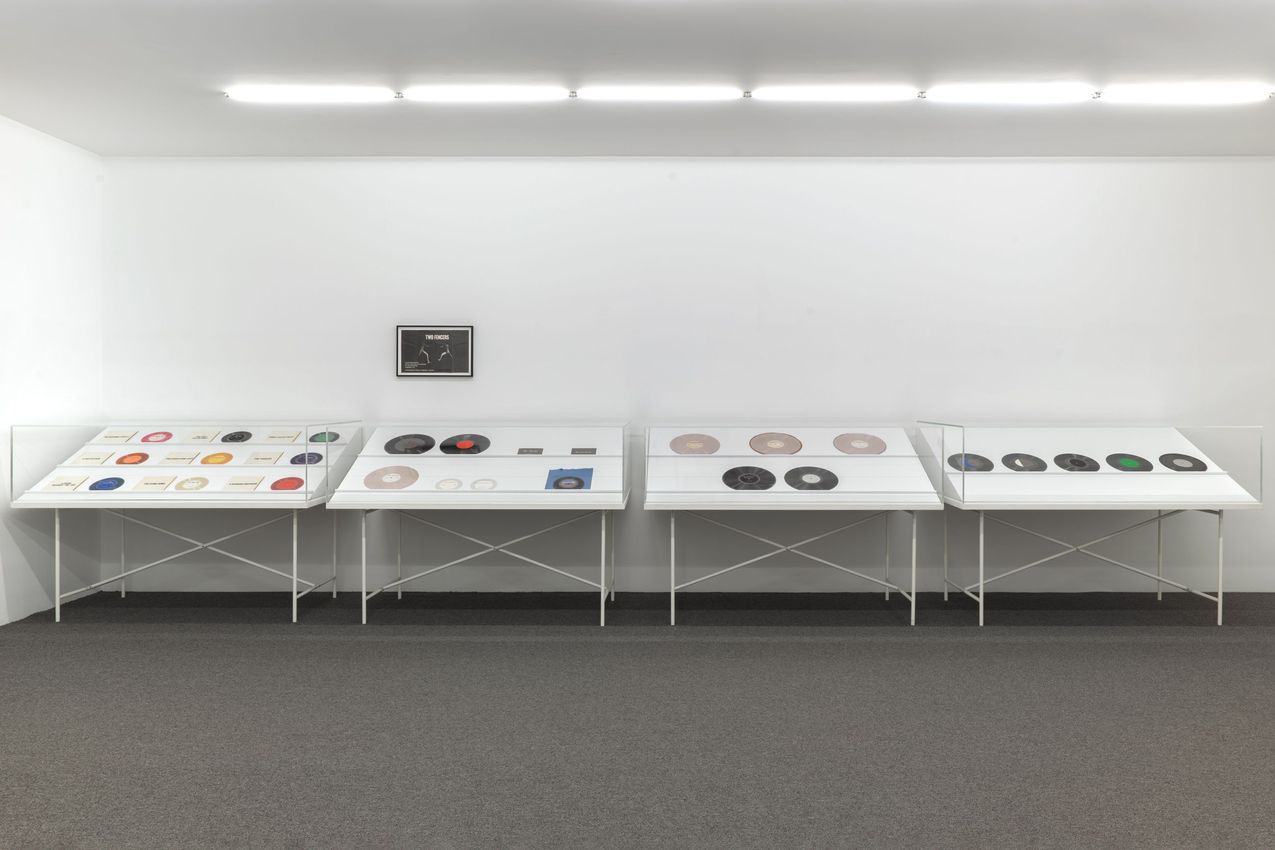
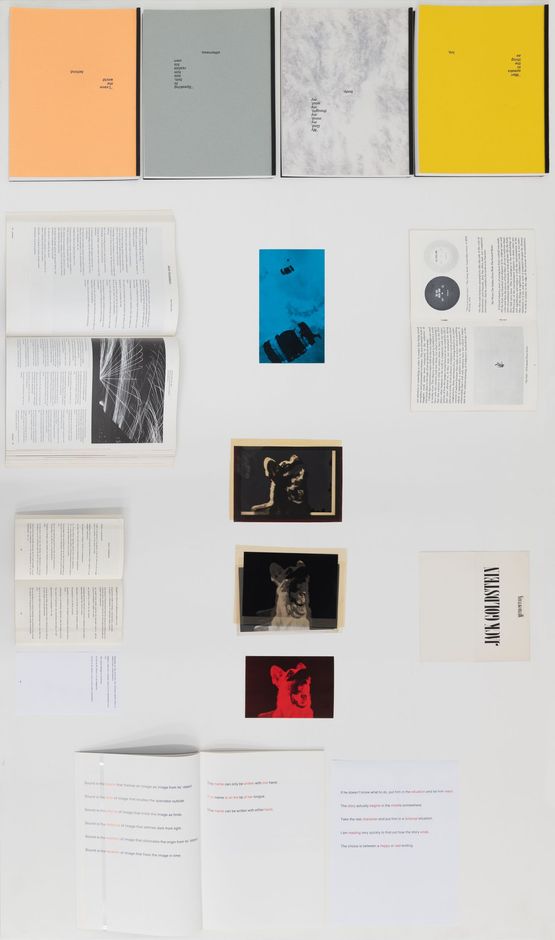
********Galerie Buchholz presents our fourth solo exhibition of Jack Goldstein (1945-2003), focusing on three groups of work by the artist: his early sculptures, his sound works on vinyl (we show a complete overview), and his text works. These conceptual pieces represent a counterpart to his well known, visually rich films and paintings. They claim an important place in the artist’s work, emerging from postminimalism, far from negating visuality, they prompt an invocation of imagery in the mind.

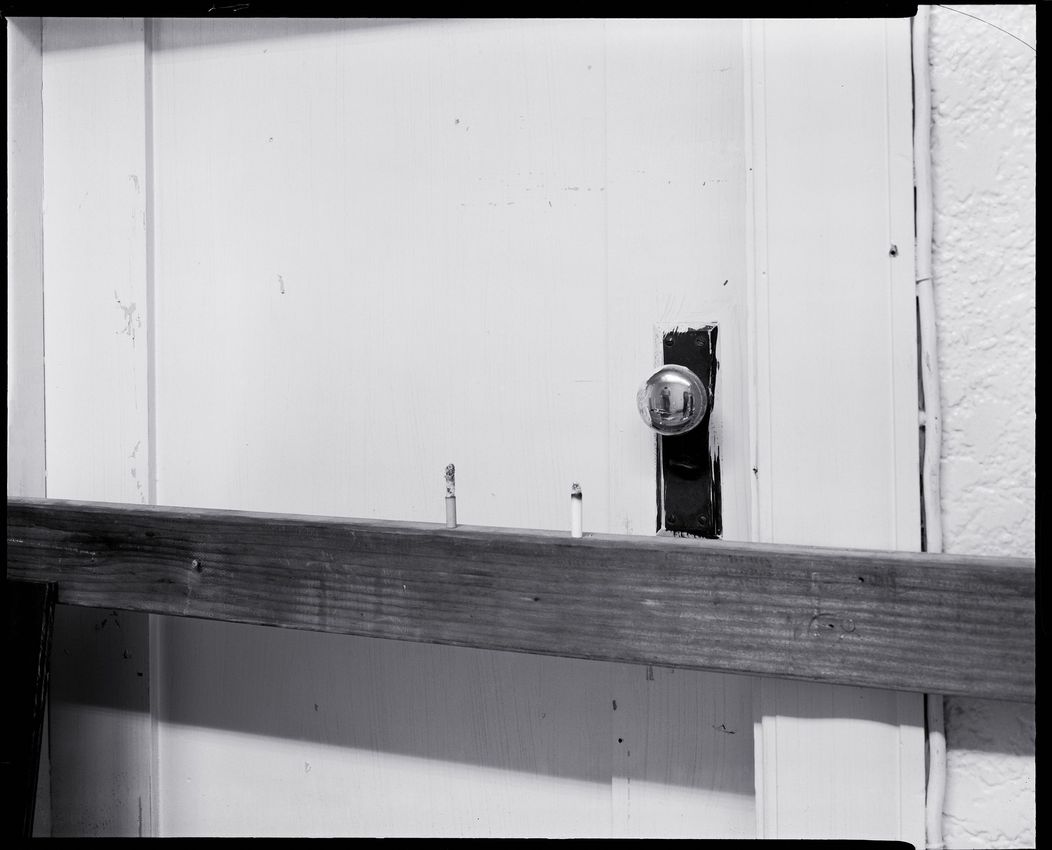
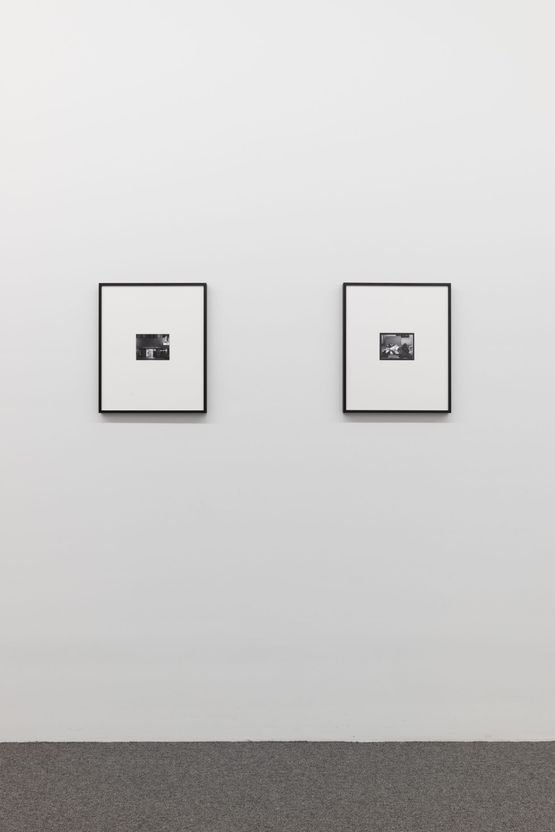
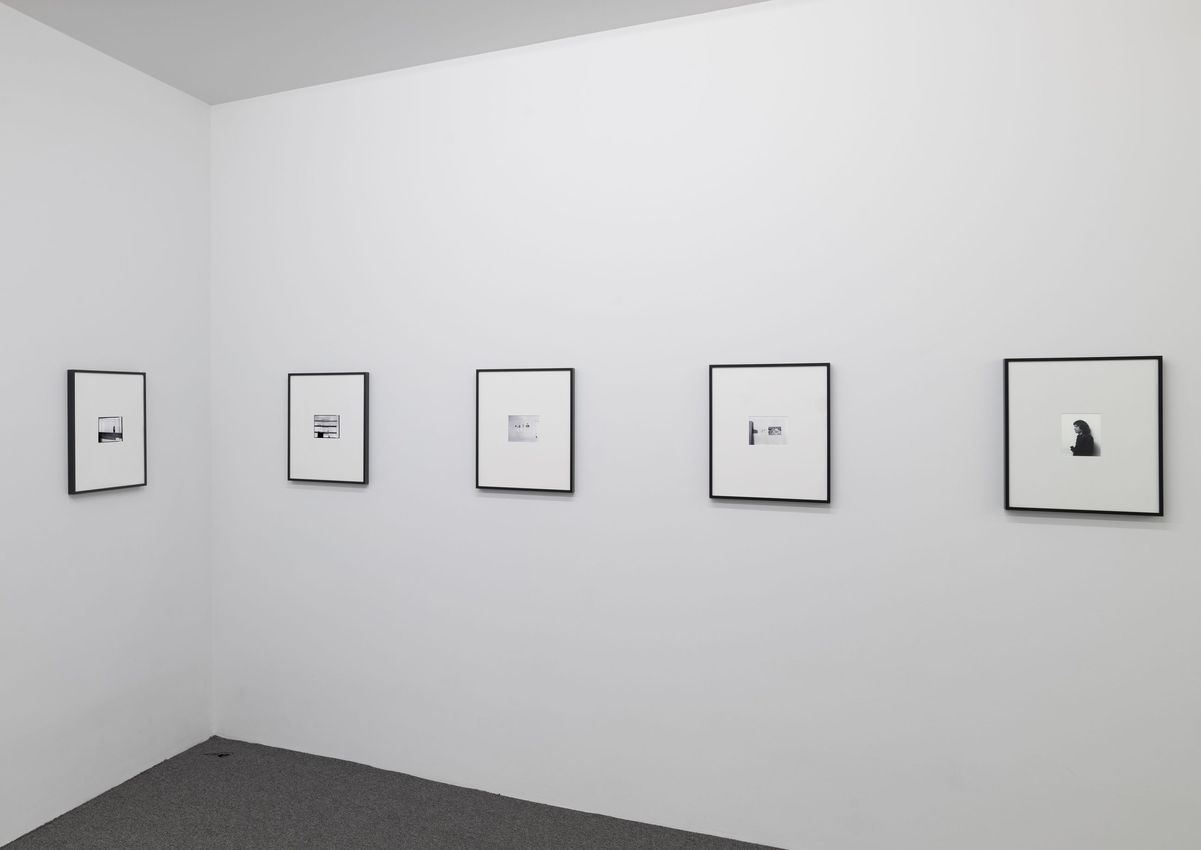
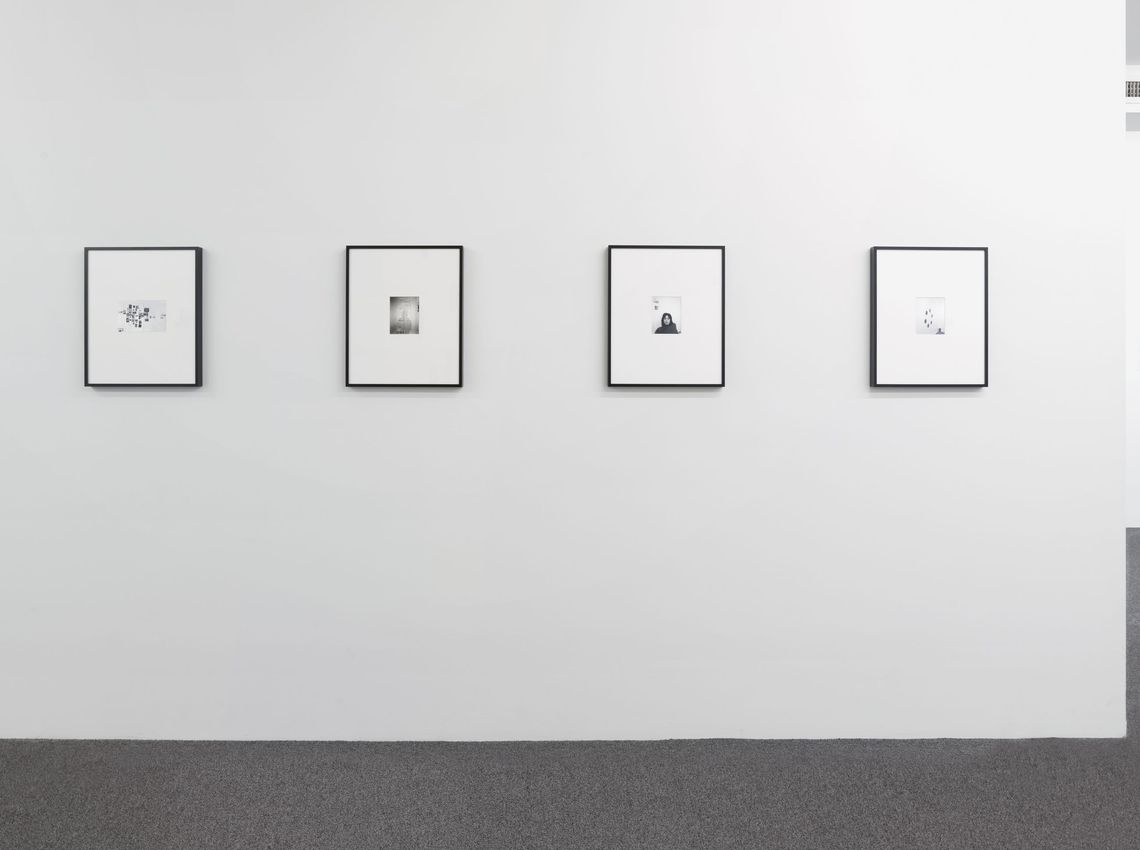
This exhibition was conceived in conversation with Helene Winer. As curator of the Pomona College Art Gallery, Winer organized Jack Goldstein’s first institutional exhibition in 1971 and then realized important projects and exhibitions with Goldstein at New York’s Artists Space and Metro Pictures gallery, which she founded with Janelle Reiring. She helped to introduce us to Jack Goldstein in Los Angeles at the end of the 1990s when we first met him and began working together. We would like to thank Helene for her continuous support. We also thank James Welling, who was a friend of Jack Goldstein’s starting in the early 1970s. In 1977-78 he photographed Goldstein’s studio in Los Angeles and took portraits of him, which are on view in the exhibition, alongside two watercolors, one from 1977 and one from 2024. Welling wrote an autobiographical text about his time with Goldstein, which is on display in the exhibition. Chris Capuozzo was Jack Goldstein’s assistant in the late 1980s and produced the Totem Portfolio with him. On view here is his scrapbook from the time when he collected examples of so-called Clipart, which was an important inspiration for Goldstein’s Totem works and was partly incorporated directly into the Totems. John Kelsey’s essay on Goldstein’s text works, the first text that deals exclusively with this group of works, is available in the exhibition in an extended form. We would also like to thank the art historian Alexander Dumbadze, who will be publishing a new monograph on Jack Goldstein next year, and Moritz Wesseler, whose father Jürgen Wesseler held an exhibition with Jack Goldstein at the Kabinett für aktuelle Kunst in Bremerhaven in the late 1970s. Moritz Wesseler made his father’s archive available to us and provided rare ephemera for the exhibition. We also thank Klaus Görner, curator at MMK Frankfurt, who made a comprehensive documentation of the vinyl works by Jack Goldstein. In addition, we would like to thank Susanne Gaensheimer, Brian Butler, Philipp Kaiser, Margaret Zwilling, Ryan Muller, Malte Lin-Kröger and the Städtische Sammlung Erlangen.

****Early Sculptures ****

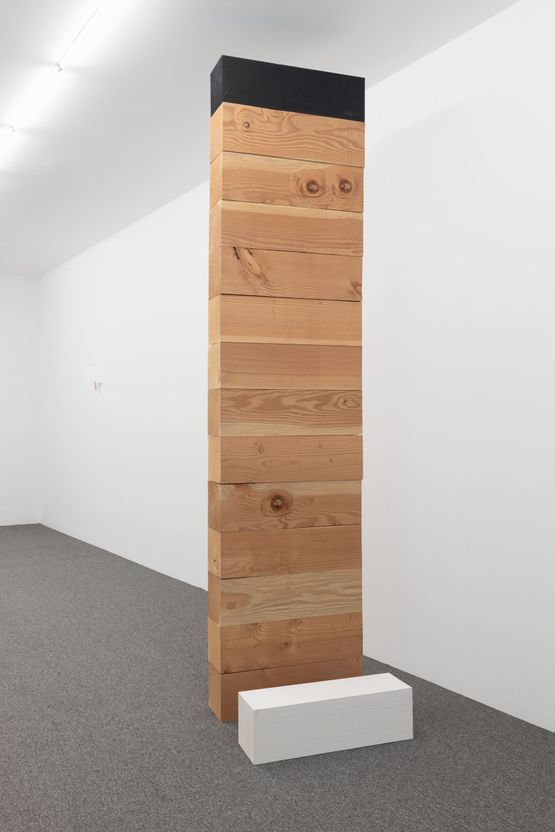
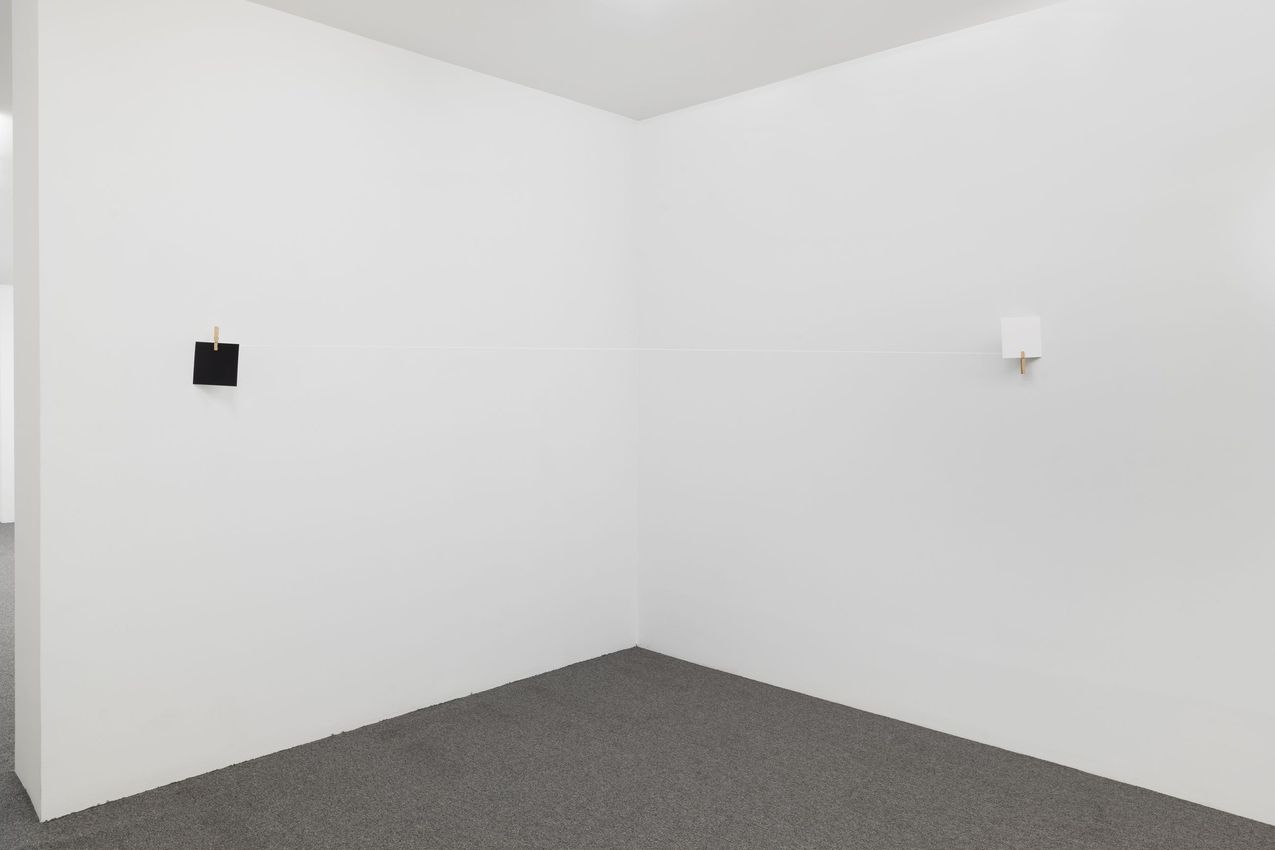
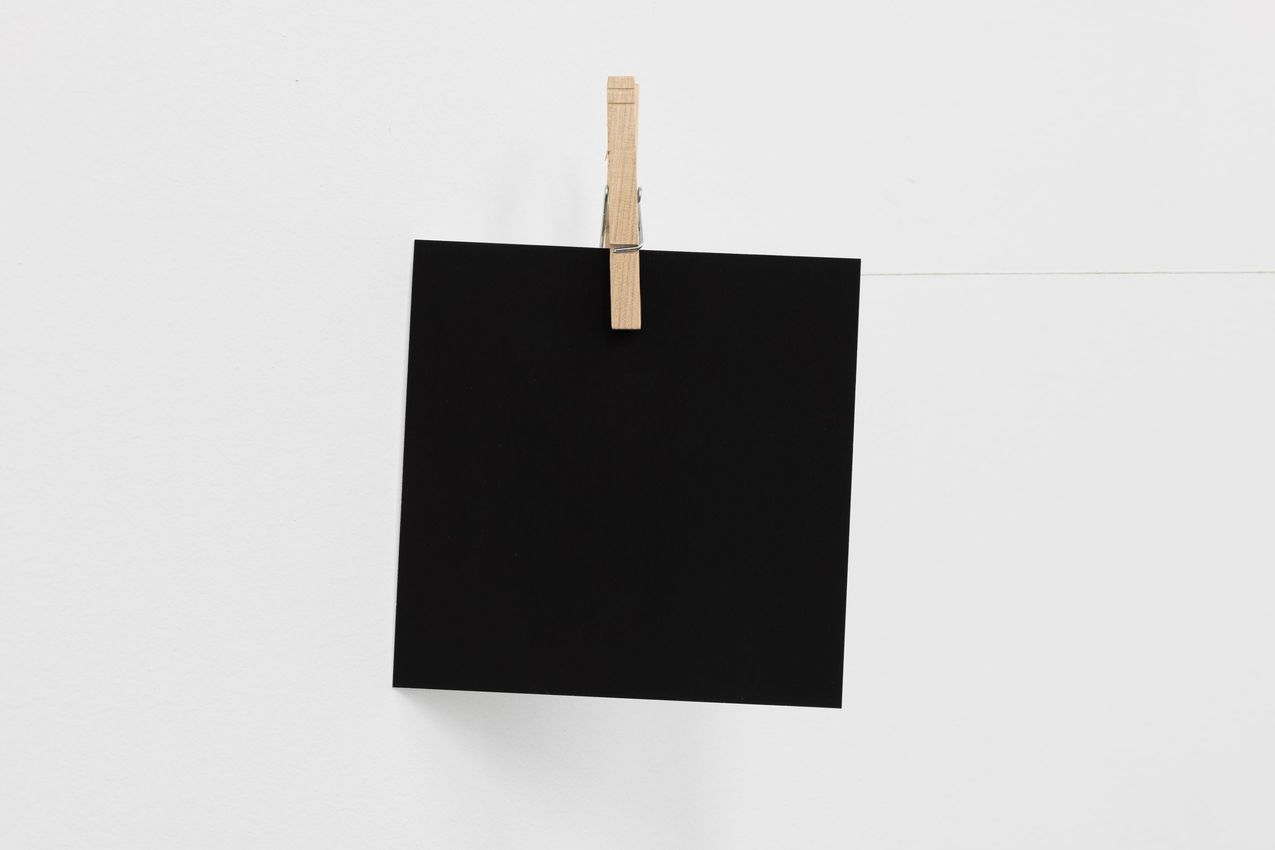
Untitled, 1970 / Untitled, 1969-1971

The sculptures that Jack Goldstein showed in his first institutional exhibition curated by Helene Winer at the Pomona College Art Gallery in 1971 are made of simple materials. Winer writes in the exhibition catalogue:

“Jack Goldstein works with wood, string, paper, nails and glass, and depends upon the components to support themselves and to dictate the form of his pieces. He combines the materials to provide strong contrasts and tensions within each work and in relation to the viewer.” (Helene Winer, in: “Jack Goldstein”, exhibition catalogue Pomona College of Art, Pomona 1971, pp. 2-3)

Goldstein’s sculptures are ideas transformed through accumulations of raw materials. Each work is supplemented with a white and a black element, intended to visualize antagonism within the precarious statics of their structures, an increase in tension.

********Text Works

__Untitled (writings), _ca. 1978/ Untitled (writings), 1988/ Untitled (Selectric Works), 1988/ _

__Totems: Selected Writings, 1988-1990/ Aphorisms, 1982-1985

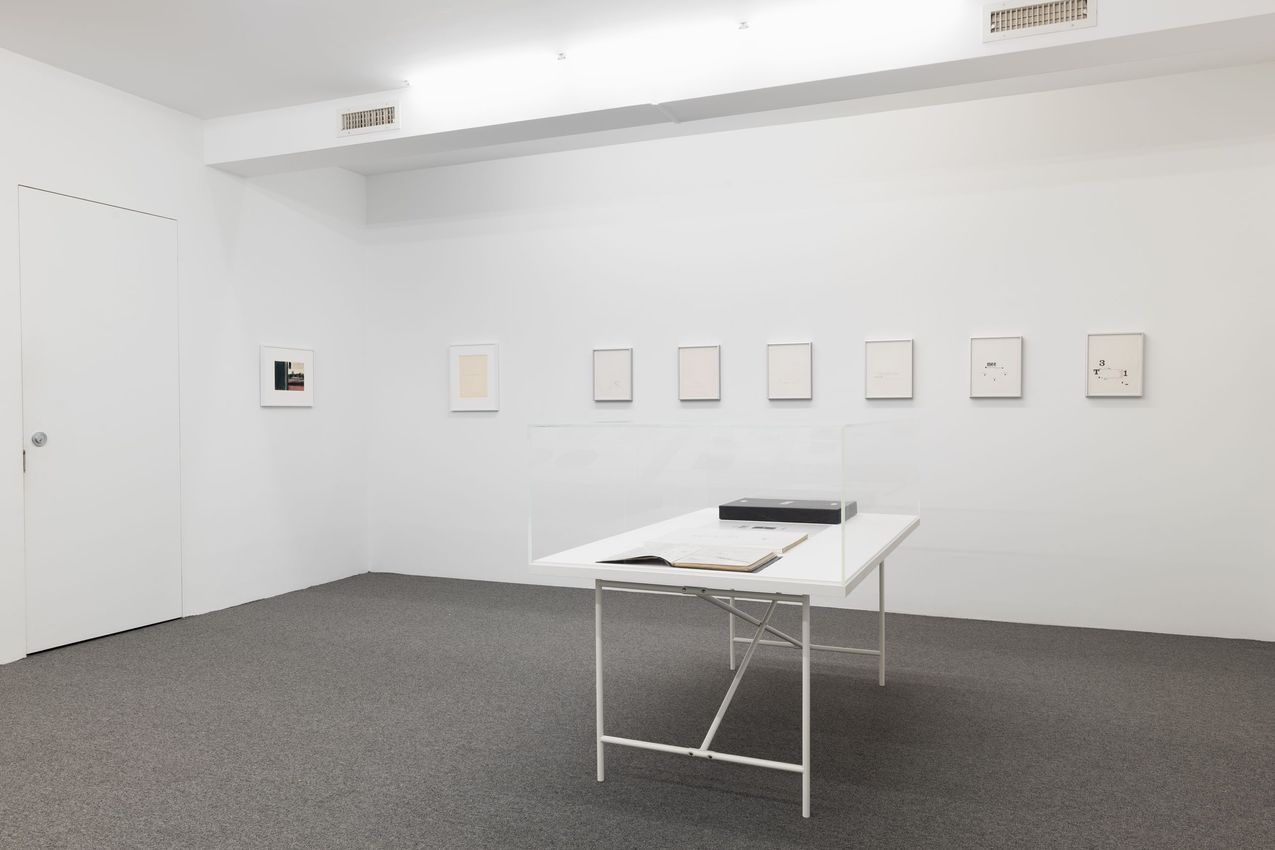
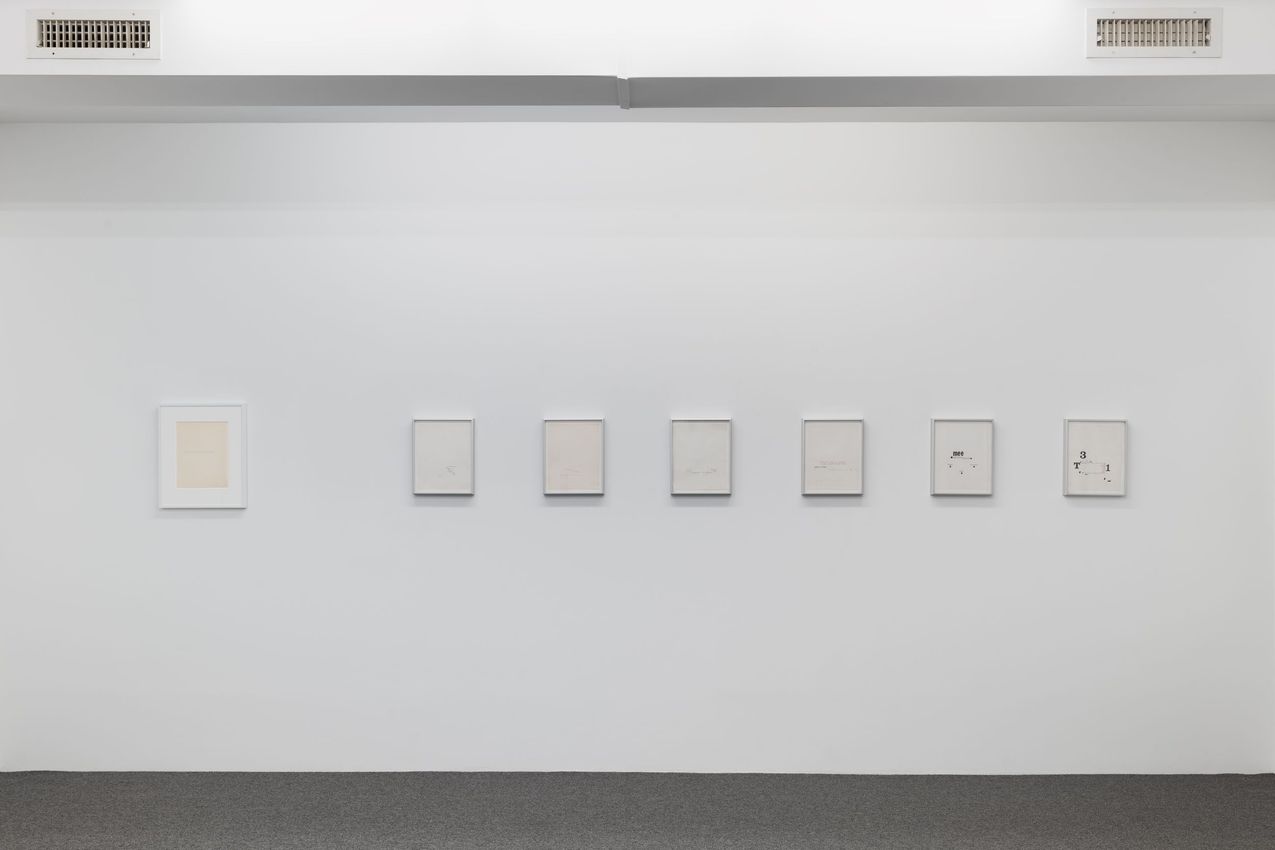
The artist James Welling, a close friend of Jack Goldstein’s for many years, describes the text works as an essential constant in the artist’s work. Goldstein produced texts at different times, starting with short handwritten observations, moving on to short sentences typed on a manual typewriter in the late 1970s; then layout combinations in which he supplemented the manual typewriter with Letraset applications in the late 1980s; then the use of an electric typewriter, the IBM Selectric, for the Untitled (Selectric Works) in 1988.

“The IBM Selectric (a portmanteau of ‘selective’ and ‘electric’) was a highly successful line of electric typewriters introduced by IBM on July 31, 1961. Instead of the ‘basket’ of individual typebars that swung up to strike the ribbon and page in a typical typewriter of the period, the Selectric had an ‘element’ (frequently called a ‘typeball’, or less formally, a ‘golf ball’) that rotated and pivoted to the correct position before striking the paper. The element could be easily interchanged to use different fonts within the same document typed on the same typewriter [...]. The Selectric also replaced the traditional typewriter’s horizontally-moving carriage with a roller that turned to advance the paper vertically.” (IBM Selectric, in: en.wikipedia.org)

As with his sculptures, Goldstein develops the form of his text works from the logic of the materials and technologies themselves. The elongated text columns that arise from the possibilities of the IBM Selectric form the transition to Goldstein’s portfolio Totems: Selected Writings, 1988-1990, which was then designed with the computer.

The artist and writer John Kelsey describes this in an essay on Goldstein’s text works:

“Goldstein produced the text-object Totems: Selected Writings (1988-90), a box containing one hundred pages of computer-generated texts organized in vertically oriented forms suggesting totem poles. Totems is a strange example of writing at a moment when word-processing and desktop design programs were suddenly flooding the consumer market. Elegant in its handling of the clunky tools and limited effects palettes of early operating systems, this is designed writing, clearly under the influence of the drug of controlling language as a thing, while using the tools (heroin, software) that were readily available at the time of its production. [...] The writing inside the box is submitted to basic formatting options and commands (which now feel dated and probably already did just a couple of years after Totems was printed). The artist has selected various fonts, scales, and readymade effects from a late 1980s desktop menu, digitally mediating each line or moment of writing. The text is stacked in centered columns, demanding a top-to-bottom (visual) rather than a left-to-right (literary) reading. There is more margin than text in Totems, but at this point we already understand that Goldstein wrote with margins as much as he did with words and that, as an artist and user of language, he was writing at the margins of literature. Nobody familiar with Goldstein at this moment of his life seems ready to say for sure whether the writing in Totems is original, appropriated, or some combination of the two. And there is little information as to the artist’s plans to distribute or edition this object. In addition to the formatting effects he applied to Totems, Goldstein inserted readymade ‘clip art’ into the layouts, thereby undermining any lingering distinction between text and image, or writing and graphic design.” (John Kelsey, “Word Processor: On the Writings of Jack Goldstein”, in exhibition catalogue “Jack Goldstein x 10,000”, Orange County Museum of Art, Los Angeles, 2012, p. 184)

Jack Goldstein first published his Aphorisms as an original contribution in the catalogue of documenta 7, 1982, and these were reprinted and extended in the 1983 issue no. 6 of Barbara Ess’ magazine Just Another Asshole. In 1985, Goldstein published another group of Aphorisms in the catalogue for his solo exhibition at the Städtische Galerie Erlangen.

__Clipart Scrapbook __

The artist Chris Cappuozzo was Jack Goldstein’s assistant in the late 1980s and helped him develop the Totems portfolio. In a recent correspondence, he wrote:

“Some thoughts about the scrapbook of clipart and the infancy of the desktop publishing revolution of the 80’s: The clipart collection was a book I had been using in the late 80’s. Libraries of digitized clip art did not yet exist. The images in this album were culled from many different sources. I was always looking for imagery. For example, around that time I came across a defunct Coast Guard base in my neighborhood in Staten Island. It was easy to enter this neglected place and freely wander around. Surprisingly, the buildings in the base were still filled with stuff - printed manuals, slide presentations, and all sorts of objects. These Cold War-era manuals were black and white and contained tons of images. One of the manuals focused on naval carpentry, another on a nuclear weapons attack, and one of the most interesting was a manual about communist infiltration. Amazing source material! — this was included in my scrapbook for my collage work. Initially, I was using copying machines, but as I became more proficient on the computer I started finding and scanning these clip art elements for use in the computer. I used a specific technique that slightly altered the images to look “bit mapped”. I was leaning into the digital. Once in the computer, I used them in creating drawings which would be used for my paintings as well as the Totems work. As we were developing the Totems design approach, Jack embraced including illustrations in the compositions. He loved all the different sorts of computer-generated typographical effects I was presenting to him.” (Chris Cappuozzo, 2024)

********Complete Vinyl Record Works 1976-1999

In a 2009 text for the catalogue accompanying Jack Goldstein’s solo exhibition at the MMK Frankfurt, the art historian Klaus Görner compiled extensive information about each of the artist’s vinyl record works. Here below we quote from a translation of “The Records - A Closer Look”. __

A Suite of Nine 7-Inch Records, 1976__

The Burning Forest, 1976, red and transparent vinyl, 45 rpm, side 1: 2’26’’

The Dying Wind, 1976, clear and transparent vinyl, 45 rpm, side 1: 2’45’’

A Faster Run, 1976, orange and transparent vinyl, 45 rpm, side 1: 2’43’’, side 2: 2’08’’

Three Felled Trees, 1976, dark green and transparent vinyl, 45 rpm, side 1: 2’40’’, side 2: 0’59’’

A German Shepherd, 1976, red and transparent vinyl, 45 rpm, side 1: 2’30’’

The Lost Ocean Liner, 1976, black vinyl, 45 rpm, side 1: 2’27’’, side 2: 2’27’’

A Swim against the Tide, 1976, blue and transparent vinyl, 45 rpm, side 1: 2’38’’, side 2: 2’55’’

The Tornado, 1976, purple and transparent vinyl, 45 rpm, side 1: 2’10, side 2: 3’

Two Wrestling Cats, 1976, yellow and transparent vinyl, 45 rpm, side 1: 2’32’’, side 2: 0’59’’

********“The first record works got under way with the Suite of Nine 7-Inch Records. This work appeared in a numbered edition of one hundred. Every record is packed in a carefully designed white cover bearing the record’s title and the name of the copyright holder. The physical material is either opaque or transparent vinyl: ‘flashed’ in reddish white for The Burning Forest, transparent blue for A Swim against the Tide, green for Three Felled Trees and a virtually colorless material for The Dying Wind. For the two ‘fog and smoke pieces’ The Lost Ocean Liner and The Burning Forest, opaque vinyl was used. The material and design are linked very closely to the sounds’ ‘image’. In an interview with Morgan Fisher, Goldstein talked about the inception and idea of his first record work. He describes the slow transformation of a film idea into a record: ‘I originally wanted to make a tornado film, but naturally I couldn’t film a real tornado without finding a suitable location in the Midwest. I thought that would be so ridiculous that I ultimately looked for film shootings of tornados in archives, but everything I found was terrible. I was totally at the mercy of how the respective cameraman had shot the film. Then I hit on the idea of making a sound recording with a tornado. On color photos, tornados appear purple. The record, for its part, turns around its own axis like a tornado and is made of transparent purple vinyl.’ (1)

As is the case with Goldstein’s films, the content of each record is limited to one object, one action, one event. However, now a separation of the two elements, sound and image, takes place. The audio track is virtually isolated from the image, and thus open for a new and different type of image, the mental image. The example cited in the interview was a clever choice. The rotating disc and the transparent purple of the vinyl serve to abstract the image of the tornado while at the same time retaining specific indicators. If in the case of the tornado this separation develops out of the circumstances of the preparation, as it were, in the case of the film Shane (1975), it is real, in the sense of being deliberate. With only very minor exceptions, the first record of the Suite of Nine, A German Shepherd, is identical to the soundtrack of this film. Unlike the purple of The Tornado, however, the red coloration of this record is chiefly associative. It plays with the ‘aggressive’ reaction to the color red, perhaps also with the idea of the signal effect. (2)

Six of the nine records in the Suite have two sides, and the sounds heard on the first side are continued on the second. Sounds characterized by repetition, such as A Swim against the Tide, A Faster Run (in which horses presumably run back and forth a dozen times, accompanied by cheering calls) The Tornado or _The Lost Ocean Liner _(with its foghorn and the breaking surf) can be lengthened at will; they have no end. The first modification to this convention is found in Two Wrestling Cats: the wailing and hissing is continued on Side 2, but ends much earlier than on Side 1.

In the case of the Three Felled Trees, Goldstein plays a wry game with the two sides - and with the turning over - of the record. On Side 1 we hear the sounds of the axe and the falling of the first tree. This is repeated, but only until shortly before the second tree falls. The virtually releasing sound of the toppling tree is only to be heard on the second side, after turning the record over-followed by the complete series of sounds for the third tree.

Three of the records in this series are played only on one side. If we follow the numbering on the labels, they are the first and the last two. The ‘image’ or narrative sequence is not continued on the other side. In the case of The Dying Wind this appears plausible: the recording of the dying wind already ends long before the end of the first side. It would make no sense to revive the wind again on the other side. The sounds of _The Burning Forest _begin in the midst of the event, and also end abruptly, without being faded out. A continuation on Side 2 would be conceivable, but there is no repetition here in the manner of the trees being chopped down, nor is there an audible end to the burning of a forest.”

(1) Jack Goldstein interviewed by Morgan Fisher, in: _Jack Goldstein. Films, Records, Performances and Aphorisms, _Galerie Buchholz, Köln 2003, p. 30

(2) Jack Goldstein interviewed by Morgan Fisher about the dog in Shane: “I chose a German Shepherd because it’s thought of as being a vicious dog, but I could still control him.” in: Jack Goldstein. Films, Records, Performances and Aphorisms, Galerie Buchholz, Köln 2003, p. 27

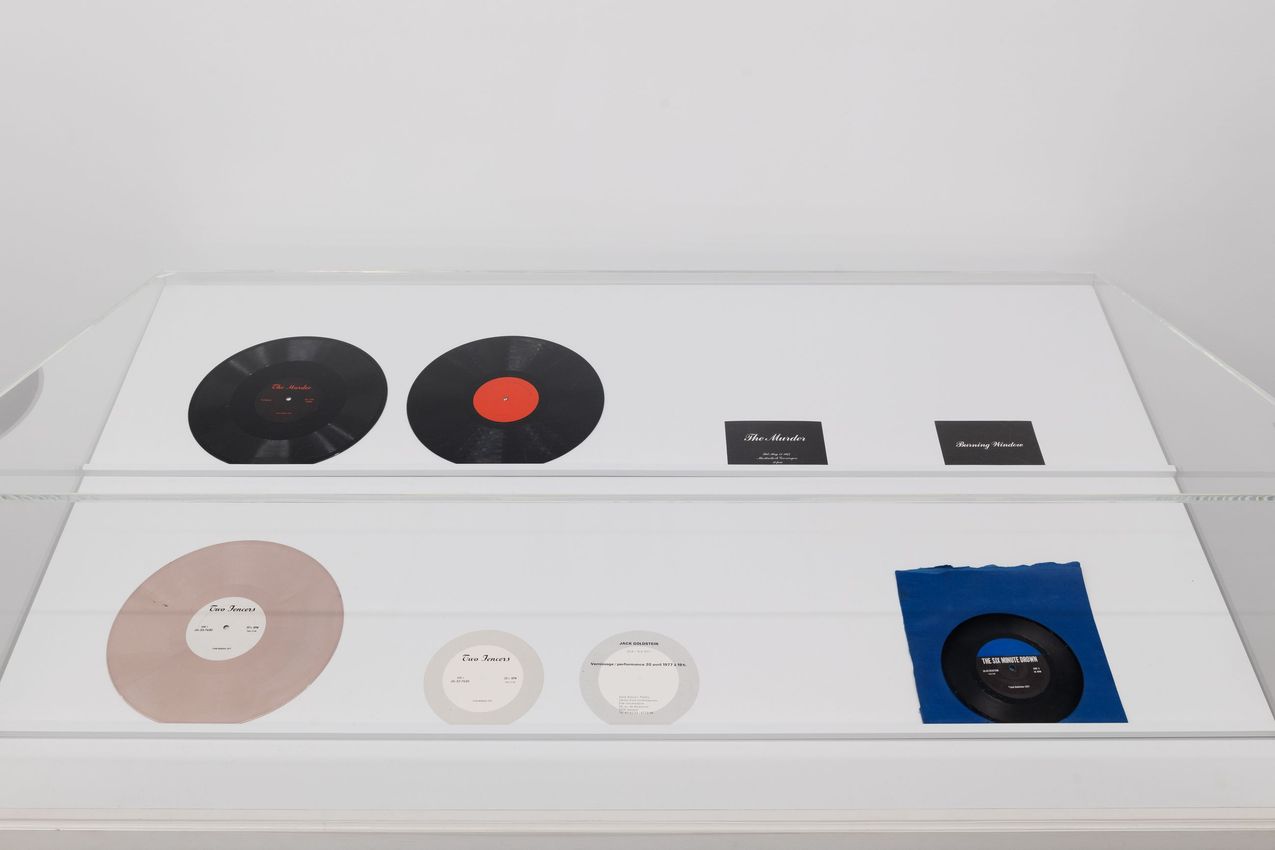
The Six-Minute Drown, 1977

black and blue vinyl, 45 rpm, side 1: 3’, side 2: 3’

“In a way, The Six-Minute Drown is related to A Swim against the Tide: wildly agitated water interspersed with human screams and, again and again, animal-like grunts. Here it cannot be clearly distinguished whether there are two people involved. If we abandon ourselves to the image of a fight between two opponents, film scenes of this kind come to mind, for example the amphibian-like monster ‘Gill Man’ from Jack Arnold’s horror classic Creature from the Black Lagoon of 1954. As in the following works as well, the associative step to (second-rate) Hollywood productions is easily taken. Even for such productions, however, a fight in the water lasting six minutes would be highly unusual. The two times three minutes and the turning of the record negates the initial impression of a soundtrack. As the climax of a film scene, a fight carried out in the water with the attempt of the perpetrator to drown his victim and the latter’s attempt to escape describes a much tighter ‘suspense curve’ - a six-minute curve inevitably collapses. Due to the over-extended length, the sound detaches itself from the imagined film, becomes abstract, and - since the fight simply refuses to come to an end - the last gasp at the end of Side 2 almost strikes one as funny.” (1)

(1) In Blake Edward’s comedy The Party of 1968, the Indian film extra Hrundi V. Bakshi (Peter Sellers) exaggerates his acting performance as a trumpeter by blowing into the instrument again and again, even though he has already been mortally wounded several times.

The Quivering Earth, 1977

white vinyl, egde cut, 33 1/3 rpm, side 1: 9’36’’, side 2: 8’37’’

white vinyl, edge uncut and painted gold, 33 1/3 rpm, side 1: 9’36’’, side 2: 8’37’’

white vinyl, edge uncut and painted silver, 33 1/3 rpm, side 1: 9’36’’, side 2: 8’37’’

********“In a number of the copies of The Quivering Earth the edge was never cut. The undulating surrounding edge left over by the production process has been painted gold or silver. On a rotating turntable, this metallically shining edge creates the impression of rolling motion. Shattering glass and breaking wood, remote detonations, avalanches of rocky masses and the crackling of falling stones can be heard in the recording. Again and again, the intensity rises to noisy peaks and then ebbs again. The second side begins with a screaming and shouting crowd of human beings fleeing in panic, in the background rumbling and cracking noises. As in the case of the Drown, the sheer length of the two recordings negates the immediacy. The empathy-evoking character such sounds can have in disaster films is exhausted. As a result, the listener is not on the ‘victims’ side, but becomes the perpetrator of - or lord over - the terror. He sets the earthquake in motion, strengthens or weakens it (by means of the volume control), repeats or stops it. (1) Yet the record does not cater to fantasies of omnipotence; on the contrary, it is a multi-layered image derived from the original phenomenon. The extreme artificiality of the recording, which is never once suggestive of reality, results from the synthetic layering or blending of individual noises in an overall image of an ‘earthquake’, available as a product with or without personnel.”

(1) Jack Goldstein interviewed by Morgan Fisher: “The record spins like a tornado and is translucent purple. You can hold it up to the light. You can turn the volume up or down. All of a sudden you have control over the tornado. [...] The control over the object that is inherent in a phonograph record is also inherent in film. The fact that a projector is running implies that you can turn it off, but nobody has the nerve to do it.” Quoted from Jack Goldstein: Films, Records, Performances and Aphorisms 1971-1984, Galerie Buchholz, Köln 2003, p. 30

********Two Fencers, 1977

white vinyl, 33 1/3 rpm, side 1: 10’30’’, side 2: 0’55’’

********“The two following records have a kind of intermediate status which is difficult to pin down. With regard to genre they are located somewhere in the neighborhood of theatre, film and performance. The Two Fencers and The Murder were both produced in close connection to performances bearing the same titles and carried out the same year.

On its first side, the Two Fencers features the ‘classical’ music of the cloak-and-dagger film. Wild string music with lots of crashing cymbals calls to mind equally wild dagger fights, daring leaps over banisters and tables, punches and counterpunches and the victor’s laughter. Again and again, the mood switches between situations of imminent danger and romantically bucolic scenes culminating in the proud equestrian departure in formation (I am naturally reminded of the musketeers). Side 1 ends in a state of limbo, the melodic phrase doesn’t come to an end, the cadence is not resolved. Then Goldstein varies the joke used in Three Felled Trees in that the record must first be turned over to Side 2 to hear the concluding musical flourish - which is followed by nothing.

The apparent ineptitude - the last bit no longer fits on the first side and has to be put on the second - is reminiscent of the theatrical stagings of the type of film which, viewed decades later, both move and amuse the viewer. It has repeatedly been emphasized that Goldstein’s aesthetic models for these works always lie in the past. In his essay ‘A Trailer for the Future’, John Miller remarks that Goldstein’s iconography never related to his own time: ‘Together, all the trained animals, fencers, contortionists and boxers instead recollect memories of 1930s or 1940s America, an America of medicine shows, minstrel shows, the circus and Vaudeville.’ (1)

Goldstein described the performance Two Fencers carried out at the Centre d’Art Contemporain in Geneva in 1977 as follows: ‘The performance is two men in traditional fencing gear, fencing against a black backdrop. A record is played during the performance of music that is normally used in films to create the sense of action, drama and tension. Because of what the music connotes, an ambiguity is set up by the combination of theatrical sound and formal image: Whether or not it is an athletic exercise or a staged duel (theater), a competition for points, or for life and death.’ (2)

The theatricality of the duel derives its tension from the contrast between the fencers’ sports gear on the one hand and the practiced fencing bouts, the red illumination and the music on the other. It is above all the music which is responsible for the ambiguity, since such music is not used to accompany sports events, but rather (the staged) fights to the death in movies. In other words, the concern is never a deception regarding the true circumstances of the duel, never do we find ourselves in the position of having to fear for the life of one of the combatants. Rather, here as well, the work revolves around the ambiguity of the imagery. It does not resolve itself in a single meaning, a single reality; it is neither the one nor the other, and nevertheless the two overlap. The distance whose creation Goldstein consistently called for is brought about here by the virtually ‘limbo’ character of the performance. The viewer does not succeed in achieving an adequate relationship to the scene. He can participate neither as the spectator of a sports event nor as the member of a cinema audience.

But how does the Two Fencers record work? In a manner similar to The Unknown Dimension, not only one short scene (e. g. a skirmish) is to be heard here, but rather a succession of scenes. The antiquated quality of the music already creates a certain artificiality which, as described above, goes hand in hand with an ambiguity of reception. The scenes imagined by the viewer are likely to appear in ‘black and white’ and be associated with theatrical gestures.”

(1) John Miller, “A Trailer for the Future”, in: Jack Goldstein: Films, Records, Performances and Aphorisms 1971-1984, Galerie Buchholz, Köln 2003, p. 1

(2) The descriptions of the Jack Goldstein performances were taken from the Performance Portfolio of the year 2001. In addition to a description of the respective performance, each of the nine sheets also contains a colour illustration. The English text and its translation into German is reprinted in:Jack Goldstein: Films, Records, Performances and Aphorisms 1971-1984, Galerie Buchholz, Köln 2003, p. 75

********The Murder, 1977

black vinyl, 33 1/3 rpm, side 1: 8’30’’, side 2: 8’02’’

“The second record produced in connection with a performance is The Murder. The performance described by the following text passage was carried out in the Martinkerk in Groningen in 1977. ‘The murder takes place in a Gothic church, whose dimly lit architectural features provide the context for an orchestral piece of music containing those rhetorical figures of suspense typical of the thriller/horror movie soundtrack. Partway through the piece, the darkness is pierced momentarily by a red spotlight which casts a rich glow over an empty balcony before fading away. The seated audience does not witness the enactment of a crime, but is encouraged to imagine a dramatic scenario evoked by light and sound. The brief, but vivid, spectacle of the red-lit balcony and the narrative associations of the music open the performance to ambiguous shifts in perception - from reality to the image of a Grand Guignol cinematic fiction.’ (1)

In the manner of a radio play, the ‘narrative associations of the music’ referred to by Goldstein, which join the red-spotlit balcony to transform the reality of the church’s nave into a grotesque horror play, merely point in the direction of film. In the performance as well as in the record, the murder remains invisible and is left to the imagination. It is only through our cineastic conditioning or - as Goldstein put it - the ‘rhetorical figures’ of cinema that the invisible becomes visible. The musical indicators transform the respective reality into an image.

Whereas the ‘reality’ of the performance was specified by Goldstein, the situation of listening to the record is completely undetermined. The artist has no influence on when and where The Murder is listened to, and the privacy usually associated with record-listening is extended into the ‘privacy’ of the imagined scenes. Nevertheless, these scenes are by no means personal; on the contrary, they correspond to the rhetorical figures of cinema, particularly the stereotypical set-pieces used as modules in the production of second-rate movies.

However, we have yet to discuss Side 2. There we hear a tone of approximately 90 Hz lasting 35 seconds, followed by a silence of the same length. The tone is repeated altogether seven times. In the following work, The Unknown Dimension, the second side features precisely the same succession of tones. There do not appear to have been technical reasons for this circumstance; other ‘one-sided’ records have no sound whatsoever on their second sides. The regular succession of tones is technical and, in its exactness, reminiscent of test records for acoustic devices. Whatever interpretation we may decide on, the contrast between grotesque fantasy on the first side and mundane technology on the second remains a fundamental aspect. Both records are furnished on Side 1 with a label bearing the title and various information, while Side 2 has a monochrome label without any text (reddish orange in the case of The Murder, silvery in that of The Unknown Dimension). The appearance of the respective second side is also ‘abstract’, since the succession of equally wide but differently ‘patterned’ stripes are visible in the vinyl. It is virtually as if the two fundamental elements of these second sides are thus reproduced: tone and non-tone. The monochrome backgrounds of the last films, but also the monochrome, informel, or geometric panels of the multipartite paintings exhibit a comparable juxtaposition. The Murder and The Unknown Dimension could be regarded as tone diptychs.”

(1) Performance Portfolio, The Murder, in: Jack Goldstein: Films, Records, Performances and Aphorisms 1971-1984, Galerie Buchholz, Köln 2003, p. 76

The Unknown Dimension, 1978

black vinyl, 33 1/3 rpm, side 1: 16’44’’, side 2: 8’02’’

********“To the catalogue of film genres - the disaster movie, the adventure movie, the crime thriller - we can now add another: the science-fiction movie. The tone and sound scenarios of the previous records were relatively simple in comparison to the Cinemascopic dimensions of the Unknown Dimension. The succession and interweave of music, noises and sound effects evoke not only a scene, but an entire film. A ‘journey’ through various places and conditions is alluded to not only by the title. The subjective and by no means obligatory ‘script’ (1) is intended merely to provide an impression of the sequence and the settings. The individual items naturally do not follow one another neatly separated, but overlap to form a dense acoustic fabric.

It gradually becomes apparent that the overall soundtrack is designed with a certain sequence in mind: there is a beginning or opening, recurring music and sounds, short breaks, and an end, or final credits. The music, the sound of a jet-propelled engine, even the jungle sounds are reminiscent of simple science-fiction films, for which Goldstein had a special predilection. (2) The ‘widescreen’ movie thus designed is reminiscent of early Goldstein paintings. There as well, astronauts are to be found in the ‘infinite expanses of outer space’; there as well, jet-propelled spacecraft travel the cosmos. On James Welling’s photograph of the wall of Goldstein’s studio (3) the respective photos can be discerned.”

(1) A subjective-associative “script” of the course of events: 1) opening fanfare - 2) suspenseful music with choir, gradually growing louder - 3) jet airplane taking off - music as in 2) - 4) child crying, music as in

  1. with organ - 5) woman screaming - 6) child laughing - 7) electronic sounds - 8) superimposed speaking, distorted - 9) dog barking - 10) distorted screams - 11) muffled heartbeat - 12) chirping, growing softer -

  2. dog barking - 14) ‘windblown’ song - 15) woman crying - 16) extended organ notes - 17) distorted screams - 18) heartbeat - 19) ‘psychedelic’ music - 20) chirping of birds (distorted) - 21) woman screaming - 22) silence - 23) electronic organ music - 24) lion roaring, distorted - 25) flocks of birds - 26) jungle sounds - 27) drumbeats - 28) silence - 29) soft, religious-like song, similar to 2) - 30) running steps - 31) women’s and children’s laughter - 32) undulating drumbeats

(2) See the discussion by Shepherd Steiner: “Corrective (><) Measures”, in: Jack Goldstein, MMK Museum für Moderne Kunst, Frankfurt 2009, p. 13

(3) Jack Goldstein, MMK Museum für Moderne Kunst, Frankfurt 2009, pp. 18,19

A Suite of Five 10-Inch Records, 1979

black vinyl, 33 1/3 rpm

label: green, side 1: 3’14’’, label: blue, side 2: 0’52’’

label: black with white band, side 1: 2’51’’, label: black with white band, side 2: 4’09’’

label: silver, side 1: 1’05’’, label: white, side 2: 1’38’’

label: all black with a narrow gold moon, side 1: 5’34’’, label: all black with a narrow gold moon, side 2: 2’42’’

label: black with blue moon, side 1: 4’05’’, label: orange, side 2: 2’45’’

********“A Suite of Five 10-Inch Records appears as the quintessence of the record workgroup to this point in time. It consists of a series of records in the rare 10-inch diameter format. This is the size of so-called shellacs, with dimensions between that of the 45 and the LP, and occasionally used for new releases in the 1960s and ‘70s. The records in the Goldstein series under discussion here bear colorfully designed labels without text. There is nothing to distinguish the records or their sides from one another. Only the production numbers scratched into the matrix provide clues to the records’ contents.

This series differs from A Suite of Nine 7-Inch Records or The Quivering Earth, for example, in that, acoustically, the two sides of each record distinguish themselves clearly from one another. The sounds they feature are different, if related. Since there is no indication of the sides’ sequence, no temporal succession can be established. Depending on what we hear first and what we hear second - the crying girl or the giggling girls running out of the room - the context which emerges (as it were) is different. We are reminded of the famous film experiment by Lew Kuleschow who incorporated the same face into different scenes, triggering the impression that the face changed to correspond to the respectively following motif (food - hungry, dead man - sad, etc.). In a similar manner, the impression made on us by Goldstein’s brief acoustic sequences is different depending on the order in which we listen to them. If we first hear the foghorn of an ocean liner from afar and then the sounds of the inside of the ship, i.e. if we are taken from the ‘safe shore’ to the swaying, creaking ship, the tension that develops is different, perhaps greater, than if we listen in the reverse order, which can virtually feel like a ‘rescue’.

The interplay between the respective sides differs greatly. Distance and proximity or inside and outside are suggested by the steamer, cause and effect by the crying and giggling girls, above and below (as well as fast and slow) by the airplane and the train, before and after by the falling bombs and the landing airplane, whole and detail by the cowboy and his horses: the list can be continued ad infinitum, but the two terms always complement one another. The imagined situation always consists of two components. In their binary structure the five records reflect the two-sidedness of the medium. To avoid suffocating the interplay of the two sides in some kind of hierarchy or definitiveness, they are not marked, there is no A and no B, only this side and this side. Even if we might be inclined to put the ‘falling bombs’ before the ‘landing airplane’, we can think of a context which would make the reverse order plausible as well.”

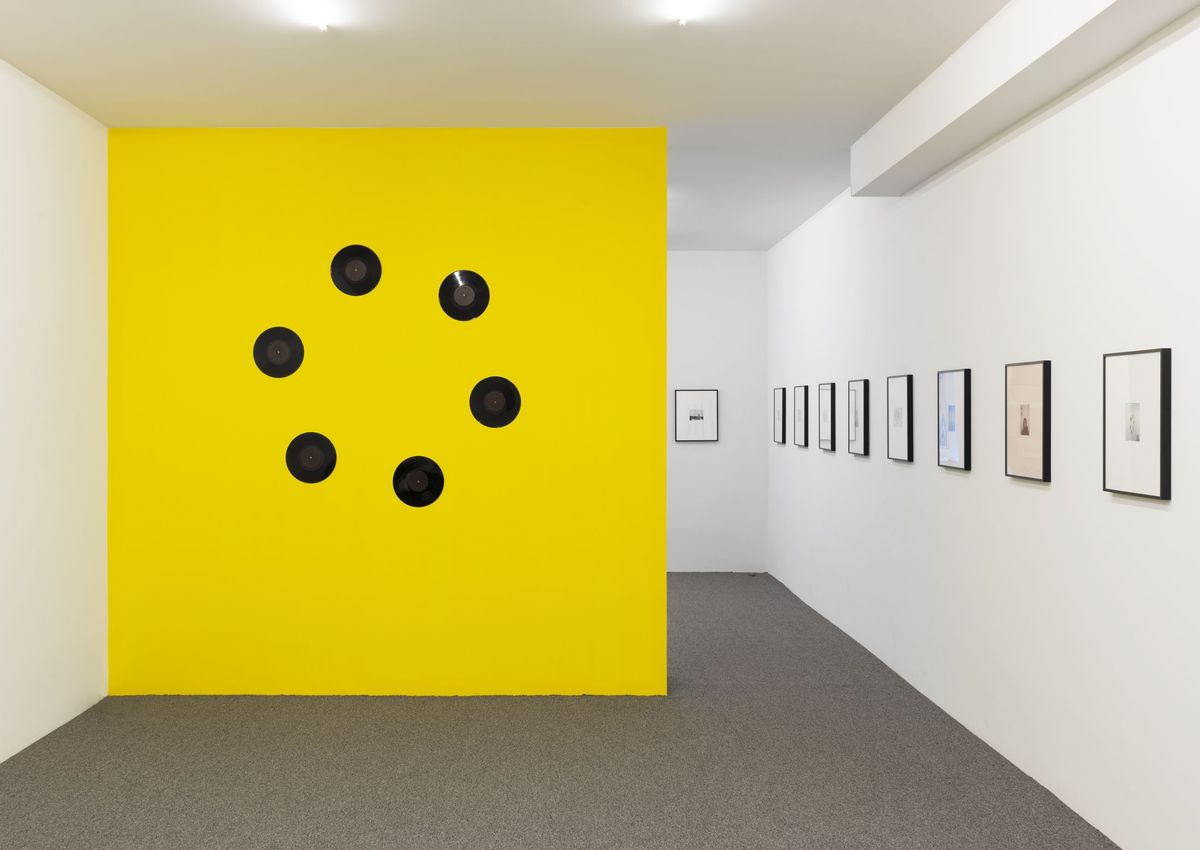
********The Planets, 1984

black vinyl, 33 1/3 rpm, label: black

side 1 and 2: 6’52’’

side 1 and 2: 5’38’’

side 1 and 2: 6’10’’

side 1 and 2: 7’41’’

side 1 and 2: 6’17’’

side 1 and 2: 7’22’’

“Five years after A Suite of Five 10-Inch Records, Goldstein produced his last record work, again multipartite: The Planets. (1) At that point in time, the chief focus of Goldstein’s œuvre had already shifted to painting. Whereas the previous records had been intended as handleable objects and media to be put on the turntable and played by the listener, the records of The Planets were mounted on the wall in the manner of an installation. The work was realized in the Städtische Galerie Erlangen in 1985. (2) However, due to the fact that they were also to be listened to while being viewed, the music was to be conceived of as separate from the audio format - it virtually came out of nowhere. Goldstein’s description in the performance portfolio takes this circumstance as its point of departure: ‘The 45s form a large circle on a painted yellow or red wall, as if they were planets themselves in our galaxy.

Each record has to be played in order to locate from our memory what planet each record might suggest. [...] Since 90 percent of the universe is in total blackness, and one needs a telescope to reveal what is out there, through meditation - one has to play the record to locate its identity.’” (3)

(1) A number of copies of the Planets were produced in a brown box which packages the individual records in a green cover. From Neutral Records, New York, No. 7. Description and illustration in: Ursula Block, Michael Glasmeier: Broken Music: Artist’s Recordworks, Daadgalerie Berlin, Gemeentemuseum The Hague, Le Magasin Grenoble, 1989, pp. 141-42

(2) The paper describing the installation in the Performance Portfolio titles ‘Records’.

(3) Performance Portfolio, Records, Jack Goldstein: Films, Records, Performances and Aphorisms 1971-1984, Galerie Buchholz, Köln 2003, p. 81

All quotations from:

Klaus Görner, “The Records - A Closer Look” in: Jack Goldstein,__exhibition catalogue MMK Museum für Moderne Kunst Frankfurt am Main, 2009, pp.109-129

Read More

Installation Views

Also Exhibiting at Galerie Buchholz

About the Gallery

Galerie Buchholz is an art gallery specializing in international contemporary art, with exhibition spaces in Cologne, Berlin and New York City. The gallery was founded in Cologne in 1986 by Daniel Buchholz, and today is run jointly with Christopher Müller.

View Gallery Profile
Address
31 West 54th Street
New York
United States
Opening Hours
Tuesday – Friday
10am – 6pm
(1)
New York 31 West 54th Street
Galerie Buchholz
31 West 54th Street, New York, United States

Opening hours
Tuesday – Friday
10am – 6pm
The art world in focus
