






JOHN CURRIN
b. 1962, United StatesJohn Currin is recognised as a significant figurative painter, blending high and low culture—for example, Renaissance-style painting and erotica. His detailed, sometimes provocative images not only reference traditional painterly techniques but raise questions about the place of the female nude in art.
Early Years
John Currin was born in Boulder, Colorado in 1962. His mother was a piano teacher and his father a physicist. He studied at Carnegie Mellon College, gaining his BFA in 1984, and at Yale Graduate School, gaining his MFA in 1986. Currin told The Guardian __in 2022 that he was inspired to _“_follow his feelings” as a painter having read The Horse’s Mouth, Joyce Cary’s 1944 novel, moving towards figurative painting. Following his first solo show at White Columns, New York City, in 1989, his paintings of women, often without clothes and with cartoonish characteristics, attracted controversy. Critics thought they were misogynistic and gimmicky, although at the time Currin absorbed this criticism, saying that he was happy simply to be getting attention. In 1994, Currin met his wife, Rachel Feinstein, when she was sleeping in a giant gingerbread house as part of a performance piece—she has since, to an extent, become his muse.
John Currin: Artworks
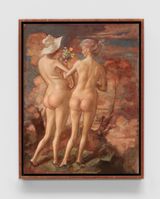
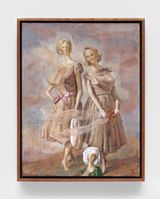
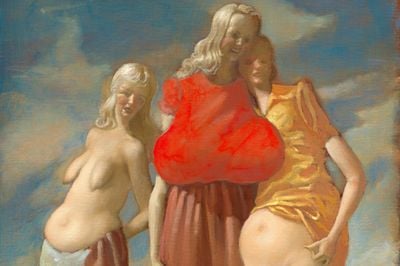
John Currin is known for his ability to mesh the contemporary and the historical—for example, classical techniques including muted backgrounds, blended oils and soft edges and depictions of women with voluptuous curves and big eyes, paired with compositions inspired by pornography or advertising.
His first significant body of work was Yearbook Paintings (1989–1990), an ironic, sexualised take on high school yearbook pictures. As his career progressed, he expanded on the idea of blending the natural and familiar with the exaggerated. Two 1997 works, The Magnificent Bosom and The Bra Shop disproportionately emphasise the subjects’ breasts, attracting viewers’ attention to the chests rather than the faces (which are more crudely rendered). While Currin’s depictions attracted criticism, perhaps he is also commenting on a society that values certain physical attributes.
Currin’s works from the early 2020s conjure images of Greco-Roman statues, using trompe l’oeil to create oil paintings that seem to stand prominent from the canvas—for example, 2020’s Memorial and Mantis—a technique that emphasises the naturalness of the female genitalia uncompromisingly depicted.
John Currin: Select Exhibitions
Select Solo Schibitions
- Opening Credits, Sadie Coles HQ, London (2026)
- Casa Malaparte, Capri (2024)
- New Paintings, Sadie Coles HQ, Londoon (2022)
- Memorial, Gagosian, New York City (2021)
- My Life as a Man, Dallas Contemporary, Dallas (2019)
- Paintings, Museo Stefano Bardini, Florence (2016)
- Gagosian, Paris (2013)
- Sadie Coles HQ, London (2012)
- John Currin meets Cornelis van Haarlem, Frans Hals Museum, Haarlem (2011)
- Works on Paper: A Fifteen Year Survey of Women, Andrea Rosen Gallery, New York City (2009)
- Whitney Museum of Art, New York City (2003)
- John Currin Selects, MFA Museum of Fine Arts, Boston (2003)
- The Honeymooners (with Rachel Feinstein), Hydra Workshops, Hydra, Greece (2002)
- Andrea Rosen Gallery, New York City (1999)
- ICA Institute of Contemporary Arts, London (1995)
Select Group Exhibitions
- Post Human, Jeffrey Deitch, Los Angeles (2024)
- I see his blood upon the rose, The MAC, Belfast (2024)
- Everyone Loves Picabia, David Lewis Gallery, New York City (2024)
- Time Travel: Italian Masters through a Contemporary Lens, Petzel, New York City (2023)
- Dix and the Present, Deichtorhallen Hamburg, Hamburg (2023), Germany GAMES, GAMBLERS & * Pictus Porrectus: Reconsidering the Full-Length Portrait, Isaac Bell House, Newport (2022)
- Repeater, Sadie Coles HQ, London (2022)
- and I will wear you in my heart of heart, Flag Art Foundation, New York City (2021)
- Painting is Painting’s Favourite Food, South Etna Montauk, Montauk (2022)
- Reason Gives No Answers: Selected Works from the Collection, Gagosian, Paris (2019)
- Nude: Art from the Tate’s Collection, Yokohama Museum of Art, Yokohama (2018)
- Body Laid Bare: Masterpieces from the Tate, Auckland Art Gallery Toi o Tāmak, Auckland (2017)
- Lucas Cranach the Elder: 500 Years of the Power of Temptation, NMWA The National Museum of Western Art, Tokyo (2016)
- America Is Hard to See, Whitney Museum of American Art, New York City (2015)
- La Peregrina, A Contemporary Response To Rubens and His Legacy, Royal Academy of Arts, London (2015)
- Fierce Creativity, Pace Gallery, New York City (2014)
- NYC: 1993: Experimental Jet Set, Trash and No Star, New Museum, New York City (2013)
- Freedom Not Genius, Works from Damien Hirst’s collection, Pinacoteca Giovanni e Marella (2012)
- Celebrating the Golden Age, Frans Hals Museum, Amsterdam (2011)
- In the Company of Alice, Victoria Miro Gallery, London (2010)
- Slow Paintings, Museum Morsbroich, Leverkusen (2009)
- L’Homme Merveilleux, Château de Malbrouck, Manderen (2008)
- Drawing from the Modern, 1975–2005, MoMA, New York City (2005)
- 20th Anniversary Show, Sprüth Magers, Cologne (2003)
- Salome: Images of Women in Contemporary Art, Castle Gallery, The College of New Rochelle, New Rochelle (1999)
- Views From Abroad: European Perspectives on American Art 3, American Realities, Whitney Museum of American Art, New York City (1997)
- A series of rotating installations: Week 1: John Currin and Andrea Zittel, Andrea Rosen Gallery, New York City (1994)
- Dead Cat Bounce, Robbin Lockett Gallery, Chicago (1992)
Further Reading
- Artist profile page from Sadie Coles HQ
- Artist profile page at Gagosian
- Interview in The Guardian from 2022
- 2021 interview in Gagosian Quarterly
- Interview with Alain Elkann (2022)
John Currin FAQs
Did John Currin paint Bea Arthur Naked?
Yes, in 1991 Currin produced the picture Bea Arthur Naked, although the US actress (known for sitcoms Maude and The Golden Girls) did not sit for the portrait. Using muted tones, Currin paints Arthur bare-breasted, gazing straight at the viewer. Unsurprisingly, Currin’s work attracted considerable press attention, not least when it sold at Christie’s in New York City for $1.9 million USD (£1.4 million) in 2013.
What are John Currin’s influences?
John Currin has been inspired by a diverse collection of influences, among them pornography, Old Masters, B-movies, Velázquez glazes, the German artist Hans Baldung Grien, popular culture and Rococo art. He has admitted that in art school he tried to produce work in the style of Willem De Kooning, Gerhard Richter and Julian Schnabel, although in the same interview said that he was also inspired by advertising and “trashy things”.
Why are John Currin’s paintings controversial?
Currin’s subject matter—he is known for images of women that emphasise flesh—has attracted controversy for its blending of the grotesque and the beautiful. During the 1990s, he caused a stir by describing a selection of works as “paintings of old women at the end of the cycle of sexual potential, between the object of desire and the object of loathing”.
Ocula

View John Currin's Artworks






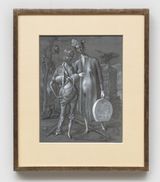

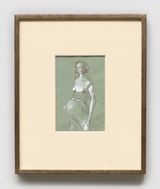

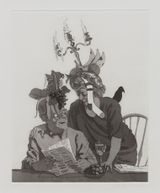


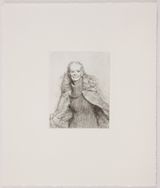


Explore John Currin's Exhibitions






Explore and Follow Artists Shaping Contemporary Art
A respected voice in contemporary art discourse.
Focusing on ambitious storytelling and insightful art-world commentary. Ocula Magazine publishes in-depth interviews, critical essays and timely analysis on the artists, exhibitions and ideas driving the global art world.
Learn more about Ocula Magazine
Showcasing the best of the art world.
Ocula partners with galleries from around the world to highlight their artists, artworks and exhibitions. Gallery membership is by application and invitation, with each member vetted by an independent panel.
Learn more about Ocula Membership
Specialises in the sale of major artworks.
Led by a team with deep ties to the world’s leading auction houses, galleries and collectors. Ocula’s advisory team offers bespoke services to high-net-worth clients from around the world who are looking to acquire the best of contemporary and modern art.
Learn more about our team and services