Press Release

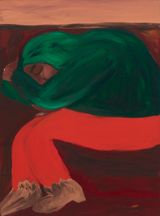
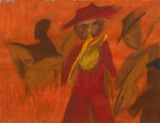
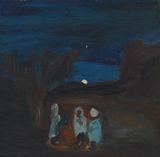
Galerie Lelong & Co., New York is pleased to announce our second solo exhibition by the late artist Ficre Ghebreyesus (b. 1962 – d. 2012). Tracing the impact of Ghebreyesus’s experiences as a refugee and immigrant on his practice, I Believe We Are Lost will present paintings and pastels in rich and bold palettes that demonstrate Ghebreyesus’s evolving definition of home, the majority of which will be shown publicly for the first time. Early works will be complemented by a selection of later works, demonstrating the development over time of the artist’s distinct visual language, with a recurring focus on themes of displacement and representations of Eritrea throughout his oeuvre.

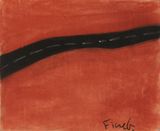
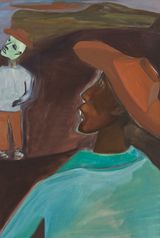
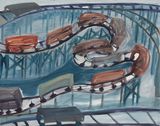
Born in Eritrea during its War of Independence, Ghebreyesus left as a teenaged refugee and ultimately settled in New Haven, Connecticut after living for a time in New York City. Ghebreyesus populates the works on view with scenes stemming from across these memories that speak to the natural beauty of his native country, the upheaval of violence, and the importance of community in creating a sense of home. Pastel drawings are vignettes capturing moments in time—be it of journeying and the experience of migration, as in Road (c.1990s), or of the beauty of nature at odds with the violence of war, as in Tree (c. 1990s)—while larger compositions amalgamate the places he lived, people he met, and cultures he encountered in his distinct blend of figuration and abstraction. Many of these works demonstrate the early emergence in Ghebreyesus’s practice of the vibrant jewel-tones for which he has become known, while a selection of darker-toned works feature expansive backgrounds of deep blues that create an ominous sense of the unknown, a reminder of the figurative darkness of war that surrounded the artist’s native community.

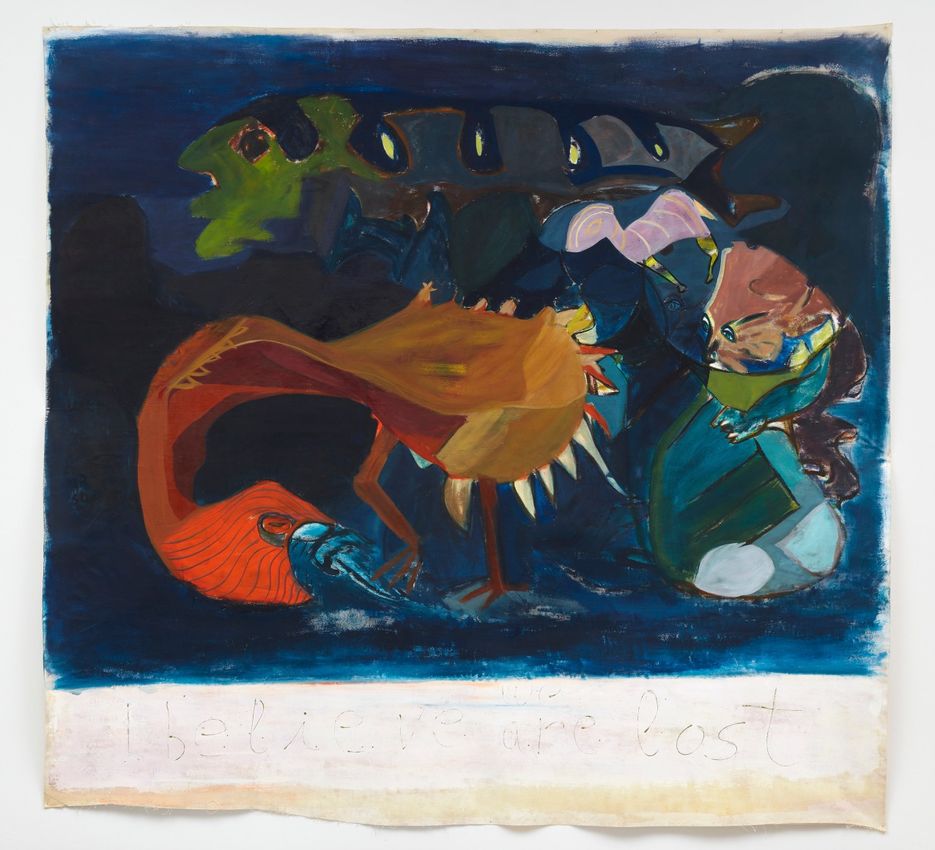
The titular work in the exhibition, I Believe We Are Lost (c. 2002), depicts a surrealist menagerie set against a dark blue background marked by mountains, calling to mind the Eritrean Highlands, where Ghebreyesus’s birthplace of Asmara is located. The painting visually references Pablo Picasso’s famed anti-war painting Guernica (1937) in its scale and method of representation. Vibrant animal-like beings twist into unrecognisable forms, while humanoid eyes and text from Erich Maria Remarque’s 1928 novel All Quiet on the Western Front peek through the blue

background. Underscoring the composition is a thick white band, on which Ghebreyesus has written the title of the painting—also a quote from the same book, which examines the psychological toll of war. Ghebreyesus—who throughout his oeuvre drew upon a broad range of interests including music, language, and literature for inspiration—incorporates references to anti-war cultural hallmarks to communicate his own experience with the enduring trauma of war.

In an untitled painting from 1995, painted after his return to the United States following a visit to Eritrea, Ghebreyesus incorporates scenes of Eritrea and of New York, using a tree trunk and a river to divide the dreamlike composition between the two environs. Figures wearing traditional Eritrean clothing convene in conversation amongst the mountains, while the opposite side of the canvas depicts streetlights, cars, and an apartment building in which solitary figures are seen through windows, evoking the loneliness of displacement. Ghebreyesus continues his explorations of the two places he called ‘home’ in Five Figures with Horse Head (1999). Figures, animals, and objects common in everyday life fill the burlap canvas, facing away from each other and lacking connection despite their physical proximity. Interspersed throughout are pockets of intricate patterns—common in Ghebreyesus’s work and evocative of Eritrean textiles—as well as trains, cars, birds, and airplanes that create a persistent sense of movement. Painted shortly before Ghebreyesus began the MFA program at the Yale School of the Arts, this painting signals the emergence of many motifs that would become recurrent in his practice.

Of the enduring impact on his life and practice of spending his childhood in a war zone, Ghebreyesus wrote, ‘I suspect I have carried this angst and fear of imminent explosion within me to this day, for when I paint I am accompanied by dissonances, syncopations, and the ultimate will for life and moral order of goodness.’ A selection of later works on view in the smaller gallery highlight Ghebreyesus’s continued grappling with his experience in, and emigration from, Eritrea in his artistic practice. Paintings in muted palettes of solitary boats and trains travelling through empty space evoke feelings of transience, while Ghebreyesus’s signature use of bold colour and geometric patterns are evident in landscapes of the Eritrean mountains and portraits of soldiers.

Read More
About the Artist

Ficre Ghebreyesus populates his works with intricate, highly personal experiences as a citizen of the world. Born in Eritrea during their War of Independence (1961–1991), he left as a teenage refugee to Sudan, Italy, and Germany, before finally settling in the United States where he studied at Yale School of Art. Ghebreyesus continued his lifelong activism for Eritrean independence alongside studying painting, printmaking, several languages, and working as the executive chef and co-owner of New Haven’s Caffé Adulis.

View Artist Profile

Also Exhibiting at Galerie Lelong & Co. New York

About the Gallery

Galerie Lelong & Co. represents prominent contemporary artists and estates from the United States, Latin America, Europe, Asia, and Australia. This uniquely diverse group includes mid-career and established artists at the forefront of the international art world working across all media.

View Gallery Profile
Address
528 West 26th Street
New York
United States
Opening Hours
Tuesday – Saturday
10am – 6pm
(1)
New York 528 West 26th Street
Galerie Lelong & Co. New York
528 West 26th Street, New York, United States

Opening hours
Tuesday – Saturday
10am – 6pm
The art world in focus