






FICRE GHEBREYESUS
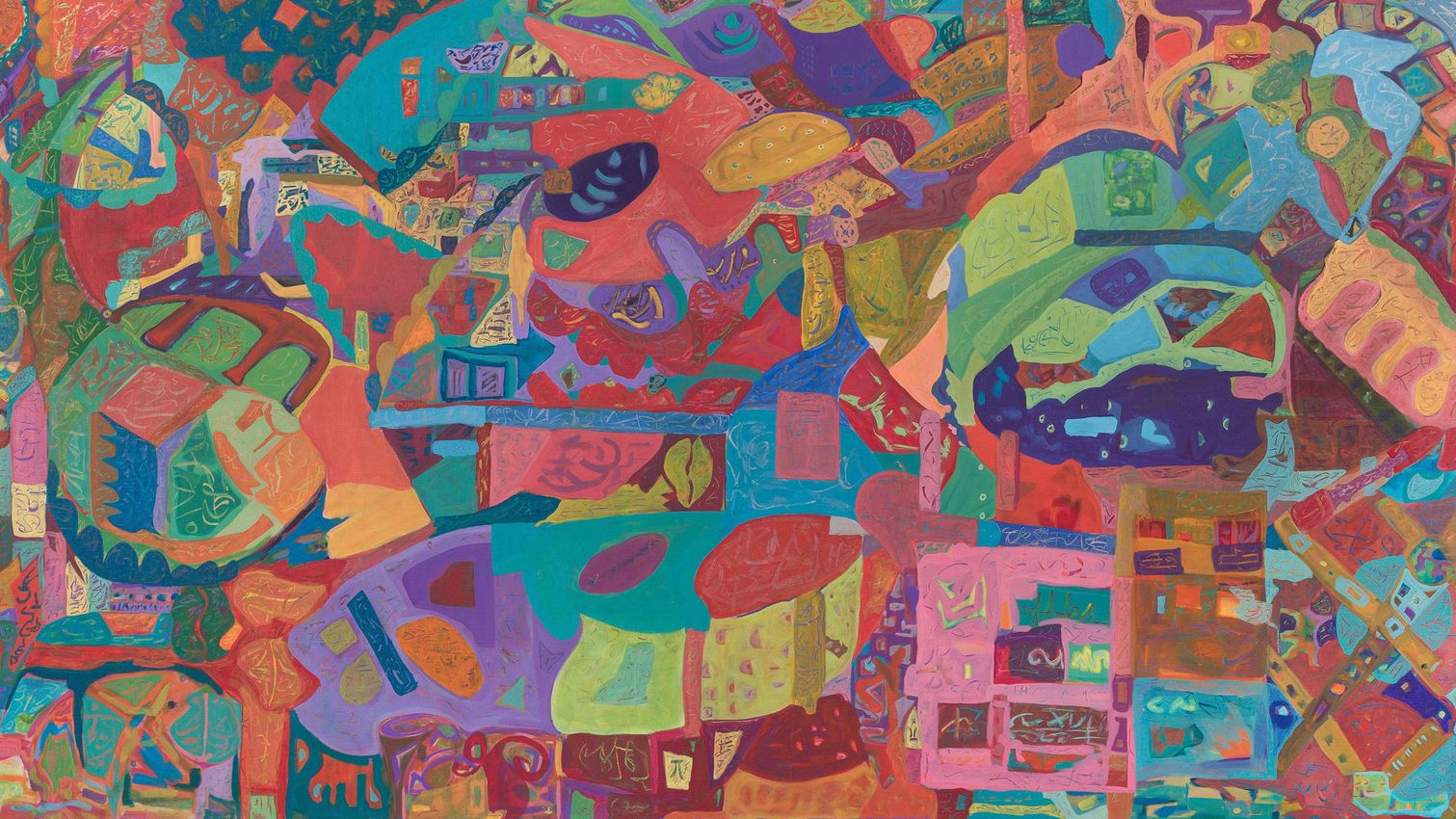
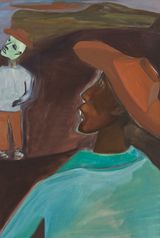
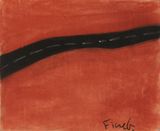
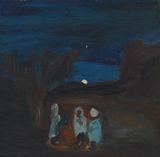
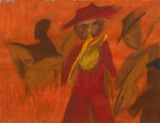
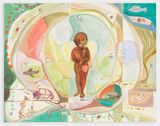
1962-2012, EritreaFicre Ghebreyesus (1962–2012) was an Eritrean-American painter whose richly coloured, dreamlike canvases move fluidly between figuration and abstraction. Working mainly in acrylic and oil on canvas, he developed a distinctive visual language in which landscapes, seascapes, textiles, and architecture merge into non-linear scenes that resemble memories or dreams. His paintings explore migration, exile, Black diasporic experience, and the search for home, drawing on the culture and scenery of Eritrea as well as European and American art. During his lifetime his work circulated largely among family, friends, and a close community, with wider attention only emerging after his death.
Early life and Career
Ghebreyesus was born in Asmara, Eritrea, in 1962, at the outset of the Eritrean War of Independence, and as a teenager joined the struggle for independence before his family urged him to leave in 1978. As a political refugee he lived in Sudan, Italy, and Germany, experiences that later informed his layered depictions of landscape, borders, and transit.
In 1981 he settled in New York City, studying at the Art Students League and the Robert Blackburn Printmaking Workshop while remaining active in Eritrean political and cultural life. He later moved to New Haven, Connecticut, completing a BA at Southern Connecticut State University in 1987 and an MFA in painting at the Yale School of Art in 2002, where he received the Carol Schlossberg Prize for Excellence in Painting. From the early 1990s to 2008 he co-founded and worked as executive chef and co-owner of the restaurant Caffé Adulis, a hub for Eritrean cuisine and diaspora community in New Haven and New York City. A lifelong activist for Eritrean independence and a gifted linguist, he lived in New Haven with his wife, poet Elizabeth Alexander, and their sons Solomon and Simon, devoting his final years entirely to painting before his unexpected death in April 2012.
Works, Series and Methods
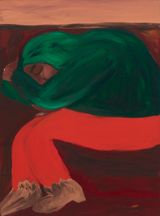
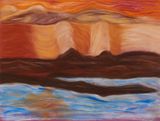
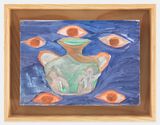
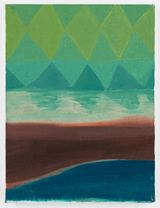
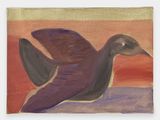
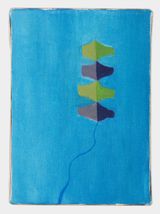
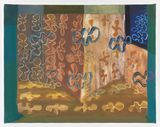
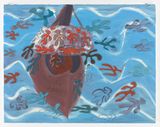
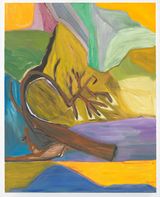
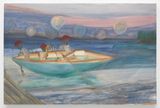
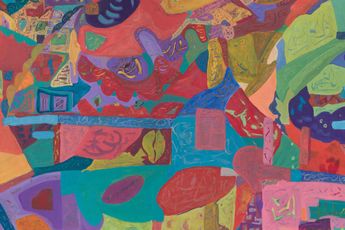
Ghebreyesus’ paintings are characterised by matte surfaces, intricate patterning, and a hybrid vocabulary in which recognisable figures, plants, animals, and buildings dissolve into fields of colour and geometric motifs. Landscapes often flow into sea and skyscapes, with shifting or multiple horizons that echo itinerant paths of exile and migration. Water and aquatic life recur throughout his work: in Boat in Blue Harbor (c. 2000s), for example, a small vessel packed with figures drifts across a densely patterned sea that reads simultaneously as waves and woven cloth, suggesting both literal passage and the carrying of culture across water.
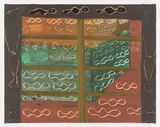
In several paintings, boat hulls, angel wings, and architectural forms are constructed from tessellated shapes that recall Eritrean textiles and markets, connecting personal memories to broader visual traditions from the Horn of Africa. These motifs sit alongside more urban or cartographic compositions in which city blocks, roads, and fields appear as patchworks of colour, suggesting both maps and woven fabrics. The large-scale City with a River Running Through (c. 2007–2008), over 18 feet long and composed of four panels, presents a city from multiple viewpoints as an abstract lattice of colour and pattern, with the river binding the composition together; the work was brought to wider attention in Ficre Ghebreyesus: City with a River Running Through at the Museum of the African Diaspora, San Francisco (19 September–16 December 2018). In politically inflected works shown in Ficre Ghebreyesus: Help Is on the Way! at Independent New York (9–12 May 2024), paintings from 2004 respond to the U.S. presidential election and global conflicts through dense patterning, layered imagery, and carefully modulated colour rather than direct illustration.
Themes and Context
Ghebreyesus’ practice is frequently discussed through the lenses of diaspora, postcolonial history, and Black abstraction, yet remains grounded in lived experience rather than theory. Recurrent themes include forced migration, war and displacement, spiritual and dreamlike states, and everyday forms of belonging and joy. Water, rivers, boats, stitched or quilt-like landscapes, and shifting horizons operate as visual metaphors for border crossings, layered memory, and the making of home across multiple geographies. His paintings draw together references to Eritrean markets and textiles, European and American modernism, and the musical rhythms of the Black diaspora, producing what critics have called a “poetic synthesis” of personal narrative, history, and luminous colour.
Exhibitions, Collections and Recognition
Broader recognition of Ghebreyesus’ work developed after his death, as curators and institutions began to reckon with the scale of his output. A key catalyst was Ficre Ghebreyesus: Polychromasia at Artspace, New Haven (30 March–24 April 2013), which presented more than 800 works from his studio and was widely described as the first exhibition to reveal the breadth of his practice. This visibility was consolidated by Ficre Ghebreyesus: City with a River Running Through at the Museum of the African Diaspora, San Francisco (2018), and by a sequence of solo shows with Galerie Lelong & Co. in New York, including Gate to the Blue (2020), Horizons (2022), I Believe We Are Lost (2023), and Color is Supreme (2026). In 2022 his paintings were included in the 59th Venice Biennale, The Milk of Dreams, further extending the audience for his work.
Ghebreyesus’ paintings are now held in public collections including the Museum of Modern Art, New York; San Francisco Museum of Modern Art; Glenstone Museum, Potomac; Baltimore Museum of Art; Pérez Art Museum Miami; The Studio Museum in Harlem; Rollins Museum of Art, Florida; Yale University Art Gallery; the Cantor Arts Center, Stanford University; and the Hutchins Center for African & African American Research at Harvard University. His life and practice are also chronicled in Elizabeth Alexander’s memoir The Light of the World (2015), which has introduced his story to a broad readership.
Solo Exhibitions
- 2026 – Ficre Ghebreyesus: Color is Supreme, Galerie Lelong & Co., New York, 2 April–9 May 2026
- 2025 – Ficre Ghebreyesus, Modern Art, London, 14 March–10 May 2025
- 2024 – Ficre Ghebreyesus: Help Is on the Way!, Independent New York art fair, New York
- 2023 – Ficre Ghebreyesus: I Believe We Are Lost, Galerie Lelong & Co., New York, 30 March–6 May 2023
- 2022 – Ficre Ghebreyesus: Horizons, Galerie Lelong & Co., New York, 1–12 November 2022
- 2020 – Ficre Ghebreyesus: Gate to the Blue, Galerie Lelong & Co., New York, 10 September–24 October 2020
- 2018 – Ficre Ghebreyesus: City with a River Running Through, Museum of the African Diaspora, San Francisco, 19 September–16 December 2018contemporaryand+1
- 2013 – POLYCHROMASIA: Selected Paintings by Ficre Ghebreyesus, Artspace, New Haven, 2013
Selected Group and Institutional Exhibitions
- 2024 – Dwelling: New Acquisitions, Cantor Arts Center, Stanford University, California
- 2022 – The Milk of Dreams, 59th Venice Biennale, Venice, Italy.
- 2022 – Recent Acquisitions, Yale University Art Gallery, New Haven, Connecticut.
- 2022 – Collection exhibition, Baltimore Museum of Art, Baltimore, Maryland.
- 2020 – Collection exhibition, Museum of Contemporary Art Chicago, Chicago, Illinos.
- 2019 – Collection exhibition, California African American Museum, Los Angeles.
Ficre Ghebreyesus FAQs
What is distinctive about Ficre Ghebreyesus’ painting style?
Ficre Ghebreyesus’ paintings combine matte colour, intricate pattern, and shifting perspectives, allowing figures, animals, and buildings to dissolve into fields of abstraction. This hybrid approach lets him hold narrative, memory, and symbolism in the same image without fixing a single reading.
How did Ficre Ghebreyesus become recognised after his death?
During his lifetime, Ficre Ghebreyesus work circulated mainly within New Haven and a close community of peers and family. After 2012, exhibitions such as Polychromasia (Artspace, 2013) and City with a River Running Through (MoAD, 2018), followed by solo shows at Galerie Lelong & Co. and inclusion in the 59th Venice Biennale (2022), brought his work to wider public and critical attention.art.
What themes does Ficre Ghebreyesus explore in his paintings?
Ficre Ghebreyesus work addresses forced migration, war, displacement, and Black diasporic histories alongside spiritual reflection and everyday family life. Motifs such as rivers, boats, fish, and quilt-like terrains act as metaphors for movement, memory, and the creation of home across multiple places.
How have critics responded to Ficre Ghebreyesus’ work?
Critics in publications including The Brooklyn Rail and Frieze have highlighted the emotional and formal richness of his paintings, noting their ‘poetic synthesis” of personal narrative, history, and colour. Reviews of exhibitions at Galerie Lelong & Co. emphasise how he engages with migration, conflict, and Black history while maintaining compositions that are open and visually generous.
Where can I see Ficre Ghebreyesus’ work today?
Ficre Ghebreyesus paintings are held in museums such as MoMA, SFMOMA, Glenstone, the Baltimore Museum of Art, Pérez Art Museum Miami, the Studio Museum in Harlem, Yale University Art Gallery, and the Cantor Arts Center at Stanford University. They are also regularly shown by the Estate of Ficre Ghebreyesus with Galerie Lelong & Co. and in institutional exhibitions focused on contemporary painting, diaspora, and abstraction.
Why was Ficre Ghebreyesus not widely known during his lifetime?
During his lifetime, Ficre Ghebreyesus rarely pursued commercial visibility and his paintings circulated mainly among family, friends, and a close New Haven community. He divided his time between art, political activism for Eritrean independence, and his work as co-founder and executive chef of Caffé Adulis, so much of his substantial output remained in his studio rather than in galleries or museums. Only after his death in 2012 did curators begin to grasp the scale and coherence of his work, leading to the landmark exhibition Ficre Ghebreyesus: Polychromasia at Artspace, New Haven (2013), followed by Ficre Ghebreyesus: City with a River Running Through at the Museum of the African Diaspora (2018) and a series of solo shows at Galerie Lelong & Co. and major institutional presentations such as the 59th Venice Biennale The Milk of Dreams (2022).
Ocula | 2026

View Ficre Ghebreyesus' Artworks




















Explore Ficre Ghebreyesus' Exhibitions







Explore and Follow Artists Shaping Contemporary Art
A respected voice in contemporary art discourse.
Focusing on ambitious storytelling and insightful art-world commentary. Ocula Magazine publishes in-depth interviews, critical essays and timely analysis on the artists, exhibitions and ideas driving the global art world.
Learn more about Ocula Magazine
Showcasing the best of the art world.
Ocula partners with galleries from around the world to highlight their artists, artworks and exhibitions. Gallery membership is by application and invitation, with each member vetted by an independent panel.
Learn more about Ocula Membership
Specialises in the sale of major artworks.
Led by a team with deep ties to the world’s leading auction houses, galleries and collectors. Ocula’s advisory team offers bespoke services to high-net-worth clients from around the world who are looking to acquire the best of contemporary and modern art.
Learn more about our team and services