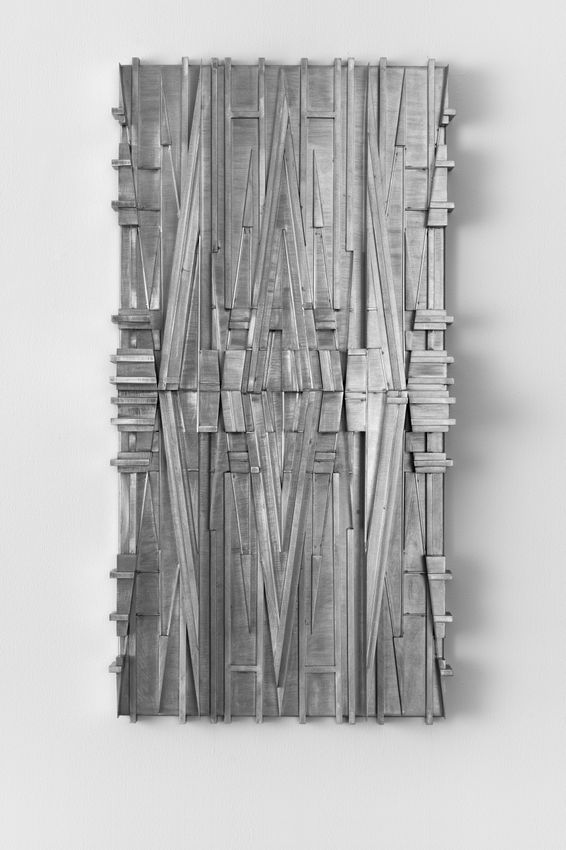
Galerie Urs Meile Beijing is honored to announce Reverse Reconstruction, the latest solo exhibition of Yang Mushi (b. 1989). This is the artist’s fourth solo exhibition at Galerie Urs Meile. It brings together Yang Mushi’s creations spanning from 2019 to 2022. As the pandemic unfolded over the past two years, the artist has expanded the scope of his exploration of material on the foundation of the concept of his previous show titled “Illegitimate Production” with his experiments yielding new working methods, forms, and philosophical deductions.
A cluster of metal geometric installations titled Welding–Relics (2021, recycled stainless steel, 120 × 680 × 600 cm, installation size variable) comprises six receding line structures arising from tight turns, distorted perspectives, contradictory proportions, precision joints, and gaping facets. It is the result of the artist’s sorting of various readymade objects, such as foam, fencing window bars, sculptural armatures, billboards, company nameplates, and stainless steel doors. These secondhand tools are then manipulated through such methods as corrosion, cutting, welding, and scoring. Finally, he uses dislocations in form and proportion to divide, isolate and block off the space. The same working logic is present in the Welding series (2021-2022) and the neon installation Distorting II (2020-2022, white neon tubes, transformers, 400 × 560 × 600 cm, installation size variable). By intercepting and refining the images and shapes of contempo- rary landscapes, the artist strengthens the material forms that shape contemporary psychology, while at the same time, these defunctionalized everyday waste materials are brutally isolated as contemporary relics with multiple contradictions. The intense labor demanded by the work production process “re- stores” materials as the focus of practice in white cube exhibition space, and as the starting point for reflection on the tense relationship between community, city, and social interactions.
In the work Distorting II, the artist has selected the conventional white neon tube, which he twists and turns to varying degrees to create similar lines of geometric light with slight variations. The white light symbolizes lighting in the work setting, while the twists and turns reference the shifts in reality. The image forms reference text, jumbled code, electrocardiographs, and candlestick charts. When large quantities of products are placed tightly together, tension and suffocation, cessation and error, pausing and retreat, surprise and death are all twisted into a single whole. Through repetitive action, the artist is attempting to fuse means of production, the rapid pace of the city, rushed breathing, the manual labor of the producer, and shrill signals into a dazzling white light.
The artist continues his exploration of polystyrene foam in the work Eroding II (2021, foam, corrosive liquid, acrylic, 127 × 880 × 460 cm, installation size variable). Nineteen black objecs are laid out in the space, covered in holes of various sizes. Monotone curved surfaces, disappearing perspectives, contradic- tory proportions, missing masses, and interlocking positions within the group of sculptures form a space that hinders movement. The shapes, proportions, and gaps were created referencing building roofs, monuments, tombstones, and billboards. They emerge in a compressed, distorted state. The artist attempts to stack together extreme working methods, radiating masses, and cross-sections of the urban spectacle. Within intense labor and a language of destruction, our existential environment comes under reexamination. These stagnant, abnormal, failed bodies emphasize the artist’s reflection and practice of the idea of sustainable development.
Yang Mushi (born 1989, Jiangxi Province, China) lives and works in Shanghai, China. In 2014 the artist graduated from the Central Academy of Fine Art, Beijing, China.


Galerie Urs Meile, established 1992 in Lucerne, Switzerland, is dedicated to representing a diverse array of Chinese and European artists spanning various generations and artistic media, encompassing painting, sculpture, installation, photography and video.

A respected voice in contemporary art discourse.
Focusing on ambitious storytelling and insightful art-world commentary. Ocula Magazine publishes in-depth interviews, critical essays and timely analysis on the artists, exhibitions and ideas driving the global art world.
Learn more about Ocula Magazine
Showcasing the best of the art world.
Ocula partners with galleries from around the world to highlight their artists, artworks and exhibitions. Gallery membership is by application and invitation, with each member vetted by an independent panel.
Learn more about Ocula Membership

Specialises in the sale of major artworks.
Led by a team with deep ties to the world’s leading auction houses, galleries and collectors. Ocula’s advisory team offers bespoke services to high-net-worth clients from around the world who are looking to acquire the best of contemporary and modern art.
Learn more about our team and services