The art world in focus
Subscribe to our newsletter for news and insights on artists, galleries and exhibitions.

Elvira Dyangani Ose, artistic director of Zeitz Museum of Contemporary Art Africa and artistic director of the second edition of Public Art Abu Dhabi Biennial. Courtesy Public Art Abu Dhabi Biennial.
The second edition of the Public Art Abu Dhabi Biennial, titled Home: A Glossary for a Communal Sense of Place, opened earlier this week in the United Arab Emirates’ capital city, ushering in a four-week period of art world happenings for the ambitious cultural destination.
The state-funded exhibition comes just ahead of the inaugural Frieze Abu Dhabi, amid America’s ongoing war with Iran, and following recent attacks by Houthi militants in neighbouring Saudi Arabia, leading to nervousness among some travelling to the region. Against the backdrop of ongoing international concerns surrounding censorship and political freedoms, it also continues the emirate’s growing focus on cultural development, which has seen the opening of several major museums in recent months.
Speaking to Ocula, Elvira Dyangani Ose, who was also recently named artistic director of Zeitz MOCAA in Cape Town, described the biennial’s theme as “a provocation, a prompt, a lens from which to read certain experiences [and] from which to reflect upon others”. As she explained: “Neither the biennial nor the artists set out to speak on behalf of anyone, or to choose one community’s idea of belonging over another’s.”
Instead, works explore the multiplicity of experiences that shape Abu Dhabi, while acknowledging that the intersecting lives and trajectories of those who inhabit the city are “sometimes in tense equilibrium”. “Life in contemporary urban spaces around the globe is negotiated, and in places such as Abu Dhabi… that needs meticulous observation,” she said.
This understanding of differing views of belonging is reflected in the biennial’s accompanying glossary, which includes terms such as Heirloom, Lineage, Hospitality, Majlis and Exile. Among them is Temporary People, referring to those who “build, shape and contribute to places they may not always be able to call home”.
For the Spanish curator, “belonging is a material practice that engages everyone willing to take part in the work of making a place meaningful”. This is, she said, “the most generous definition of citizenry as public”.

This emphasis on collective participation also informs the biennial’s evolving relationship with the city that surrounds it. The exhibition’s inaugural edition in 2025, Public Matter, curated by Reem Fadda, brought works from more than 70 artists into ubiquitous yet unexpected urban settings, including the Corniche waterfront promenade, a carpet souk and the central bus terminal.
Dyangani Ose feels that the biennale’s second addition has inherited this confident approach. However, this year the presentation has adopted a more concentrated strategy, cutting its featured artists by more than half and embracing fewer, more clustered locations in an attempt to establish communal gathering points.
Ultimately, the curator considers the biennial’s relationship with Abu Dhabi to be a process, rather than a singular edition—or even series—of events. In due course, some works will become part of the city’s art collection—the works people have made their own, returned to, gathered around and told stories about.
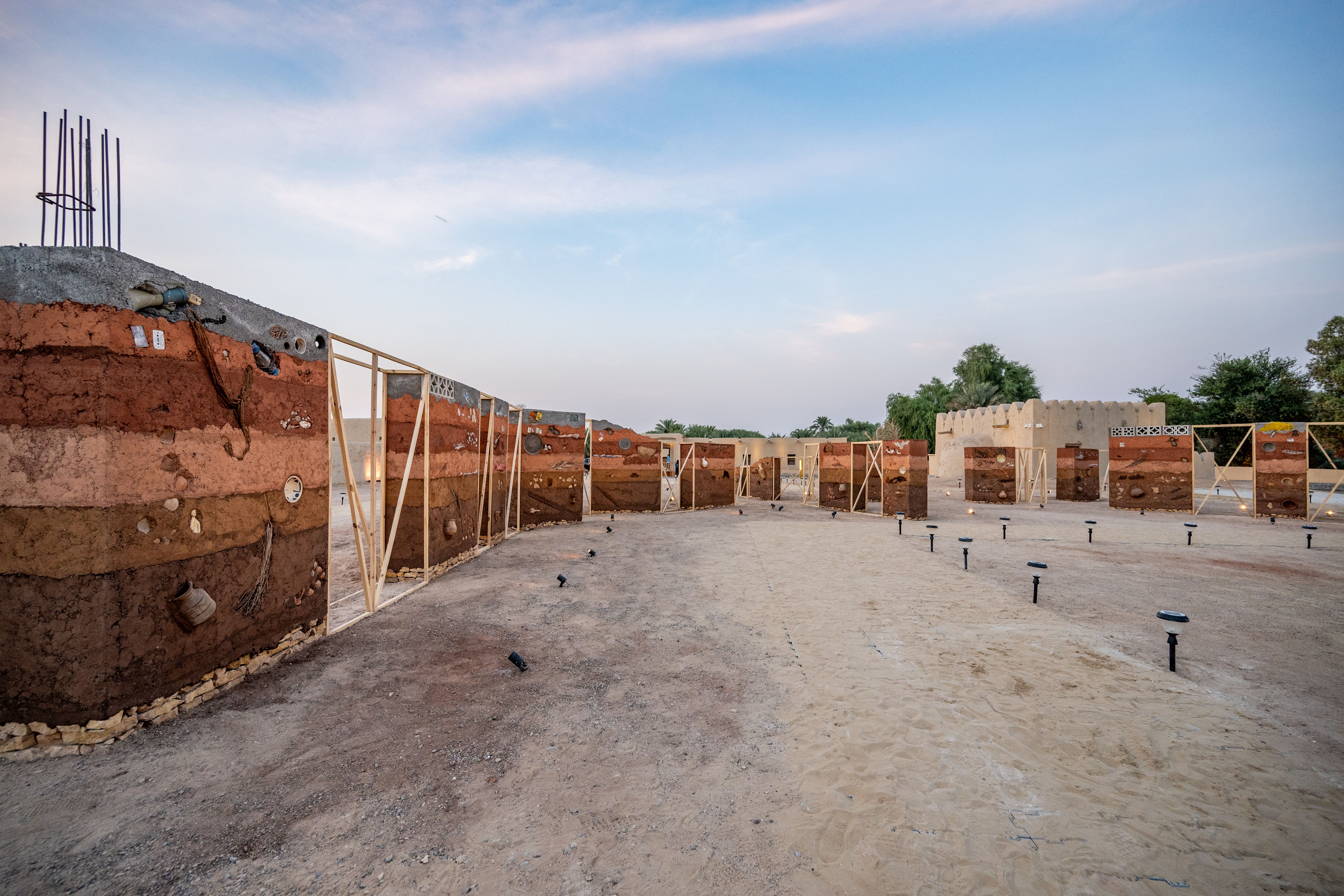
Rather than measuring success through visitor numbers alone, the curator is concerned with whether fishermen at the commercial port of Mina Zayed might debate Nari Ward’s abstract installation, Ground Break Duty (2026), or whether farmers in Al Qattara Oasis can recognise their own histories in Asunción Molinos Gordo’s rammed-earth walls (Bil Hana wa Al Afia, 2026).
“Success, for me, is when the work enters conversation… when people are affected [by] stories embedded in the works that the artists did not write,” she explained. “Legacy,” she added, “is not something you install.”
Achieving a meaningful legacy for the biennale is undoubtedly made more achievable by the support afforded by its organiser, Abu Dhabi’s Department of Culture, including considerable institutional resources, and the capacity to produce large-scale commissions and to maintain works over time.
Yet Dyangani Ose acknowledges the constraints of working within an official framework, drawing parallels with her institutional experience in London and Barcelona. “Every project is a negotiation,” she said, adding that “the best partners are those willing to be changed.”
The curator’s interest in the relationship between institutions and their communities also informs her new role as artistic director of Zeitz MOCAA in Cape Town, where she succeeds the late Koyo Kouoh. She considers taking up the role to be both a privilege and a great responsibility.
“Koyo was a friend and an interlocutor for many years, and her absence is felt every day, in the building and well beyond,” Dyangani Ose said. “What she did at Zeitz MOCAA was to reinvent a private not-for-profit initiative into a public institution. She did so with the conviction that is needed to place artists from the Africa continent and its diasporas at the centre, unapologetically.”
Dyangani Ose identifies three priorities for her tenure at the museum: strengthening its relationship with public space, expanding research and education, and developing networks connecting Cape Town with other African cities and the wider world. In Kouoh’s work at Zietz MOCAA, Dyangani Ose saw “a way of curating rooted in generosity, rigour and care” and, she said, “that is what I am committed to carrying forward”.
A respected voice in contemporary art discourse.
Focusing on ambitious storytelling and insightful art-world commentary. Ocula Magazine publishes in-depth interviews, critical essays and timely analysis on the artists, exhibitions and ideas driving the global art world.
Learn more about Ocula Magazine
Showcasing the best of the art world.
Ocula partners with galleries from around the world to highlight their artists, artworks and exhibitions. Gallery membership is by application and invitation, with each member vetted by an independent panel.
Learn more about Ocula Membership
Specialises in the sale of major artworks.
Led by a team with deep ties to the world’s leading auction houses, galleries and collectors. Ocula’s advisory team offers bespoke services to high-net-worth clients from around the world who are looking to acquire the best of contemporary and modern art.
Learn more about our team and services