The art world in focus
Subscribe to our newsletter for news and insights on artists, galleries and exhibitions.

Dan Flavin did not like people writing about his art. He once said of his “situations”, his term for the constellations of fluorescent strip lights that comprise his work, that: “It is what it is, and it ain’t nothing else!” This was a way of telling the critics scrabbling together symbolic interpretations of his pieces as representations of the divine or the commercial: just look at the thing in front of you. Like Robert Ryman who made sumptuous, mostly white paintings within the same school of minimalist artists working in New York City in the 1960s, Flavin did not believe that art should require thinking about. It was for experiencing.
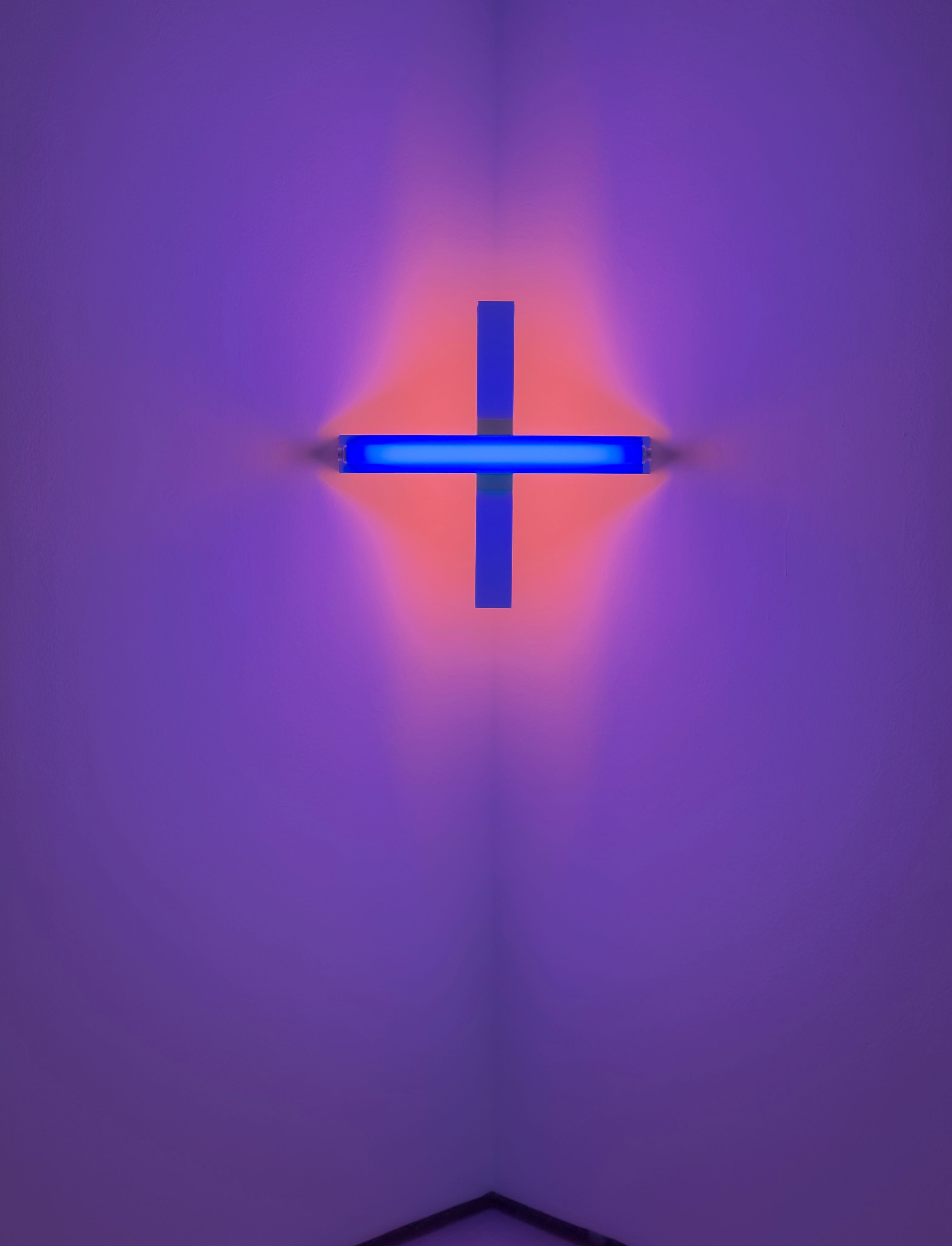
If we approach a work by Flavin in this spirit, what do we find? In an exhibition of Flavin’s work currently on show at the Guggenheim Bilbao, his piece Untitled (to Barbara Nüsse) (1971) is formed of a cross hanging in the corner of a room. It is made up of two strips of standard commercial fluorescent lighting, each two feet long. The vertical strip directs its rose light inwards, casting the corner of the room in what becomes an intense neon flamingo pink; the horizontal light glows blue outwards, towards the viewer. Somewhere on the wall, where the rose light and the blue light meet, a soft violet colour forms.
There are several experiences we might have when looking at this work. Its effect is to draw you towards the corner of the cavernous room in which it is displayed. We can stand or sit in front of it, the smallest piece in the exhibition. At Guggenheim Bilbao, the curator of the exhibition mentions the influence of icons on Flavin, who was raised in a Catholic household and attended seminary college before he became an artist. Icons are always placed in the corner of rooms to create the greatest degree of privacy with the viewer. If you are standing in front of Untitled (to Barbara Nüsse), the walls enclose you, and the work seems to invite you into a communion.
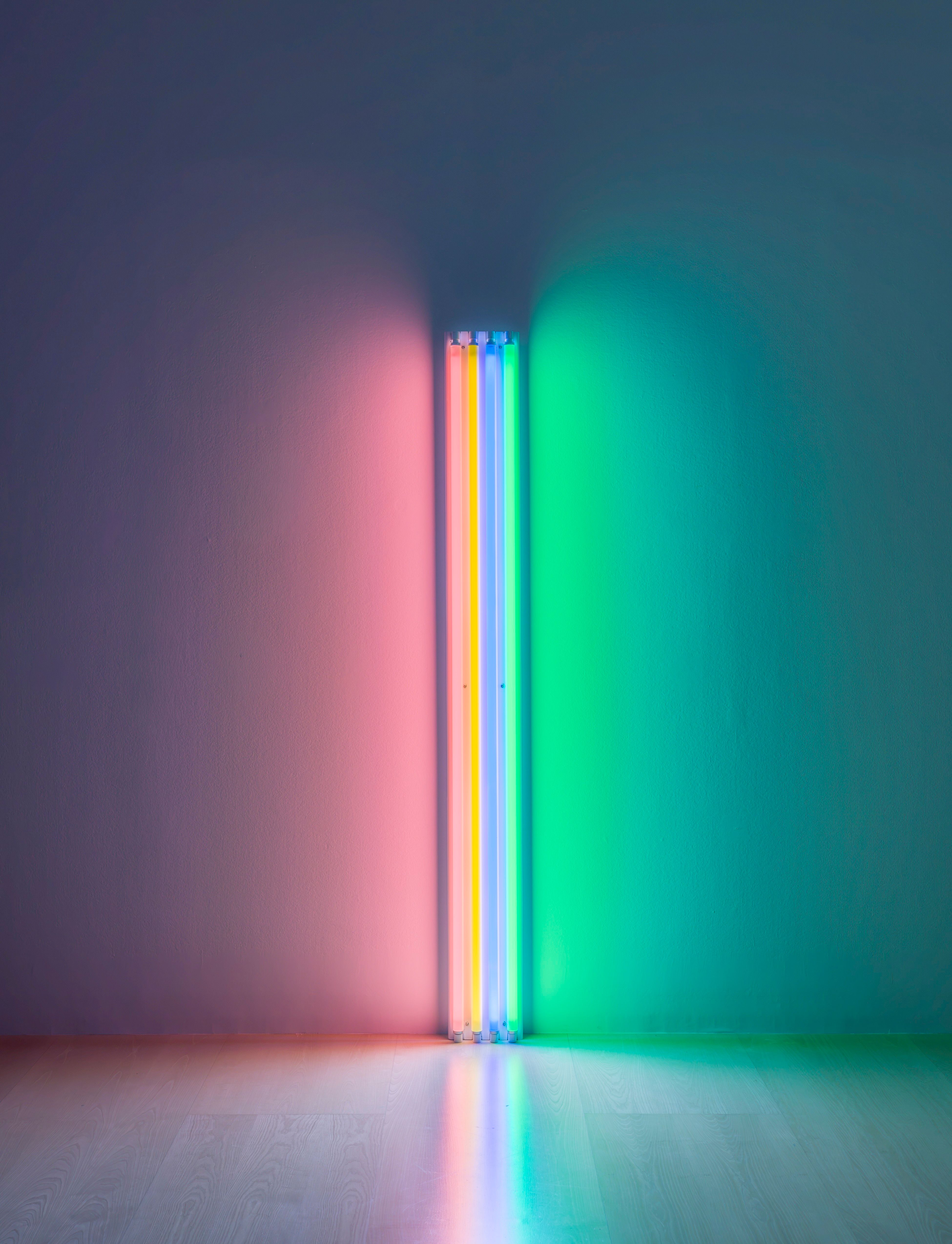
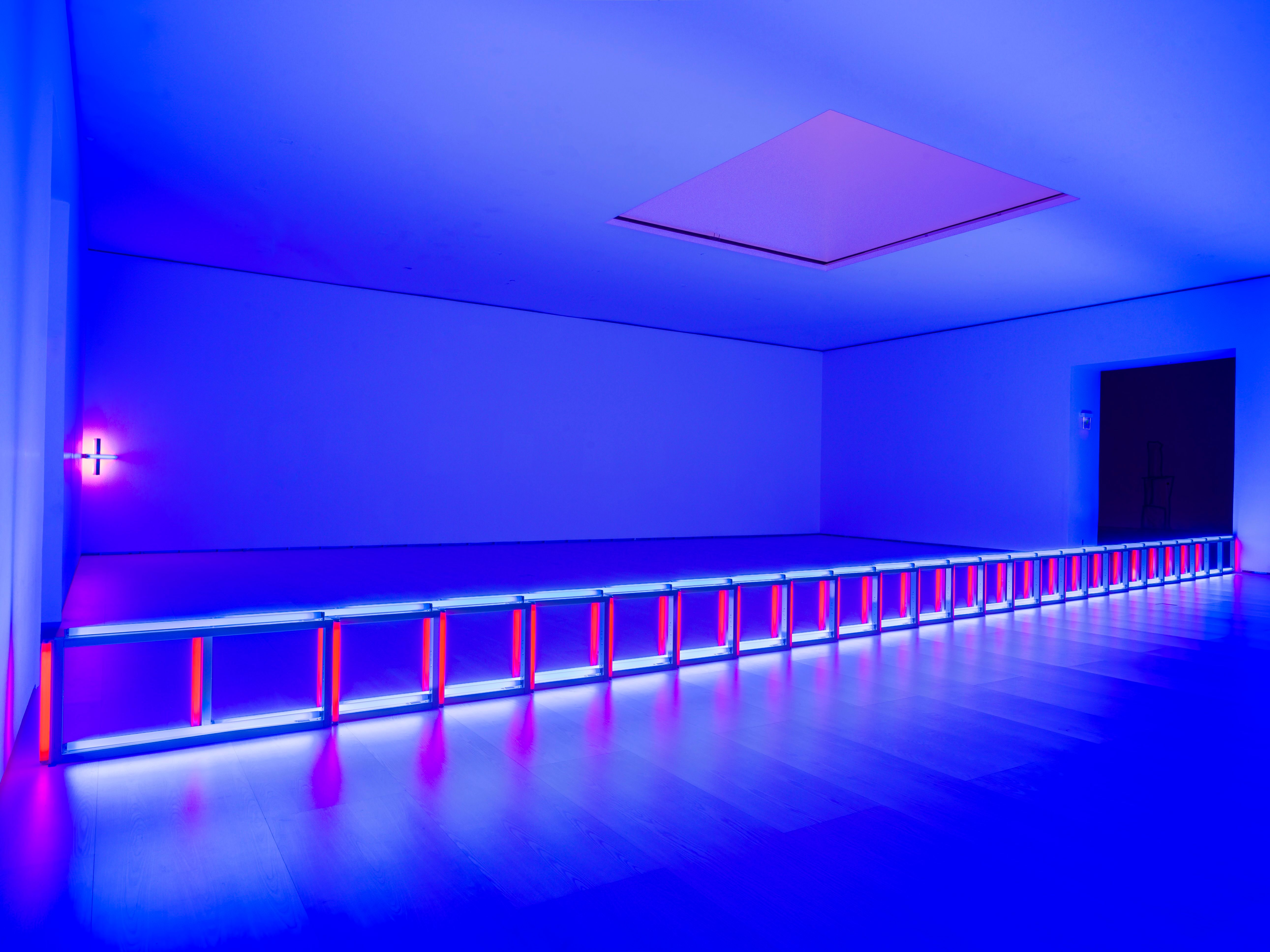
After Flavin left college, he got a job as a night guard in the American Museum of Natural History in New York City. It was while working there that he had the idea to make things out of artificial light. Following his instruction that the piece is what it is, we might also see it as an object in a dark room, glowing into the glooming space. This experience could be a version of the peace that we imagine comes from being alone in an echoey, dim museum hall at nighttime, and looking at the objects, gently illuminated, almost alive from the energy emitted by the bulbs.
“The walls enclose you, and the work seems to invite you into a communion”
Another piece in the exhibition is named after the 13th-century friar William of Ockham (the nominal three (to William of Ockham)) (1963), who preached that meaning was to be found in the physical world and not in universal or abstract concepts. As the curator of this exhibition says, what Flavin shows us is that the experience we are having has a source, and that source is the material world. It is what it is, and it ain’t nothing else.—[O]



A respected voice in contemporary art discourse.
Focusing on ambitious storytelling and insightful art-world commentary. Ocula Magazine publishes in-depth interviews, critical essays and timely analysis on the artists, exhibitions and ideas driving the global art world.
Learn more about Ocula Magazine
Showcasing the best of the art world.
Ocula partners with galleries from around the world to highlight their artists, artworks and exhibitions. Gallery membership is by application and invitation, with each member vetted by an independent panel.
Learn more about Ocula Membership
Specialises in the sale of major artworks.
Led by a team with deep ties to the world’s leading auction houses, galleries and collectors. Ocula’s advisory team offers bespoke services to high-net-worth clients from around the world who are looking to acquire the best of contemporary and modern art.
Learn more about our team and services