Press Release

Galerie Urs Meile is pleased to present Under the Volcano, a solo exhibition by Swiss artist Martin Disler (1949–1996), curated by Beat Wismer. Thirty years after his passing, the exhibition celebrates Disler’s artistic legacy across both of the gallery’s Zurich locations. On view from November 19, 2026, to January 9, 2027, the presentation at Rämistrasse will focus on works on paper from 1981 to 1983, while paintings, sculptures and monotypes from 1983 to 1995 will be presented at Ankerstrasse.

Text by Beat Wismer

Paintings and drawings 1981–1983, Galerie Urs Meile, Rämistrasse Paintings, sculptures and monotypes 1983–1995, Galerie Urs Meile, Ankerstrasse

In its directness, the radical art of the Swiss artist Martin Disler (1949–1996) never tolerated any compromises. With his feverish energy, he pushed himself to the brink of self-destruction throughout his short artistic life. During his relatively brief 25-year career as a visual artist, his uncompromising stance also posed an unrelenting challenge to the art scene of the time. Disler began his artistic work around 1970; from the mid-1970s onwards, his vehement, sensual and often deliberately awkward drawings earned him recognition as one of the most interesting representatives of a young Swiss art scene attracting considerable international attention. No formal artistic training shaped his work; his self-taught approach to different artistic practices produced direct, often crude works entirely devoid of virtuosity or elegant routine.

No routine: this very refusal was reflected in the title of the spectacular exhibition Invasion durch eine falsche Sprache (Invasion through a false language), held at Kunsthalle Basel in 1980. There, Disler presented monumental drawings covering entire walls alongside large-format paintings in emulsion paint on canvas, some arranged as installations within the space. The exhibition vividly demonstrated the energetic transition from draughtsman - a role he nevertheless maintained with undiminished intensity - to a painter of striking intensity. Published to accompany the exhibition was his feverish, turbulent novel Bilder vom Maler (Pictures of the painter), in which he described his struggles with painting and his pictures, but also his struggles with the exhibition and the exhibition system. The draughtsman and painter Martin Disler, also remained a writer until the end. The Basel exhibition marked the beginning of widespread international recognition of him as a painter, with the first major milestones coming in 1981 with the legendary, 140-metre-long panorama Die Umgebung der Liebe (The surroundings of love), painted with his partner Irene Grundel, and in 1982 with the presentation of enormous, forceful paintings at documenta 7 in Kassel. Disler and Grundel spent extended periods in New York at the time; in those years, he was a successful, internationally celebrated star, though not without controversy. Important works from this period are on view at Galerie Urs Meile Rämistrasse. Towards the end of this first decade of painting, Disler was awarded the Prize for Young Swiss Art by the Zürcher Kunstgesellschaft in 1987.

His sculptural work began in 1987 and, alongside painting, shaped the last decade of his life. His first three-dimensional works were extremely fragile plaster sculptures, constructed using an entirely unconventional technique. They depicted vulnerable, wounded figures, utterly defenseless, their brittle skin barely able to protect the underlying skeletons assembled from a wide variety of found objects. As in his paintings of the 1980s and 1990s, the themes revolved around the AIDS catastrophe and the misery of drug addiction, around war, injury, death and mourning. In 1990, the plaster figures grew larger, reaching human scale and taking human form. These were mostly individual figures intended for casting in bronze and, therefore were less fragile, less detailed, simpler and more stable. As sculpted human figures, they clearly belong to a tradition of monumental figurative sculpture; despite the existential vulnerability they convey, the nobler material of bronze lends their presence something almost classical. These 66 bronze figures constitute Disler’s largest group of works.

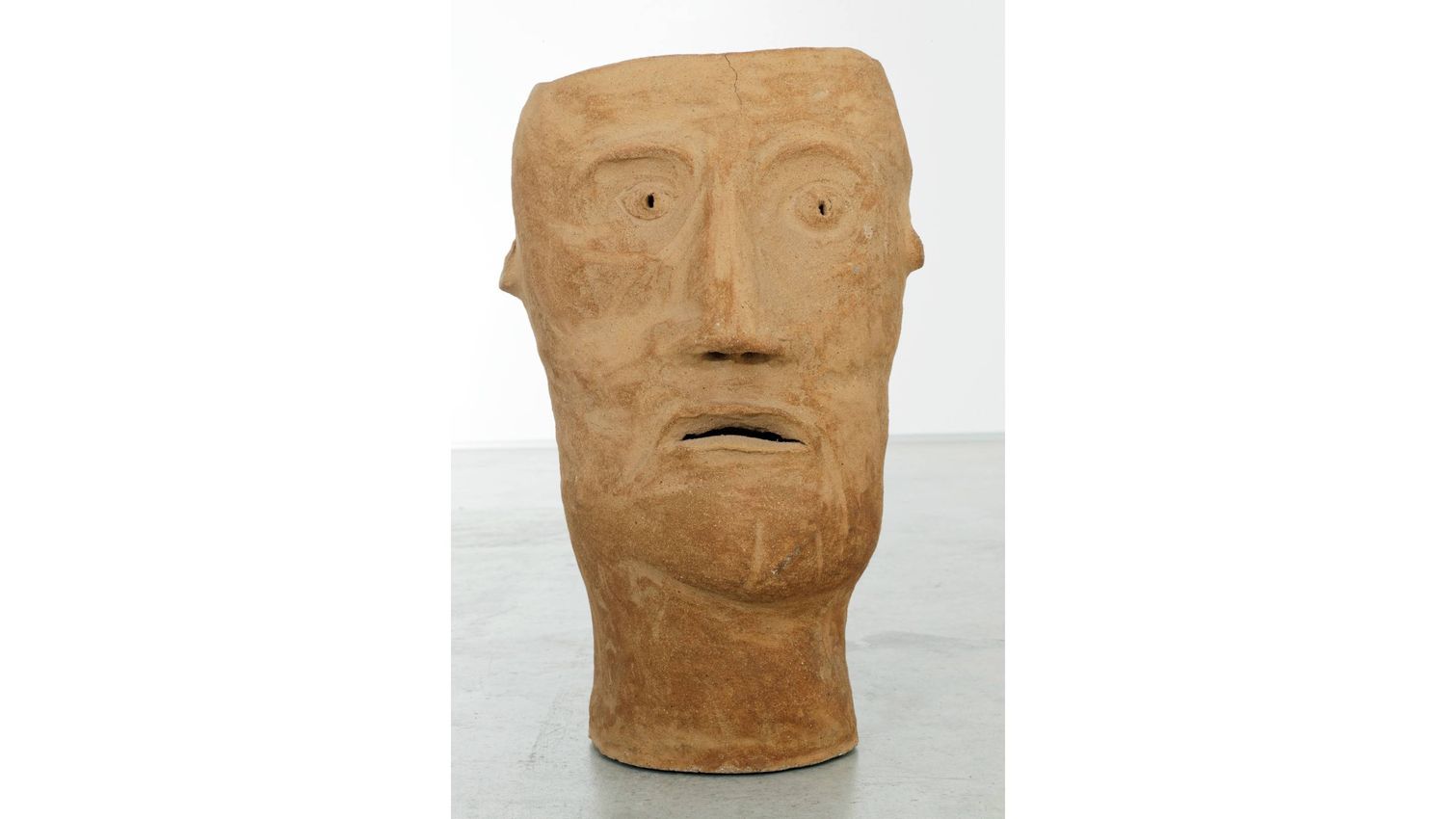
Surely in response to these qualities of the bronze figures, Martin Disler turned in 1993 to an entirely different kind of sculptural activity: working with terracotta. His ambition echoed one he had articulated much earlier; this turn towards the primordial sculptural practice of shaping clay, earth and loam could again be described as an “invasion through a false language”. He produced numerous terracotta heads and reliefs, which he exhibited under the title Steinzeug und gebrannte Erde (Stoneware and fired earth). They consist of lime, earth, clay and grog. The vessel and head forms are as elemental as the technique and materials: “The vessel as the primal form, the origin of all sculpture.” (M.D.) The heads, including Janus heads, and faces convey the full range of primordial human emotions, from joy to grief, from screaming rage to silent expressionlessness.

In 1988, Disler and Grundel acquired a remote house in the Neuchâtel Jura, where Disler worked in seclusion during the final years of his life, deliberately distancing himself from the art scene, partly out of disappointment with the art world. While his sculpture, such as the bronze figures, featured prominently in international exhibitions in the early 1990s, the paintings of his final creative years received little attention. The era of - and hype surrounding - Wilde Malerei (wild painting), with which Disler’s paintings had been indiscriminately associated through superficial readings of his work, had passed, and his late paintings dropped out of critical discourse. After 1992, Disler’s painting was largely forgotten; his late works remained unexhibited and unpublished. Only ten years after his death were they exhibited and discussed as part of the first posthumous retrospective; in 2020, Disler’s late years were the focus of an exhibition at Kirchner Museum Davos. The exhibition was entitled Theater des Überlebens (Theatre of survival). This title could stand for Disler’s entire oeuvre, but it is in fact the title of one of his last paintings, dating from 1995. As with the most violent paintings of 1982, whose specific impetus can be traced to acts of war or sexual violence, death and war crimes, later paintings refer to wartime atrocities, a devastating flood in the Netherlands, or AIDS patients awaiting death at the hospice Lighthouse in Zurich. Yet the painterly approach had changed: questions of painting itself and of composition now seemed more important; the images of the theatre of survival appeared more balanced and calmer, and can also be placed within a traditional lineage of realist painting. Despite this shift in artistic priorities, they convey their existential themes - which extend far beyond the specific events that inspired them - with no less intensity. In today’s world, with its wars across the globe and a climate catastrophe threatening everything, they seem more relevant than ever.

In the years before his early death in 1996, Disler also produced numerous monotypes on Japanese paper, including large-format works. Of all his works on paper, these are closest to sculptural practice: with the thin paper resting on a wet layer of paint, the artist presses a drawing into it from the back with his bare fingers. The draughtsman feels his way towards the images, pressing configurations of lines into the paper from the reverse, or tracing them with a fingernail or another implement. The artist works almost blindly, seeing the image only when lifting the sheet from the paint. Martin Disler particularly valued this almost tender method, which possesses a distinctly erotic quality - a quality that also shaped his work as a whole. It should not be overlooked, even if, it can often only be sensed beneath the predominantly sombre subject matter.

On Sunday, November 22, at 11am the gallery will host a brunch and talk with art historian Beat Wismer and Julian Denzler, curator at the Aargauer Kunsthaus, Aarau. Together, they will explore Disler’s multifaceted oeuvre, his uncompromising artistic approach, and the relevance of his work today. The talk will be held in German. No RSVP is required.

Read More

Also Exhibiting

Address
Rämistrasse 33
Zurich
Switzerland
Opening Hours
Wednesday–Friday: 10am–6pm
Saturday: 11am–5pm
(1)
Zurich Rämistrasse 33
Galerie Urs Meile
Rämistrasse 33, Zurich, Switzerland
+41 (0)44 523 19 19

Opening hours
Wednesday–Friday: 10am–6pm
Saturday: 11am–5pm
The art world in focus