



Press Release

GALLERIA CONTINUA is pleased to host a new solo exhibition by Jorge Macchi titled “False Autumn”. The work of the Argentine artist is positioned precisely at the turning point between two opposites, in that grey area between the real form and the fictitious form of reality. In a world where art serves as a bridge between the tangible and the intangible, Macchi’s work testifies to the power of visual expression, chance, and the enduring influence of personal experiences. His art captures the ephemeral and the transient, inviting us to reflect on the fragile boundaries that define our existence.

The sculptures of various sizes, watercolors, oil paintings, and installations in this exhibition recreate the conditions for a new paradoxical reality that, through the assertion of artifice, upends our certainties and infiltrates the folds of consciousness. “Paradox is the suspension of meaning. It is one form of humor. It is one of Borges’ favorite tools. It is the word that defines much of what I do. The archer and the arrow, Zeno of Elea’s aporia, the scene where an arrow aimed at a target never reaches it because the distance between them is infinitely divisible, it is a paradox that has been with me forever” says the artist.

“False Autumn” is the work that gives its name to the exhibition by Macchi in San Gimignano. In one corner of the gallery, over a thousand leaves are scattered across the floor. As the title (“False Autumn”) suggests, these are not real autumn leaves: they are not yellow or red but green. Each one has a unique shape resembling a puzzle piece. A closer look reveals that these puzzle pieces are made from real leaves, each carefully cut out. This process disrupts the usual harmony between the natural shape of a leaf and its veins, prompting the observer to wonder what possible image could emerge from assembling all the puzzle pieces.

Jorge Macchi’s work creates powerful visual fictions; his pieces are artifacts that explore the functioning of vision and perception. “Rorschach #1” and “Rorschach #2” are two site-specific murals painted in the corners of a room. Similar to the symmetrical images in Hermann Rorschach’s famous psycho-diagnostic test, the forms on one wall are imperfectly mirrored on the other, as if the walls could fold onto each other to transfer the image. However, this symmetry is an illusion—the image in the corner is simply a representation of a real symmetrical image made on paper. There is no actual transfer of form or color from one wall to the other. Yet, a question lingers in the space: what if the things we consider stable and durable, like a building, could fold and change their structure?

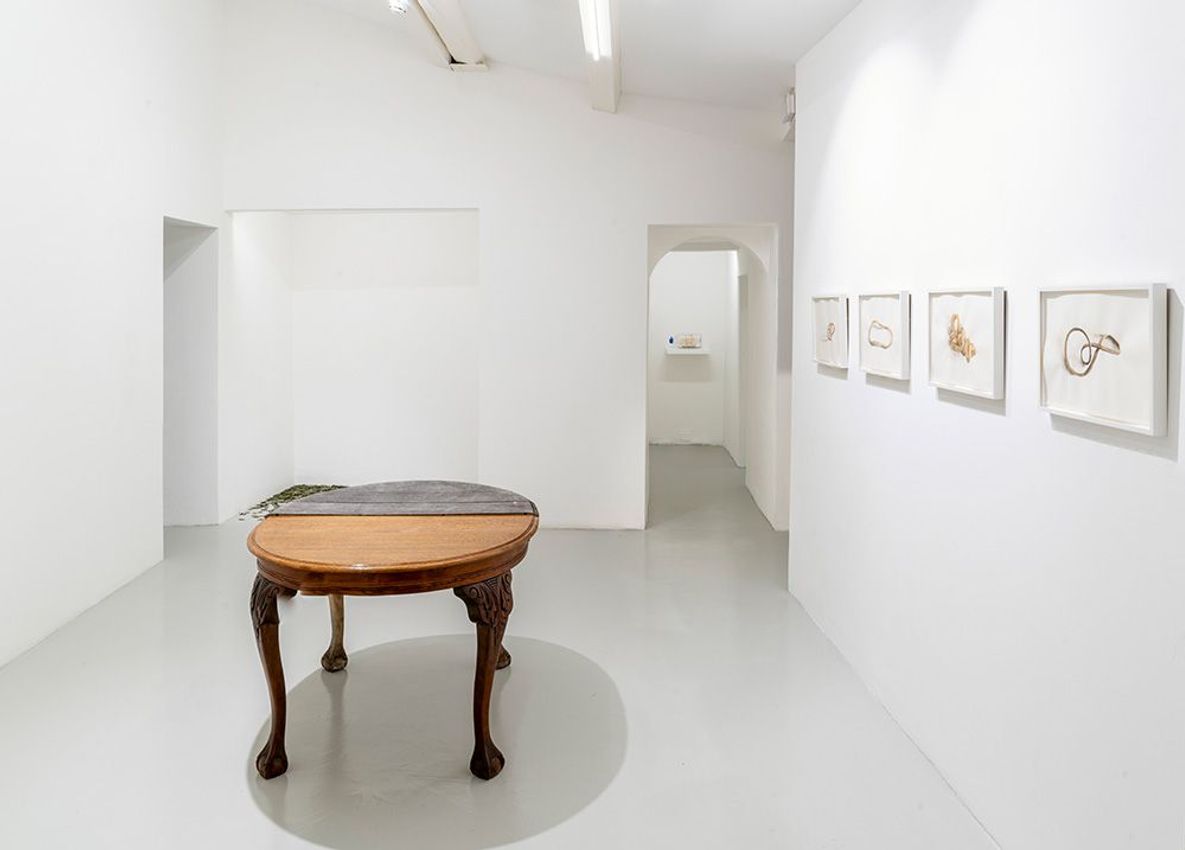
The play between reality and artifice reappears in “Dos Banderas” where one element of the diptych consists of four sheets from the same notepad, while the other is made of sheets from different pads. The ribbon, which seems to hold the sheets together, is painted with watercolor and tempera. In the piece “Dejà vu” one half of a wooden table was left outdoors for two years, exposed to sun and rain, and suffered damage. The other half was restored and polished. Now, they are brought together again. Although this process is real, the reunion of the two halves becomes a melodramatic artifice.

“Confesión” is a cardboard box from a 50-inch Smart TV with all sides carved into a repeated cross pattern, resembling the perforated metal of confessionals. The box no longer contains any object; the perforation has transformed it into a visual tool that offers a fragmented view of its interior and what lies behind it.

The series “Drift Bottles” refers to a historical experiment used to study marine currents, where bottles containing a document indicating the exact time and place of their release into the ocean were tracked. Once recovered, this information was used to determine the circulation of surface water in the ocean. In Macchi’s “Drift Bottles”, each of the six plastic bottles contains a small ship model crafted by an artisan in Buenos Aires. Unlike the original glass bottles, these are replaced with plastic ones, like those used for mineral water or soda, found in any supermarket.

About the artist:

Jorge Macchi was born in Buenos Aires in 1963, where he lives and works. He won the John Simon Guggenheim Memorial Foundation Fellowship in 2001 and has exhibited at numerous international institutions. Notable solo exhibitions include: Diaspora, Galleria Continua, San Gimignano (2022); The Submerged Cathedral, Musée Cantonal des Beaux-Arts, Lausanne, Switzerland (2020); Portal, Galleria Continua Habana, Cuba (2019); Der Zauberberg, Quartz Studio, Turin (2018); Perspectiva, MALBA, Museo de Arte Latinoamericano Buenos Aires (2016), CA2M, Centro de Arte 2 de Mayo, Madrid (2017); Lampo, NC ARTE, Bogotá (2015); Prestidigitador, Contemporary Art University Museum (MUAC), Mexico (2014); Container, Kunstmuseum Lucerne, Switzerland (2013); Music Stand Still, SMAK, Ghent, Belgium (2011). In 2005, Macchi represented Argentina at the 51st Venice Biennale. His works are included in major international collections such as the Tate Modern (London), MoMA (New York), MUSAC, Museo de Arte Contemporáneo (León), CGAC, Centro Galego de Arte Contemporáneo (Santiago de Compostela), Fundación Arco (Spain), MUHKA (Antwerp), SMAK (Ghent), MAMAC Musée d’Art Moderne et d’Art Contemporain (Nice), and Fundación Banco de la Nación Argentina (Buenos Aires).

Read More
About the Gallery
It was in the year 1990 that three friends, Lorenzo Fiaschi, Mario Cristiani and Maurizio Rigillo, decided to open a gallery in a quite unexpected location, far from the big cities and smoothly running art circuits – in San Gimignano, a town steeped in history and somehow out of time, in the heart of Tuscany. Over these 25 years of activity, generosity and altruism have formed the basis for numerous and multifaceted artistic collaborations. The aspiration to write a history of the present which, through creativity, can nourish the tie between past and future, between individuals and between different geographical areas led Galleria Continua to become, in 2004, the first Italian gallery to open in China with a programme of international artists. In 2007 came another challenge, to bring back to life a fascinating but completely abandoned and forgotten place like Le Moulin. Since then, this historic factory at Seine-et-Marne, in the countryside near Paris, has evolved not just into a venue for showing large-scale works but also into a space devoted to culture, experimentation and multi-disciplinary meetings that have given rise to unexpected synergies between international galleries. Since 2011, two large spaces have also been active in the ancient paper mill of Sainte-Marie, just one kilometre from Le Moulin de Boissy, housing major monographic exhibitions by artists from around the world. A pioneering spirit and a commitment to promoting culture, human solidarity and, above all else, the conviction that contemporary art can be a universal language capable of building bridges between different cultures and nations, is now leading Galleria Continua to embark on new paths and to open a space in Cuba. Aguila de Oro in Havana will be devoted to art, to meeting and exchanging ideas, and to cultural projects designed to overcome every frontier.
View Gallery Profile
Address
Via del Castello 11
San Gimignano
Italy
Opening Hours
Monday – Sunday,
10am – 7pm
(1)
San Gimignano Via del Castello 11
Galleria Continua
Via del Castello 11, San Gimignano, Italy

Opening hours
Monday – Sunday,
10am – 7pm
The art world in focus
