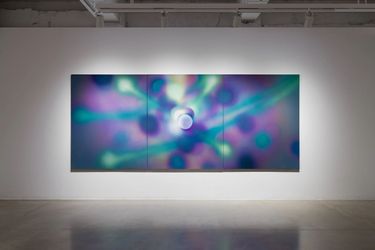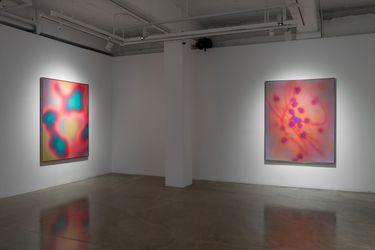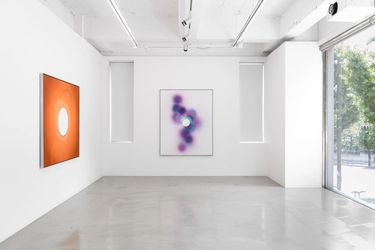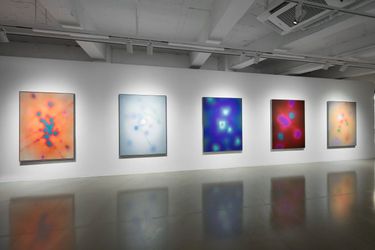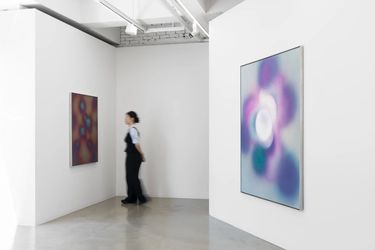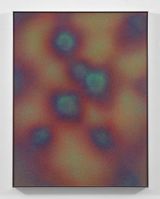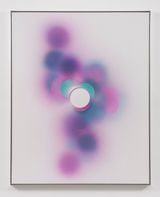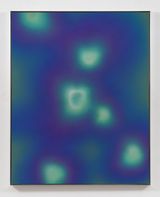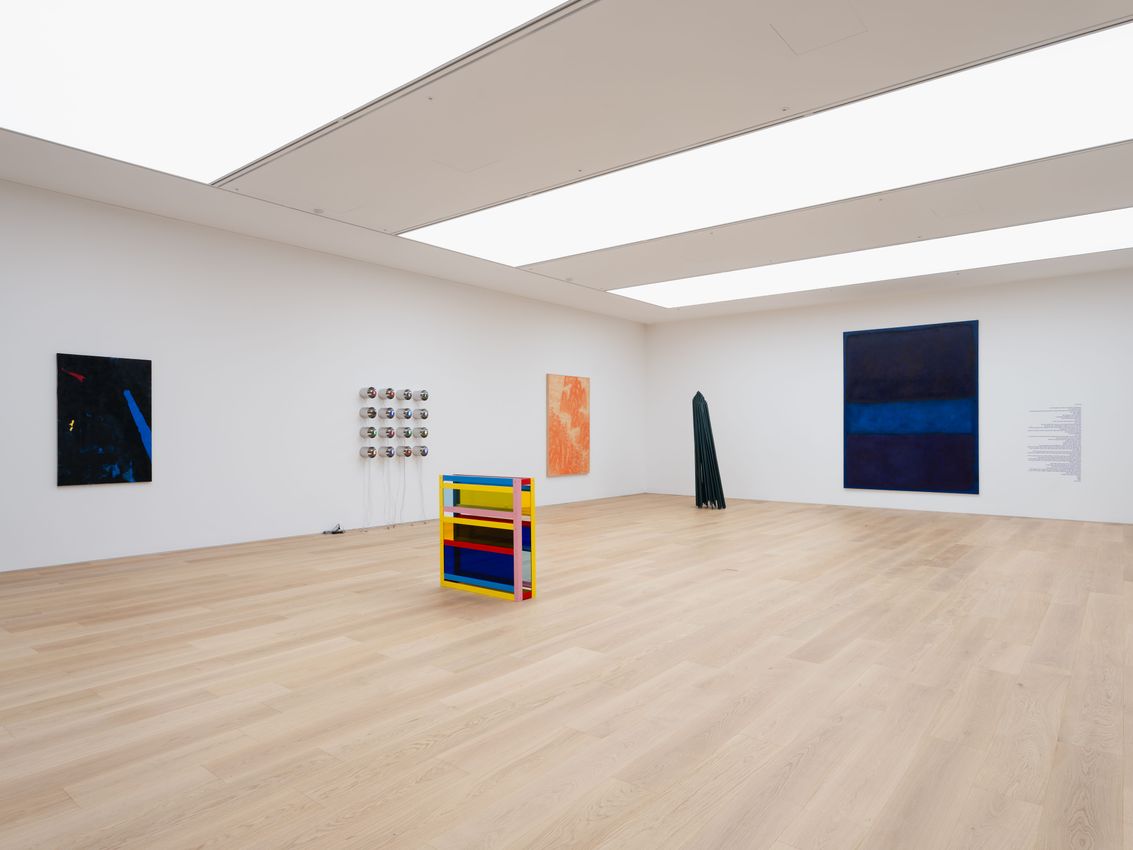
Gallery Baton is pleased to present A Hundred Suns, a solo exhibition by Jimok Choi (b. 1981), at its exhibition space in Seoul’s Hannam area from 20 August to 20 September 2025. Taking place at a moment when the forms and concepts of Choi’s “afterimage” series have reached new levels of maturity through years of immersion, the exhibition also includes an audience-participatory performance (Your retina is my canvas), providing an opportunity for an in-depth exploration of the “perceptual painting” that the artist has steadily pursued.
A first step in understanding Jimok Choi’s afterimage series can be found in understanding the words quoted by Goethe in his Theory of Colours (Zur Farbenlehre, 1810): “If the eye were not sunny, how could we perceive light? If God’s own strength lived not in us, how could we delight in Divine things?” Goethe was remarking on the limitations of Newton’s optics—which subordinated color to the physical properties of light—and arguing that the essence of color lay in the experience and perceptions of the physical organ exposed to light. A key aspect of the artist’s color composition and aesthetic structures rests in the concept of Nachbilder: complementary afterimages (red-green, blue-yellow) formed by the retina immediately after long exposure to a particular light source.
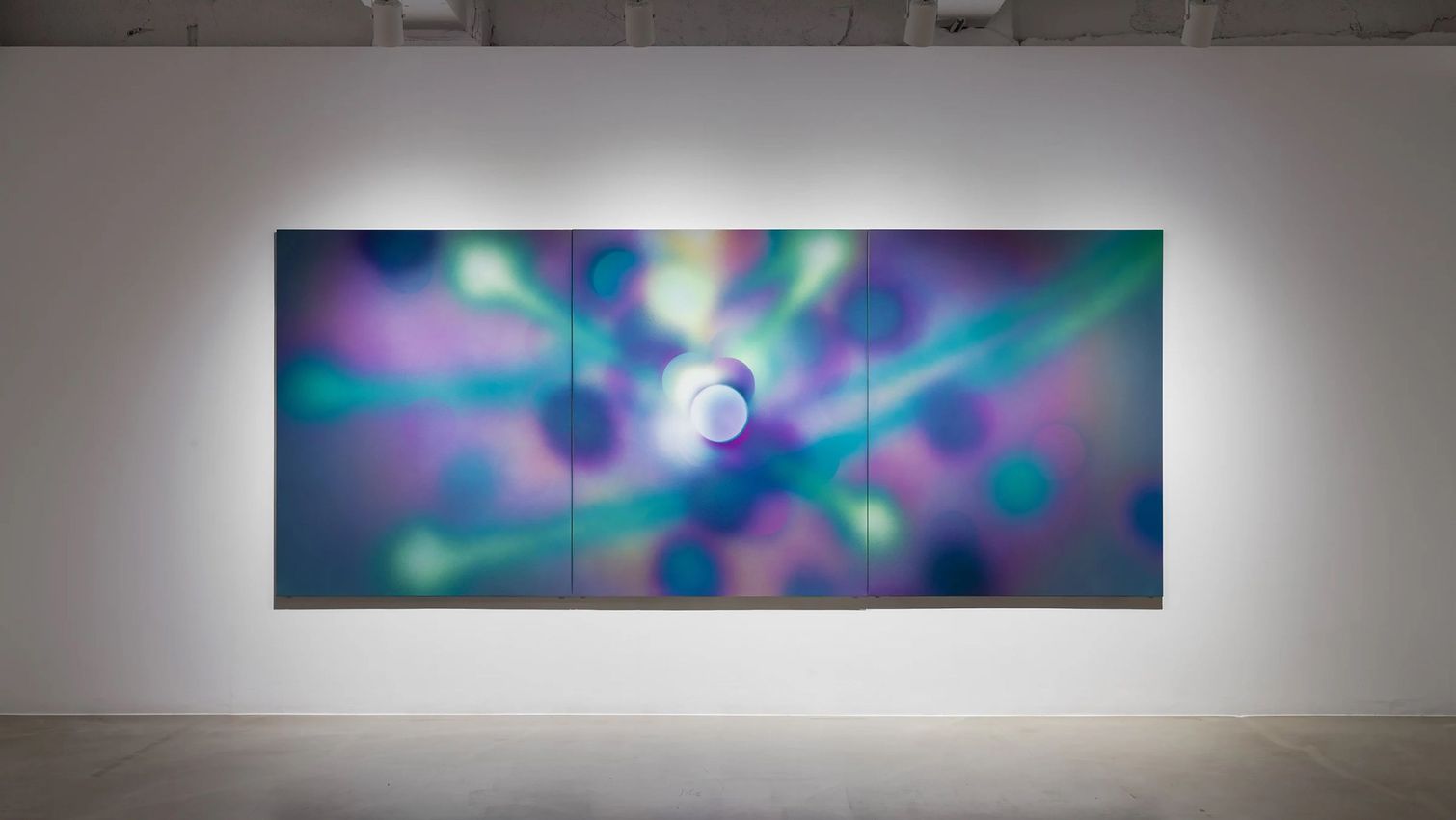
As the exhibition title suggests, Choi’s paintings are a form of pictorial archiving of complementary afterimages as his own retina’s visual response to experiencing the sun. The colorful phantom images that appear when one closes one’s eyes after viewing the sun directly manifest in complementary shades that are completely different from the original color; from there, they weaken before finally disappearing. The artist’s admission—“In the end, I am painting the world within my eyes”—indicates that the subject of his work lies in the random, unpredictable illusions that arise where light has disappeared, and that the medium is one that must be translated into the material substance of pigments.
Intriguingly, the duality of light as something that is both particle and wave relates closely to Choi’s methods of working in terms of painting technique. For an artist relying on their senses to depict afterimages, airbrushing is a superb tool for representing borderless juxtaposition and the nonmaterial presence of seemingly floating masses of color. The dominant afterimage is expressed through thick, flowing elements, and as its reverberations fade, it is captured through the dispersion of thin color particles, simulating the properties of an image that forms and disappears on the retina. In achieving physical contact on the canvas with his brush, the artist focuses on deliberately creating and fixing boundaries. Much like the clearly bounded interference patterns formed by overlapping waves of light, the images emphasized through Choi’s brush subtly reveal his yearning for pure abstraction beyond the realm of sensory representation.


Jimok Choi suggests new interpretations and alternative perspectives contrasting to rigid formality and stereotypical view towards the traditional painting. Working with painting, installation, performance, he has developed unique artistic style. He selects ordinary objects containing cultural symbolism and signs as staple medium; then, by dissembling and recombining them to let their insides out, he reveals his personal attitudes towards social stereotypes. New painting series by Choi can be perceived as a rich pictorial archive of afterimages left on his retinae exposed to an overwhelming light. The documentations delivering his resistance against ever-changing optical stimuli are multifarious, although they are responses of a single organ—eyes; therefore, his practice encourages the audience to contemplate the arbitrary relation between experiences per se and how they visually manifest.
Since its founding in 2011, Gallery Baton has gained international recognition as a leading contemporary art gallery in Korea. Distinguishing itself with a dynamic and refined program, Baton consistently strives for an in-depth understanding of current paradigms within the complex and ever-changing landscape of contemporary art.

A respected voice in contemporary art discourse.
Focusing on ambitious storytelling and insightful art-world commentary. Ocula Magazine publishes in-depth interviews, critical essays and timely analysis on the artists, exhibitions and ideas driving the global art world.
Learn more about Ocula Magazine
Showcasing the best of the art world.
Ocula partners with galleries from around the world to highlight their artists, artworks and exhibitions. Gallery membership is by application and invitation, with each member vetted by an independent panel.
Learn more about Ocula Membership

Specialises in the sale of major artworks.
Led by a team with deep ties to the world’s leading auction houses, galleries and collectors. Ocula’s advisory team offers bespoke services to high-net-worth clients from around the world who are looking to acquire the best of contemporary and modern art.
Learn more about our team and services