Press Release

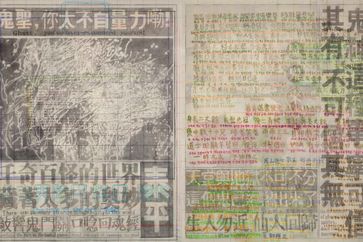
For the past few years, I have been transcribing Qing dynasty zhiguai fiction and traditional East Asian art treatises, carefully parsing them alongside their Korean translations. The handwritten notes born from this study seemed, in some ways, even better than my previous paintings, and I began to think there was no reason why they couldn’t become paintings themselves.

The notebooks look like this: Classical Chinese characters are written in black ink, fairly neatly and in a large hand—though some of the more complex, difficult characters are practically drawn. The pronunciations and Korean interpretations are jotted down in whatever colors happen to be within reach at the moment. Lines meander and stray; mistakes are crossed out and rewritten; omitted words are squeezed in belatedly; and fluorescent highlights block out sections or mark what is important. Sometimes I write my own translation beneath an existing one, or I lead with my own literal translation and put the smoother, established version in parentheses. Every now and then, I even noted down the historical background or scribbled down criticisms of the characters involved.

In this process, the unfamiliar and the familiar intertwine on the page. Weathered tones sit flush against bright, vivid colors, and what I know is sharply demarcated from what I do not. Through the lens of language, this is an exercise in handwriting and translation. But through the lens of painting, unexpected colors and forms gratefully surface ahead of my conscious intent, naturally carving out an inevitable composition.

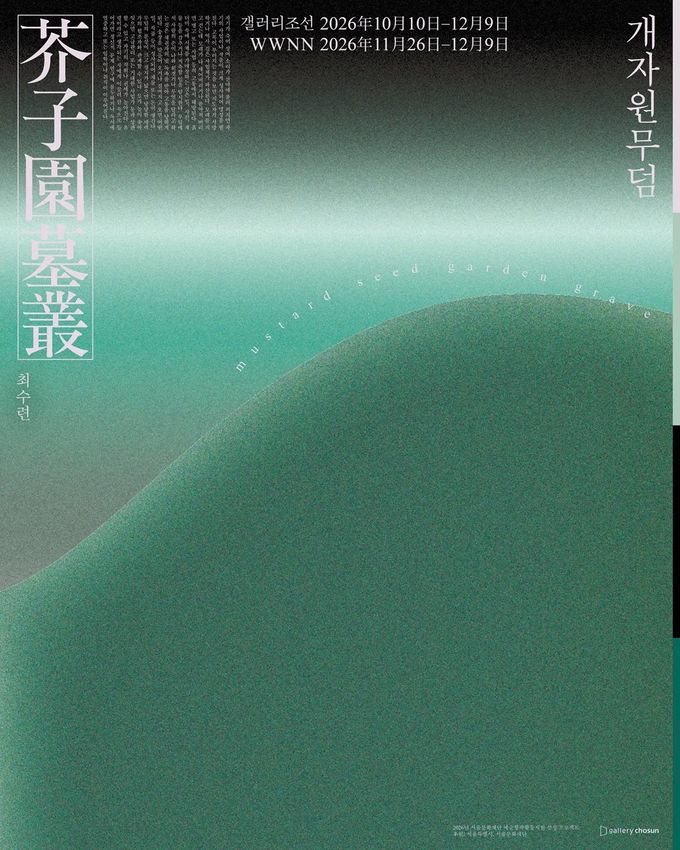
I began to imagine that among the small mounds in the “Mustard Seed Garden” , some might have been graves. I played with the hypothesis that beneath that small garden—where profound discourses on painting once unfolded—something “perverse and uncanny” lay buried.

Since the narratives weaving through the works mostly emerge from graves, the accompanying images are summoned from the Mustard Seed Garden Manual of Painting and other traditional East Asian painting heritages. The trees, rocks, ripples, hills, and houses of Korea, China, and Japan—each carrying a subtly different pictorial lineage—converge into mundane yet serene, universal landscapes that could serve as illustrations for almost any story.In execution, the hand is occasionally deft, but more often reveals an unrefined, awkward brushwork born from unfamiliarity.

Spanning two venues, this exhibition is broadly divided into paintings and drawings. Gallery Chosun features large-scale paintings that draw on the compositional logic of Persian miniatures. Meanwhile, WWNN showcases drawings that experiment with comic-strip layouts, doodles, the reverse side of paper, and paper inserts.

Read More
About the Artist

Sooryeon Choe observes with fascination the aspects and consumption of Oriental-style images reproduced in contemporary times. She questions the ‘Oriental’ aspects deemed old and strange in Korean society after modernization, yet she unabashedly cherishes them and reconsiders their utility. She aims to depict sorrow, femininity, the disconnection from reality, inner Orientalism, doubt, ignorance, and absurdity based on the traditional cliché images shared by Northeast Asia. Born in 1986, Sooryeon Choe graduated from the Department of Painting at Hongik University in 2010 and from the Graduate School of Painting at Seoul National University in 2017.

View Artist Profile Choe Sooryeon contemporary artist
About the Gallery

Gallery Chosun was established in 2004 in Bukchon, an area in Seoul known for its vibrant art scene comprising prominent art galleries and the National Museum of Modern and Contemporary Art. With a reputation for providing a versatile environment for its forward-thinking exhibitions, Gallery Chosun is committed to becoming an ultimate paradigm for Korean contemporary art.

View Gallery Profile
Address
BF1, 2F
64, Buckchon-ro 5-gil
Jongno-gu
Seoul
South Korea
Opening Hours
Tuesday – Sunday
10:30am – 6:30pm
(1)
Seoul BF1, 2F, 64, Buckchon-ro 5-gil
Gallery Chosun
BF1, 2F, 64, Buckchon-ro 5-gil, Jongno-gu, Seoul, South Korea

Opening hours
Tuesday – Sunday
10:30am – 6:30pm
The art world in focus