





The Radical Japanese Women Artists Who Shaped Global Modernism
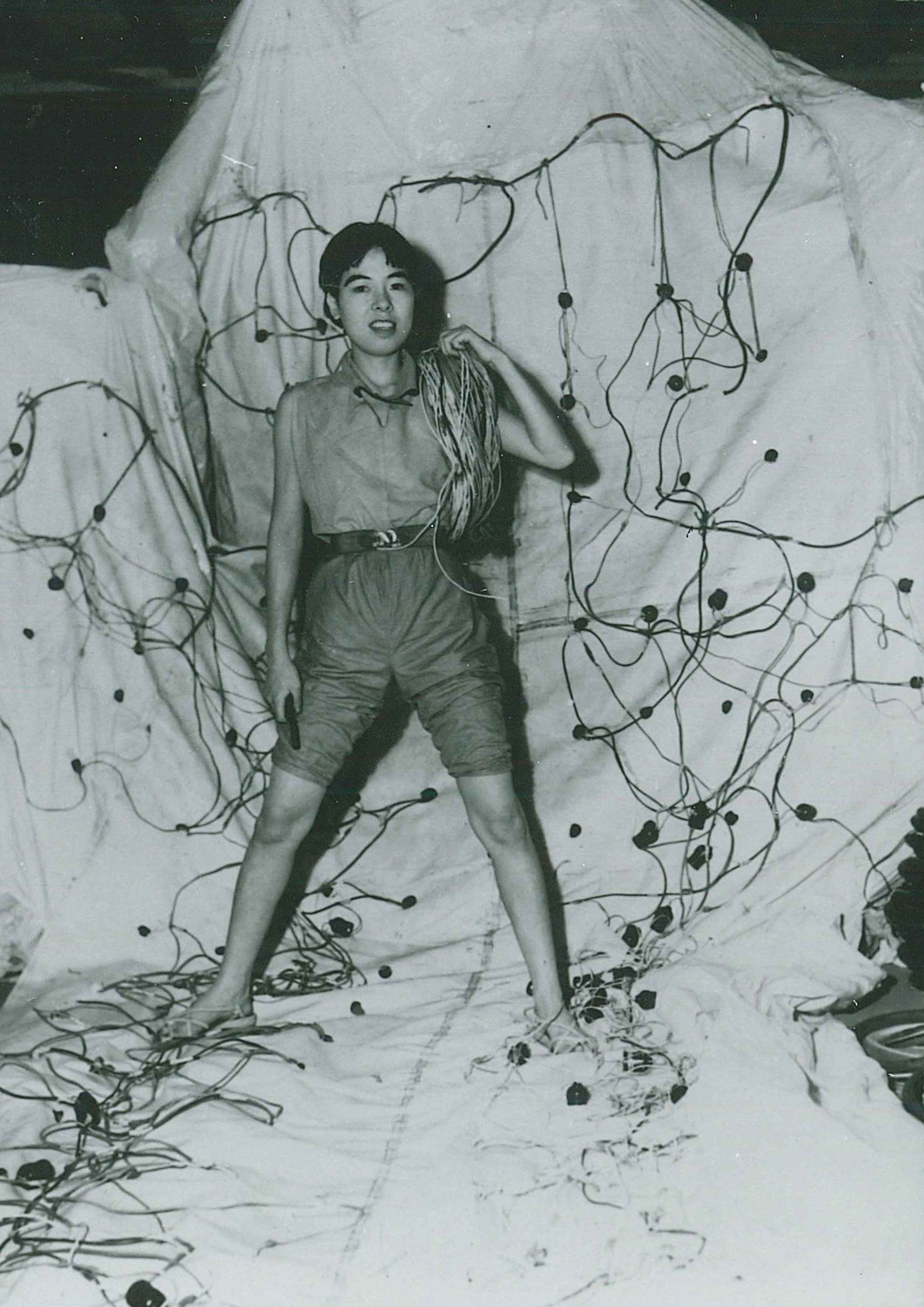
Much changed in Japan after World War II, including the growth of the technology sector and an improvement in women’s rights. An exhibition of work by Japanese women artists offers a new perspective on the era. Save to My OculaIn 1955, Atsuko Tanaka created what was later described as an “invisible work”, made of 20 electric bells wired around the perimeter of the main gallery space at the inaugural Gutai Art Exhibition in Tokyo. Visitors were invited to press a button which caused the bells to ring in succession: a interconnected circuit of communication. Tanaka’s work emerged during a period of rapid change in Japan following the end of the Second World War and the Pacific War, when artists were challenging the status quo and using technology in new and unique ways.
The post-war period also brought significant changes to women’s rights and democratic freedoms, with women gaining the right to vote in December 1945, while access to art schools was also opened. Two years after the end of the war, the Women Artists Association was created. “History has given us our first chance,” founding member Setsuko Migishi said in 1950.
A new exhibition, Kaihō: Japanese Women Artists after 1945, brings together more than 120 works from 39 female artists across multiple generations, disciplines, art movements and countries, including Tanaka’s Work (Bell) (1955), alongside pieces by leading figures including Ruth Asawa, Mariko Mori and Yoko Ono. While all the artists on show are Japanese, many left the country as migrants or never lived in Japan at all. Japan is often perceived as a historically isolationist country, yet the history of these artists offers a different view as they moved around the world, including to Brazil, the US and Europe. It is these circulations that tell a new story of global modernism, challenging a fixed notion of national identity in favour of transnational interconnection.
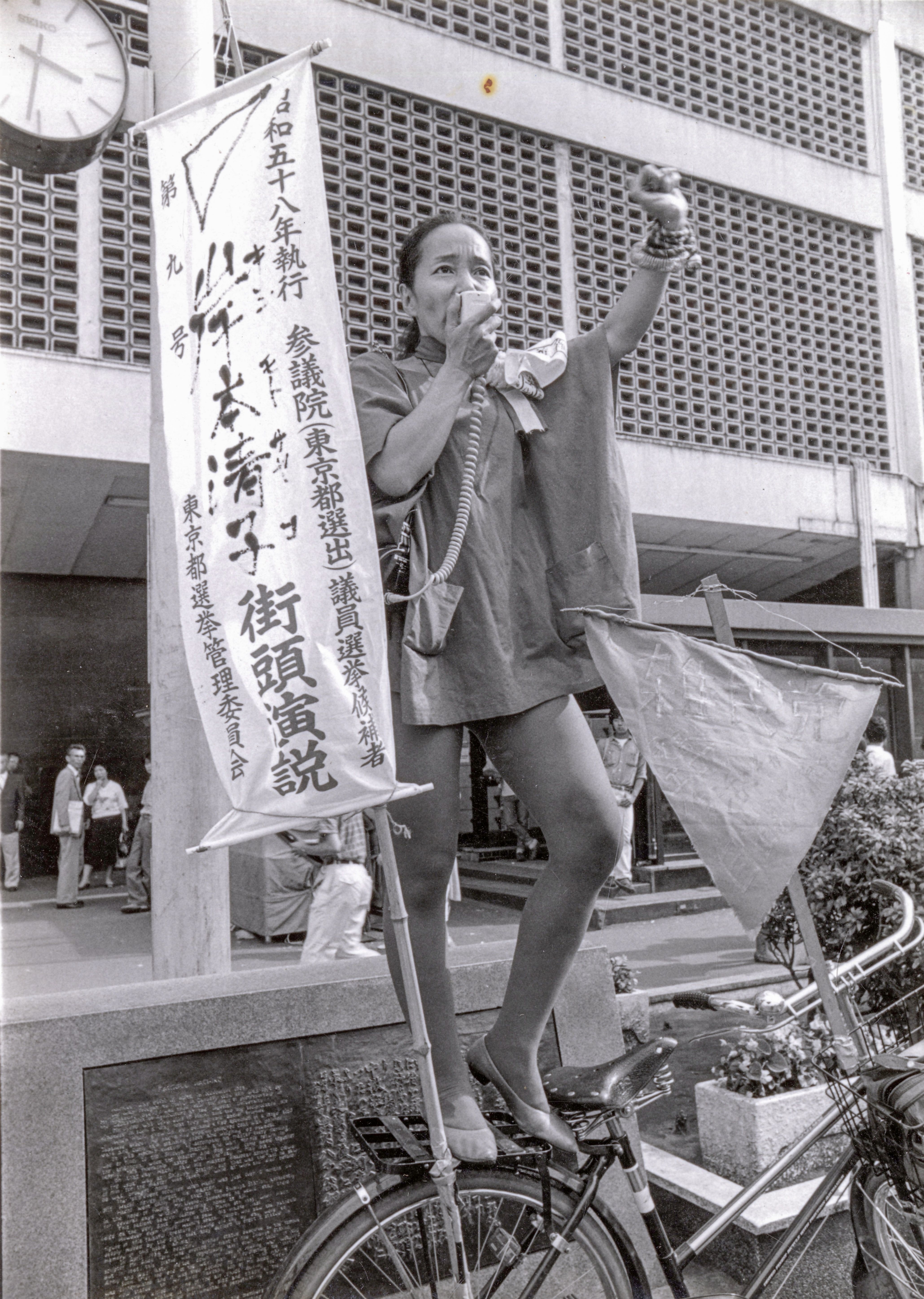
Situated during a period of rapid industrialisation and economic growth, as well as a growing understanding of ecological issues, many of the works on show reflect major shifts in media and technology, which became mediators of human imagination, including Yayoi Kusama’s early Infinity Room: Fireflies on the Water (2002). Avant-garde art movements Fluxus and Gutai, as well as post-war abstraction and video art can all be seen, offering a cross-section of 20th-century artistic transformation through a historical lens.
While the exhibition commences in 1945, the show’s curator, Florence Ostende, argues that Japan’s wartime defeat should not be viewed as a singular moment of rupture but as part of a wider movement towards change. Artists from the 1930s and 1940s onwards were contending with Japan’s legacy of imperial violence in Korea and China, and the work that followed forms a bridge between a modern period and the world we live in today, reaching from the past and into a projected future.
Here, Ostende selects her highlights from the exhibition, from the radical performance art of Tāri Itō to the warm abstract paintings of São Paulo-based Tomie Ohtake.
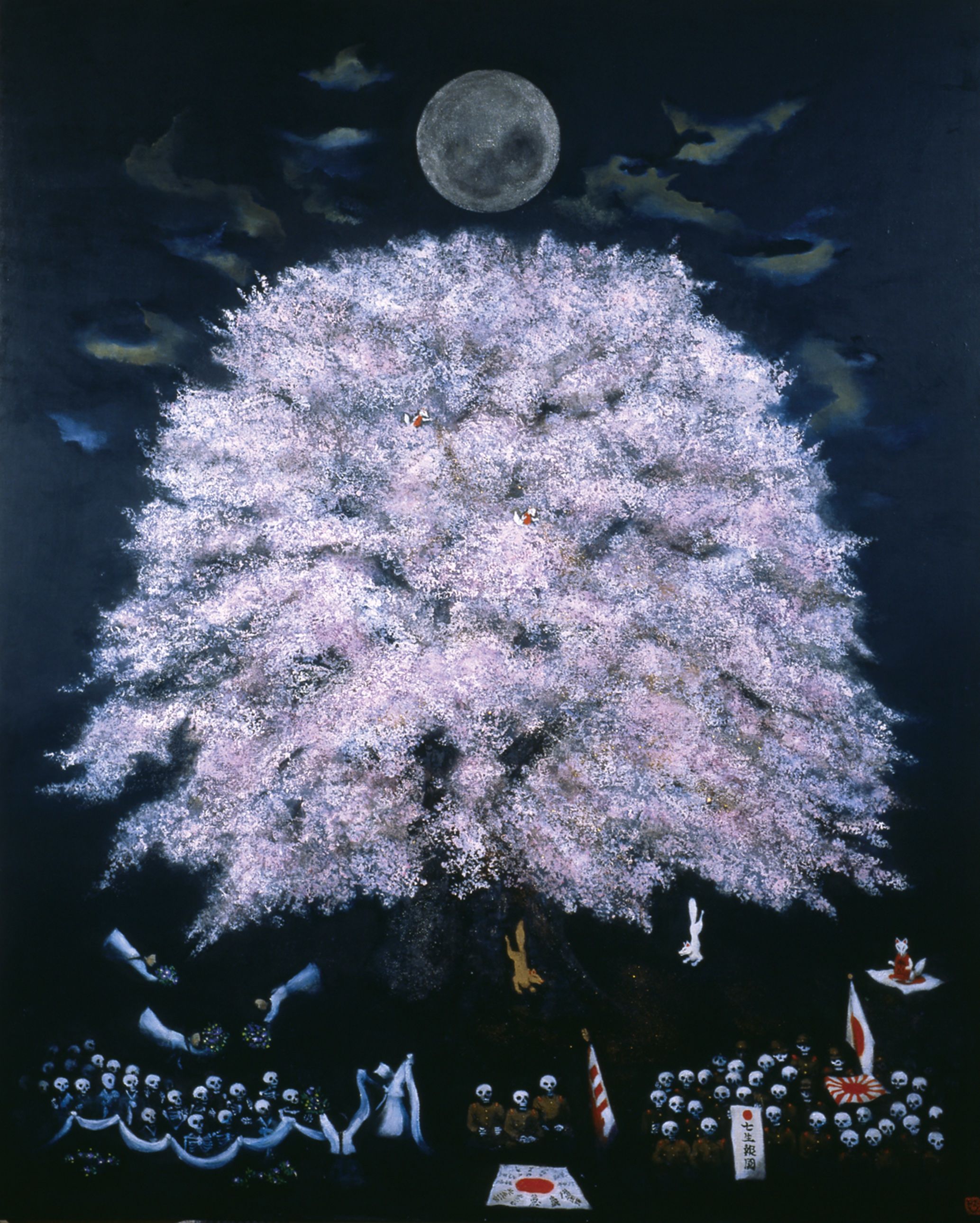
Taeko Tomiyama, Illusions of Cherry Blossoms II (1997)
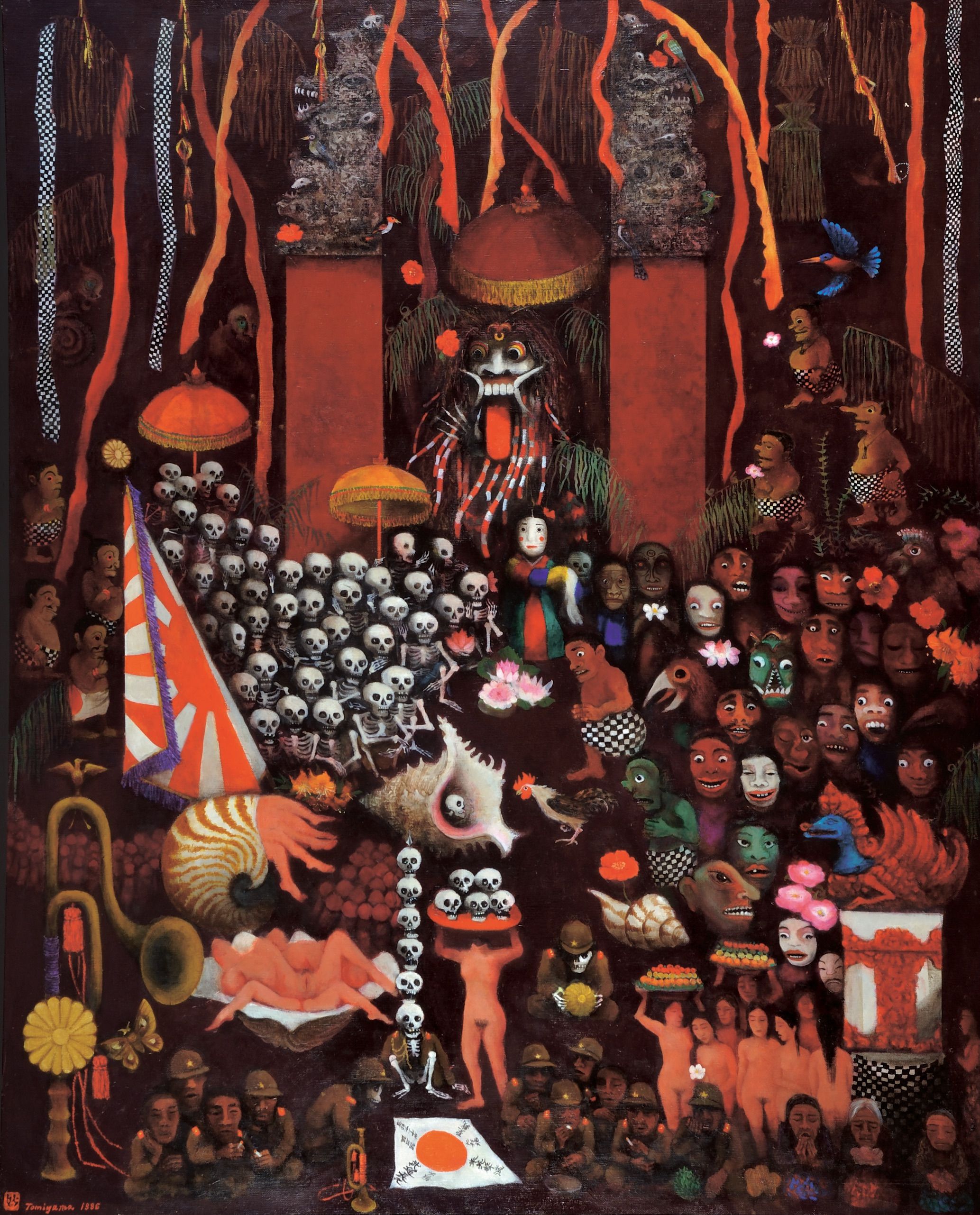
An incredible moon can be seen above a gigantic cherry blossom tree in full bloom. This painting captures the heart of Taeko Tomiyama’s practice, in which she uses figurative painting as a critique of Japan’s imperial violence and reworks national history. In this painting, she explores the legacies of Japan’s expansion across Asia. The realism of the body of the painting contrasts with a surreal strip at the bottom, where you can see the skeletons of soldiers and an imperial flag lying on the floor. In Japan, cherry blossom was associated with fallen soldiers, and so the tree was also a metaphor of return, of memory and celebration. She contrasts the idealised beauty of the cherry blossom with the atrocities and realities of war. Hidden in the tree are two tiny white foxes. These are the kitsune, the supernatural trickster spirits from the Japanese tradition that descend upon the dead, and they disrupt this glorification of wartime sacrifice. It is as beautiful as it is violent.
“The idealised beauty of the cherry blossom contrasts with the atrocities and realities of war”
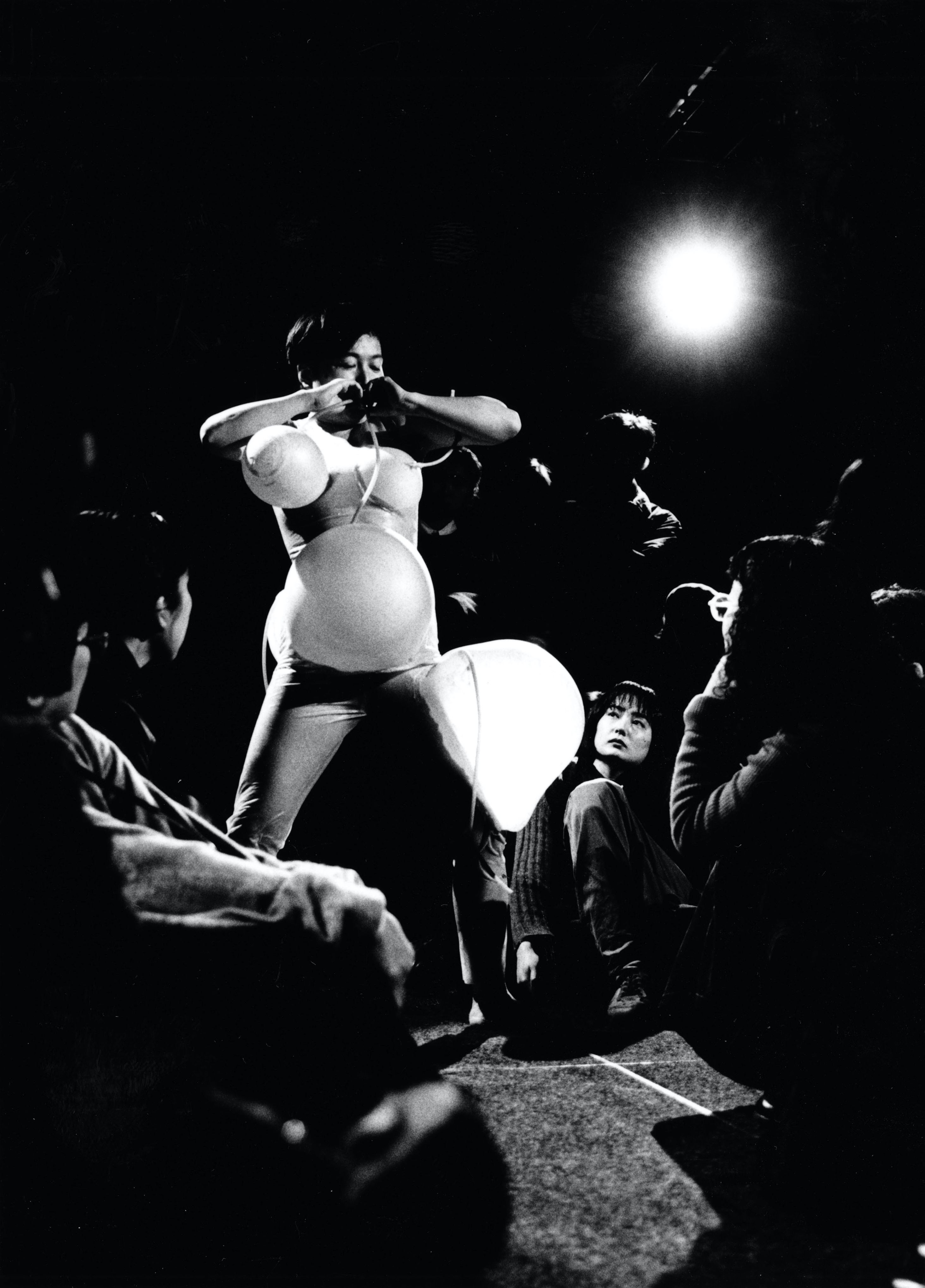
Tāri Itō, Self-Portrait (1996)
An important figure in Japan in the field of performance and feminist practice, Tāri Itō was active in travelling across Asia, especially Thailand, and circulated across many different feminist groups. She made a performance in 1996 called Self-Portrait in which she used latex as a second skin. She blew into the latex, creating an inflatable expansion of her own body, and in the performance she also revealed details about herself: her age, her profession, whether she was married, that she did not have children and, at some point, she revealed her lesbian identity. It has become both an important autobiographical work in her practice, and an important moment in the history of Japanese women artists. Tāri Itō felt the need to make a public statement of self-affirmation because she was suffering from the pressure to have a ‘normal’ relationship to gender, which was strong in Japan, even into the 1990s. You have this collapsing of boundaries between the interior and the exterior in the way she expanded the costume around her body. Itō is asking what it means to reveal an intimate portion of yourself to the public.
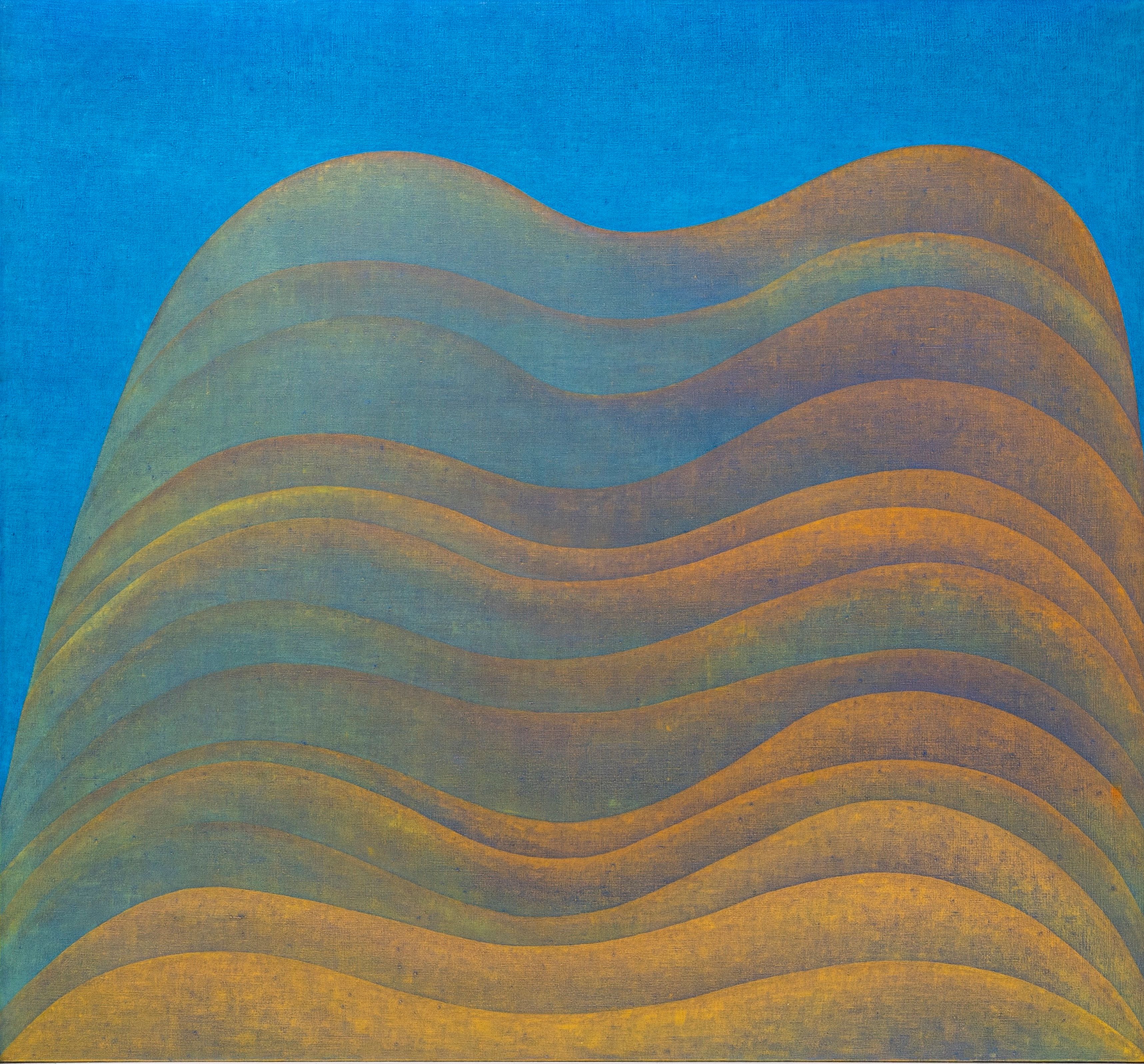
Tomie Ohtake, Untitled (1978)
Tomie Ohtake was born in Kyoto in 1913. She visited Brazil in 1936, and soon found she wasn’t able to return home to Japan because of the war happening across the Pacific. She ended up staying in São Paulo for most of her life. Ohtake’s work reflected many of the ideas around abstraction happening in Latin America at the time. This is a very beautiful abstract work that she started to make in the 1970s, where she used torn paper collages to make abstract forms. When she had first arrived in Brazil, she had often talked about the warm light. In this work, the yellow wave, the sun and blue sky take you into a moment in the architecture of her studio. Ohtake died aged 101 and produced art for many decades, but all her works are untitled. When she was asked what the meaning behind her work was, she always replied, “Thank you”, and never said anything else. She is a rare kind of artist: one who resisted any form of interpretation of her work. The one thing Ohtake said about her life and work was that she was trying to be as objective as possible, which is inevitably a contradiction.
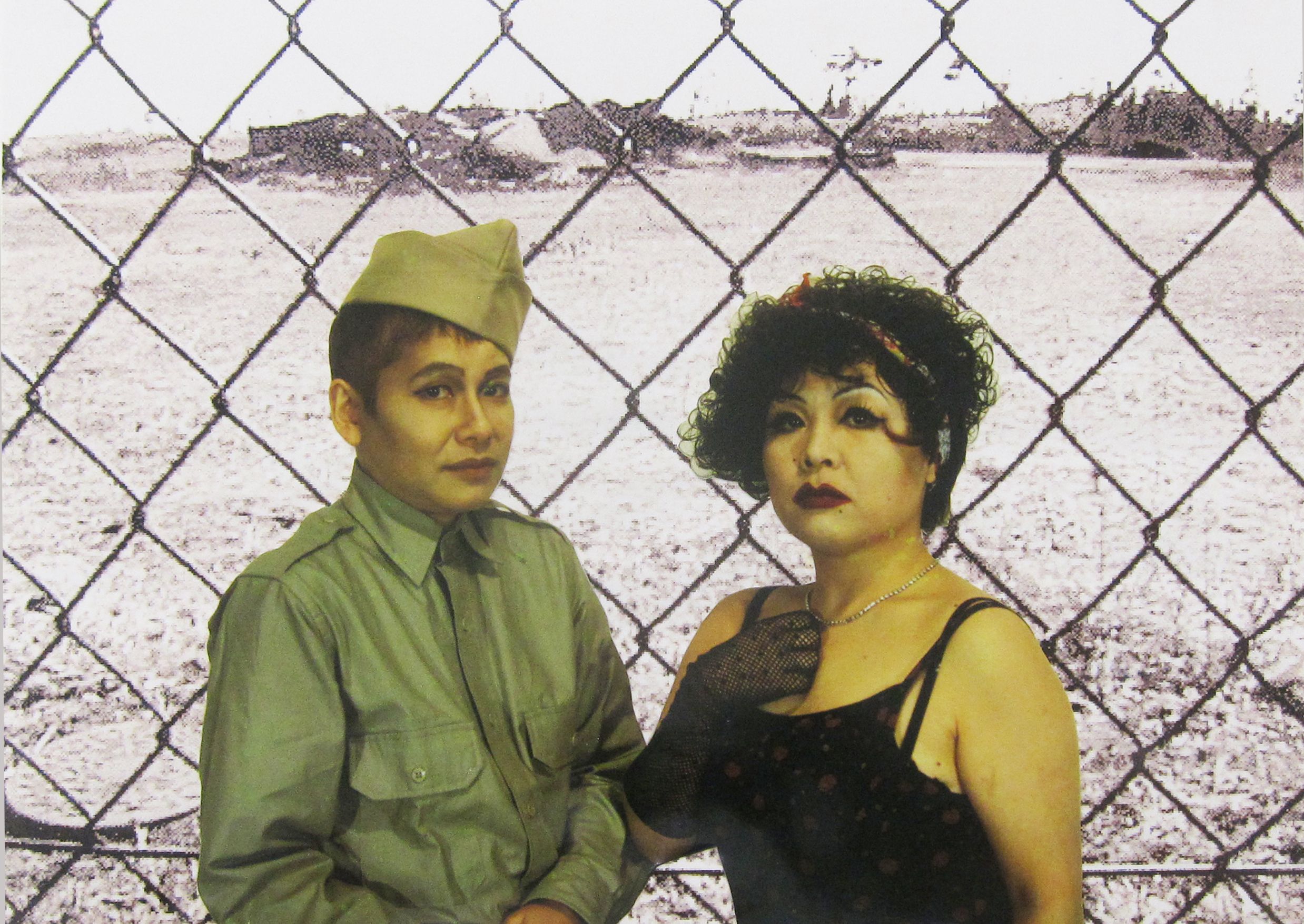
Yoshiko Shimada + BuBu de la Madeleine, Portrait (1998)
Yoshiko Shimada is an artist who has often focused on reworking Japanese imperial history and the complex moment of the US occupation of Japan from 1945 until 1952. In this photographic collage, Shimada is dressed as a US soldier. She is on the left of the image, and on the right side you see artist and collaborator Bubu de la Madeleine, who is dressed as a sex worker. The work restages the relationship between a Japanese sex worker and a US soldier, looking at the way femininity and masculinity are shaped by this context of militarism and colonial power. Bubu de la Madeleine is an artist who has frequently used theatre drag and humour. Together, they are not making the work autobiographical but trying to question the bigger picture. As Shimada says: “Dressing up was a way to bring those issues back to ourselves, back to our bodies.”
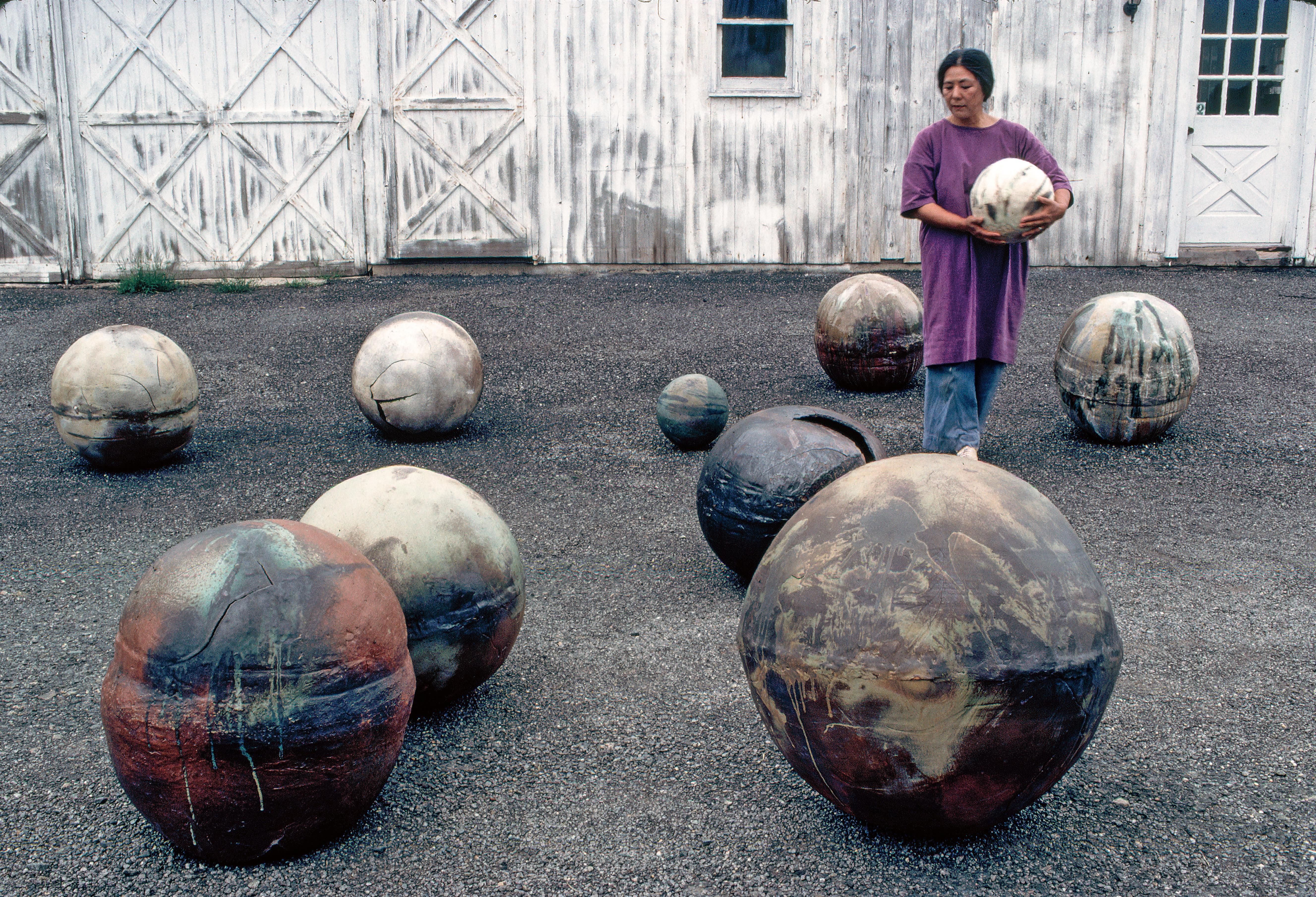
Toshiko Takaezu with Moons (August 1979)
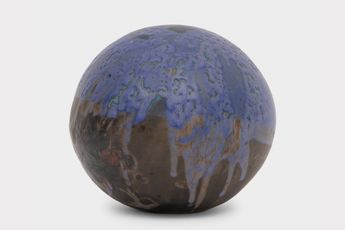
Toshiko Takaezu never lived in Japan. Takaezu was born in Hawaii, to parents who were originally from Okinawa, and she grew up in a rural landscape in 1930s Hawaii, where she was completely immersed in the seasons and the natural rhythm of the island. She never said her ceramic work was an illustration of those landscapes, but in the way she applied those glazes—the pouring, the dripping, the stroking—you can see the actual landscapes: the volcanic rock, the continuum of the sky and the Earth, the Pacific Ocean emerging. Takaezu looked at environmental consciousness, and how a deeper connection with nature was becoming central to many women artists as an affirmation of themselves. Ceramic was the medium that really encapsulated this shock between tradition and modernity in the 1950s. It is known as an open form: bowls, vases, or utilitarian forms that are used as vessels. Takaezu—pictured in this photograph holding all these big ceramic moons, which are on show in the exhibition—instead invented something she called a “closed form”, with just a tiny hole so the air could go out during the firing. She imagined a work where everything would be hidden and enclosed in this dark, seductive space inside.
Kaihō: Japanese Women Artists after 1945 (until 14 February 2027) at Mudam, Luxembourg
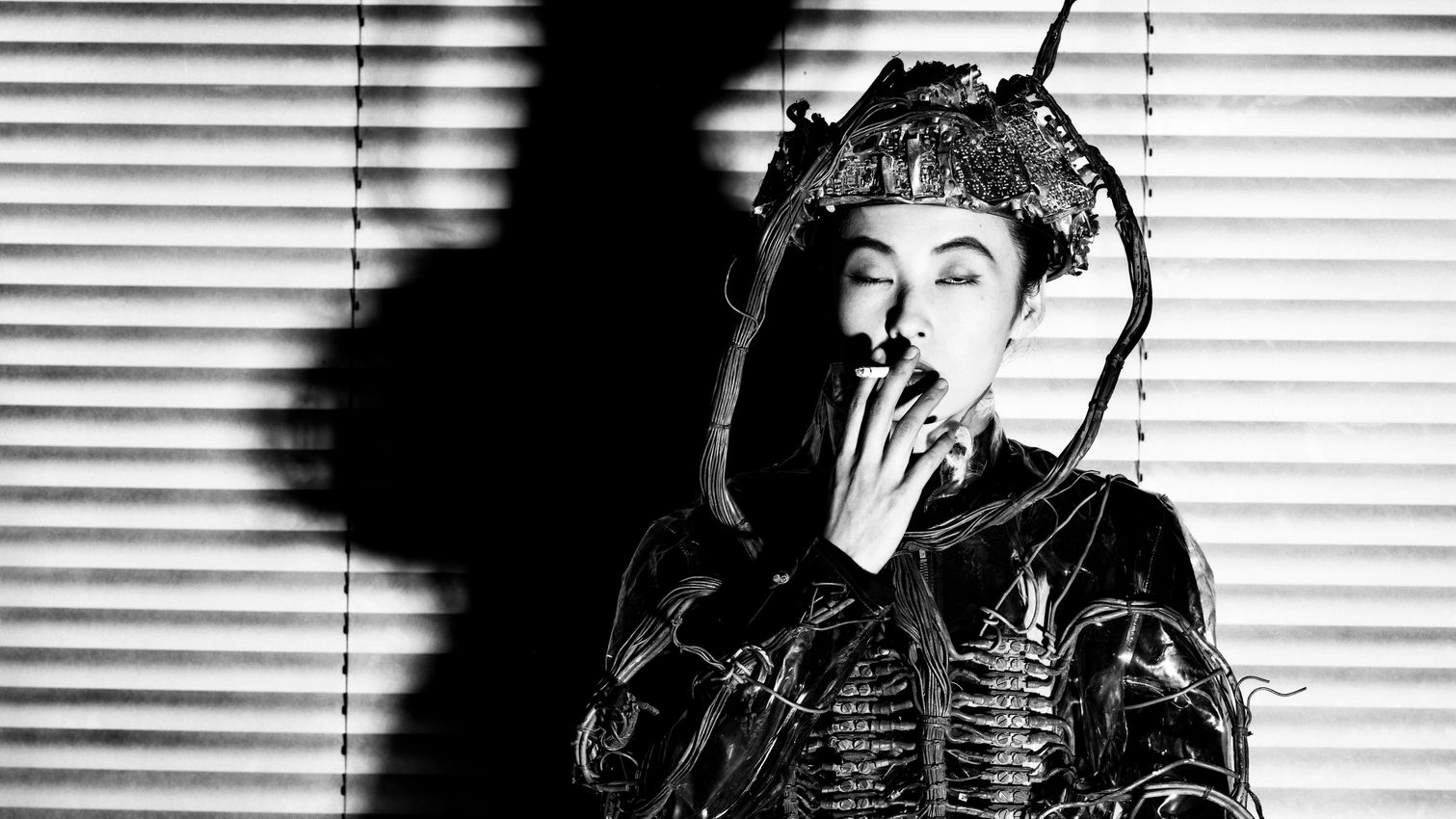
Main image: Portrait of Seiko Mikami (1989). Photo: K. Kurigami.




A respected voice in contemporary art discourse.
Focusing on ambitious storytelling and insightful art-world commentary. Ocula Magazine publishes in-depth interviews, critical essays and timely analysis on the artists, exhibitions and ideas driving the global art world.
Learn more about Ocula Magazine
Showcasing the best of the art world.
Ocula partners with galleries from around the world to highlight their artists, artworks and exhibitions. Gallery membership is by application and invitation, with each member vetted by an independent panel.
Learn more about Ocula Membership
Specialises in the sale of major artworks.
Led by a team with deep ties to the world’s leading auction houses, galleries and collectors. Ocula’s advisory team offers bespoke services to high-net-worth clients from around the world who are looking to acquire the best of contemporary and modern art.
Learn more about our team and services