Press Release

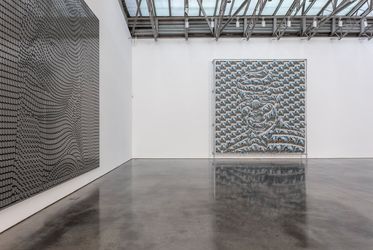
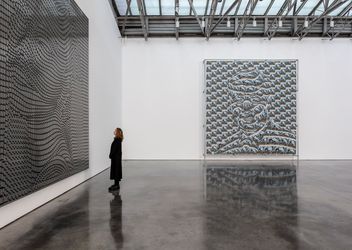
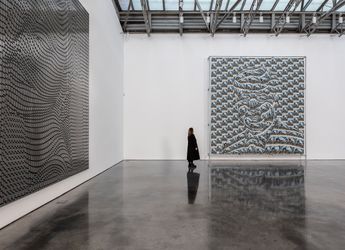
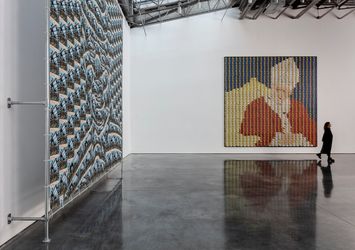
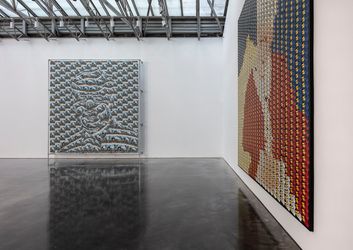
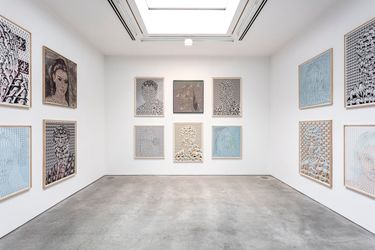
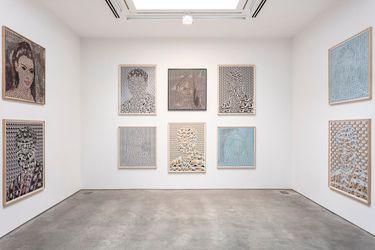
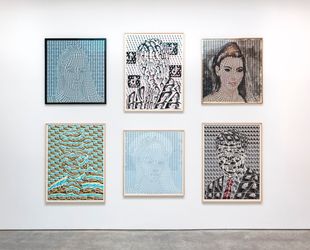
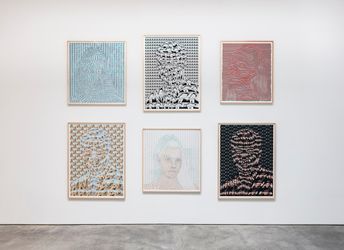
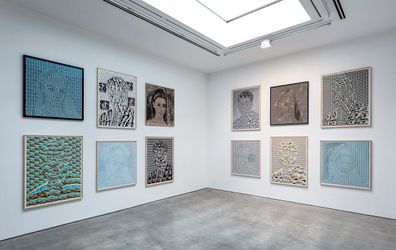
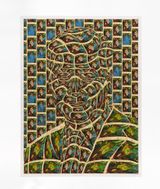
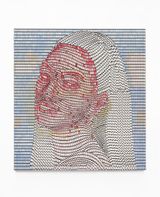
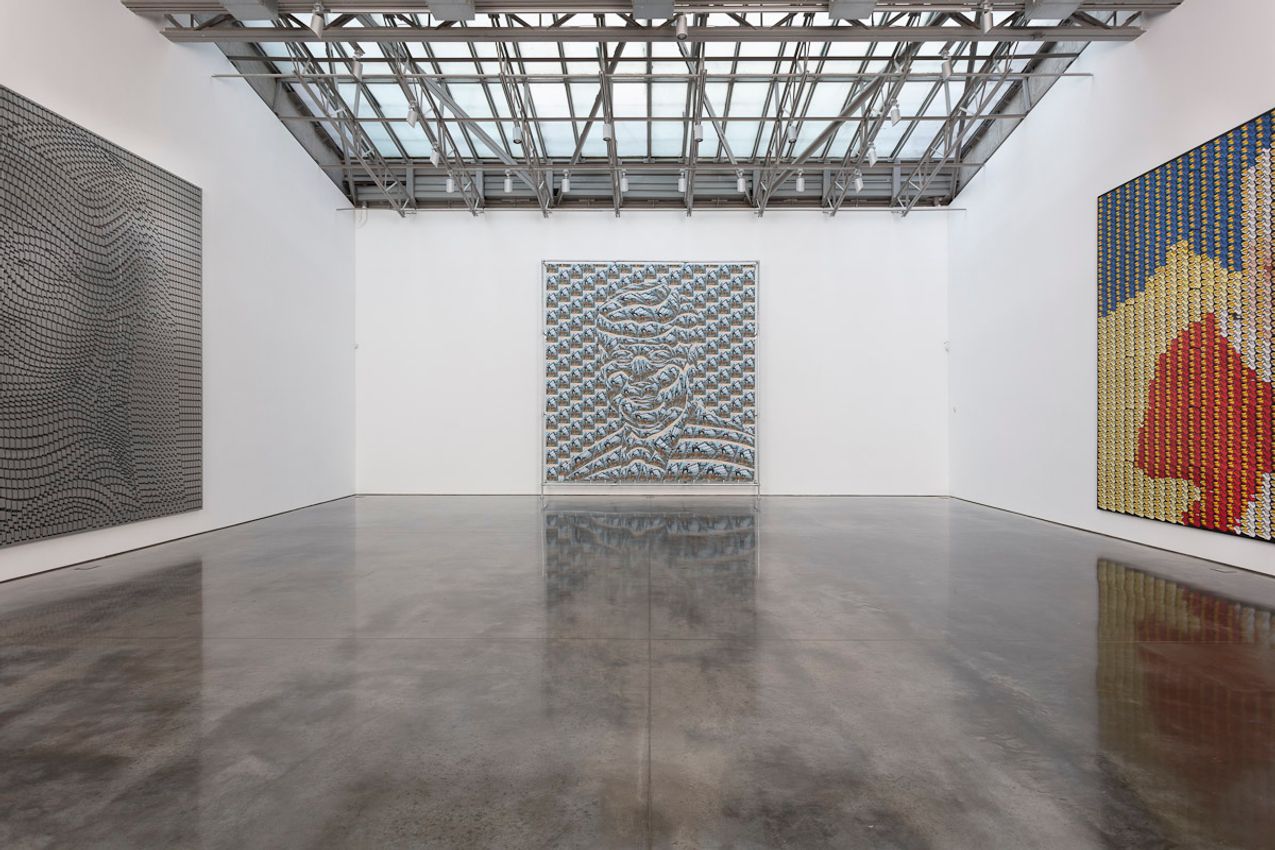
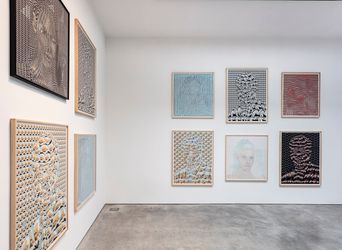
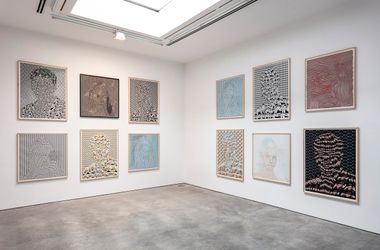
In this time of uncertainty and mixed feelings, Thomas Bayrle’s new body of work grapples with and negotiates our splintered culture, the strikingly frequent intersection of our aspirations and our anxieties, our hopes and our resentments. Continuing his uncannily prescient, presciently uncanny exploration of the ways in which images saturate, inform, transform, liberate, and implicate, Bayrle presents a series of ‘superforms’–the artist’s trademark portraits composed of repeated distortions of small, subtly unique images–of political, historical, and pop culture figures, including Xi Jinping, the Pope, and Kim Kardashian. Dense, occasionally impenetrable, evocative, these superforms play with the distances implicit in images of the famous and the infamous. We feel like we know them because their images are so much around us, and yet we do not - and cannot - know them precisely because they are all image. Bayrle’s is a visual vernacular that emerges from a thoughtful, playful, deliberately contradictory engagement with the high-low, marked by equal parts fascination and repulsion with capitalism, mass culture, authorianism. A Pop-by-way-of-Op Art, Bayrle’s work brightly invites a look, suggesting contemporary icons, as if the internet were a religion.

Born in Berlin in 1937, Bayrle came of age in post-war Germany, defined simultaneously by guilt and the ‘economic miracle’ of a booming economy. Initially trained as a weaver, he worked, in the late 60s and early 70s, as a graphic designer, and co-ran Gulliver Press, publishing artist’s books, lithographs, and posters, and lived, as he expressed in a 2018 interview on the occasion of his first major New York museum survey at the New Museum, “the contradictions of the time. During the day, I would work for Ferrero, Benckiser, Pierre Cardin, and McCann Erickson, the German factories and the American agencies, and at night I worked for the Marxists and the anarchists, the students, the Italian protest paper Lotta Continua, and the German extra parliamentary left.” The incongruity was a way, he believed, of experiencing something more complete and complex, and it has consistently defined his oeuvre, which marries critique and excitement, protest and celebration across silkscreens, illustrations and posters, kinetic paintings Bayrle termed ‘machines,’ installations and environments.

The superform gives sculptural form to individually flat elements, creating the illusion of dimension through repetition. Long interested in accumulation, Bayrle anticipated the digital age and the internet’s relocation of images from backdrop to foreground. His work interrogates how images signify and what happens to their significance when they amass. Like a visual equivalent of a word repeated until it loses its meaning, changes its very sound, the images emerging in and through repetition are a distortion, their meaning contestable. ‘I like the closeness of individual differences. Trying to be the same, but always failing. Or trying to be different and realising you are just like all the others,’ Bayrle said in the interview with the New Museum. With these new superforms, the artist asks us to see the similarities among public figures like the Pope and Mao Ze Dong, while remaining attuned to their differences. Like his earlier work, which often suggested the continuities of East and West, of communist ideology and the capitalist faith in mass, the new works are interested in correspondences and disjunctions, in the mixing of seemingly disparate patterns. At once, familiar and defamiliarised, the portraits play with the micro and macro, with the ways images–both as visual and as reputation–are always composed of other images, expanding upon and contracting themselves. Like a communist adman, Bayrle offers us a catchy vision of our cultural moment, polished to a shiny glimmer, with an undercurrent of nostalgia and an affectionate, incisive, witty indictment of late capitalism and its discontents.

Read More

Installation Views

About the Artist

Thomas Bayrle’s pioneering work is characterised by an obsessive preoccupation with repetition and grid structures, conceiving and representing the world around him as a multitude of social threads. Bayrle began his career as a designer and, after an apprenticeship within a textile factory, he became fascinated by mechanisation and its repetitive patterns and rhythms.

View Artist Profile

Also Exhibiting at Gladstone

About the Gallery
Gladstone is known for its commitment to artists whose prescient approaches and experimental practices have defined the contours of contemporary art. The gallery has long been an active partner in the cultivation of iconoclastic careers, fostering a roster of artists recognized for their ground-breaking contributions. Headquartered in New York and including outposts in both Brussels and Seoul, Gladstone’s impact extends globally, enabling both the presentation of new bodies of work, and an amplification of the international reach of its artists. Alongside its work with contemporary artists, the gallery is steward to the legacies of pivotal historical artists and serves as an advocate for the enduring power of art. Gladstone is led by a team of partners who spearhead its long-term vision and program, building on the values of its founder Barbara Gladstone.
View Gallery Profile
Address
530 West 21st Street, New York
New York
United States
Opening Hours
Tuesday - Saturday
10am - 6pm
(1)
New York 530 West 21st Street, New York
Gladstone
530 West 21st Street, New York, New York, United States
+1 212 206 7606
http://gladstonegallery.com

Opening hours
Tuesday - Saturday
10am - 6pm
The art world in focus