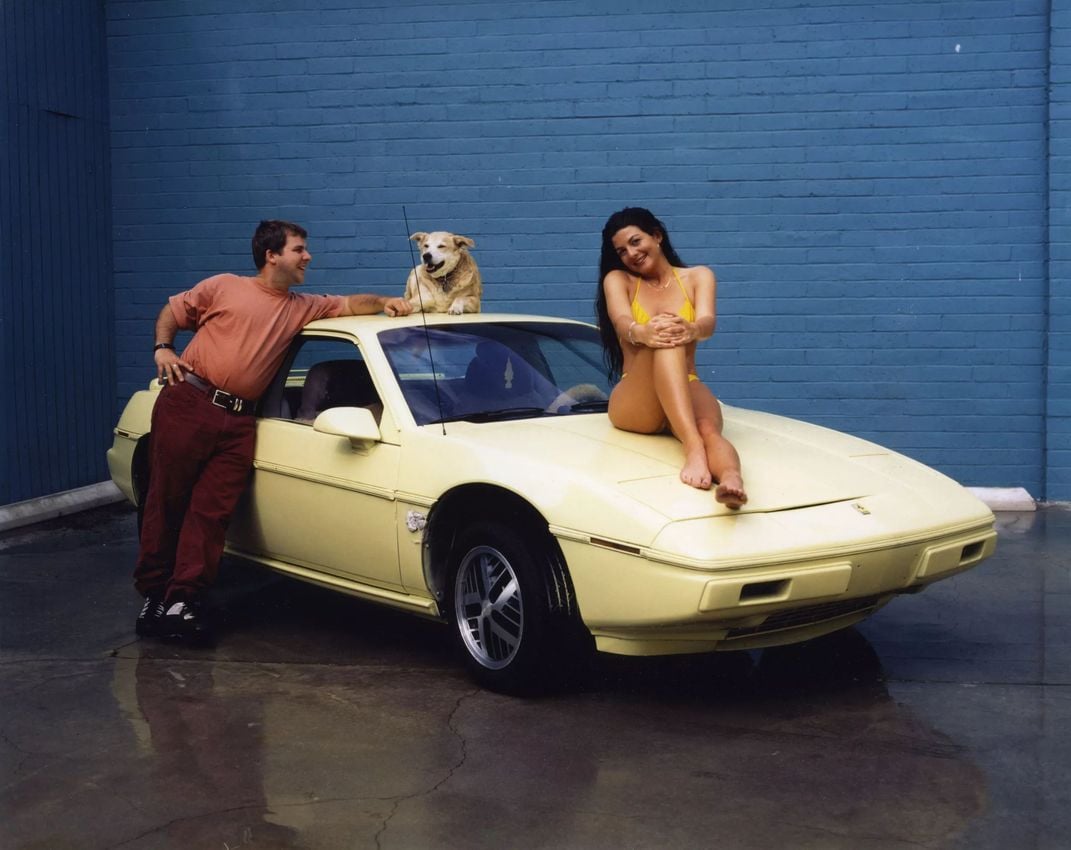
For Jason Rhoades, the car was a vehicle of artistic pursuit and ambition. Starting 5 September, Hauser & Wirth New York will present a major exhibition of his ‘Car Projects,’ including a fleet of different makes of readymade car sculptures. The installation will also feature a monumental work from 2000 named in tribute to the dada modernist and car collector Francis Picabia. ‘DRIVE II’ will run concurrent to the yearlong exploration of Rhoades’ art and car culture taking place at Hauser & Wirth Downtown Los Angeles.
‘I spend hours going to my studio, so I established this extension of my studio, or rather this second space, in my Caprice.’
Jason Rhoades (1965–2006) was renowned for the driving imagination and exuberance of his work, as well as, at times, its reckless provocation and overwhelming materiality. His epic-scaled installations established him as a force of the international art world in the 1990s while he was based in Los Angeles. Going with the storied flow of L.A. traffic, Rhoades considered the car an extension of the studio: a space in which the artist’s mind can race and wander. However, as a body of work, the ‘Car Projects’ have not been widely seen or considered within the scope of his art, in large part because the sculptures themselves have been in storage for decades, with one notable exception being the presentation of the ‘Caprice Auto Project’ in the 2022 Whitney Biennial, in which the 1992 Caprice was installed on the museum plaza as an outdoor sculpture.
This exhibition will be the first to present all five of Rhoades’ readymade car sculptures, starting with the ‘Yellow Fiero’ (1994). Representing an American idea of a European sports car, the Pontiac Fiero was originally part of a massive 1994 installation, titled ‘Swedish Erotica and Fiero Parts,’ that transformed the Rosamund Felsen Gallery in Los Angeles into an ersatz IKEA entirely constructed by Rhoades. The Fiero will be joined by a Chevrolet Caprice and Impala, a Ferrari 328 GTS and a Ligier microcar, all parked in the gallery alongside a video of Rhoades, driving around Los Angeles, fervidly discussing his ‘Car Projects.’ Recorded in a 1998 interview with the curator Hans Ulrich Obrist, Rhoades explains the relationship of cars to his art (parking is equated with situating a sculpture) and expounds on cars as icons of art history (Marcel Duchamp and Francis Picabia speeded modern art forward with their mechanized abstractions; postmodernism put on the brakes) as well as of aspiration and class (you are what you drive). The radio is tuned to Power 106 FM and as the world streams by to the propulsive hip-hop beat, the romance of cars seems irresistible.
‘By going between places, [the car] will generate things. It’ll snowball, take on a mythology and a history, and then at some point it’ll just stop. And that’ll be it, it’ll be a finished sculpture.’
The uncanny spectacle of five cars in a gallery will be augmented by the bestial display of ‘Fucking Picabia Cars with Ejection Seat’ (1997/2000). Assembled like an adult tinker-toy, from aluminum poles, plywood cutouts, plastic buckets, porn and other materials, a pair of automotive silhouettes appear conjoined and suspended high in the air. Per Rhoades’ specifications, the sculpture will be shown alongside work by Francis Picabia, an artist Rhoades revered for his systematic refusal to be contained or categorized, as well as for his passion for cars. Picabia raced and collected high-powered automobiles.
As an artist, Rhoades was keenly attuned to sources of cultural power and weakness. With cartoon gusto, his ‘Car Projects’ make vivid connections to complex human realities, such as our inability to forgo the combustible engine and get past the car. Through its very provocation, Rhoades’ art is always taking us somewhere.
Quotes by Jason Roades are from Daniel Birnbaum, ‘Jason Rhoades: 1000 Words,’ Artforum, September 1998.
Jason Rhoades (1965–2006) is known for monumental, room-filling installations. These idiosyncratic sculptures incorporate a wide range of objects including products of mass culture combined with hand-made items and biographical references. Drawing on the history of assemblage, Rhoades imbues his materials with powerful formal, narrative and allegorical links, encouraging viewers to connect and interpret the associative chains. Rhoades often drew inspiration from the city of Los Angeles where he lived and worked as well as The Great American West, informed by his rural upbringing in Northern California. His work has been exhibited internationally since the early 1990s.


A respected voice in contemporary art discourse.
Focusing on ambitious storytelling and insightful art-world commentary. Ocula Magazine publishes in-depth interviews, critical essays and timely analysis on the artists, exhibitions and ideas driving the global art world.
Learn more about Ocula Magazine
Showcasing the best of the art world.
Ocula partners with galleries from around the world to highlight their artists, artworks and exhibitions. Gallery membership is by application and invitation, with each member vetted by an independent panel.
Learn more about Ocula Membership

Specialises in the sale of major artworks.
Led by a team with deep ties to the world’s leading auction houses, galleries and collectors. Ocula’s advisory team offers bespoke services to high-net-worth clients from around the world who are looking to acquire the best of contemporary and modern art.
Learn more about our team and services