Press Release

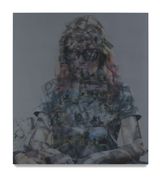
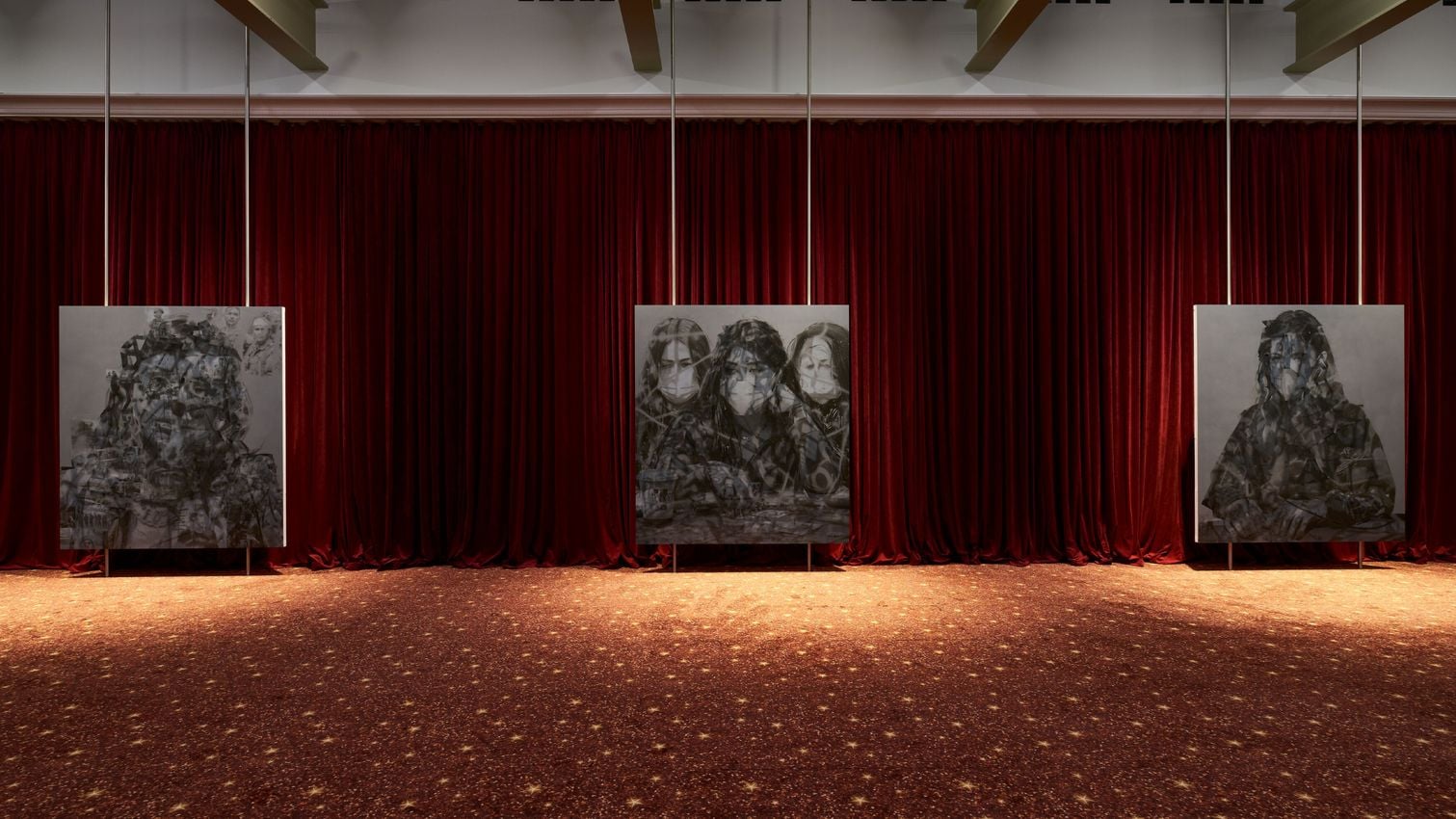
Coinciding with Zurich Art Weekend 2026, New York-based artist Avery Singer presents new paintings alongsidea site-specific architectural intervention transforming the gallery’s upper floor into a casino-like environment– a space charged by surveillance. Incorporating AI-based tools into her painting process for the first time,‘War_overlays’ examines how media and accelerating technologies shape our consciousness, destabilizingthe boundaries between perception and reality. Following on from Singer’s body of work reconciling with herpersonal memories of 9/11, the new paintings reflect on the artist’s experience growing up amid televisedconflict in the early 2000s, using distorted, AI-influenced imagery to evoke the mediated violence of the era.

Influenced by Jean Baudrillard’s writings on the Gulf War, the exhibition considers how conflict in the West isprimarily experienced as a media spectacle, constructed and construed through images rather than directencounters. This dissonance is heightened by the seemingly disparate nature of the casino setting, completewith long red curtains, tiled carpet and staged CCTV cameras, and the unsettling content of Singer’s paintings.Throughout the works, Singer’s Poker Player motif recurs as a central figure: a stand-in for the artist whonavigates risk by reading patterns, anticipating outcomes and perceiving what others overlook. This figure isoverlaid with a mosaic of AI-influenced imagery drawn from images of contemporary warfare, bringing intofocus the harsh realities that persist beyond the studio – or casino – yet are easily ignored in everyday life.

Singer’s use of AI to develop the prompts and keywords that initiate aspects of the image generation processfurther implicates themes of memory, truth and knowledge, underlining the paradoxes of the digital era. Theresulting images are characterized by what Singer terms an ‘AI slop aesthetic,’ revealing uncanny distortionsthat underscore the limits of algorithmic systems (for example, in the work ‘Solver’ (2026), a U.S. marine isdepicted wearing a keffiyeh).

Working initially in ComfyUI, the artist develops custom LoRAs trained on individuals to create a base character.These subjects are further refined before becoming the painting’s central figure. The tiled imagery acrossthe surface comes from training AI models to mash together specific imagery with AI slop aesthetics: war fetishization, LAN parties and other aspects of real world, digital culture, alongside semi-autobiographicalsubject matter. As Singer states on the final outcome, ‘I thought it would be interesting if the viewers could lookat the paintings and recognize an AI system that was malfunctioning. Maybe there’s poetry to be found in thebreakdown of this highly developed technology:’

‘Strong uncanny valley feeling throughout. Unsettling artificial humanity, collapsed identities, syntheticmemory fragments, psychological collage of historical trauma and chaos. Appears generated by abroken AI system trained on corrupted military archives, damaged war photography databases, lowresolution sources, and misaligned facial data. Full AI slop—unsettling, almost real, deeply wrong.

The mosaic tiles clip through her skin and clothing. They float at inconsistent depths across her face,and torso. They overlap incorrectly with no regard for her anatomy. U.S. soldiers, militants, battlefieldscenes, and distorted faces recur chaotically throughout the overlay.

The system does not attempt reconciliation. There is no blending between the sharp, well-lit casinobroadcast and the corrupted war documentation mosaic. No narrative explanation. No aestheticharmonization. The failure is categorical: a clean poker tournament frame has been contaminated withan entirely wrong, deeply broken photographic archive.

The sharp focused well lit background is filled with spectators/audience like in a poker tournament,completely untouched by the overlay corruption.’

Courtesy Hauser & Wirth.

Read More

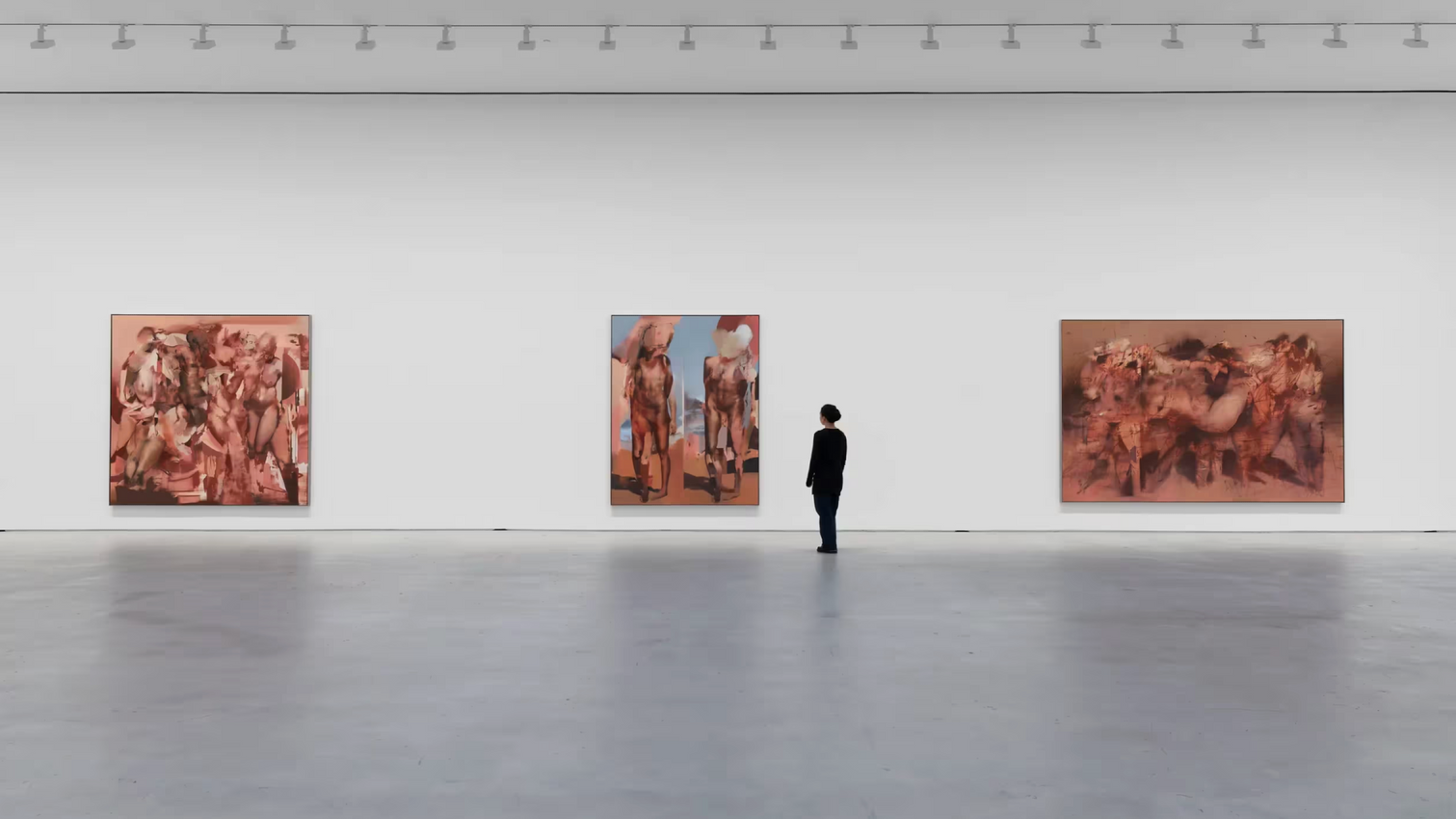
Installation Views

About the Artist

Avery Singer (b. 1987) was born and raised in New York. Her parents, the artists Janet Kusmierski and Greg Singer, named her after Milton Avery. Growing up in a creative community, Singer experimented with photography, film, and drawing, but in those years never considered working with paint. In 2008, Singer studied at the Städelschule, Frankfurt am Main, and in 2010, she received her B.F.A. from Cooper Union, New York. During her studies, Singer engaged in performance art, video making, as well as sculpture utilising carpentry, metal casting, and welding. After graduation, she discovered her chosen art form from an unanticipated experiment with SketchUp, a program used by her peers to design exhibition spaces, and airbrushed a black-and-white painting based on a digital illustration. Since then, Singer has employed the binary language of computer programs and industrial materials in order to remove the trace of the artist’s hand while engaging the tradition of painting and the legacy of Modernism.

View Artist Profile

Also Exhibiting at Hauser & Wirth

About the Gallery

Hauser & Wirth was founded in 1992 in Zurich by Iwan Wirth, Manuela Wirth and Ursula Hauser, who were joined in 2000 by Partner and Vice President Marc Payot. A family business with a global outlook, Hauser & Wirth has expanded over the past 26 years to include outposts in Hong Kong, London, New York, Los Angeles, Somerset and Gstaad. The gallery represents over 70 artists and estates who have been instrumental in shaping its identity over the past quarter century, and who are the inspiration for Hauser & Wirth’s diverse range of activities that engage with art, education, conservation and sustainability.

View Gallery Profile
Address
Limmatstrasse 270
Zurich
Switzerland
Opening Hours
Tues - Fri, 11am - 6pm
Sat, 11am - 5pm
(1)
Zurich Limmatstrasse 270
Hauser & Wirth
Limmatstrasse 270, Zurich, Switzerland
+41 444 468 050
http://www.hauserwirth.com

Opening hours
Tues - Fri, 11am - 6pm
Sat, 11am - 5pm
The art world in focus