Press Release

Malibu is Barbie’s horse: a triumphant cascade of platinum mane, pink tack and wide blue eyes—the dream of countless children crystallised in sweetly scented plastic. More than a toy, Malibu is a companion in adventure, a silent confidant galloping through the boundless territories of childhood imagination. In bedrooms and living rooms alike, she has carried generations of young riders across landscapes of make-believe, where play is not merely pastime but a way of inhabiting the world—elastic, inventive, gloriously unburdened by gravity.

Earlier this year, on the seventeenth of February, the Lunar New Year ushered in what the Chinese zodiac names the Year of the Fire Horse: a sign long associated with vitality, perseverance and the restless courage to reinvent oneself. The Fire Horse promises a season of momentum, a time for resolve, bold gestures and the spirited pursuit of transformation and growth. Yet here, under the rosy glow of Malibu Moon, the matter softens somewhat. For endurance and creative flair cannot be celebrated without acknowledging the more elusive ingredients of the recipe: playfulness, humour and the sheer delight of pretending. Malibu enters as the Fire Horse’s sugary double, a light-hearted and cheeky interlude, an antidote, too, to the anxious culture of performance that so often turns the quest for self-realisation into a rather exhausting affair.

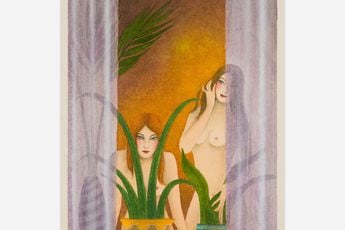
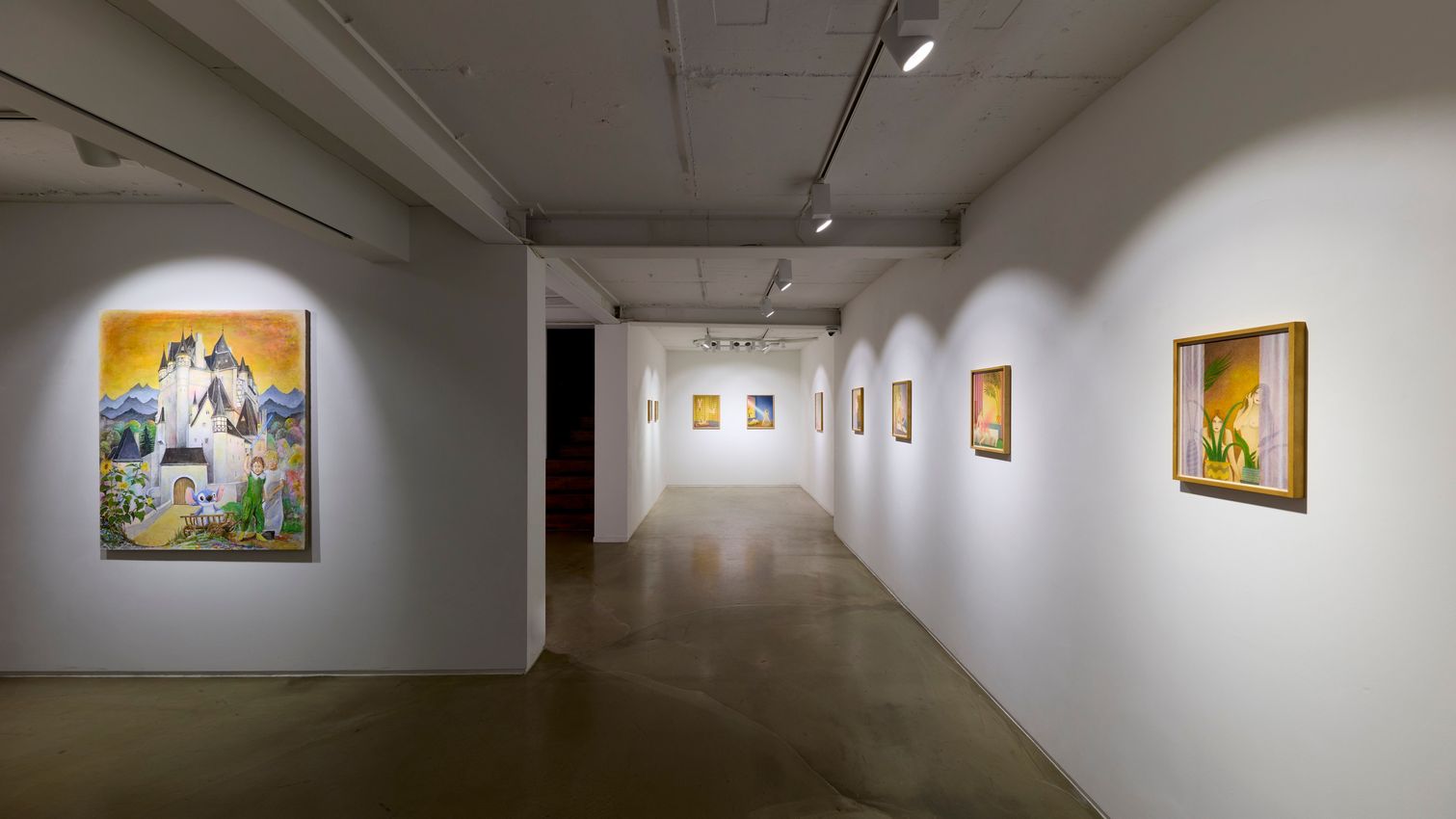
Presented jointly at JARILAGER Gallery Seoul, the works of Corinne von Lebusa and Michael Conrads move in this same refreshing register. Both painters confront idealised practices of image-making, identity/gender discourse and stereotypes with a healthy dose of whimsy. If Lebusa’s nudes or Conrads’ chimeras were to claim a symbolic address, it would likely be inside what Huizinga famously called the magic circle: the temporary arena created by a game, where possibilities may be tried out without consequence, identities role-played, things rearranged or entertained as if they were true. Across the paintings, the ordinary loosens its grip, fantasy and desire take over. Familiar elements appear slightly out of joint, figures and settings behaving with a certain theatrical licence—the pressure off, our Faustian bargain forgotten. Nuance, ambivalence and, above all, detail keep viewers hooked. Nothing is entirely fixed; the outcome remains cheerfully uncertain. The real reward does not lie in solving the images, but in the beauty of playing along.

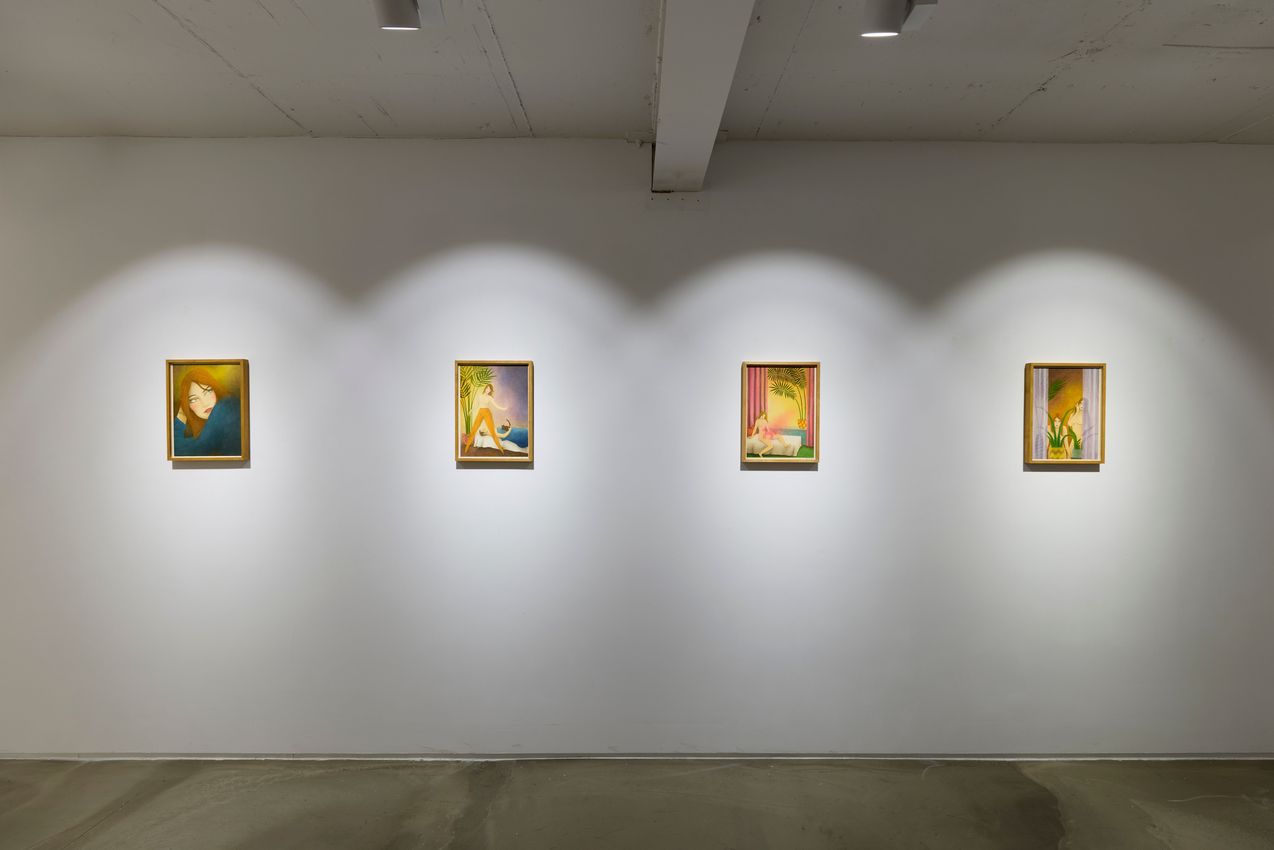
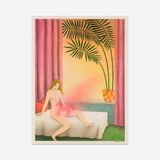
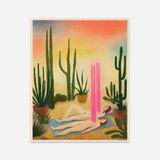
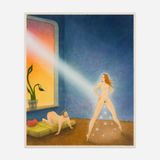
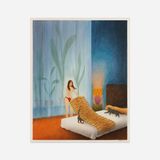
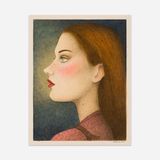
Corinne von Lebusa (b. 1978) paints small atmospheric scenes suspended mid-story. The main focus of her work might be described as an exploration of the breadth of female tenderness and an introspective reflection on the feminine principle. In Malibu (2024), we sense a moment of teasing inwardness. A young woman rests on her bed in a candy-lit room, playing a little game with Barbie’s horse. Delicately painted naked skin and uncovered breasts suggest vulnerability; yet the image simultaneously conveys the feeling of female sensuality and control: a woman self-possessed in her own body and free to explore erotic potential as and when she wishes it. In many of the works on view, plants frame the scene like gentle stage props. Exotic agaves and cacti appear—lush elements of a kind of paradise. Yet one might ask: paradise for whom? The relationship between women and men in Lebusa’s paintings is ambivalent, at times deliciously cruel. In her staged scenes, often bedrooms, men tend to occupy secondary roles; occasionally they are half-submerged or diminished, as in Sunshine Guild (2025)—a sassy game of one-sided adoration.

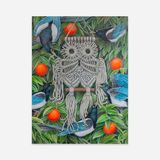
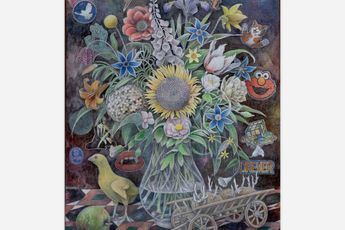
Michael Conrads (b. 1977) approaches painting with a pronounced sensitivity to structure, colour and rhythm. His compositions, whether abstract or figurative, balance carefully between order and mild disruption. Lines, grids, perspectival floors and geometric forms create a precise, almost architectural palimpsest. Most of his works reflect on pictorial construction—on the exchange between inner worlds, memories and the collective archive of images, whether the flowers of a Dutch master or the stickers from a teenager’s bedroom wall. In The Haunted Artist (2025), we face a studio scene illuminated by the cool light of the moon. At its centre, a self-portrait of the artist with the head of a monk vulture, surrounded by objects that drift between art history and invention: a Warhol Campbell’s can repurposed as a brush holder, a dangling light bulb recalling Bacon’s studio. On a deeper level, Conrads’ works can be understood as a continuation of childhood—the motto is playing. Time stops, images are saturated with references; objects hover in an in-between state: much like the castle in Die Burg (2026), they invite speculation about the fragile boundary between imagination and reality.

Read More

Installation Views

Selected Works

Loading...

Artists Exhibiting

About the Gallery

Since its establishment in 2012, JARILAGER Gallery (Cologne/Seoul) has played a pivotal role as the holding company for UNION Gallery (London) and has expanded its reach with the recent opening of its doors in Seoul’s Gangnam district in 2023. Jari Lager serves as the director of both entities. Over the course of a decade, JARILAGER Gallery (Cologne/Seoul) has evolved into a distinct entity while maintaining collaborative ties with its sister gallery, UNION Gallery, located in London and managed by William Gustafsson.

View Gallery Profile
Address
12 Eonju-ro 165-gil
Gangnam-gu
Seoul
South Korea
Opening Hours
Wednesday – Saturday
1pm – 6pm
And by appointment
(1)
Seoul 12 Eonju-ro 165-gil, Gangnam-gu
JARILAGER Gallery
12 Eonju-ro 165-gil, Gangnam-gu, Seoul, South Korea
+ 82 (0)10 8191 5834
http://www.jarilagergallery.com

Opening hours
Wednesday – Saturday
1pm – 6pm
And by appointment
The art world in focus