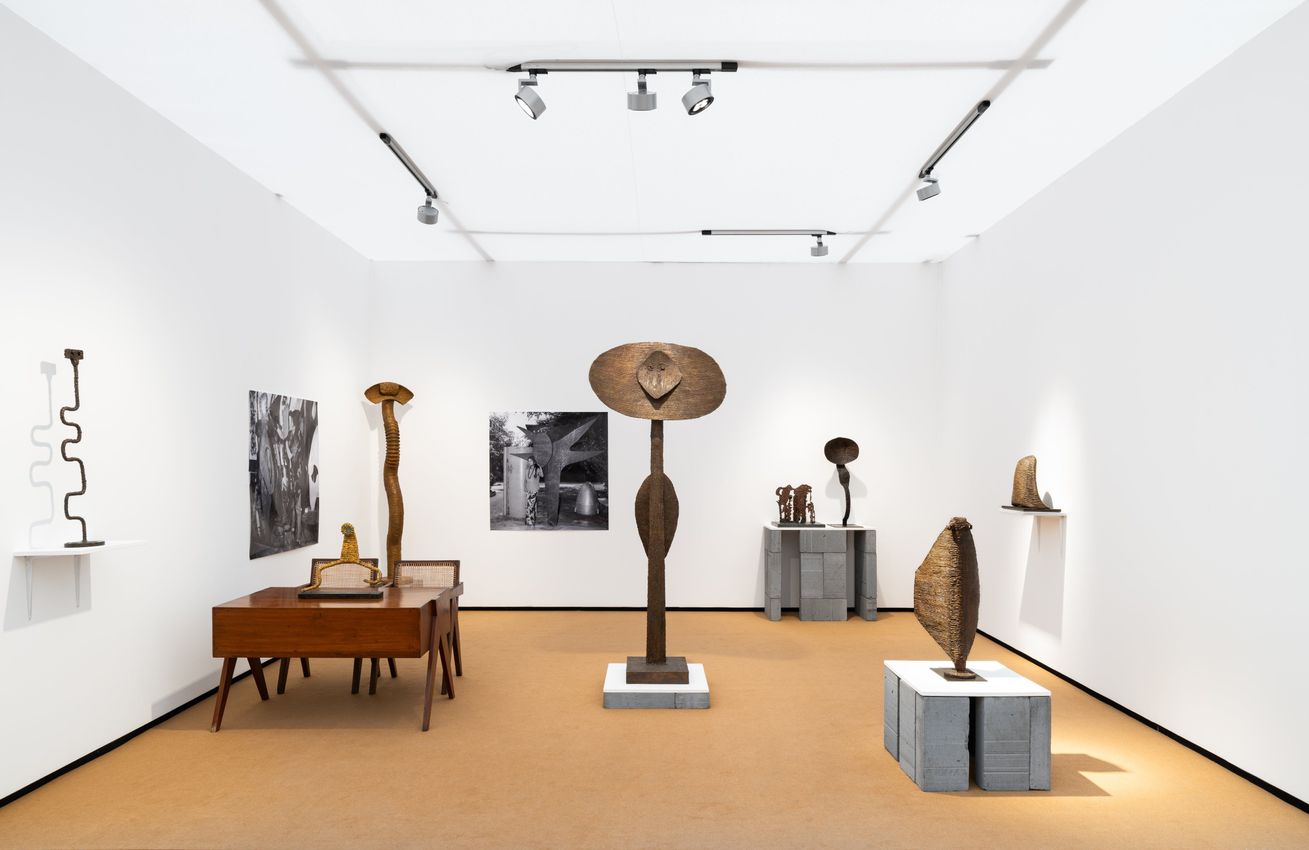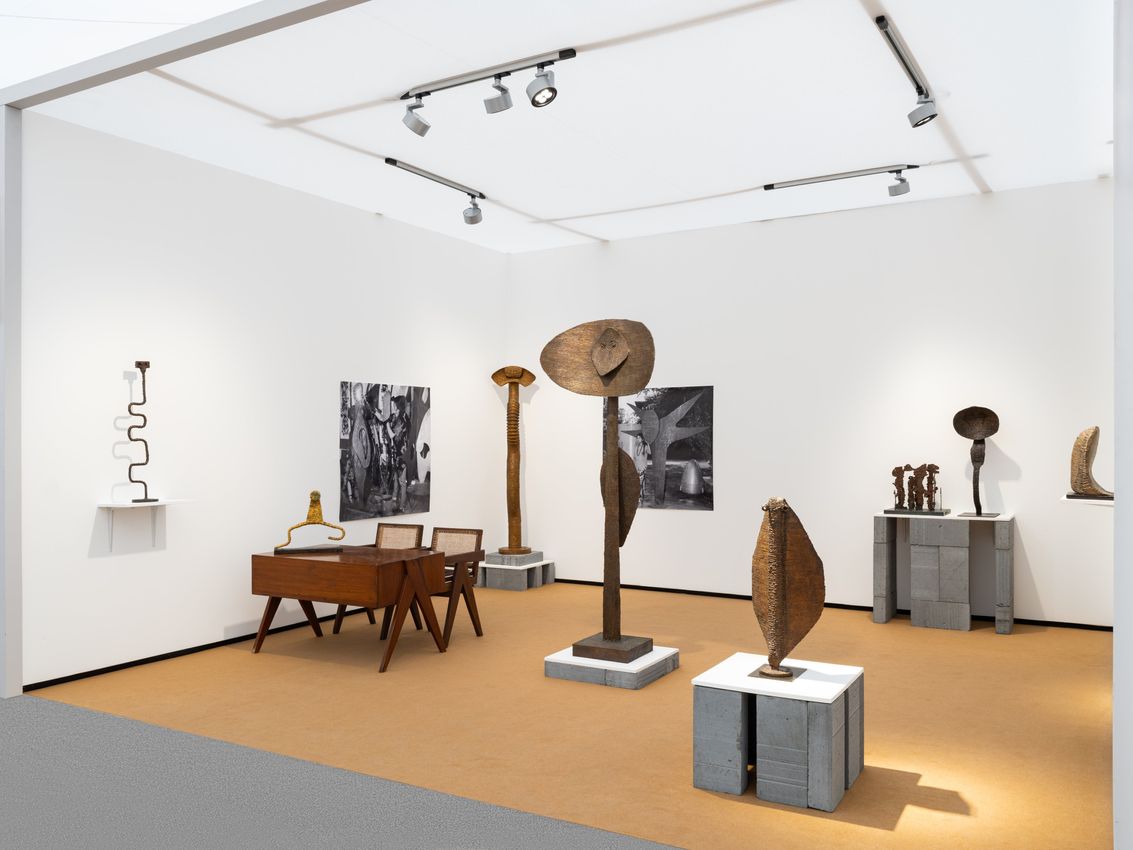
A bronze figure appears to lean slightly forward, one leg lifted in mid-motion, its limbs caught between balance and flight. La danse du soleil 1972 seems to hover, poised between gravity and release. For Novera Ahmed, who trained as an artist and later studied classical dance in India, the rhythmic sensibility of movement was central to her art. Made in France, La danse du soleil bridges two lifelong passions, form and dance, and demonstrates Ahmed’s enduring interest in the interplay of material, movement, and sculptural expression. Novera Ahmed’s practice occupies a space between worlds: modernity and tradition, abstraction and figuration, East and West. Her work renders these distinctions porous rather than oppositional, creating a language in which inherited myth, folk forms, and modernist experimentation coexist.
‘Look at Ahmed’s art and what it actually meant during that time, when there was a significant effort by artists from newly liberated countries to show a sense of identity; to own their art. Art in Bengal went the direction of Zainul Abedin and Quamrul Hassan, these founding figures who turned to the grassroots with landscapes and depictions of people, farmers, and everyday life. The earlier schools, like the Bengal School, had focused on stylised British forms and romanticised visions of Bengal. There is no doubt that Novera Ahmed was contributing to an entirely different form of Bengal – more emotive, more abstract, and modern. Not as others had done; this was a new way of rendering the rural into purely abstract forms. This is the milieu.’ – Saiful Islam
Born in the 1930s in Bengal, then part of British India, Ahmed’s story traversed continents and histories. She grew up primarily between the Sundarbans and Chittagong, surrounded by the rhythms of agrarian Bengal: the gestures of daily life, the intimacy between humans and animals, and riverine landscapes. Her fascination with three-dimensional forms was nurtured from childhood as her mother crafted traditional figures out of clay. After completing her early studies in Kolkata and Comilla, she relocated to London in the 1950s to continue her art education at the Camberwell School of Arts and Crafts.
Ahmed arrived in a postwar Europe that was preoccupied with rethinking the very language of sculpture. Her training brought her into contact with artists such as Karel Vogel and, by some accounts, Jacob Epstein, whose experiments with concrete and cement opened her to the expressive potential of so-called “base” materials—those traditionally regarded as outside the conventions of fine art. She later continued her studies in Florence under Venturino Venturi, further refining her approach to form and material. The sculptural languages of Henry Moore and Barbara Hepworth, with their explorations of volume and void, also resonated with her, yet she reinterpreted these modernist lessons through a sensibility rooted in the folk forms and vernacular traditions of Bengal.
Returning to East Pakistan (now Bangladesh) in the late 1950s, Ahmed applied her modernist training to create a series of sculptures, primarily in cement, that were at once modern and deeply rooted in local life. Her works featured rounded, ovoid forms suggesting women, domestic animals, and familial groupings. In August 1960, she held her first solo exhibition, Inner Gaze, in Dhaka. Among the earliest modern sculpture exhibitions in South Asia, it featured 75 of her works and established her as a pioneering figure in the region’s sculptural avant-garde.
Ahmed’s involvement in the design of the Shaheed Minar in Dhaka, a monument to the martyrs of the Bengali Language Movement, 1952, brought both visibility and erasure. Though she worked with Hamidur Rahman, her contribution was later obscured, leaving her excluded from the monument’s legacy. Frustrated by such marginalisation and by the limited opportunities for modern sculpture, she left East Pakistan, embarking on a peripatetic chapter in her life. Invited by Faiz Ahmed Faiz, she moved to Lahore in West Pakistan, and then to India to study dance, before settling in Paris. She also travelled through East and Southeast Asia, living in Bangkok for nearly three years in the late 1960s, a period that proved significant to her artistic development.
In Bangkok, Ahmed entered a pivotal phase of bold experimentation, moving from cement to metal and from mass to line. She welded and hammered thin metal sheets directly in space, often improvising without preparatory sketches, at times assisted by photographer Grégoire de Brouhns. The resulting sculptures -large, sinuous forms- emerged from this improvisational approach. Working in bronze, she discovered a medium whose properties enabled her to achieve monumentality while maintaining a sense of lightness. Her immediate environment in Thailand also shaped her imagination, with owls, snakes, and other local fauna echoing in her sculptural forms.
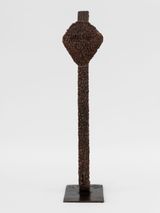
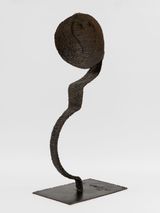
The late 1960s to the early 1970s, encompassing her years in Bangkok and her return to Paris, marks the mature phase of Ahmed’s sculptural practice. By this time, she had fully assimilated her diverse influences –folk idioms, modernist abstraction, and South and Southeast Asian mythologies– into a language entirely her own. Angkor, La danse du soleil, Djinn, Un serpent nommé désir, Le petit serpent, Cobra, L’envoûtement, and Bangladesh all belong to this period of artistic production and were made in France for an exhibition in 1973.
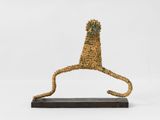
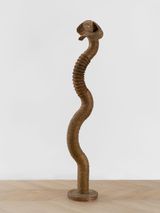
The serpent series stands among Ahmed’s most iconic. Vertical and coiled with latent energy, some svelte with pronounced heads, these bronzes embody both myth and memory. In her native South Asia, the naga –revered across Hindu and Buddhist mythologies– appears as an ancient guardian, at once protector and aggressor, a symbol of rebirth and power. Depending on where one stands – before, behind, or beside– the serpent may threaten, shield, or support. Serpents were familiar presences in her life, observed in both Bengal and Thailand, where Ahmed recalled watching them sunbathe near her home. This direct engagement with animals carries through to Angkor, a hollow sculpture constructed from thin, striated metal lines and cast in bronze. Named after her pet owl, Angkor, the sculpture translates the essence of the bird, its watchfulness and poised stillness, into three-dimensional form.
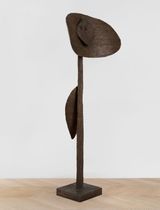
Much of Ahmed’s work reflects the personal dimension of her practice. Drawing on her environment, animals, movement, memory, and imagination, these sculptures translated lived experience into formal experimentation. In 1966, Ahmed had also begun exploring kinetic possibilities in works such as Le radarman, where movement and balance became intrinsic to the sculptural form. The sculpture combines a slender, column-like element with a heavier upper section, creating a tension between lightness and weight. Conceived on a large scale as a sentinel-like figure, its head could turn to scan the horizon, evoking vigilance, observation, and a probing gaze.
Alongside these personal explorations, Ahmed’s practice occasionally engaged with the political. Bangladesh 1971 exemplifies this turn. Conceived as a model for a larger monument that was never built, the work depicts a dispersed crowd of figures coalescing into a collective, rendered through flame-like sheets of metal arranged on a flat base. Each figure is distinct yet part of a group, suggesting individuals gathering in anticipation of a speech or moment of civic significance. The composition captures the spirit of a nation on the threshold of independence, and the subsequent establishment of Bangladesh.
Through a synthesis of folk traditions, abstract forms, and modern materials, Novera Ahmed forged a sculptural practice –and a broader artistic oeuvre– that was singular in vision and expansive in scope. Ahmed’s legacy endures not only in the formal innovations of her sculptures but also in the relevance of vernacular traditions within the global art discourse.
Essay courtesy Jhaveri Contemporary. Text: Beatriz Cifuentes Feliciano, 2025. With thanks to Saiful Islam and the Musée Novera Ahmed.


A respected voice in contemporary art discourse.
Focusing on ambitious storytelling and insightful art-world commentary. Ocula Magazine publishes in-depth interviews, critical essays and timely analysis on the artists, exhibitions and ideas driving the global art world.
Learn more about Ocula Magazine
Showcasing the best of the art world.
Ocula partners with galleries from around the world to highlight their artists, artworks and exhibitions. Gallery membership is by application and invitation, with each member vetted by an independent panel.
Learn more about Ocula Membership

Specialises in the sale of major artworks.
Led by a team with deep ties to the world’s leading auction houses, galleries and collectors. Ocula’s advisory team offers bespoke services to high-net-worth clients from around the world who are looking to acquire the best of contemporary and modern art.
Learn more about our team and services