





LUCIAN FREUD
1922-2011, GermanyAcclaimed figurative painter Lucian Freud was known for his ongoing exploration of the art of portraiture, considering both physiology and psychology. Over 70 years he created impasto portraits of family and friends based on intense observation of his subject, often over a long period of time.
Early Years
Lucian Freud was born in Berlin on 8 December 2022, grandson of pioneering psychoanalyst Sigmund Freud. They moved to London in 1933 and Lucian Freud attended schools in Devon and Dorset—returning to London in 1938, his drawings are included in a children’s art exhibition at Guggenheim Jeune. He studied at the Central School of Arts and Crafts in London for a term., transferring to the East Anglian School of Painting and Drawing at Dedham, where he was taught by artist and horticulturalist Cedric Morris. He joined the Merchant Navy, serving in the North Atlantic, but was invalided out in 1941. He moved back to London and his drawings began to be exhibited—his first solo show was at Alex Reid and Lefevre Gallery in 1944. He spent summer 1946 in Paris, where he made his first two etchings: The Bird and Chelsea Bun. His first marriage, to Kitty Garman, lasted from 1948–1952. In 1954, he represented Great Britain at the Venice Biennale, with Francis Bacon and Ben Nicholson.
Lucian Freud: Artworks
Lucian Freud became known as one of the most important figurative painters of portraits, faces and nudes. His detailed realism was created using dynamic brushstrokes, a technique that he also used to convey emotion.
- He was initially influenced by the figurative painters of the Slade School, as well as surrealism—partially glimpsed in Girl with a Kitten (1947), a portrait of his first wife Kitty Garman holding a kitten strangely tightly around the neck. By the 1950s his style had evolved towards realism
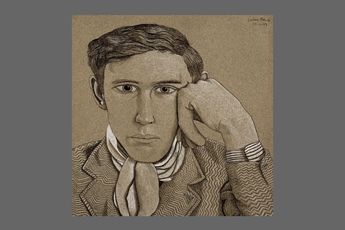
- Self-portraits were a huge part of Freud’s canon, including Man with a Feather (Self-Portrait) (1943) and Man with a Thistle (Self-Portrait) (1946), the latter showing how Freud was exploring the representation of textures from material to skin to leaf.
- The large-scale Large Interior, W11 (after Watteau) (1981–1983) reimagines the French artist’s Pierrot Content (1712), replacing the clown and its entourage with hyper-detailed human figures and everyday objects.
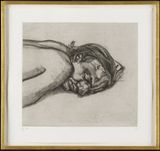
- Freud often painted Sue Tilley (who worked with Leigh Bowery)—perhaps the most recognised portraits of her are Woman with an Arm Tattoo (1996) and Benefits Supervisor Sleeping (1995), in which he painstakingly captures the nuances of human flesh but also challenges traditional representations of the nude by avoiding idealism and instead celebrating the actuality of human flesh.
Lucian Freud: Select Exhibitions
Select Solo Exhibitions
- Lucian Freud: Drawing into Painting, National Portrait Gallery, London (2026)
- Lucian Freud: The Painter and his Family, Freud Museum, London (2022)
- Lucian Freud: The Self-Portraits, Royal Academy of Arts, London (2019)
- Freud Project, Irish Museum of Modern Art, Dublin (2016, for five years)
- Lucian Freud Portraits, National Portrait Gallery, London (2012)
- Lucian Freud: The Painter’s Etchings, MoMA, New York City (2007)
- Lucian Freud: Etchings 1946–2004, Scottish National Gallery of Modern Art, Edinburgh (2004)
- Lucian Freud, Museum of Contemporary Art, Los Angeles (2003)
- Lucian Freud, Tate Britain (2002)
- Lucian Freud: Recent Work, The Metropolitan Museum of Art, New York City (1994)
- Lucian Freud Paintings, Hirshhorn Museum and Sculpture Garden, Washington DC (1987)
- Lucian Freud, Hayward Gallery, London (1974)
Select Group Exhibitions
- Moore/Freud, Hastings Contemporary (2026)
- Going Modern: British Art 1900–1960, Yale Centre for British Art (2026)
- A Vanished Wholeness, Modern Art, Paris (2025)
- Real Families: Stories of Change, Fitzwilliam Museum, Cambridge (2023)
- The Male Gaze, James Hyman Gallery, London (2014) *Bacon, Freud, Kossoff, Auerbach, James Hyman Gallery, London (2000)
Further Reading
- Lucian Freud Archive
- “Lucian Freud Art” Instagram
- 2026 article from the Guardian to coincide with the National Portrait Gallery exhibition
Lucian Freud FAQs
Was Lucian Freud friends with Kate Moss?
Yes, they formed a perhaps unlikely friendship when Freud painted Moss over nine months during 2002. The painting sold for £3.9m in 2005, even though neither artist nor model were allegedly happy with it. During this period, Freud—who learned to tattoo when he was in the navy—tattooed a flock of birds on Kate Moss’ thigh. A semi-fictionalised film of the creation of the portrait, Moss & Freud, was released in cinemas in 2026.
Did Lucian Freud paint Queen Elizabeth II?
Lucian Freud painted Queen Elizabeth between 2000 and 2001, creating a small (23cm x 15cm) canvas picturing the late monarch’s face and the Diamond Diadem crown. While Freud and the late queen allegedly got on well, discussing horse racing during sittings, when the portrait was revealed, sections of the British press considered it unflattering.
How many children did Lucian Freud have?
Lucien Freud acknowledged 14 children in his will, although there is speculation that he might have fathered as many as 30. He painted many of the children he recognised as his own—controversially, he persuaded six daughters and one son to pose nude.
What was Lucian Freud’s relationship with Francis Bacon?
Freud and Bacon were close friends for more than 40 years, but fell out during the 1980s. Both artists were fascinated by depicting the human figure, although while Freud painted live models, Bacon worked from photographs. They also painted each other; Bacon’s Three Studies of Lucian Freud (1969) was bequeathed to the Los Angeles County Museum of Art in 2025.
Ocula


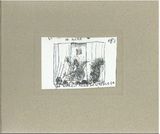

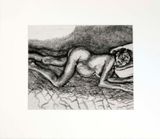

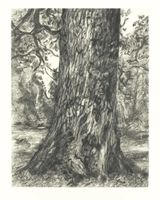

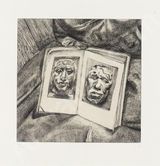

Explore Lucian Freud's Exhibitions




Lucian Freud in Ocula Magazine









Explore and Follow Artists Shaping Contemporary Art
A respected voice in contemporary art discourse.
Focusing on ambitious storytelling and insightful art-world commentary. Ocula Magazine publishes in-depth interviews, critical essays and timely analysis on the artists, exhibitions and ideas driving the global art world.
Learn more about Ocula Magazine
Showcasing the best of the art world.
Ocula partners with galleries from around the world to highlight their artists, artworks and exhibitions. Gallery membership is by application and invitation, with each member vetted by an independent panel.
Learn more about Ocula Membership
Specialises in the sale of major artworks.
Led by a team with deep ties to the world’s leading auction houses, galleries and collectors. Ocula’s advisory team offers bespoke services to high-net-worth clients from around the world who are looking to acquire the best of contemporary and modern art.
Learn more about our team and services