





STEVEN SHEARER
b. 1968, CanadaSteven Shearer’s painted figures bring music subcultures to the fore in work that references art history as well as contemporary themes. The Canadian artist also works in sculpture, drawing, text and photography mined from the internet.
Early Years
Steven Shearer was born in 1968 in New Westminster on the outskirts of Vancouver. He grew up in Port Coquitlam, another Vancouver suburb, which he remembers as not being “too spectacular”, although he said in a 2026 interview that he lived not far from Robert Pickton, “the Pig Farmer Killer” of the 1990s. As a teenager, Shearer spent a lot of time in his parents’ basement, listening to heavy metal, playing guitar and growing his hair long: references to metal are woven through many of his works. He achieved his BFA in 1992 at the Emily Carr University of Art and Design, first gaining recognition during the early 2000s.
Steven Shearer: Artworks
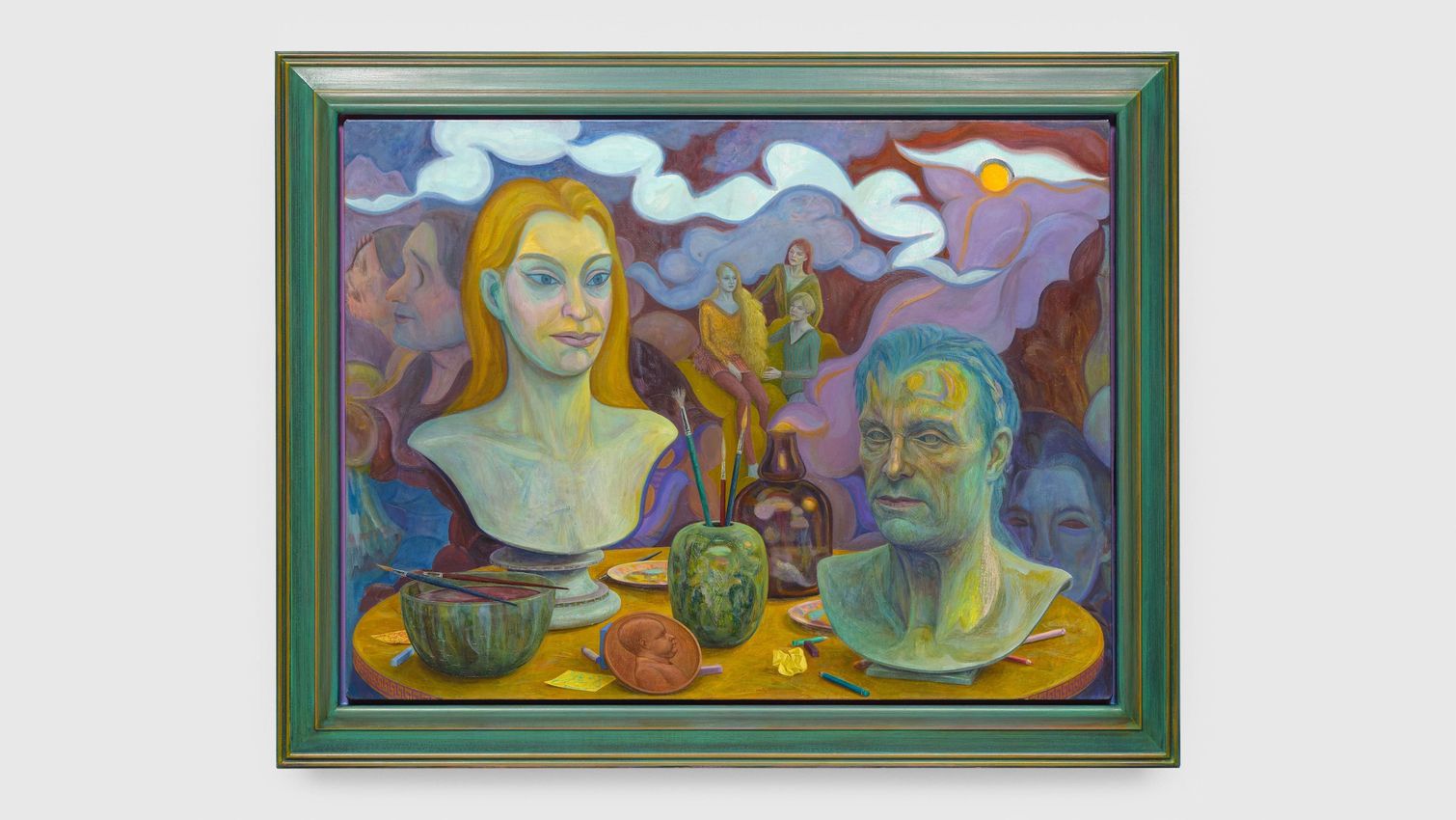
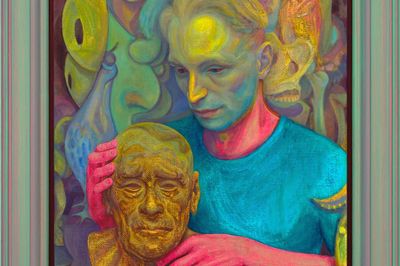
Steven Shearer weaves stylistic references from art history—from German Romantic Art to Old Masters to Fauvism and Symbolism—into his hypersaturated-colour paintings of figures frequently inspired by music subcultures. A solemn mood is often communicated through dark backgrounds, metallics and subtle flesh tones. Man Sitting (2006), for example, sees Shearer inspired by a photograph of a heavy metal drummer to create an oil painting of a gender-fluid youth executed in a style that offers echoes of Edvard Munch.
He also works with text—his Poem for Venice, which stood outside the Canada Pavilion at the 2011 Venice Biennale, was a monumental text work featuring lyrics from death metal songs in huge white lettering on a black background. Found photography also plays a part in Shearer’s creative practice: he has downloaded pictures from the internet (frequently of people sleeping), yet has, years later, reverse-searched these and discovered they are no longer online.
2026’s Tokerman sees Shearer’s familiar youth subjects growing up. An older-looking figure is in the foreground of the painting, smoking a joint (Shearer described this in a 2026 conversation with Raf Simons as a “Renaissance low-relief figure”), while behind him could be fingers or toes (Shearer sees it as a car), and behind that lie clouds.
- The Wizzer (2026), Shearer’s largest painting at the time of its production, frames a long-haired figure in a narrow brick arch. Exhibition text from his 2026 David Zwirner show My Moody Muse points towards a pseudo-religious composition, with the figure’s pallor reminiscent of “dying saints”.
Steven Shearer: Exhibitions
Select Solo Exhibitions
- Steven Shearer: My Moody Muse, David Zwirner, London (2026)
- Steven Shearer: The Golden Recline, Galerie Eva Presenhuber, Maag Areal, Zurich (2025)
- Steven Shearer: Wools and Effigies, P21, Seoul (2025)
- Spotlight: Steven Shearer, Flag Art Foundation, New York City (2024)
- Steven Shearer: Profaned Travellers, David Zwirner, New York (2024)
- Steven Shearer: Sleep, Death’s Own Brother, The George Economou Collection, Athens (2023)
- Steven Shearer: Working from Life, Galerie Eva Presenhuber, Zurich (2021)
- Steven Shearer, Polygon Gallery, Vancouver (2021)
- Steven Shearer: The Late Follower, Eva Presenhuber, New York City (2018)
- Steven Shearer: Printed Works, Galerie Eva Presenhuber, Zurich (2017)
- Steven Shearer, Brant Foundation Art Study Centre, Greenwich, Connecticut (2016)
- Steven Shearer: Selected Works, Charles Riva Collection, Brussels (2015)
- Steven Shearer: Exhume to Consume, Canada Pavilion, 54th Venice Biennale (2011)
- Double Album: Daniel Guzmán and Steven Shearer, New Museum, New York City (and MUCA, Mexico City (2008) [two-person exhibition]
- Steven Shearer, Ikon Gallery, Birmingham (2007)
- Steven Shearer, Mars Gallery, Tokyo (2002)
- Steven Shearer: Craftmonster, Monte Clark Gallery, Vancouver (1999)
Select Group Exhibitions
- The Only True Protest is Beauty, Palazzo Pisani Moretta, Venice (2026)
- Zeichnungen und Drucke (Drawings and Prints), Galerie Eva Presenhuber, Vienna (2025)
- Day for Night: New American Realism, Palazzo Barberini, Rome (2024)
- Death and the Devil: The Fascination with Horror, Kunstpalast, Dusseldorf (and touring) (2023)
- Dark Light: Realism in the Age of Post-Truths, Aïshti Foundation, Beirut (2022)
- Just what is it that makes today so different, so appealing?, Galerie Patrick Seguin, Paris (2019)
- Canadian Biennial, National Gallery of Canada, Ottawa (2017)
- Freux Follets, BBB Centre d’Art, Toulouse (2016)
- 1+1=1: When Collections Collide, Montreal Museum of Fine Arts in collaboration with Musée d’art contemporain de Montréal, (2014)
- Fresh Hell—Carte Blanche à Adam McEwen_, Palais de Tokyo, Paris (2010)
- Pop! goes the weasel_, Badischer Kunstverein, Karlsruhe (2008)
- Pin Up: Contemporary Collage and Drawing, Tate Modern, London (2004)
Further Reading
- Artist profile at David Zwirner
- Steven Shearer’s Tumblr
- Interview in The Guardian (2026)
- Steven Shearer’s Instagram
Steven Shearer FAQs
Why are there no pictures of Steven Shearer on the internet?
Despite Steven Shearer’s use of images of sleeping people culled from the internet, the artist has apparently managed not to allow any pictures of his face to appear on the internet (a picture that purports to be the artist does not match the written description of the artist from a 2026 interview in The Guardian).
What are the main themes in Steven Shearer’s work?
Steven Shearer explores music subcultures (particularly heavy metal) and the ideas of white masculinity within them, but also refers to art history in his oil paintings—from German Romanticism to Symbolism, Fauvism and the Old Masters.
How did Steven Shearer use pictures of sleeping people?
Steven Shearer created a massive collage of sleeping figures, made from thousands of images sourced online, for Sleep II (2015). Later, he enlarged these images on to canvas—for example, in the exhibitions The Golden Recline (2025) and Profaned Travellers (2024). Taking a painterly approach to the artworks, he has digitally filled in the gaps that the original enlargement generated.
Ocula




Steven Shearer in Ocula Magazine





Explore and Follow Artists Shaping Contemporary Art
A respected voice in contemporary art discourse.
Focusing on ambitious storytelling and insightful art-world commentary. Ocula Magazine publishes in-depth interviews, critical essays and timely analysis on the artists, exhibitions and ideas driving the global art world.
Learn more about Ocula Magazine
Showcasing the best of the art world.
Ocula partners with galleries from around the world to highlight their artists, artworks and exhibitions. Gallery membership is by application and invitation, with each member vetted by an independent panel.
Learn more about Ocula Membership
Specialises in the sale of major artworks.
Led by a team with deep ties to the world’s leading auction houses, galleries and collectors. Ocula’s advisory team offers bespoke services to high-net-worth clients from around the world who are looking to acquire the best of contemporary and modern art.
Learn more about our team and services