
‘To me, the poetic quality of the works, especially the two earlier ones, comes through in the delicate overlays and the slightly effervescent colours. There is something poetic in them. There is also joy. That childlike joy in the simple things, like looking closely, trying to guess what you see. That sense of spontaneous wonder, of playful wandering, is something Balraj carried into his work.’
—Kaushalia Khanna
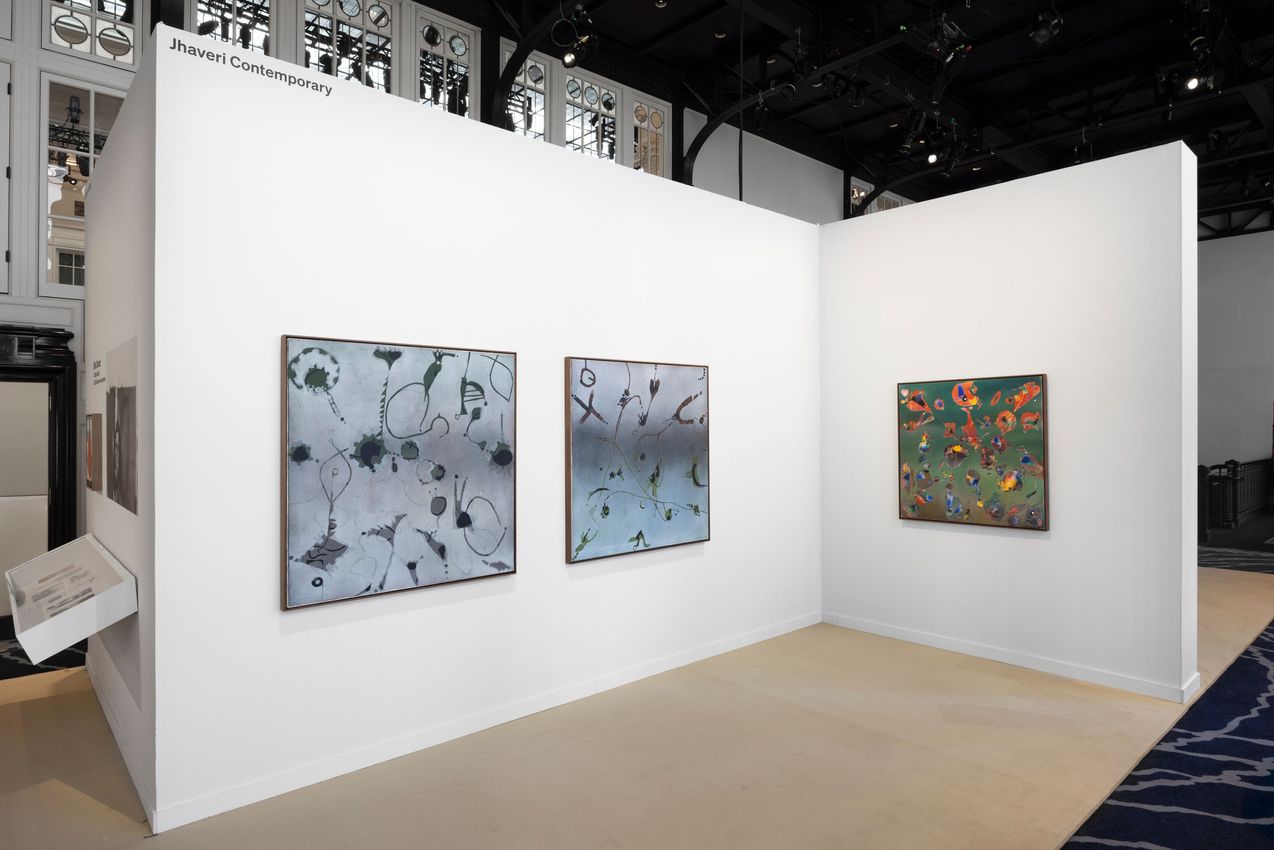
Balraj Khanna’s Pond on Hampstead Heath paintings are abstracted explorations of the landscape that capture the quiet poetry of forms drifting across water. This trio –two canvases from 1986 and a third from 1999– returns to the single motif of the pond to explore its shifting moods and possibilities over time. Seen in sequence, the works read as variations on a theme, a meditation on surface and depth, movement and stillness. These canvases highlight Khanna’s sustained engagement with the landscape and with water in his practice. They are also markers of the artist’s mature style: inventive and deeply personal.
Born in 1939 in present-day Indian Punjab, Khanna moved to the UK in 1962 to study English Literature before turning fully to art. A painter and writer, he became associated with a circle of peers in London, including F.N. Souza and Avinash Chandra, who were exploring questions of modernism, migration, and identity in the British art world. During the 1960s, Khanna joined the Indian Painters’ Collective, a group of Indian artists in the UK who sought to promote their work and engage with these cultural and artistic debates. It was during this period that he also embraced abstraction as his primary mode of expression.
In 1965, while convalescing from a motorcycle accident at his wife Francine’s family home in Metz, in northeast France, Khanna entered a pivotal phase in his practice. Immersed in the surrounding forest, he deepened his connection with nature, which became central to his work. Drawing on his life in Britain, his Indian heritage, and his time in France, he developed a distinctive visual language that foregrounded colour and form.
Khanna’s paintings were born from his imagination, informed by his observations of nature. Here, abstraction meets memory, observation fuses with invention, and the water’s surface becomes a metaphor for reflection and transformation. The Ponds on Hampstead Heath are at once depictions and meditations.
For Khanna, the pond was not a neutral motif. Its meaning extended beyond Hampstead Heath, where he often walked when living nearby in North London. The pond belongs to a lineage of nature as metaphor, tied to the English Romantic poets from which he drew inspiration. John Keats, who lived on the edge of the Heath, and Samuel Taylor Coleridge, who found inspiration in the Lake District, both wrote of landscapes as mirrors of the mind. For them, weather, seasons, and solitude were not background but states of being. Khanna’s interest in ponds channels this legacy, filtered through his own diasporic lens. Like the Romantics, Khanna treats landscape less as a literal scene than as a mirror of the self.
The pond is an intimate body of water, smaller than a lake or river, often observed from above. It invites close looking: lilies floating, insects darting, reflections rippling. In his paintings, Khanna magnifies this dual perspective of the macro and the micro, the visible surface and the teeming life below. His forms could be read as petals or bacteria, ripples or creatures. Meaning is left open-ended, and the works also carry a metaphysical dimension. Khanna often returned to water as a symbol of creation itself. Do we come from water? Are our origins bound to this element? As a writer, he also used the titles of his paintings to offer poetic clues, guiding the viewer’s attention and interpretation without prescribing a single meaning.
The two canvases from 1986 feature large, rounded ovals that appear to drift across the surface, resembling lilies or bubbles seen from above. Dotted lines link them, creating rhythm and movement, like ripples on the water. Set against light pink and blue hues, the compositions are airy, conveying a sense of freshness and spontaneity. These paintings retain a two-dimensional clarity: the shapes seem to float across a flat plane, with subtle transparencies, evoking both stillness and gentle wandering. Their palette of delicate tones is evocative of Monet’s water gardens, transposed into Khanna’s distinctly playful abstraction and colour. Fine sand produces a subtle relief on the canvas, adding texture without disrupting the paintings’ delicacy.
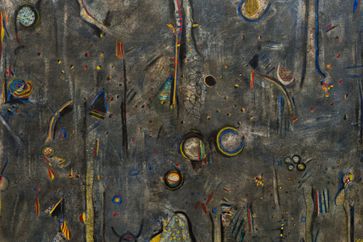
The 1999 Pond on Hampstead Heath introduces a shift in form and texture. The shapes are more intricate, with sharply defined contours that could suggest microscopic organisms or aquatic creatures glimpsed beneath the surface. Coarser sand produces a more pronounced relief, giving the canvas a tactile presence. The colours are deeper and richer, lending the work a bolder, more grounded mood. In this later painting, Khanna’s mature style is evident, as technique and metaphor are layered with confidence and intensity.
In all three of the Pond on Hampstead Heath paintings, Khanna worked from his imagination, never painting en plein air or using photographs or sketches. By the mid-1980s, he had entered a highly creative period in which his approach matured. He embraced acrylics, incorporated sand, used string to draw lines, cut stencils by hand, and mastered the technique of blowing paint with his own breath. These techniques, developed through careful experimentation, became the core of his method and continued into the 1990s.
His process was both disciplined and playful. Canvases were often laid flat on the studio floor so sand, a found object sourced from his immediate urban environment, could settle, adding texture and depth. Previously cut paper forms were used as stencils, arranged on the surface, sprayed over, and then removed, leaving traces that became his characteristic organic, enigmatic shapes. Each stencil was intended for single use, ensuring that every composition remained unique.
Khanna’s paintings are noted for their lyrical abstraction, delicate handling of form, and deeply personal vision, reflecting a sustained engagement with the natural world and its metaphysical resonances.
The Pond on Hampstead Heath paintings embody multiple registers. They are intimate landscapes of London, tied to a specific place yet rendered through abstraction. They are cultural hybrids, shaped by Khanna’s Punjabi heritage, his French connections through marriage, and his life in Britain. They are ecological meditations, attentive to the micro-worlds of water long before environmental consciousness became widespread. And they are poetic reveries, aligned with a literary tradition that shaped the artist’s sensibility as much as his visual one.
Courtesy Jhaveri Contemporary, Mumbai. Text: Beatriz Cifuentes Feliciano, 2025 With thanks to Kaushalia Khanna.

Balraj Khanna (b. 1939, Jhang - d.2024, London. Lived and worked in London) a versatile creative talent, excelled as an artist, writer and curator. Relocating to London in 1962 to pursue a literature degree at Oxford University, he instead focused on painting and developed a rhythmic style of abstraction that was indebted to nature. Atop layered pigment, sometimes given texture by sand, seemingly weightless and shape-shifting forms evoked memories of the rural landscapes associated with his childhood in Chandigarh, Punjab. Later utilising stencils and spray paint, the works hinted at a microcosm of life both on earth, in the ocean and beyond.

A respected voice in contemporary art discourse.
Focusing on ambitious storytelling and insightful art-world commentary. Ocula Magazine publishes in-depth interviews, critical essays and timely analysis on the artists, exhibitions and ideas driving the global art world.
Learn more about Ocula Magazine
Showcasing the best of the art world.
Ocula partners with galleries from around the world to highlight their artists, artworks and exhibitions. Gallery membership is by application and invitation, with each member vetted by an independent panel.
Learn more about Ocula Membership

Specialises in the sale of major artworks.
Led by a team with deep ties to the world’s leading auction houses, galleries and collectors. Ocula’s advisory team offers bespoke services to high-net-worth clients from around the world who are looking to acquire the best of contemporary and modern art.
Learn more about our team and services