




MONIKA SOSNOWSKA
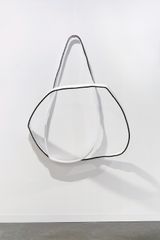
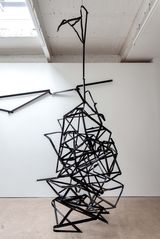
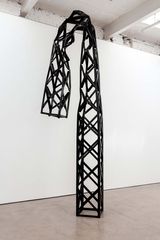
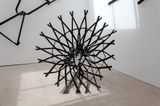
b. 1972, PolandUsing construction materials such as concrete and steel beams, Monika Sosnowska creates enormous, site-specific installations that engage with the psychological properties of architecture and the legacies of post-war modernism.
Monika Sosnowska’s Early Years
Born in 1972 in Ryki, Poland, Sosnowska studied at a private art academy in Poznań between 1992 and 1993, before transferring to the painting department at Poznań’s Academy of Fine Arts. There, conceding to a desire to escape the boundaries of the canvas, she abandoned painting to embrace three-dimensional work.
In 1999, Monika Sosnowska took up postgraduate studies at the Rijksakademie van Beeldende Kunsten in Amsterdam. The next year, she erected one of her first large-scale installations: The Additional Illumination (2000) saw the artist arranging hundreds of found lamps on the rooftop of Amsterdam’s Royal Academy of Art. In a gesture of futility, the lamps were kept on even when the sun was shining.
Alice in Wonderland and Absurdity
Absurdity is a recurring theme in Sosnowska’s practice, often employed to confuse the works’ relationship to the body by dramatically distorting scale and form. For Little Alice (2001), Sosnowska built a corridor of four Victorian-style rooms at Warsaw’s Center for Contemporary Art at Ujazdowski Castle. Referencing the ‘shrinking’ scenes from the novel Alice in Wonderland, the proportions of each room progressively diminished, the last being miniscule. Similarly, at New York City’s Sculpture Centre in 2003, Sosnowska built an installation comprising a Russian-doll arrangement of increasingly smaller doors.
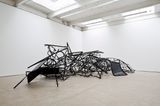
Non-functional hallways were a mainstay of Sosnowska’s output during this period. In 2003, she gained international attention at the 50th Venice Biennale for her installation, The Corridor, which employed optical tricks to resemble a hallway much longer than it actually was. In 2007, Sosnowska represented Poland at the 52nd Venice Biennale. For the Arsenale solo exhibition, titled 1:1, she used black steel beams to recreate the structure of the Polish Pavilion in its interior, which appeared to bend and buckle under invisible pressures. The work, which was monumental in scale, resembled a burnt-down cathedral of which only its metal framework remained.
Failures of Architecture
1:1 is a notable example of Sosnowska’s interest in the failures of architecture, which informs her practice until the present day. This concern arises out of political circumstance; growing up in Poland, Sosnowska witnessed the impact that the transition from communism to democracy had not only on Poland’s socioeconomic reality, but also on architecture and public construction. Thus, forms of her installations are often influenced by the geometric, prefabricated aesthetic of Eastern European housing blocks, government offices, shopping centres, and transit stations.
Sosnowska lives and works in Warsaw.
Elliat Albrecht | Ocula | 2021


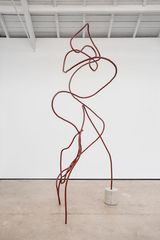

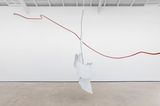
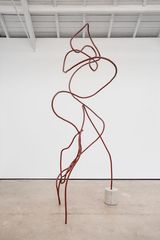















Explore Monika Sosnowska's Exhibitions







Explore and Follow Artists Shaping Contemporary Art
A respected voice in contemporary art discourse.
Focusing on ambitious storytelling and insightful art-world commentary. Ocula Magazine publishes in-depth interviews, critical essays and timely analysis on the artists, exhibitions and ideas driving the global art world.
Learn more about Ocula Magazine
Showcasing the best of the art world.
Ocula partners with galleries from around the world to highlight their artists, artworks and exhibitions. Gallery membership is by application and invitation, with each member vetted by an independent panel.
Learn more about Ocula Membership
Specialises in the sale of major artworks.
Led by a team with deep ties to the world’s leading auction houses, galleries and collectors. Ocula’s advisory team offers bespoke services to high-net-worth clients from around the world who are looking to acquire the best of contemporary and modern art.
Learn more about our team and services