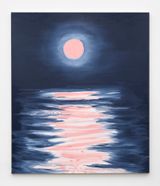
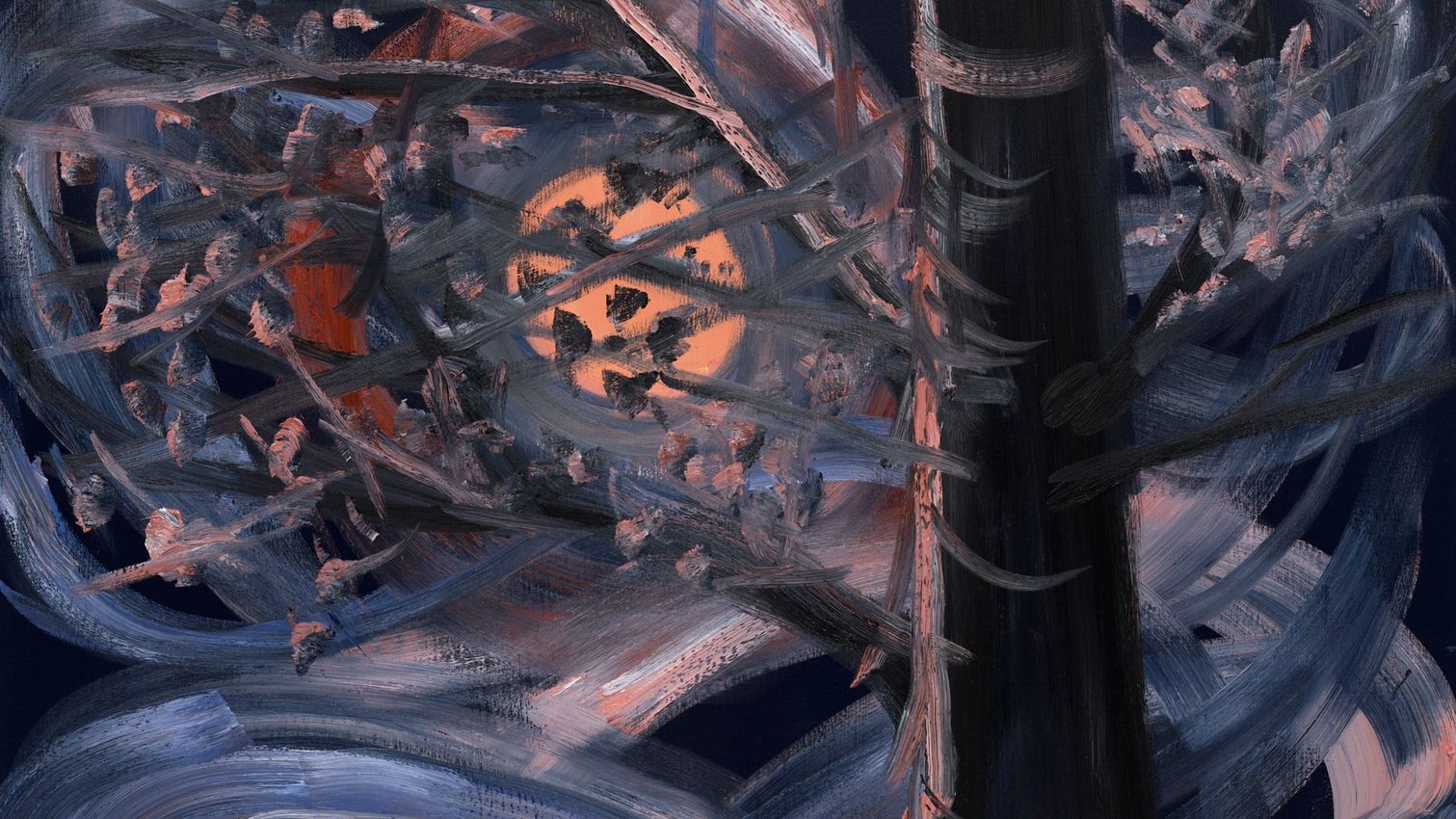
Since she first painted the moon in Maine in 1995, Ann Craven has returned to the subject in its countless guises—waxing and waning; full and crescent; yellow, pink, and white. This exhibition brings together three grids of moon paintings from 2009, 2012, and 2022 with new, larger canvases that revisit selected earlier compositions. Each grid unites a group of smaller paintings from that year into a single work. Across changes in scale, place, and time, the moon has become Craven’s means of archiving experience and, years later, returning to it. Moons (2009, 2012, 2022), 2026 traces the interplay of observation, repetition, and memory at the heart of her practice.
Working en plein air on small, square canvases—often three, but at times up to five in one evening—Craven follows shifts in light, atmosphere, and her own perception. Though she returns to the moon night after night, each of her fourteen-by-fourteen-inch paintings registers a particular encounter. In one of the eighty-eight squares that compose Moons, 2012 (2012), made in Guilford, Connecticut, at 9:30 pm on August 25, a white crescent illuminates a veil of brushed clouds with flecks of soft yellow. In the next panel, finished later that same night, the moon has become a golden blaze, its light spreading into the shape of a cross. Craven records the location, date, and time she completes each canvas in its title, anchoring every impression in the circumstances of its creation.
Three years after producing the small moon paintings, Craven gathers those that she has kept in her studio into a single grid, forming one artwork. This practice, a rule she has followed for more than a decade, extends the conceptual logic of her iterative process: just as each painting holds a particular moment, each grid arranges a year’s paintings in sequence, functioning as a visual diary. Together, they preserve a record of passing time and reveal “the guts . . . the DNA of the year,” Craven says. The artist, who grew up in a family of roofers in Boston, has likened the repetitive act of laying tiles on a roof to the rhythm of her own brushwork. The grid is also a protective arrangement: like shingles, its squares accumulate into a unified structure, connecting her family’s labor to her own approach to painting.
The three grids at the core of the exhibition bring distinct periods and places into view. In the 2009 Paris paintings, made on the sidewalks of the Marais in the January cold, the moon emerges from darkness as pale crescents and glowing disks, at times behind skeletal winter branches. The 2012 paintings, made in New York, Connecticut, and Maine, range from isolated yellow orbs to expanses of blue swept by clouds. The nocturnes grow more dramatic in the 2022 paintings made in Cushing, Maine, which depict the moon in vivid palettes, fluorescent halos, and looping clouds.
Craven’s new paintings, created in 2026 on sixty-by-sixty-inch canvases, return to compositions from each of these years. The larger works, which she calls “revisitations,” are guided by both her recollection of the original encounter and the muscle memory of the brushwork. “It’s all memory,” she explains, “the memory of a brushstroke is potent.” Held in lush, sensuous passages of pigment, Craven’s painterly marks function as content, preserving something of how she felt at a given moment and offering her a new way to return to it.
For Craven, the moon invites prayer-like devotion because it is at once “a constant presence, always the same” and also “perpetually changing.” Similarly, even as she returns to a single celestial body—or to a view of it first observed years before—no two moon paintings are exactly alike. In the revisitation Moon (Guilford, 8-25-12, 11:22 PM), 2026 (2026), she extends the cruciform image first glimpsed in the small 2012 painting, at once brightening its yellow beams and stretching them outward. Each revisitation carries an earlier encounter forward, registering the changes introduced by time, memory, and the artist’s hand.
Ann Craven (b. 1967, Boston, MA) is known for her lush, serial portraits of the moon, birds, and flowers, as well as her painted bands of color. After completing each work, she dates and titles each palette, rendering it a unique and isolated index of her process. Craven’s predilection for the copy—both from referent photographs and from her own plein air paintings—is both an homage to Pop Art and an exploration of remembrance. As she explains, “My paintings are a result of mere observation, experiment, and chance, and contain a variable that is constant and ever-changing—the moment just past.” Craven presented her first retrospective, titled TIME and curated by Yann Chevalier, at Le Confort Moderne in Poitiers, France in 2014. Recent solo exhibitions include Karma, New York (2021); the Center for Maine Contemporary Art, Rockland, Maine (2019); Shane Campbell Gallery, Chicago (2019); Karma, New York (2018); Southard Reid, London (2017); Maccarone, New York (2016); among others.


A respected voice in contemporary art discourse.
Focusing on ambitious storytelling and insightful art-world commentary. Ocula Magazine publishes in-depth interviews, critical essays and timely analysis on the artists, exhibitions and ideas driving the global art world.
Learn more about Ocula Magazine
Showcasing the best of the art world.
Ocula partners with galleries from around the world to highlight their artists, artworks and exhibitions. Gallery membership is by application and invitation, with each member vetted by an independent panel.
Learn more about Ocula Membership

Specialises in the sale of major artworks.
Led by a team with deep ties to the world’s leading auction houses, galleries and collectors. Ocula’s advisory team offers bespoke services to high-net-worth clients from around the world who are looking to acquire the best of contemporary and modern art.
Learn more about our team and services