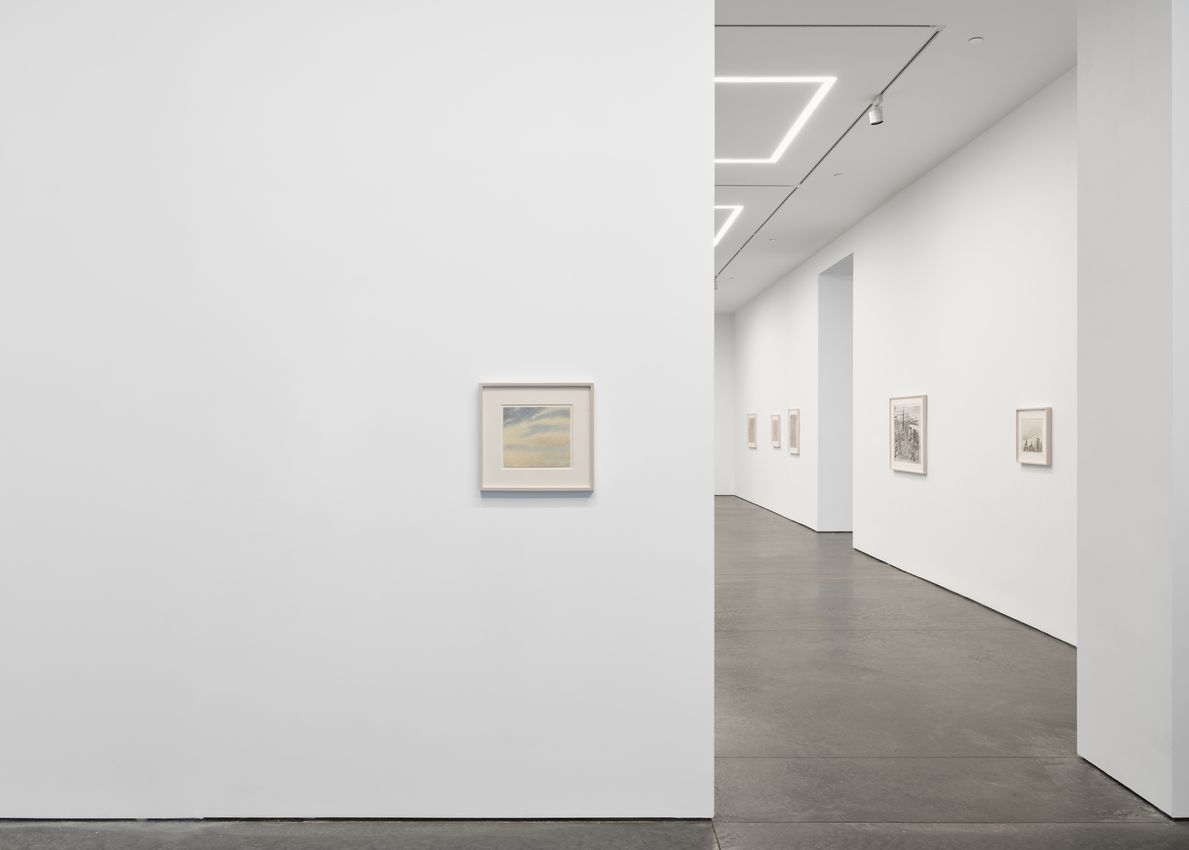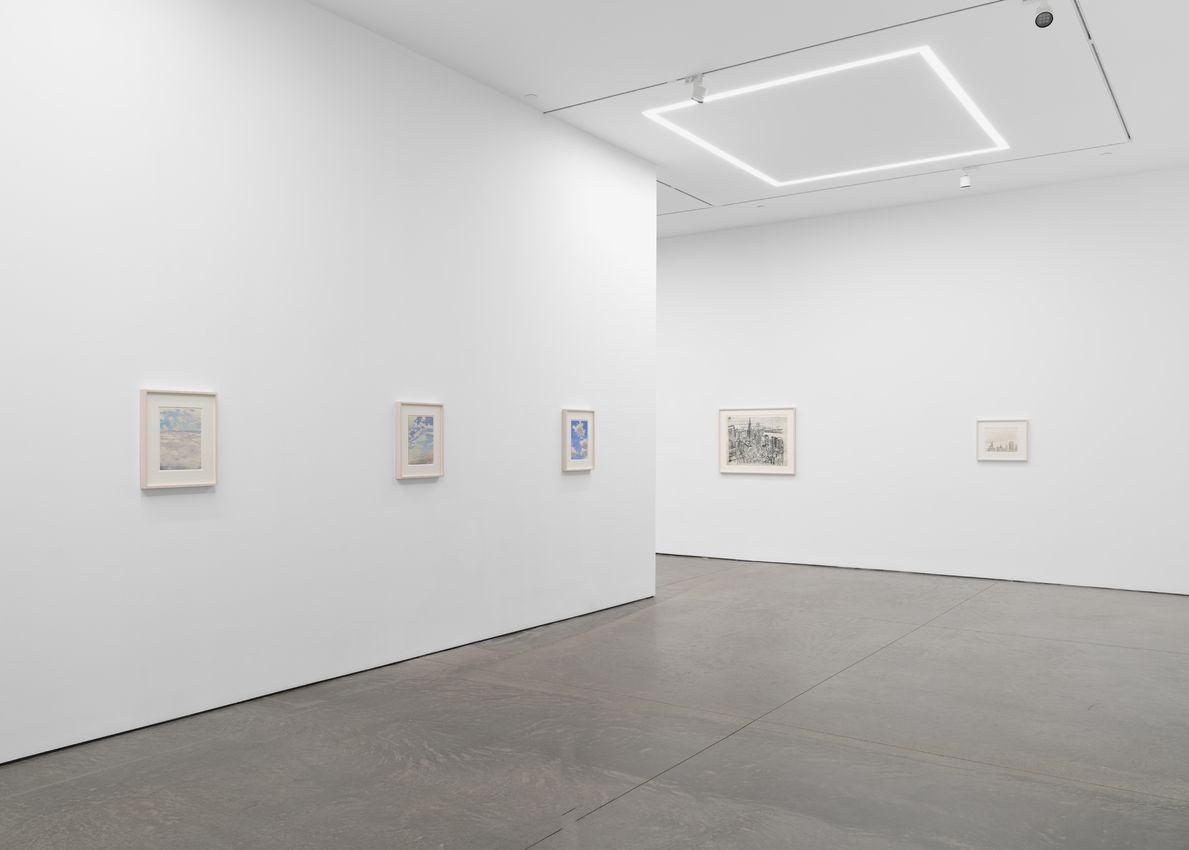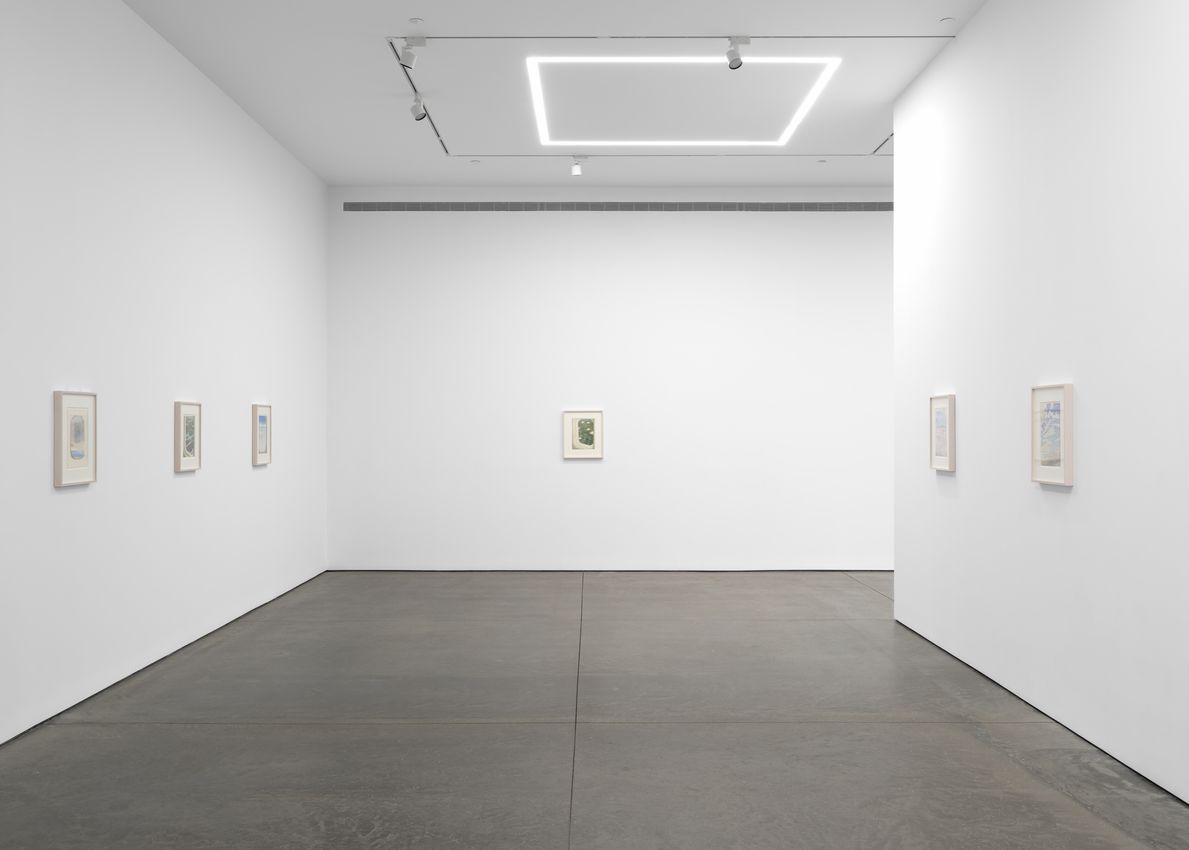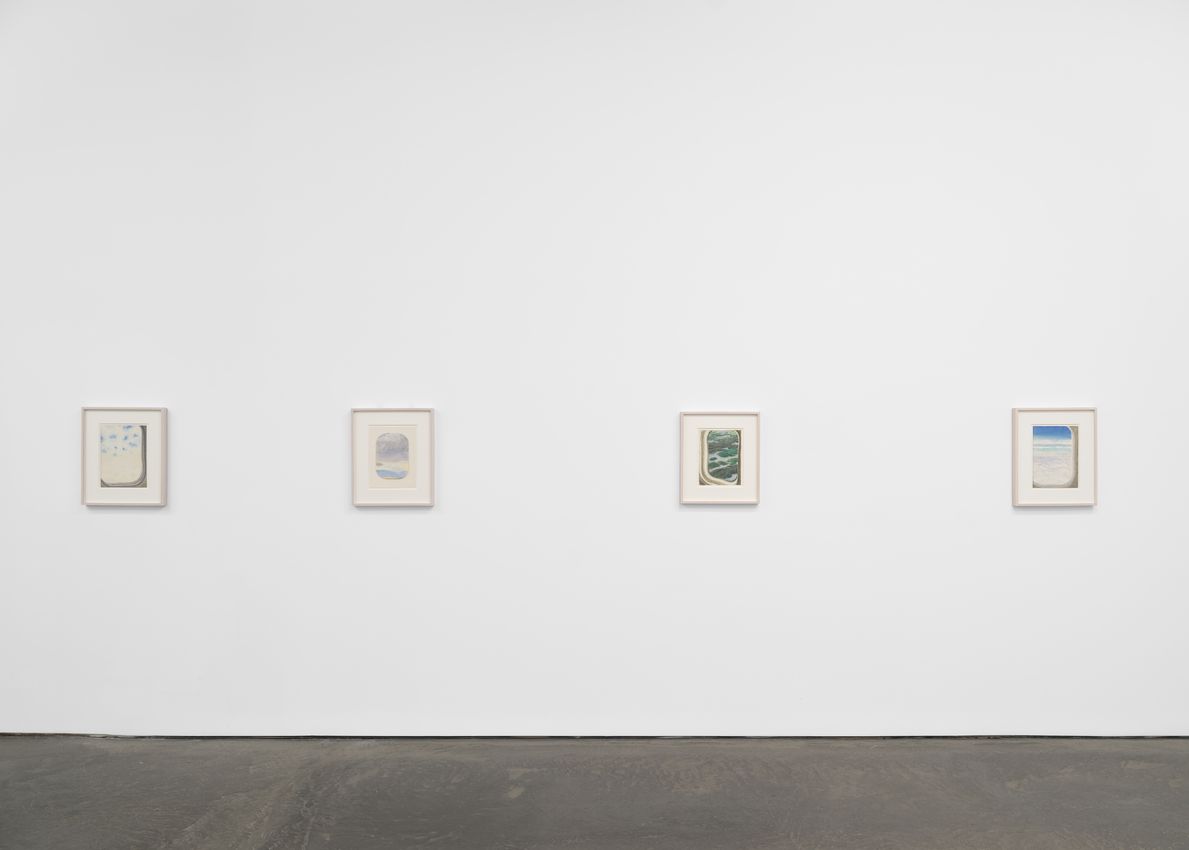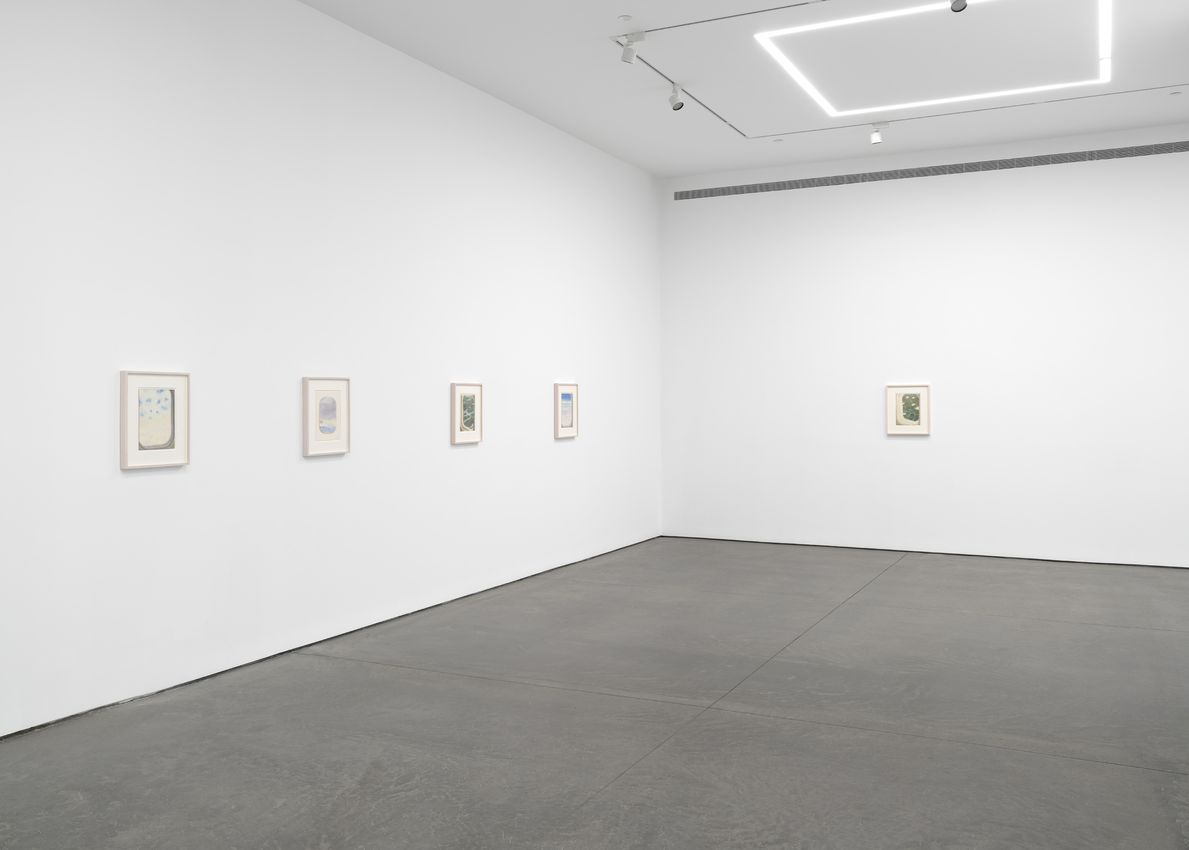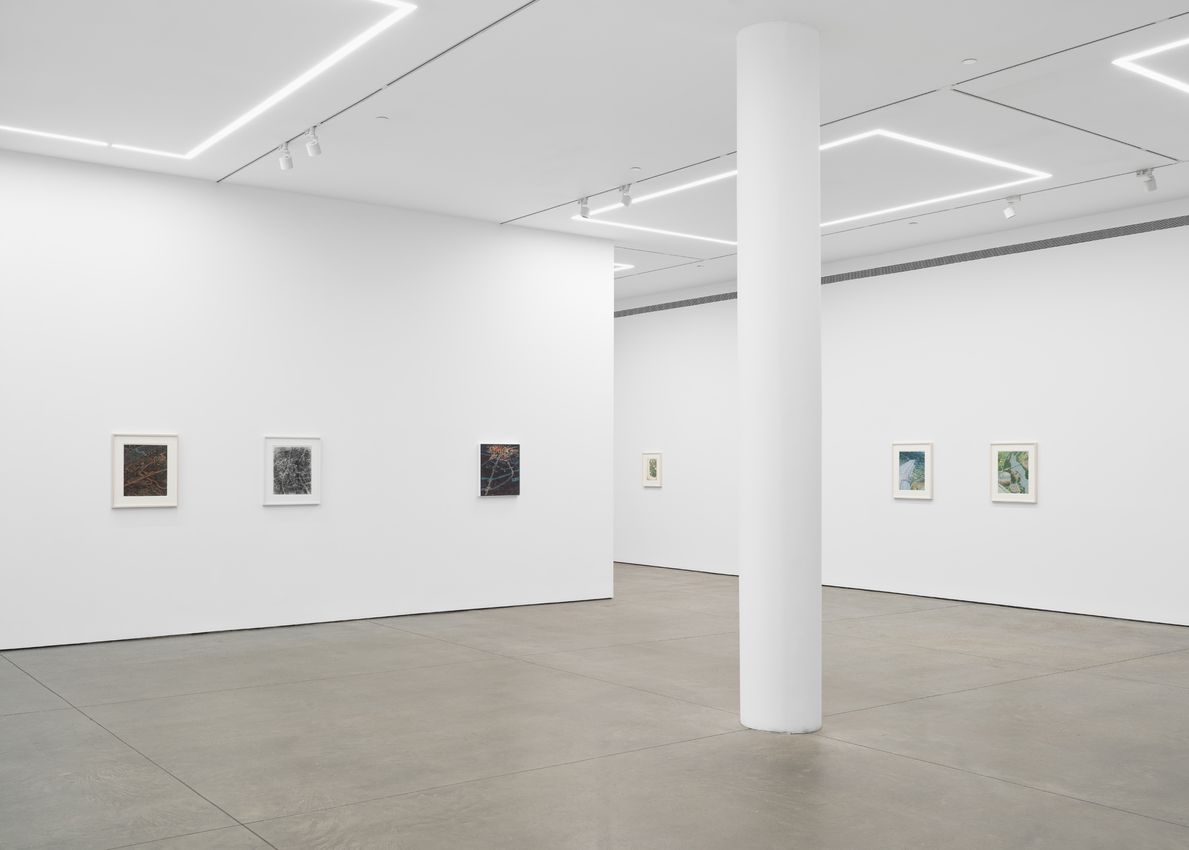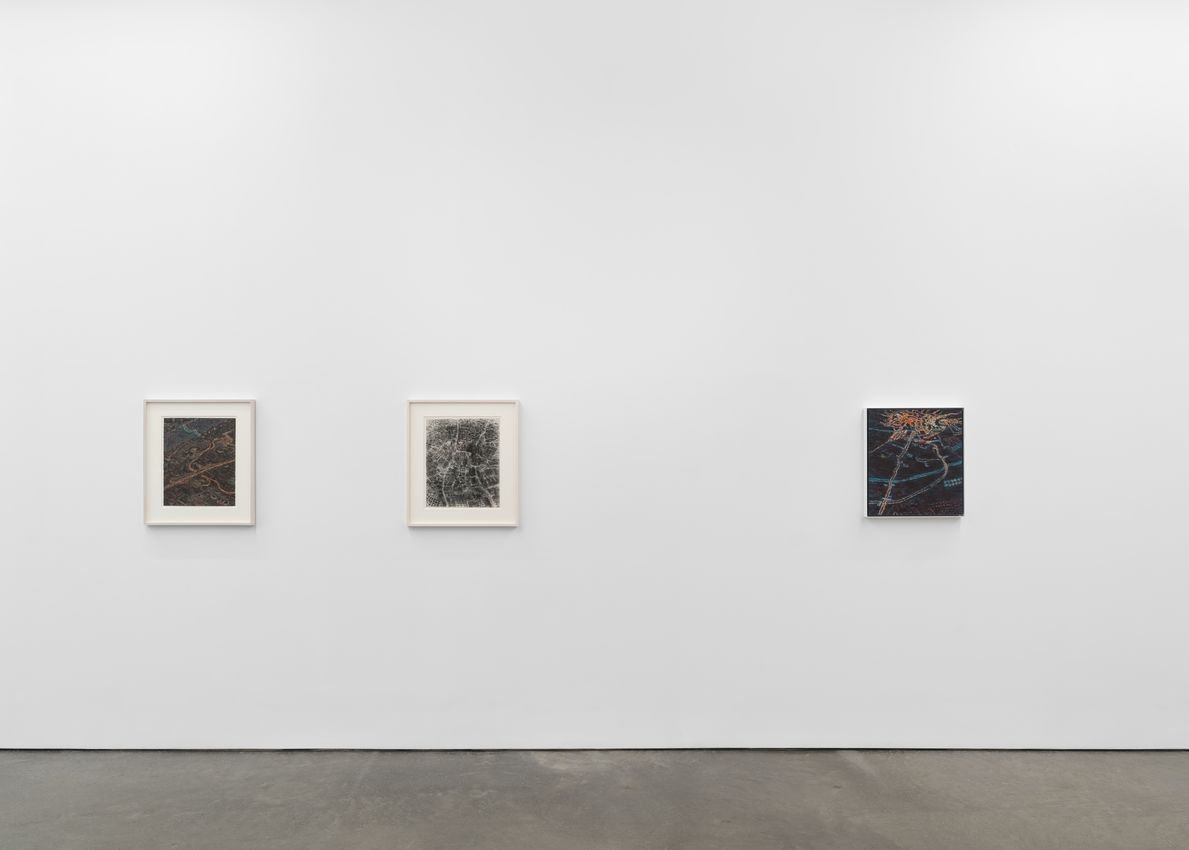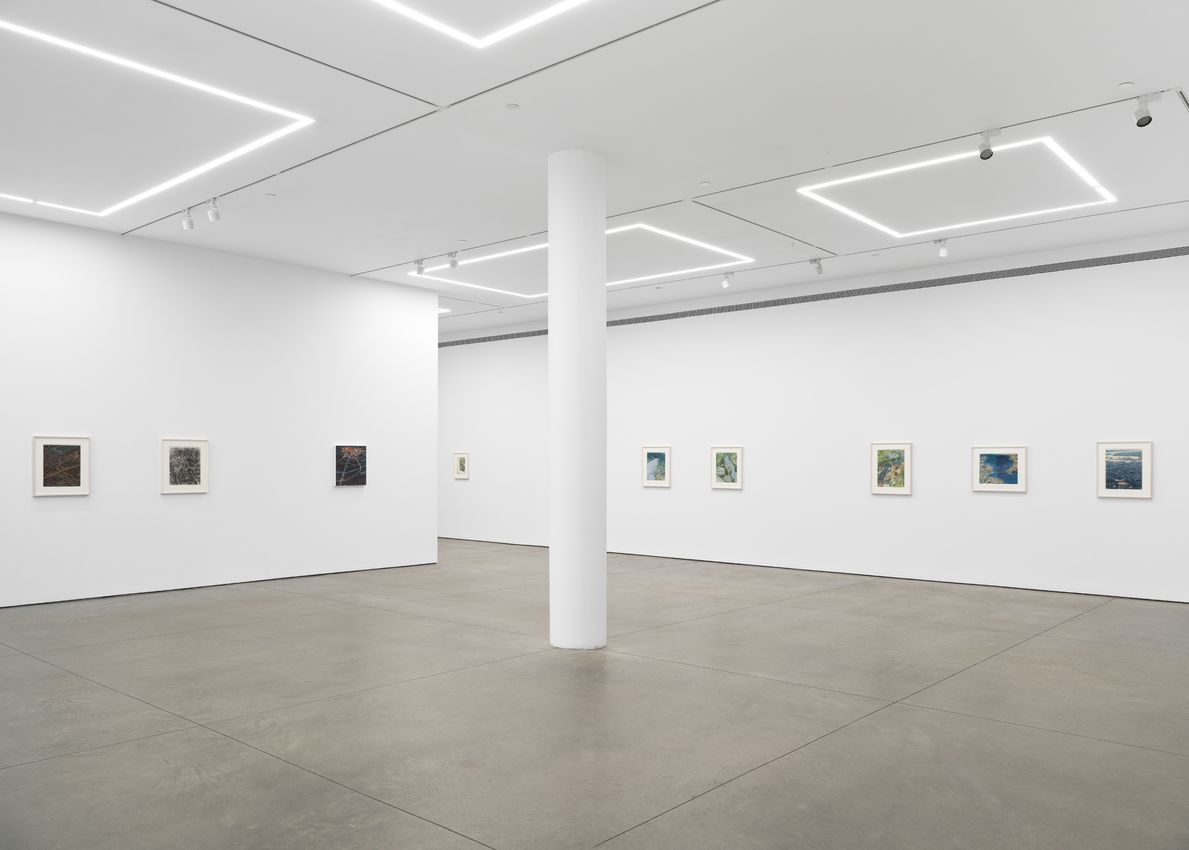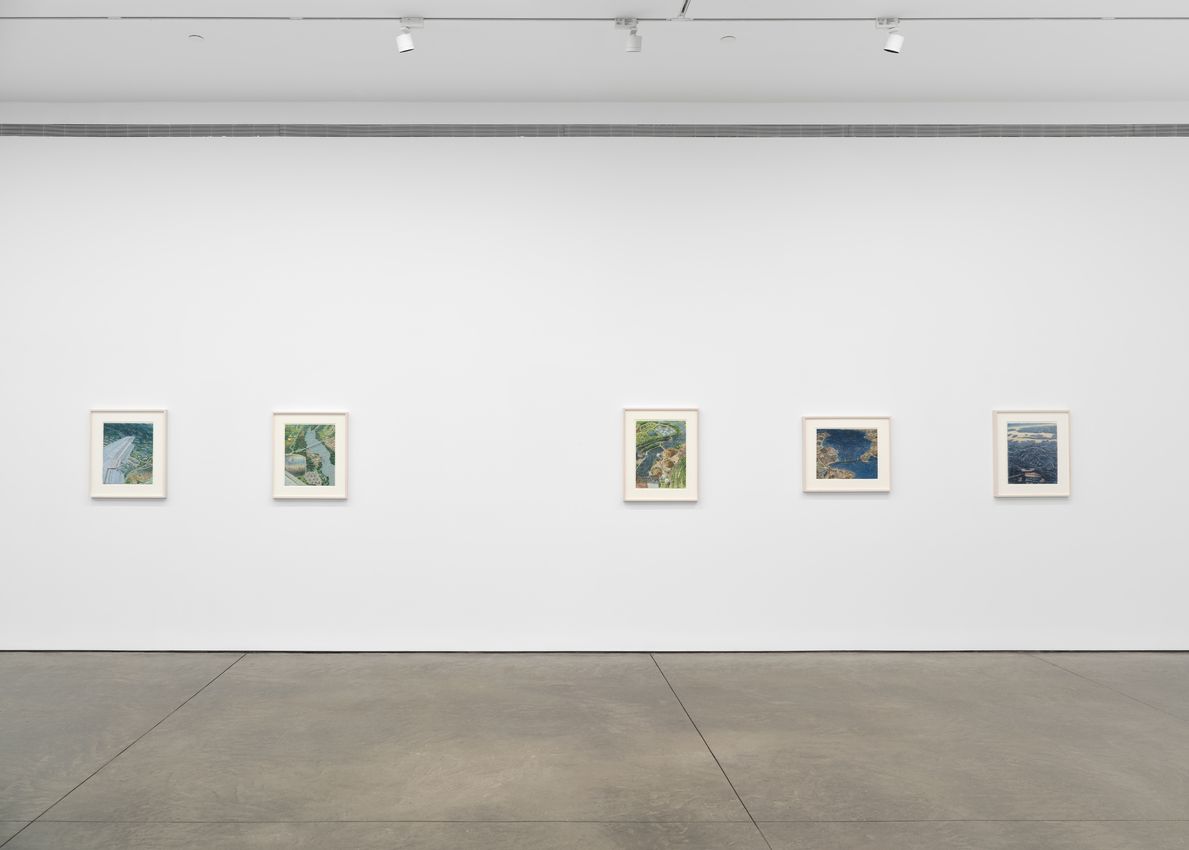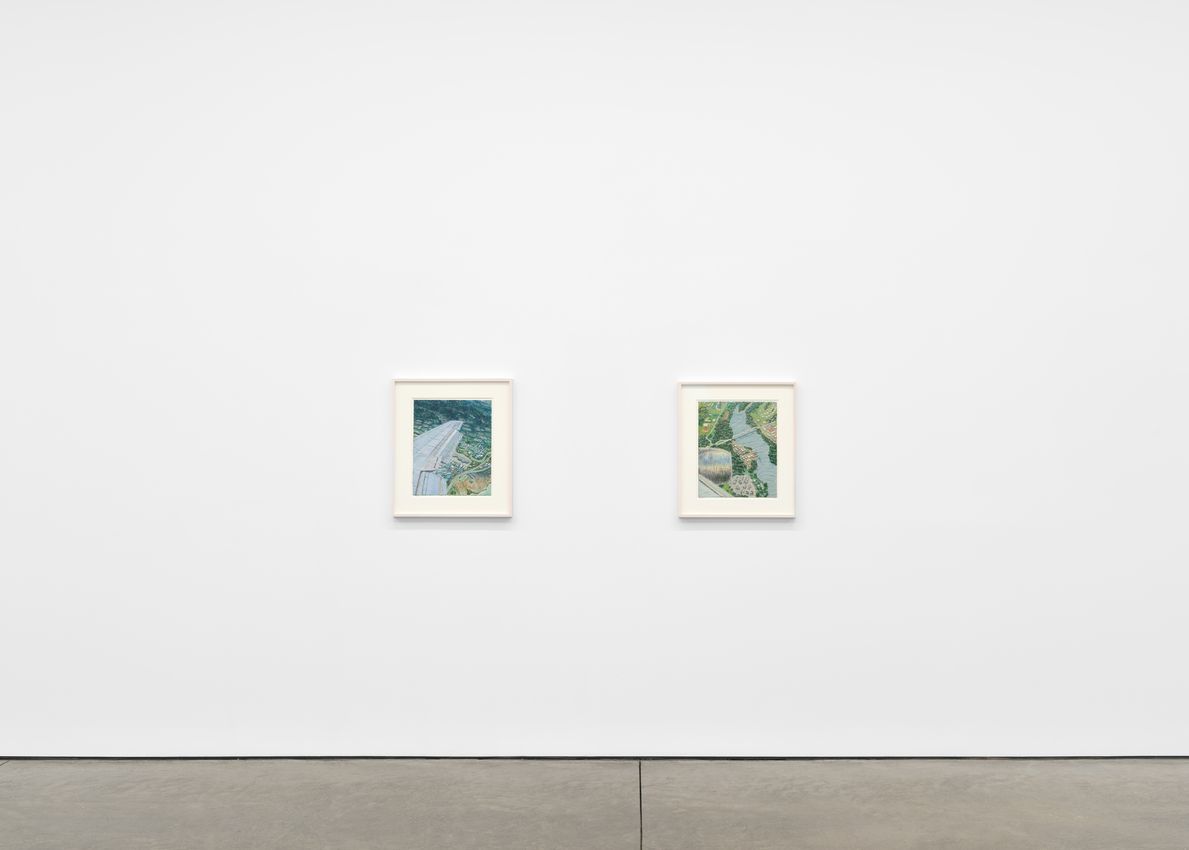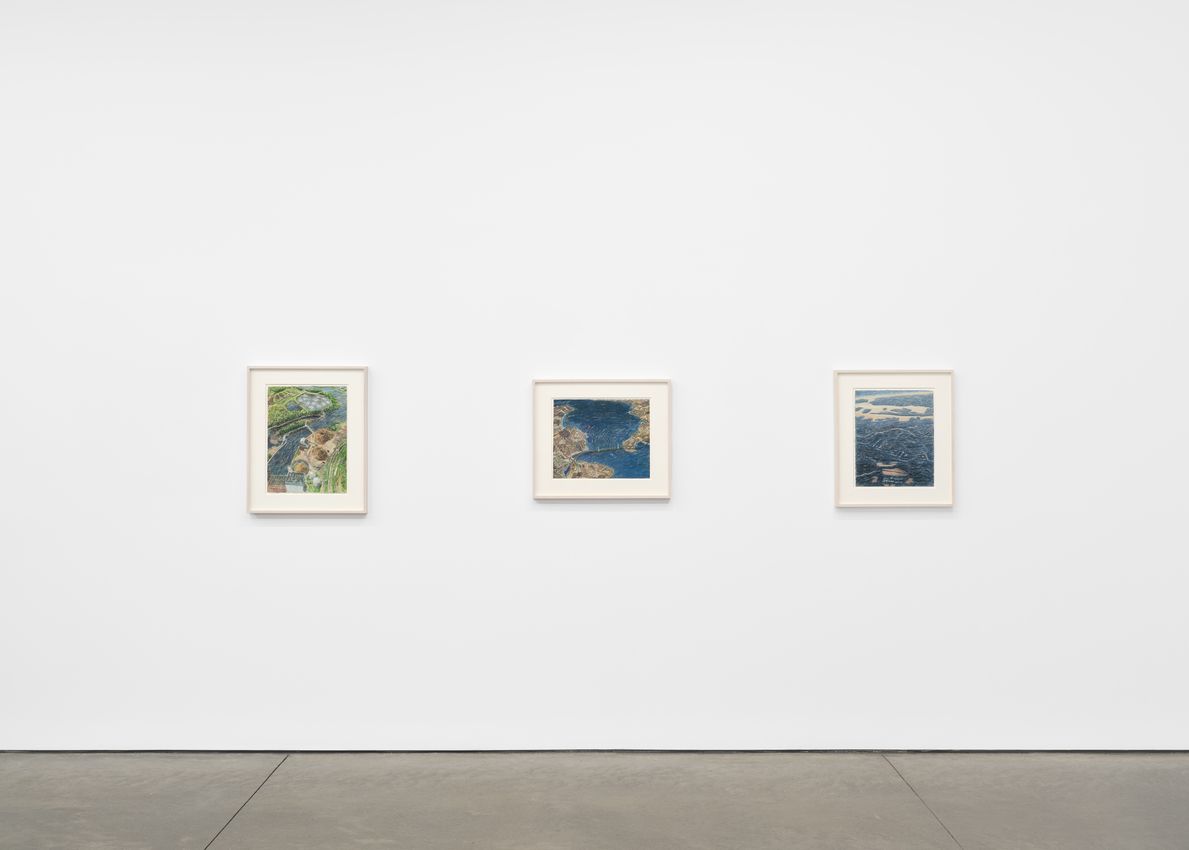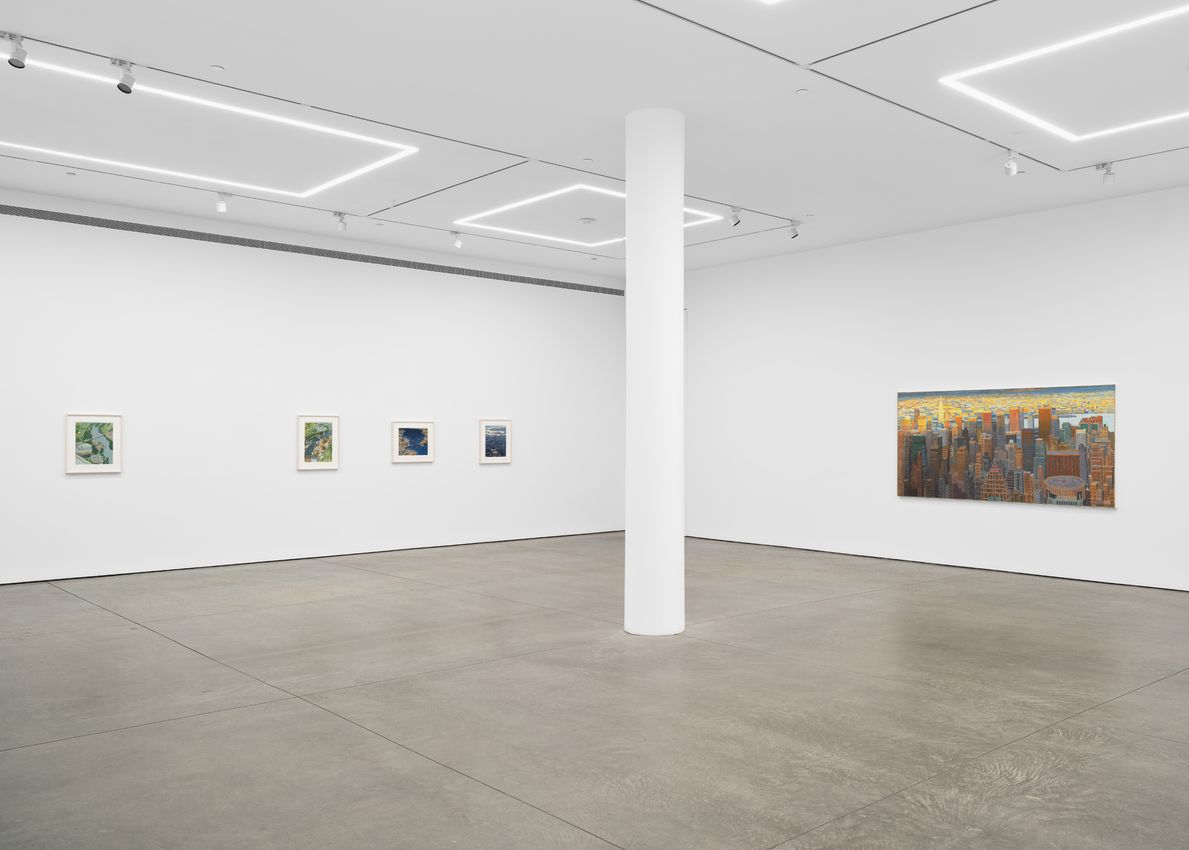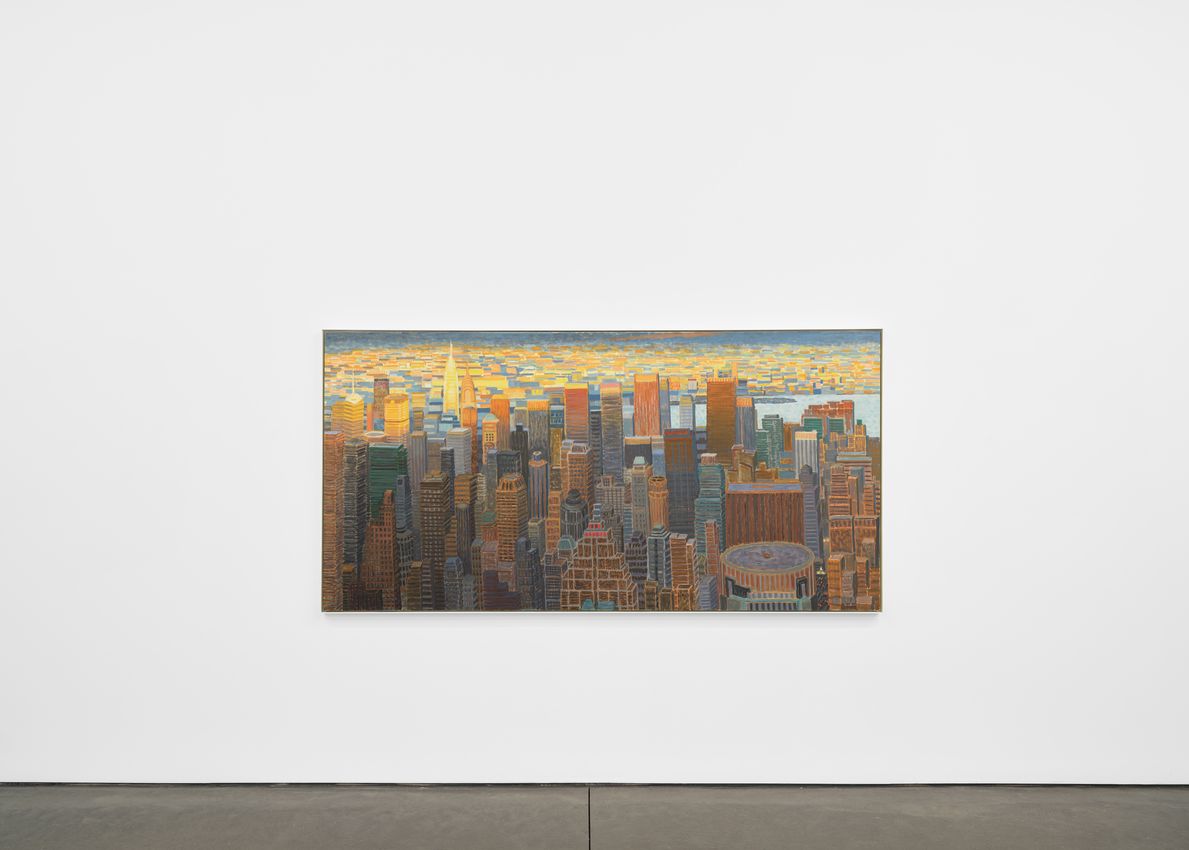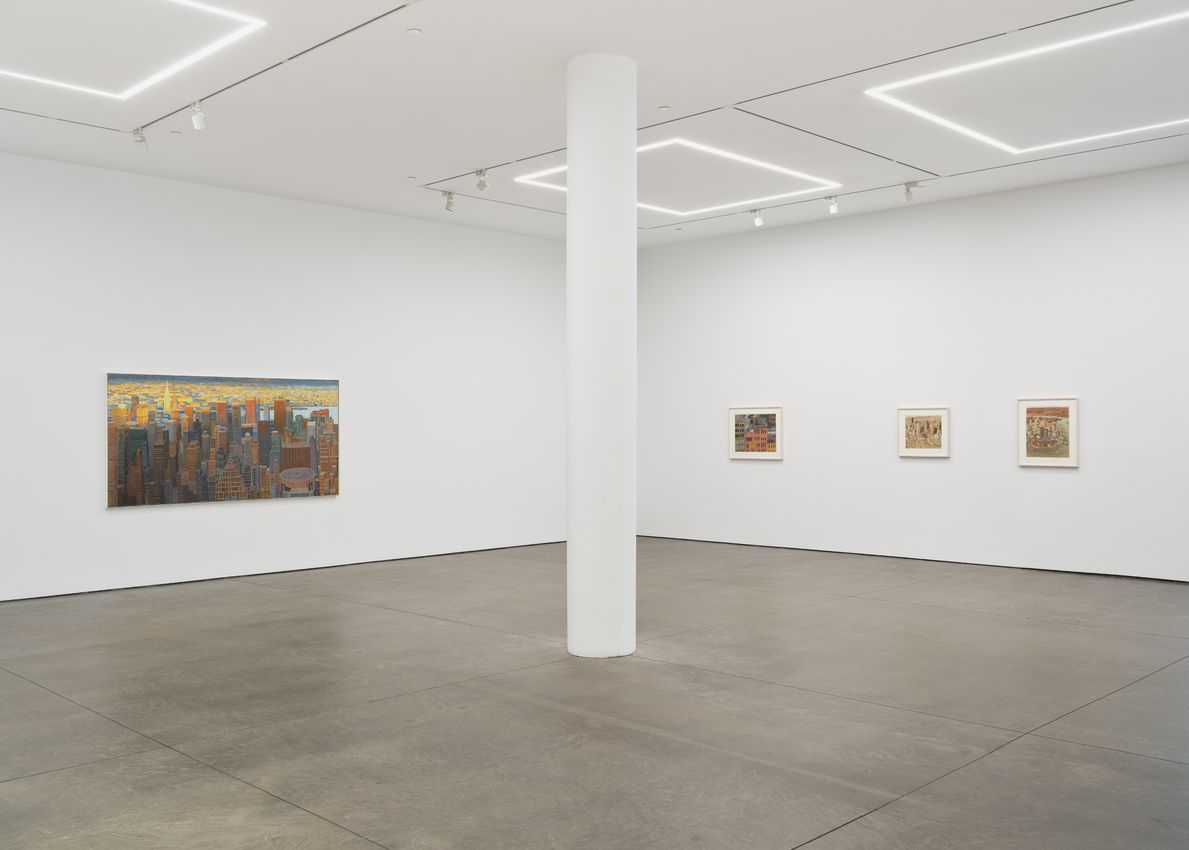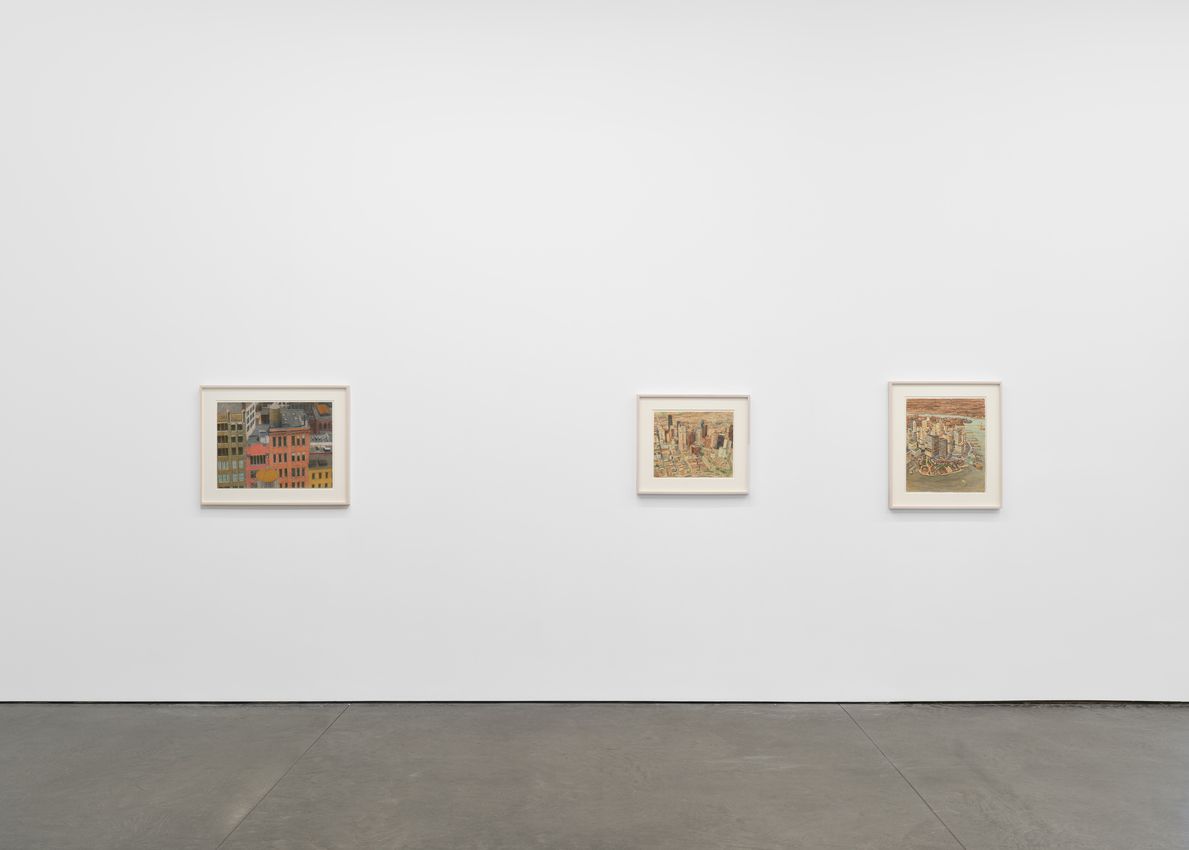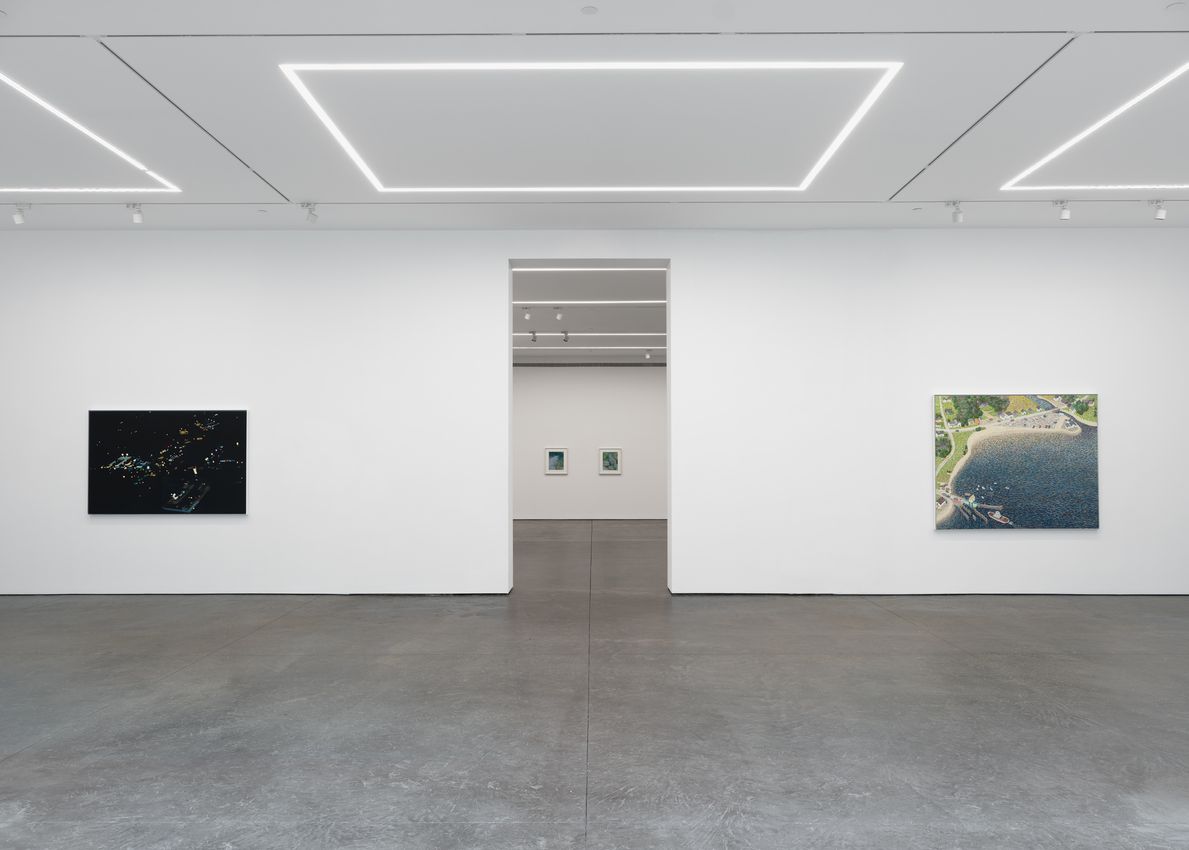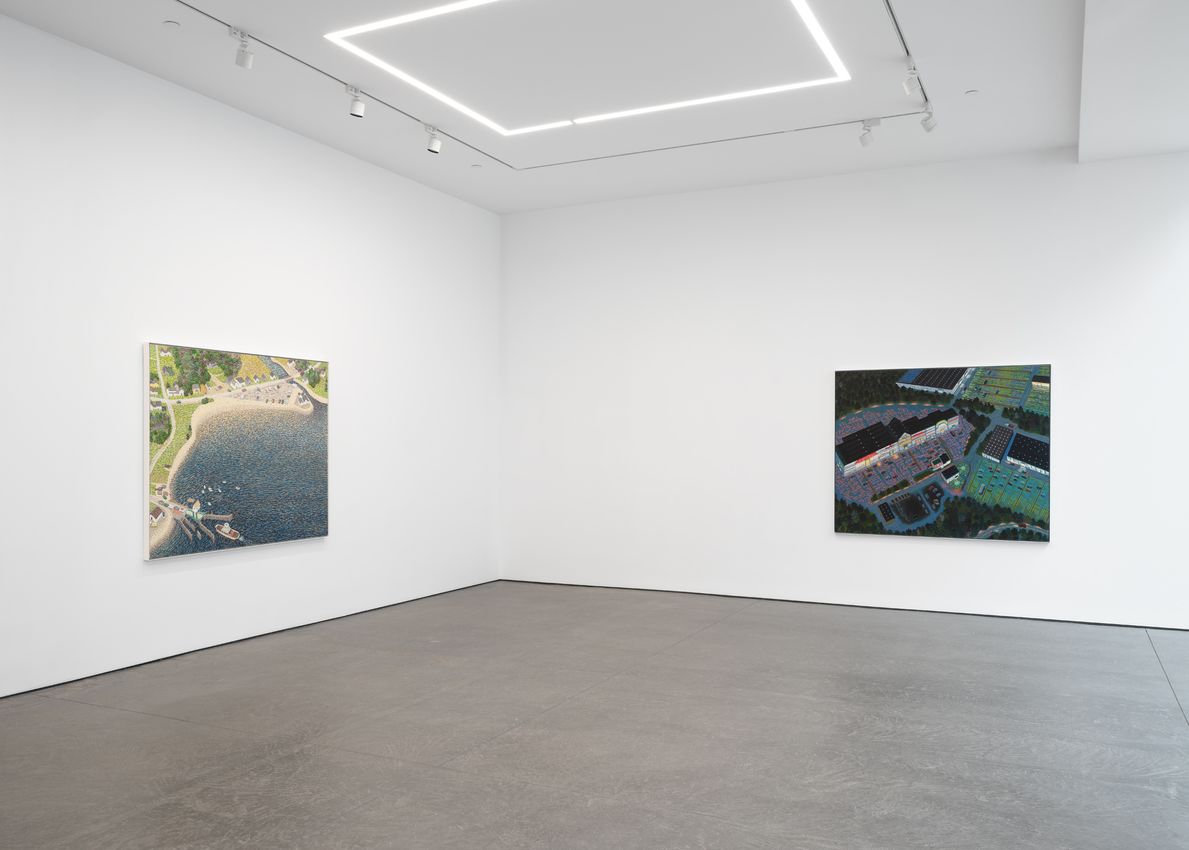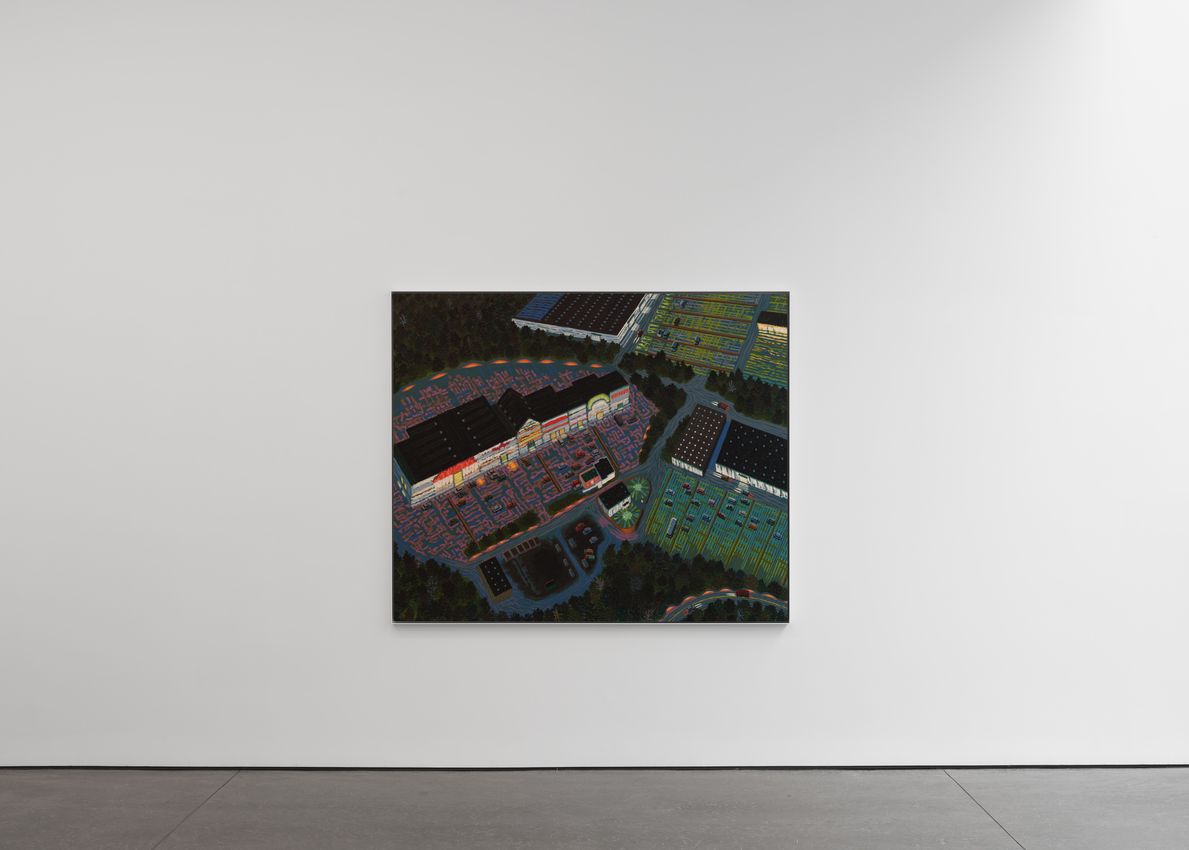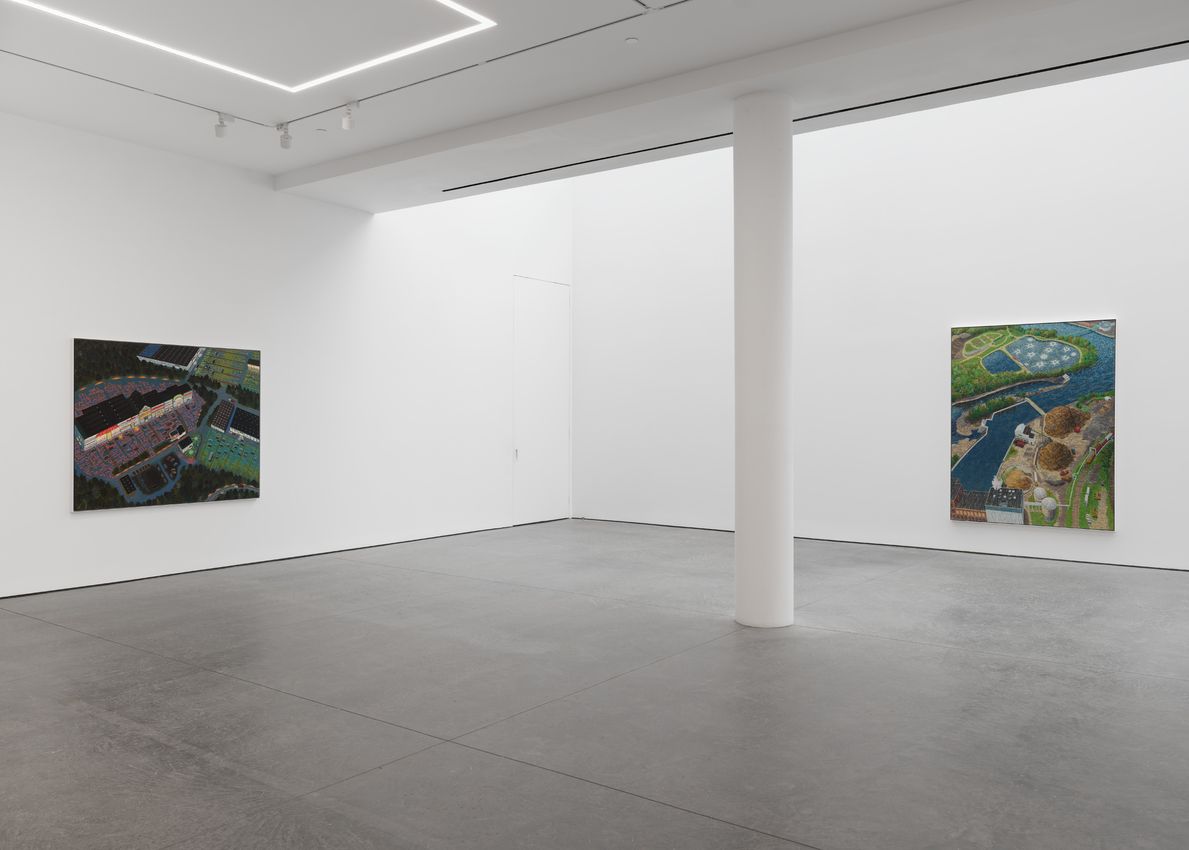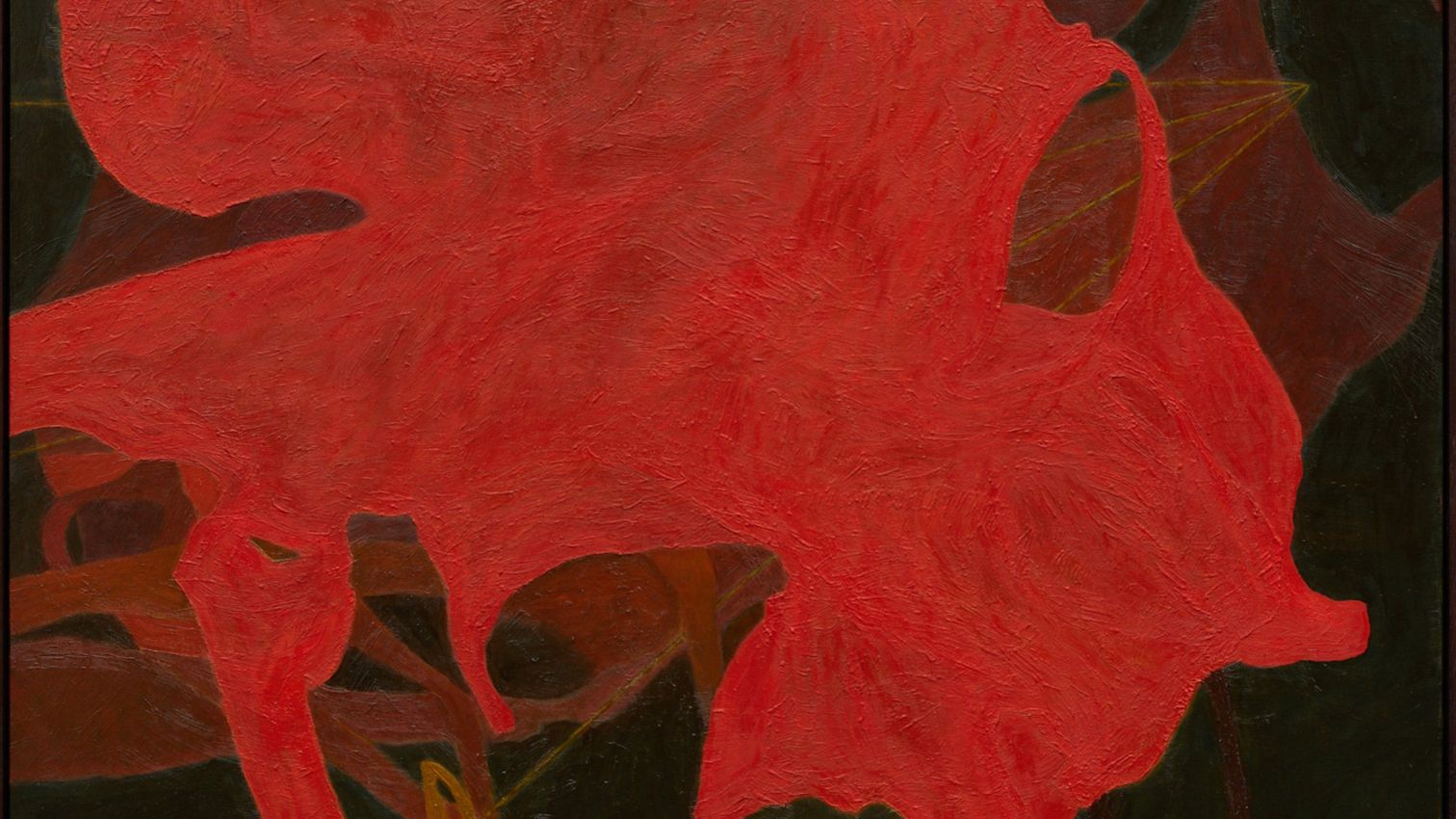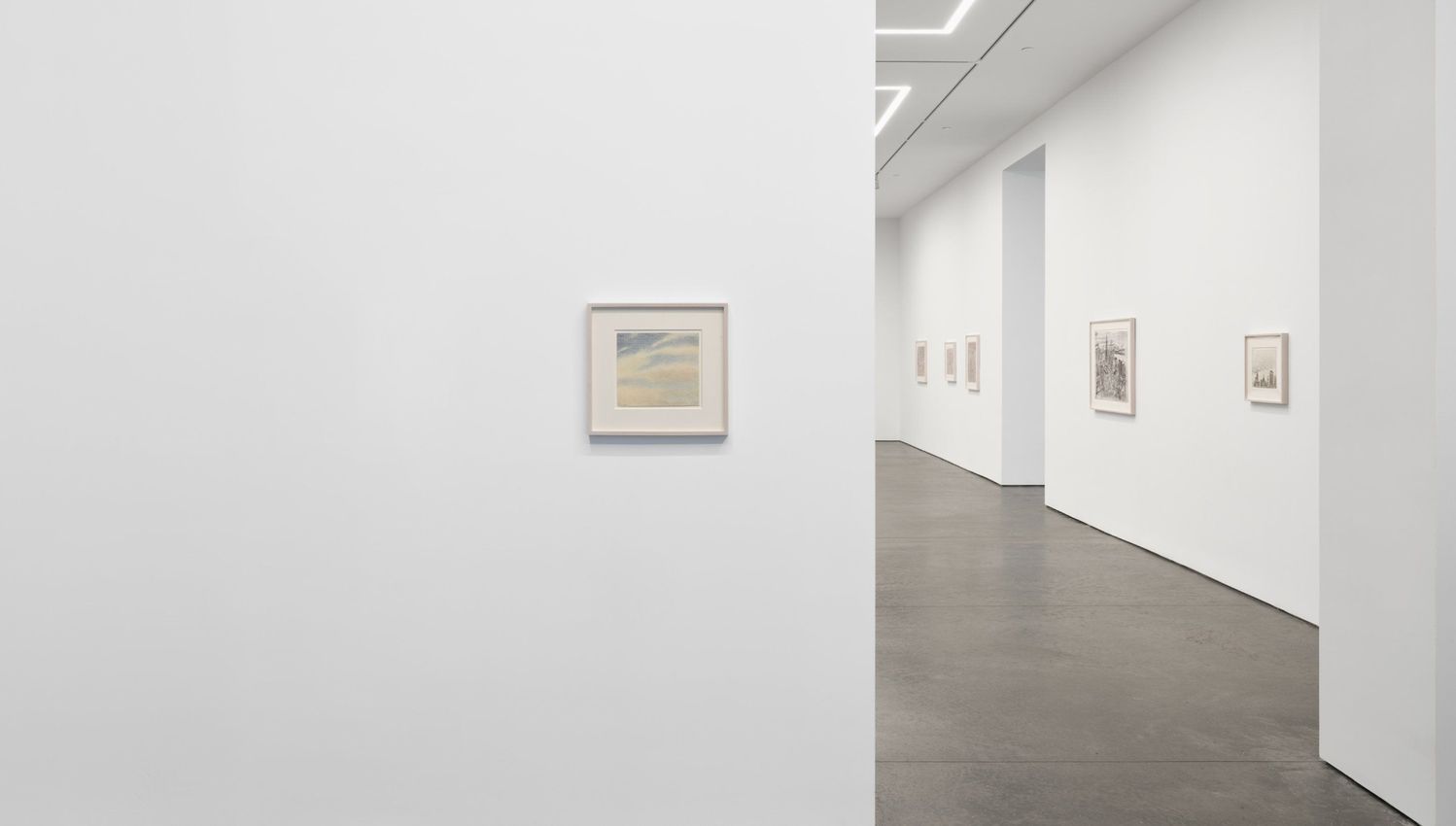
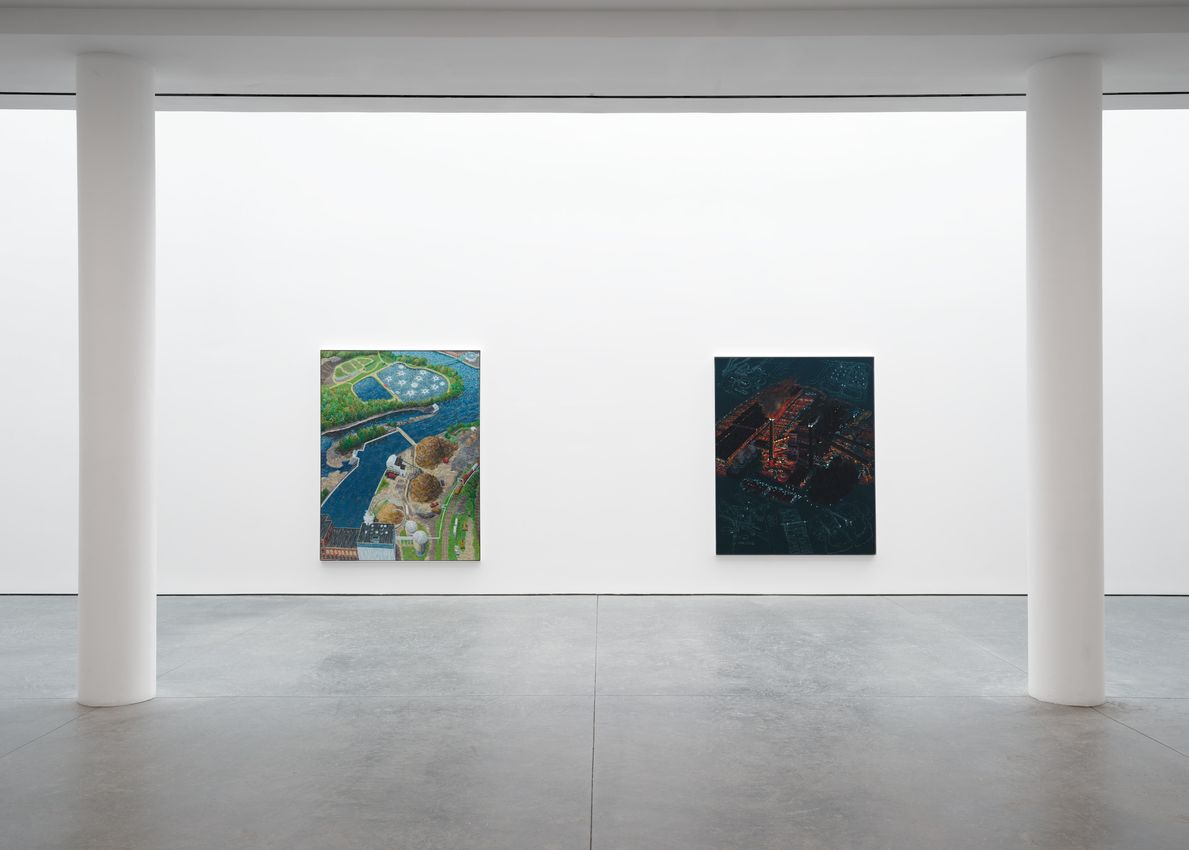
For over five decades, Yvonne Jacquette (1934–2023) observed the world from above, rendering clouds, cities, and cultivated fields as interlocking patterns of line and colour. Karma’s first Jacquette solo exhibition, From the Air brings together paintings and works on paper made between 1971 and 2019, tracing how she developed the aerial perspective as both subject and method. Whether looking down on Manhattan or Maine, Jacquette remained absorbed in the act of seeing, treating distance as her way of relating to the world below.
Jacquette’s aerial vision grew from an early fascination with unusual vantage points. In the 1960s, she painted her surroundings from oblique angles, looking through windows, down at her son’s toys on the floor, and up at the ceilings of her Manhattan loft. After a cross-country flight to San Diego, California in 1969, she turned her attention to more vertiginous perspectives. Early watercolours such as Airplane Window, Clouds and Hills (c. 1976) depict a familiar passenger’s view—clouds floating above a patchwork of green and beige fields, seen through the oval window. In later paintings like Napa Valley Composite II (2005), Jacquette removes the frame entirely, flattening tract houses, vineyards, and groves into a single continuous field. As poet Bernadette Mayer wrote in “On ‘Little River Farm,’” published in Aerial, the literary journal Jacquette created with Edwin Denby:
it’s all laid out in the painting
by a woman who paints from the air
From the mid-1970s on, Jacquette sought out new bird’s-eye views, chartering planes to circle Maine, riding helicopters over Manhattan at night, and drawing from the upper floors of the World Trade Center. Working first in charcoal and pastel, she reduced what passed beneath her to shapes, patterns, and blocks of colour, later drawing on memory and imagination to develop these studies into Pointillist-like paintings. Writing in 1977 about one of Jacquette’s depictions of Manhattan, Barbara Baracks notes: “Atmosphere obscuring vision is as finely varied as the weight of waterways, traffic conduits, and industrial buildings—all meander with the purposiveness of living tissue . . . objects are linked not so much by mechanical spatial ties or gradations of colout as through the mind’s interpretation.” Jacquette’s travels to Colorado, California, Hong Kong, and elsewhere brought the particular terrain and infrastructure of each place into her compositions, creating a geographically diverse record of modern life. The nocturne Route One, Maine (2008) conveys a sense of movement, as if the scene were in perpetual motion. The image is turned on its axis—its slant suggesting a skyward ascent—and the array of lights that are the painting’s primary subject are delicately haloed, ablur. This fluorescence spills outward, dotting the inky ground like stars.
In her final years, Jacquette continued to paint elevated landscapes, though no longer from the altitudes of an aircraft. Four boulders anchor the foreground of From Mt. Battie, Stones at Parking Area (2019), while the ocean extends in furrowed bands to the top-edge of the canvas. The view is no less expansive, even observed from the ground. In a 1989 interview with Barbara Shikler for the Archives of American Art, Jacquette described the trajectory of her work as moving from a high, detached position toward the “evidence of figures in daily life,” until she could look into a landscape “as if I could see myself in there.” In her late paintings, Jacquette brings her elevated perspective down to earth, finding her place within the wide world which she had long observed from above.
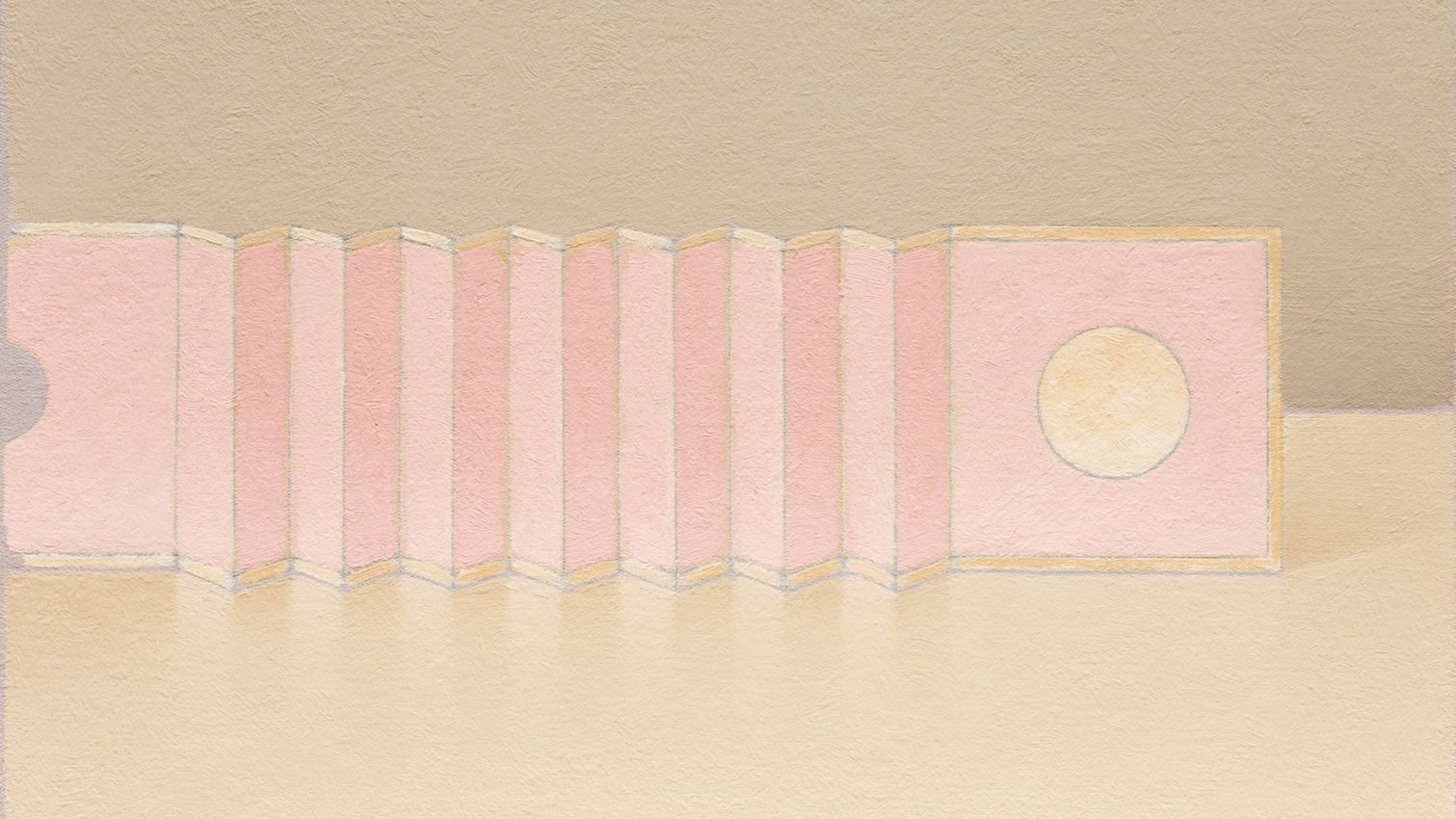
In 1981, Yvonne Jacquette and Edwin Denby published the literary journal Aerial, with artworks by Jacquette alongside contributions from John Ashbery, Ted Berrigan, Joe Brainard, Eileen Myles, Frank O’Hara, Ron Padgett, and Peter Schjeldahl, among others. In preparation for From the Air, a maquette of Aerial’s second volume was discovered in her former studio. In conjunction with this exhibition, the facsimile Aerial (vol. II) will be published by Karma Books in collaboration with the Estate of Yvonne Jacquette.
A respected voice in contemporary art discourse.
Focusing on ambitious storytelling and insightful art-world commentary. Ocula Magazine publishes in-depth interviews, critical essays and timely analysis on the artists, exhibitions and ideas driving the global art world.
Learn more about Ocula Magazine
Showcasing the best of the art world.
Ocula partners with galleries from around the world to highlight their artists, artworks and exhibitions. Gallery membership is by application and invitation, with each member vetted by an independent panel.
Learn more about Ocula Membership

Specialises in the sale of major artworks.
Led by a team with deep ties to the world’s leading auction houses, galleries and collectors. Ocula’s advisory team offers bespoke services to high-net-worth clients from around the world who are looking to acquire the best of contemporary and modern art.
Learn more about our team and services