Press Release

Karma presents ‘90s Paintings, the first exhibition to focus on works by Ouattara Watts from that decade, open from November 1–December 21, 2024, at 22 East 2nd Street. ‘90s Paintings is open concurrently with the Currier Museum of Art’s two-person exhibition Jean-Michel Basquiat and Ouattara Watts: A Distant Conversation, on view through February 23, 2025.

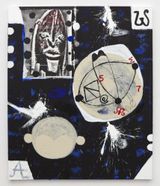
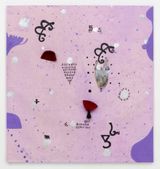
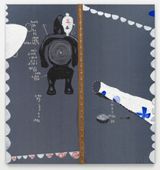
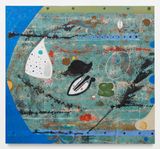
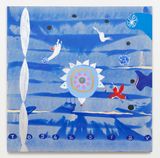
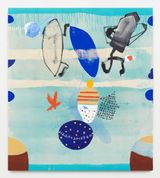
Over the course of the past four decades, Ouattara Watts has created densely layered paintings embedded with a kaleidoscopic range of materials and symbols. In his often-monumental works, numbers, fractals, and otherworldly forms painted by the artist are brought into relation with sacred objects, photographs, and textiles gleaned from flea markets. Watts’s syncretic approach also pulls from his studies of Picasso, Baudelaire, and Surrealism, his African heritage, and his interest in Egyptology, among other cultures from around the world. The five paintings from the 1990s exhibited here are key waypoints in the development of his idiosyncratic artistic language.

Spurred by a fortuitous 1988 meeting with Jean-Michel Basquiat in Paris, Watts, who was then living in the French capital, settled permanently in New York in 1989. In the next ten years, he would be included in the 45th Venice Biennale; receive his first solo museum exhibition, curated by Lawrence Rinder and hosted by the Berkeley Art Museum and Pacific Film Archive; and befriend curator Okwui Enwezor, who wrote in 1995 that Watts was ‘rewriting and reinscribing the position of African artists in modern art history.’ This pivotal decade culminated in an invitation from Enwezor to participate in documenta 11, an iteration of the exhibition now famous for its non-Eurocentric curatorial bent, and his inclusion in the Whitney Biennial, both in 2002.

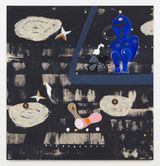
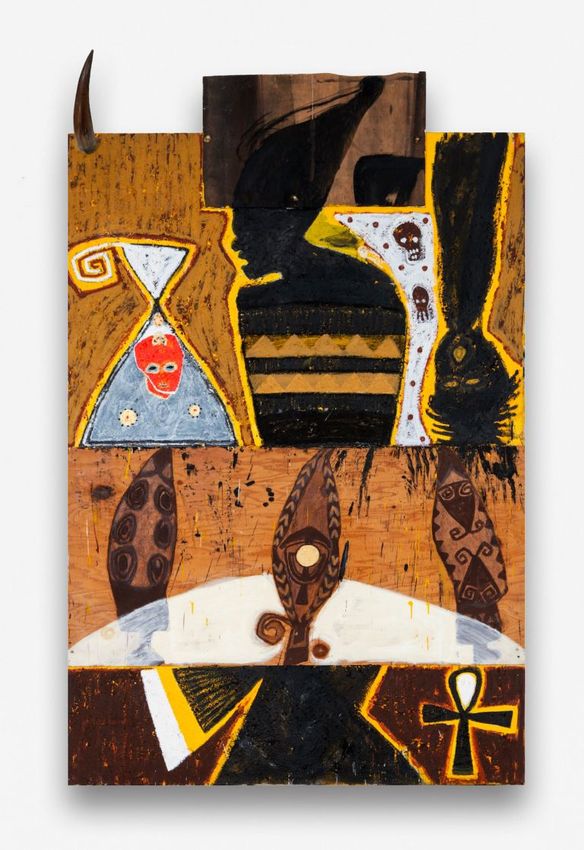
__Pythagor and Thot __(1990) was first shown in Watts’s inaugural New York solo presentation, a 1990 outing at Vrej Baghoomian, Inc. in SoHo. In Pythagor and Thot, Anubis, the Egyptian god of the underworld, rides in a boat on a river schematised as black triangles. A lantern lights his way and an ankh, symbolic of eternal life, hangs behind him. The work represents a journey to the underworld and back, like the Greek myth of Orpheus and Eurydice, and parallels Watts’s two journeys across the Atlantic: the first, when he traveled with Basquiat to New Orleans for the jazz festival and to see the Mississippi River Delta, and the second, when he moved to New York for good. The triangular waves and essentialised forms emerge in part from Watts’s interest in Kazimir Malevich and other European avant-gardists of the early twentieth century, while the nailed-on panel connects Pythagor and Thot to Watts’s other extensions of his canvases into the realm of architecture.

The triptych Sacred Painting, from the same year, is a prime example of the artist’s sculptural tendency during the 1990s, an approach that led art historian Robert Farris Thompson to deem him “the black architect, the builder of the city of the twenty-first century, a city of reunion, of association, and not of division.” To create the work’s arcing marks, Watts applied paint thickened with leaves to the panels as if building up the facade of an earthen building. A lighter-hued ridge running along the top of __Sacred Painting __juts out from the picture plane. The monumental work is pierced through with holes, calling attention to its three-dimensionality, while a doorway-shaped cutout invites the viewer to step into the constructed space. Aluminum containers, likely salvaged from New York’s streets, hang from the rightmost panel, while “347,” one of the city’s area codes, is inscribed at the top of the composition. Explaining his sculptural approach to his medium in 1993, Watts said: “If you are born in Africa, sculpture and painting are the same.” For __Sacred Painting __and other works, the artist found inspiration in not only African architecture but also in the work of Mark Rothko, whose paintings, like Watts’s, draw viewers into their implied depth.

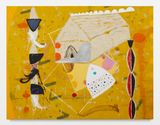
__The Dama __and __Untitled __(both 1998), with their earthen mounds that sit on the top edge of the canvas, similarly call on the adobe structures of Ivorian and Sudano-Sahelian architecture. These works, however, are less figurative and hierarchical than his paintings from the turn of the decade, revealing the rhizomatic approach to composition that would come to characterize much of Watts’s practice. In The Dama, a signature Wattsian motif emerges—mound-shaped characters with spiraling, antennae-like protrusions that still appear in his paintings, more than twenty-five years later. The abstract, red-dotted orb at the center of __Untitled __evokes a celestial sphere, itself a metaphor for the otherworldly constellation of references that cohered in this decade and from which Watts pulls to this day.

To coincide with ‘90s Paintings, Karma has published__Ouattara Watts__, the first comprehensive monograph on the artist. Edited by curator and scholar Dieter Buchhart, this 572-page volume features essays by Kaelen Wilson-Goldie and Lawrence Rinder and a conversation between the artist and Swiss Institute curator KJ Abudu. The monograph reproduces 277 paintings by Watts from 1986 to the present.

Read More
About the Artist

Outtara Watts (b. 1957, Abidjan, Ivory Coast) is an American artist who uses brilliant colors, dynamic patterns, and hypnotic signs and symbols to explore the spiritual ties between people that transcend location or nationality. He constructs fantastic landscapes and mystical scenes to examine these metaphysical relationships. Watts has established a large lexicon of quantitative, geographic, musical, and scientific symbols and forms, both modern and ancient, to communicate his dynamic vision. Taking inspiration from Africa, his Parisian education, and his life in New York, he combines found artifacts, fabric, collage, and traditional painting and drafting methods, creating images that invoke his multicultural identity and give rise to various socio-historical readings. As he has stated: “My vision is not bound to a country or continent...While I use identifiable pictorial elements to be better understood, this project is nevertheless about something much wider. I am painting the Cosmos.” Watts studied at L’École Nationale Supérieure des Beaux-Arts in Paris, France, before relocating to New York in 1989.

View Artist Profile

Also Exhibiting at Karma

Address
22 East 2nd Street
New York
United States
Opening Hours
Tuesday – Saturday
10am – 6pm
(1)
New York 22 East 2nd Street
Karma
22 East 2nd Street, New York, United States
+ 1 (212) 390-8290
http://www.karmakarma.org

Opening hours
Tuesday – Saturday
10am – 6pm
The art world in focus