



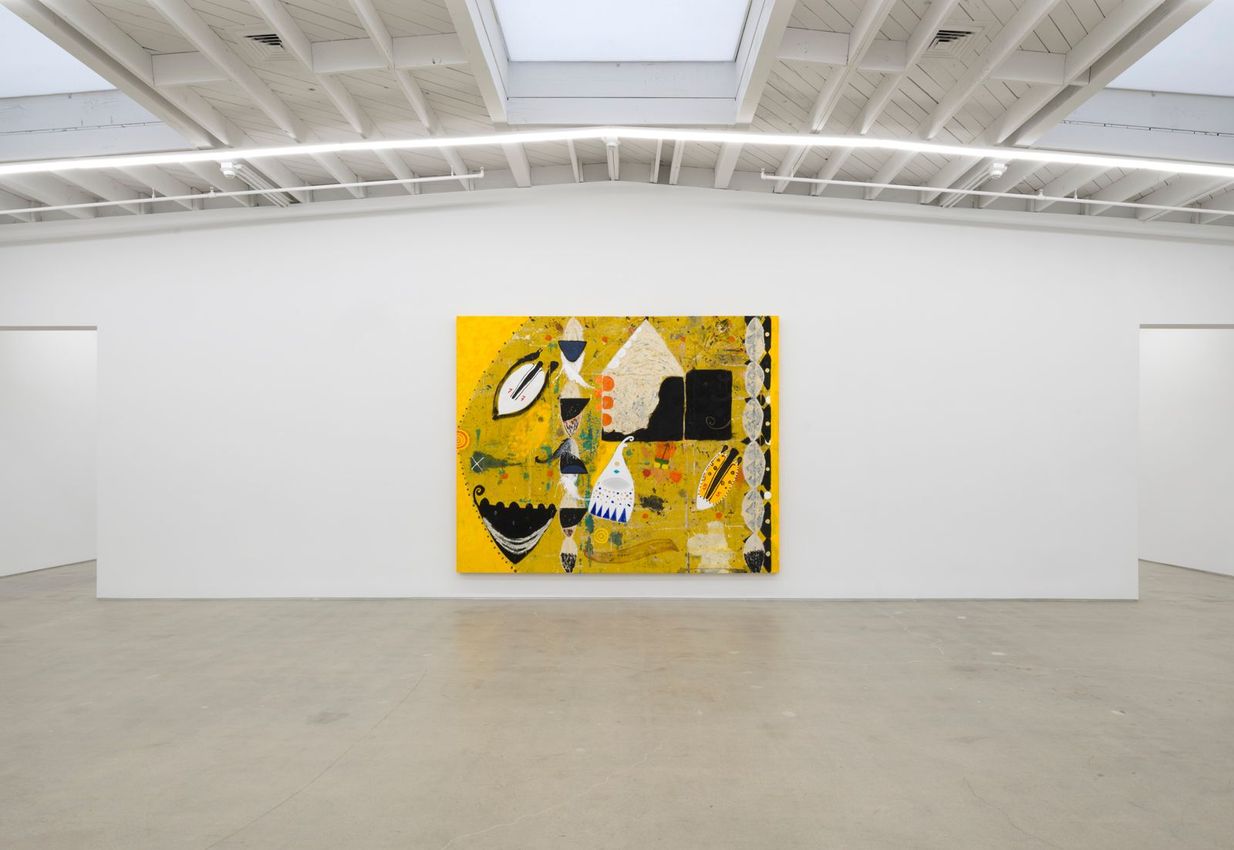
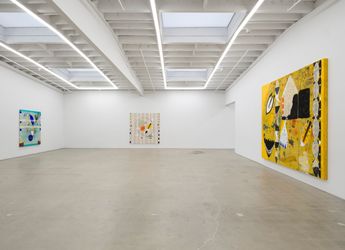
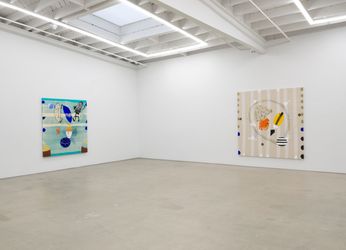
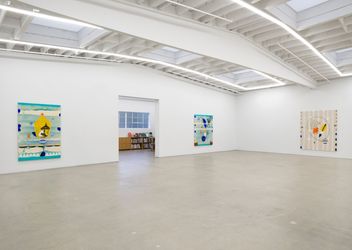
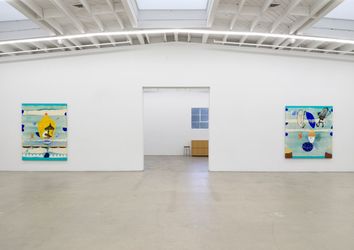
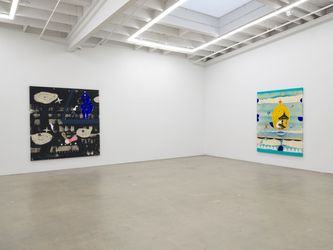
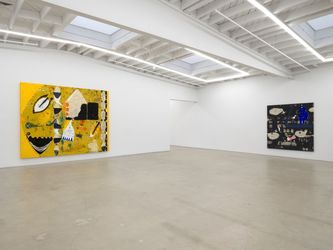
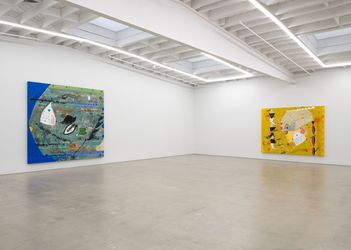
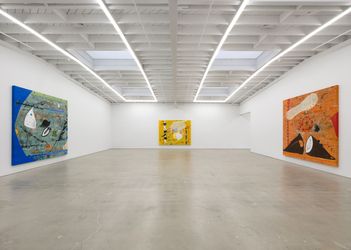
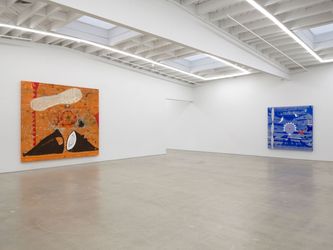
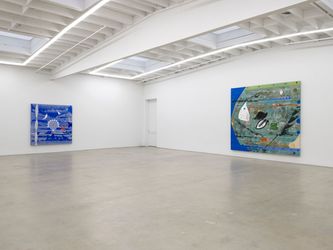
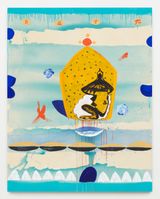
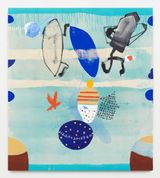
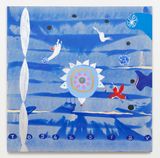
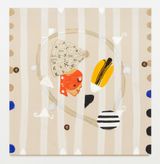
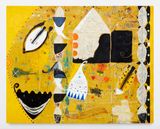
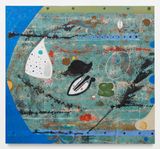
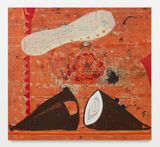
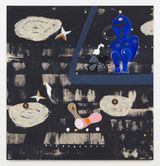
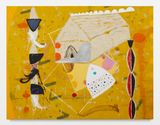
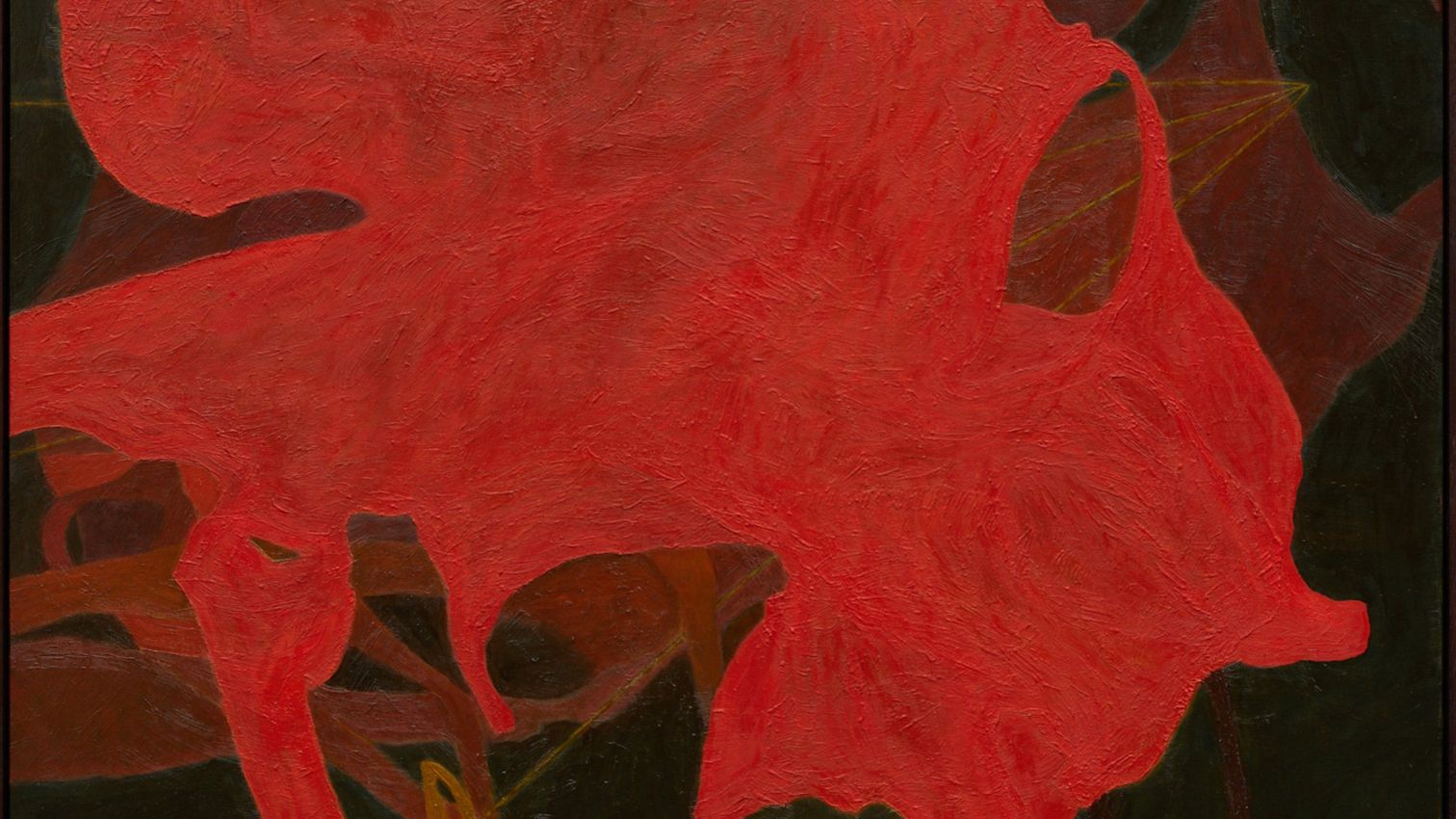
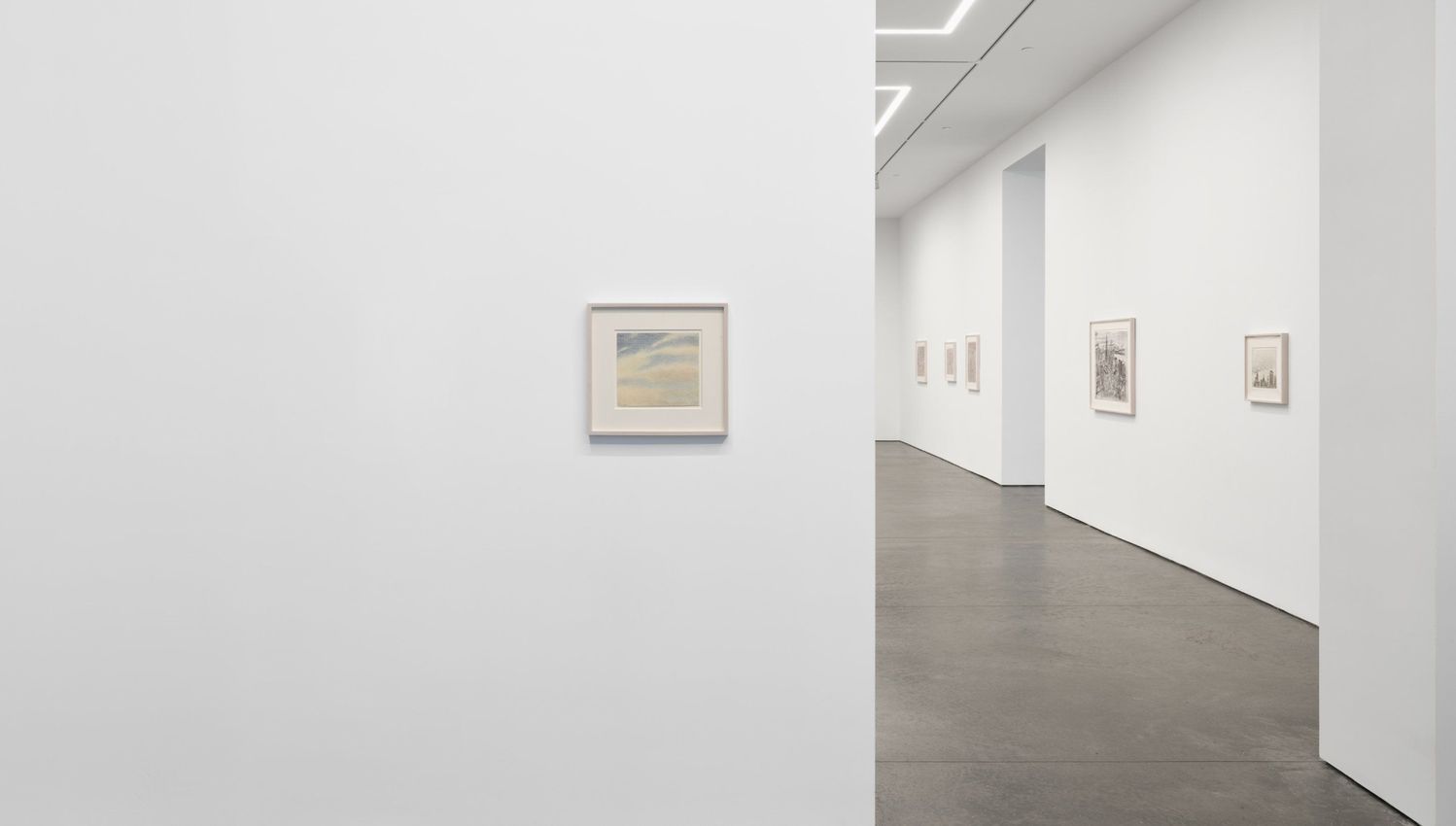
Karma presents an exhibition of new paintings by Ouattara Watts, open from January 19 to March 16 at 7351 Santa Monica Boulevard, Los Angeles.
Over the course of nearly four decades and across three continents, Abidjan-born, New York–based artist Ouattara Watts has developed a painting practice that places cosmograms, numerals, cloth, and other symbols and relics from around the world into relation with each other, levelling hierarchies and creating new relations in the process. Alongside traditional media like acrylic and gouache, the artist embeds materials from a kaleidoscopic range of sources in his monumental, densely layered canvases: papier-mâché, fallen leaves, textiles gleaned from flea markets, and photographic reproductions, among others. The large-scale paintings on view here, all made in the last year in Watts’s Brooklyn studio, comprise the artist’s first-ever exhibition in Los Angeles.
As curator and scholar Okwui Enwezor, a champion of his work, wrote twenty years ago of the “postcolonial constellation” conjured by Watts in his canvases, the artist’s world is one of “discontinuous, aleatory forms, creolisation, [and] hybridisation . . . with a specific cosmopolitan accent.” The content of his work often gestures at his dual educations—as a young man in Côte d’Ivoire, the artist received an initiation into the animist religion of the Senufo people of West Africa; he later moved to Paris to study at L’École Nationale Supérieure des Beaux-Arts, where he began what would become a longstanding fascination with the Parisian modernists, particularly Pablo Picasso. Like Jean-Michel Basquiat, whom he met and befriended in 1988, Watts inserts his intricate, cipher-like forms into brilliant fields of colour. The concept of fractality is foundational for the artist: fractal shapes, common to life forms across time and space, contain reduced-size copies of themselves within their structure, speaking to particularity and universality at the same time. Discussing his practice, Watts explains: “I think universally. . . about the history of the human soul. It’s not a history of clans, ethnic groups, or even artists, it’s what we can call the human condition.”
Watts alternates between working on the wall and the floor. Since the late 1990s, he has utilised drop cloths stained with acrylic as substrates for new paintings. Black and red marks stamped by the paint-covered treads of the artist’s shoes give Spiritual Gangster 02 an allover patterning reminiscent of Jackson Pollock, whose Number 1A, 1948 (1948) features his own handprint as autograph, and the broader legacy of Abstract Expressionism, one of many art-historical movements informing Watts’s painterly vernacular. These indexical traces suggest motion or tempo, evoking Watts’s abiding passion for music, which plays constantly in the studio and deeply influences his practice—like his paintings, music communicates universally while remaining a manifestation of a specific culture (or cultures).
Spiritual Gangster 01, which also features a background stained with splashes of paint, was inspired in part by sigui, a festival held once every six decades by the Dogon people of West Africa to honour the emergence of a new generation. The architectural and mask-like forms in this work tie directly to this practice. During sigui, which takes place when the star Sirius appears between two mountains, a select group of young men are secluded from the rest of the tribe, taught Sigi So, a secret dialect, and entrusted with the Great Mask, a meters-long, carved-wood object that serves as a ritual altar. Like Sigi So, Watts’s oeuvre speaks to the eternally renewing nature of existence in a mysterious language all its own.


Outtara Watts (b. 1957, Abidjan, Ivory Coast) is an American artist who uses brilliant colors, dynamic patterns, and hypnotic signs and symbols to explore the spiritual ties between people that transcend location or nationality. He constructs fantastic landscapes and mystical scenes to examine these metaphysical relationships. Watts has established a large lexicon of quantitative, geographic, musical, and scientific symbols and forms, both modern and ancient, to communicate his dynamic vision. Taking inspiration from Africa, his Parisian education, and his life in New York, he combines found artifacts, fabric, collage, and traditional painting and drafting methods, creating images that invoke his multicultural identity and give rise to various socio-historical readings. As he has stated: “My vision is not bound to a country or continent...While I use identifiable pictorial elements to be better understood, this project is nevertheless about something much wider. I am painting the Cosmos.” Watts studied at L’École Nationale Supérieure des Beaux-Arts in Paris, France, before relocating to New York in 1989.


A respected voice in contemporary art discourse.
Focusing on ambitious storytelling and insightful art-world commentary. Ocula Magazine publishes in-depth interviews, critical essays and timely analysis on the artists, exhibitions and ideas driving the global art world.
Learn more about Ocula Magazine
Showcasing the best of the art world.
Ocula partners with galleries from around the world to highlight their artists, artworks and exhibitions. Gallery membership is by application and invitation, with each member vetted by an independent panel.
Learn more about Ocula Membership

Specialises in the sale of major artworks.
Led by a team with deep ties to the world’s leading auction houses, galleries and collectors. Ocula’s advisory team offers bespoke services to high-net-worth clients from around the world who are looking to acquire the best of contemporary and modern art.
Learn more about our team and services