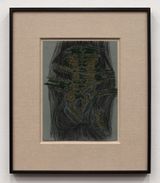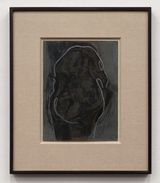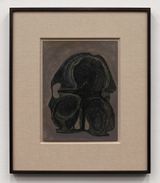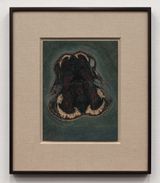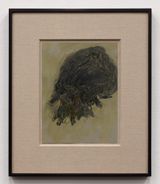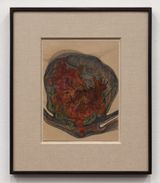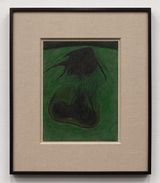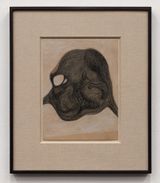
Describing the process of preparing for this exhibition over the last two years, Randy Wray referred to his studio as “a kind of hothouse where I’m growing paintings.” Sealed off from the world’s vicissitudes, the hothouse is a protective enclosure. Rare species flower and multiply in liquid-thick air. While retaining his characteristic earthy, virescent palette and organic forms, these new abstractions have a sharp, lustrous quality, as if crystallized in some sultry climate.
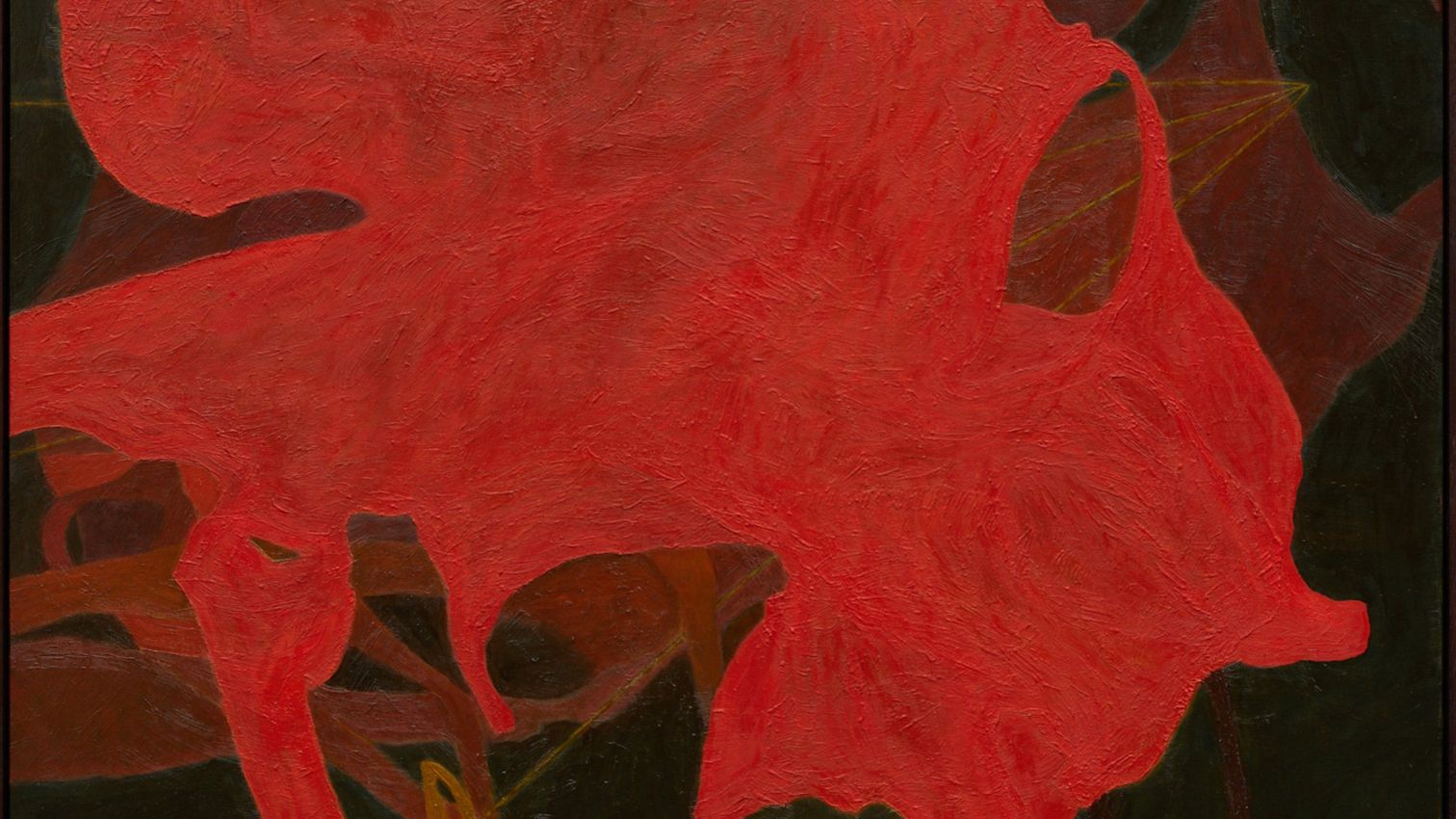
Time is among Wray’s core materials. He works elliptically over long periods, leaving and returning to compositions, reconstituting select elements. His surfaces are dense and topographical, registering these intervals in tracts alternately burnished or matte, ridged or scarred. Paintings often contain traces of earlier works: transplanted forms swell, shrink, or are otherwise defamiliarized in their new settings. As with words, meaning is shaped by context. A collection of fine lines in Flower (all works 2024–26) that recur, transfigured, in Organ, originated in his 2019–21 work Root. In Organ, the lines’ downward, branching trajectories and pale-yellow hue evoke shafts of light—the artist describes these and other elements that traverse time and his canvases as “transmissions.”
A sense that Wray’s paintings have origins beyond his studio and the present is palpable. Exotic Transmission seems primeval, its pinwheeling blooms both familiar and inconceivable in any known landscape. At the same time, there is a machinic integrity to its interlocking forms, which are curved and fused like an engine. Across his practice, suggestive shapes and titles hint to unconscious drives (thought to be rooted in the ancient, reptilial part of the brain) and the language used to interpret them. Wray’s play with bilateral symmetry has drawn comparisons to Rorschach inkblots. Titled after a psychological framework for human connection, Attachment Theory contains a spidery, creaturelike element—another “transmission”—its brassy tendrils looped and latching. In the same essay where he links Wray’s enigmatic scenes with, among other associations, an arachnid by Odilon Redon, Bob Nickas writes: “As with visualization recalled from the unconscious, after-images in art may be familiar or only vaguely so, wavering seductively in between, allowing for a wider, variable latitude of sight, closer to images recalled from the imagination and its infinities.”
Paintings like Between Husk and Bloom and Organ feature geometric components that contrast starkly with Wray’s typically amorphous forms. A rectangular band hemming Organ’s bottom edge teases linear perspective—a technique used in representative painting to imply receding space—which is corroborated by his golden, grafted lines. The right angle formed by intersecting planes in Between Husk and Bloom echoes structuring devices like windowsills or picture frames, mediating the view into the rest of the painting. In Wray’s compositions, these architectural elements muddle, rather than clarify, distinctions between fore- and background. Still, they are among the artist’s many thresholds, open for traversal.
Multiple works in this suite feature a vast, monochromatic form at the fore of the picture plane. Each is sculptural, with impastoed layers encrusted, relief-like. At turns, these forms resemble wax seals, shields, or carapaces—something sticky and protective. In Hothouse, a pair of reniform disks, like lilypads, feature grooves that seem carved from thick, still-wet lacquer, the fossilized imprint of some heavy, solid entity. In fact, the artist built the ridges up. Cast or mold, impression or embossing—Wray consistently confounds the object with the trace of its presence.
Among abstraction’s seductive qualities is its potential to accommodate its opposite. Figuration, whether present or imagined, has a magnetic pull: an association glimpsed in the convergence of forms; an alliance between color and texture that flirts with legibility. Bones, organs, flowers, alien landscapes mapped from above—the range of near-subjects in Wray’s paintings is vast. But more interesting than the over-discoursed “space between abstraction and figuration” is the sustained and open engagement these works cultivate in the viewer. Pull on a familiar thread until it unravels. “Recognition,” the artist says, “never settles.”
—Sophia Larigakis
Randy Wray is an American contemporary artist known for his layered paintings and sculptures that often transform found and recycled materials into evocative, ambiguous forms, earning accolades, including the John Simon Guggenheim Memorial Fellowship and the inaugural Irving Sandler Prize.


A respected voice in contemporary art discourse.
Focusing on ambitious storytelling and insightful art-world commentary. Ocula Magazine publishes in-depth interviews, critical essays and timely analysis on the artists, exhibitions and ideas driving the global art world.
Learn more about Ocula Magazine
Showcasing the best of the art world.
Ocula partners with galleries from around the world to highlight their artists, artworks and exhibitions. Gallery membership is by application and invitation, with each member vetted by an independent panel.
Learn more about Ocula Membership

Specialises in the sale of major artworks.
Led by a team with deep ties to the world’s leading auction houses, galleries and collectors. Ocula’s advisory team offers bespoke services to high-net-worth clients from around the world who are looking to acquire the best of contemporary and modern art.
Learn more about our team and services