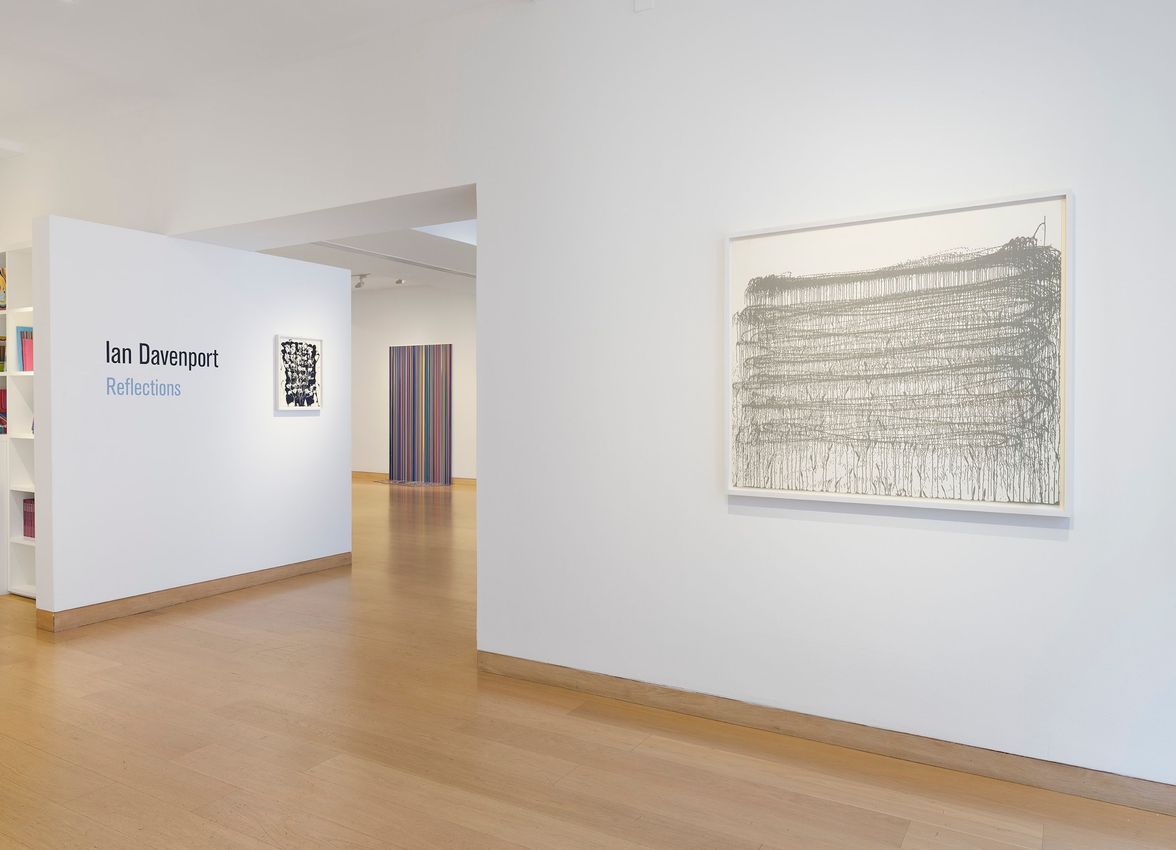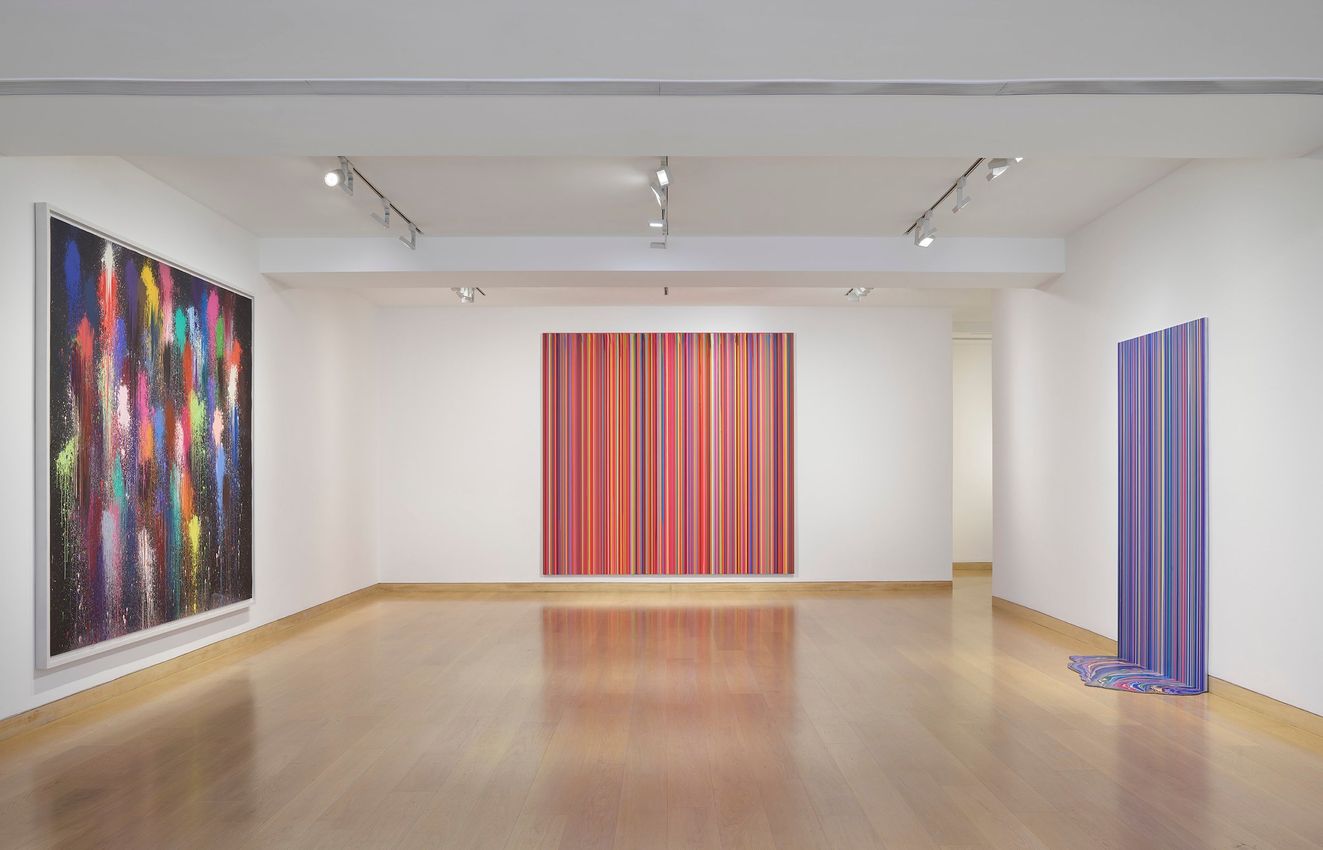
Waddington Custot is pleased to present Reflections, a survey exhibition that celebrates the remarkable breadth of Ian Davenport’s (b.1966) career, spanning the late 1980s to the present and including works on paper, among them early experimental pieces from when Davenport had first graduated from Goldsmiths college, alongside the Puddle Paintings, for which he is best known.
Reflections marks Davenport’s 11th solo exhibition with the gallery since his landmark debut at Waddington Galleries in 1990. The relationship began in 1988 after London art dealer Leslie Waddington visited the degree show at Goldsmiths College of Art. Michael Craig-Martin, Davenport’s tutor at Goldsmiths, had encouraged Waddington to pay attention to the young artist, whose distinctive voice was already taking shape.
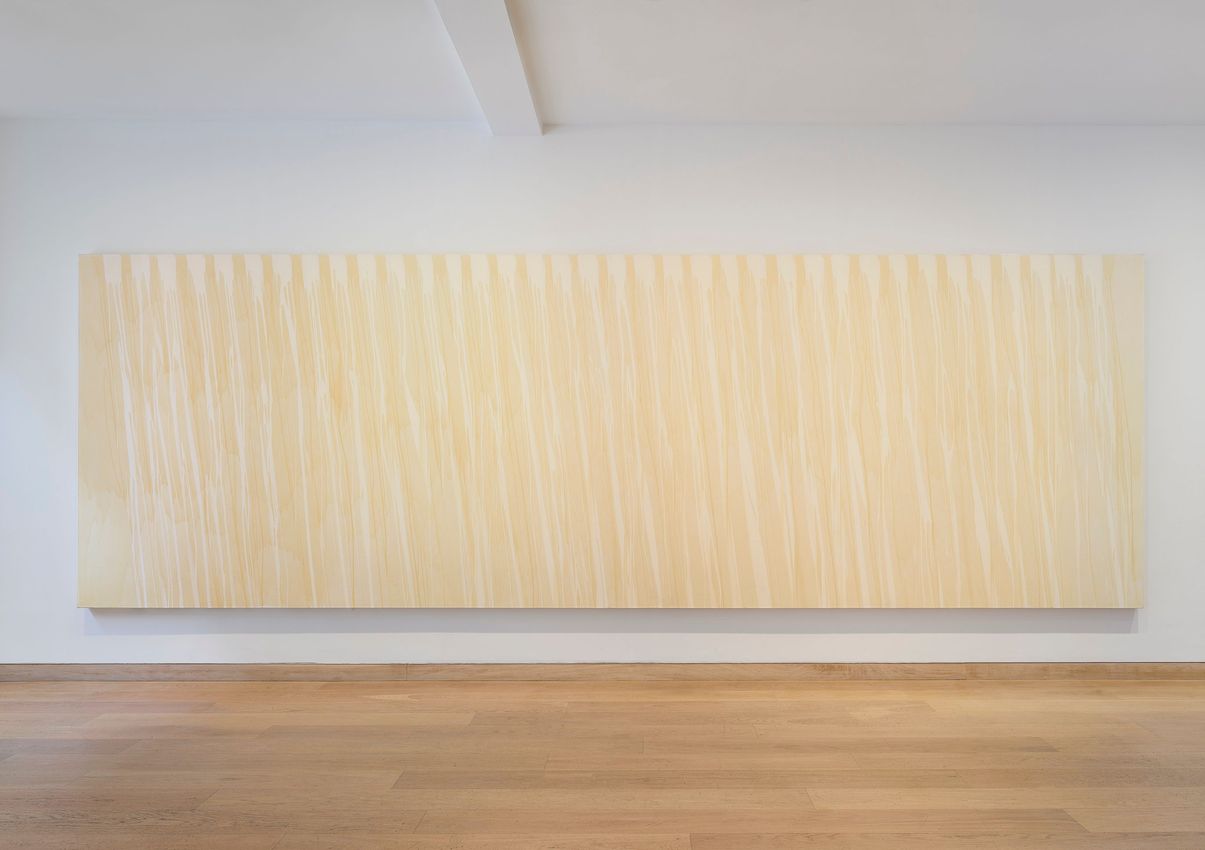
The exhibition opens with the early, monumental work ‘Untitled (Large White)’ (1991). This canvas, measuring over 6 metres in width, formed part of the body of work that led to Davenport’s nomination for the Turner Prize that year, making him the youngest artist ever shortlisted.
As early as the 1980s, Davenport was developing his unconventional, process-led approach to painting. On view in the exhibition are two works from Erased Lines (1988), a series in which household paint was used together with white spirit to create translucent, dripping marks. Alongside this, the Electric Fan Studies (1989 and 2006) find Davenport using electric fans to spread gloss paint into thin, thread-like strands. The early ‘Electric Fan Study on Black’(1989) embraces chaos and frantic energy, with white streaks buzzing across a black ground. At the same time, in Davenport’s Watering Can Drawings (1992), diagonal trails criss-cross to form a fluid mesh across the paper. Watering the garden during a hot summer in London, Davenport observed the sprinkles created by the hose-pipe. He began copying those movements, swinging watering cans filled with diluted household paint onto the paper to mimic what he described as ‘balletic’ twists and turns.
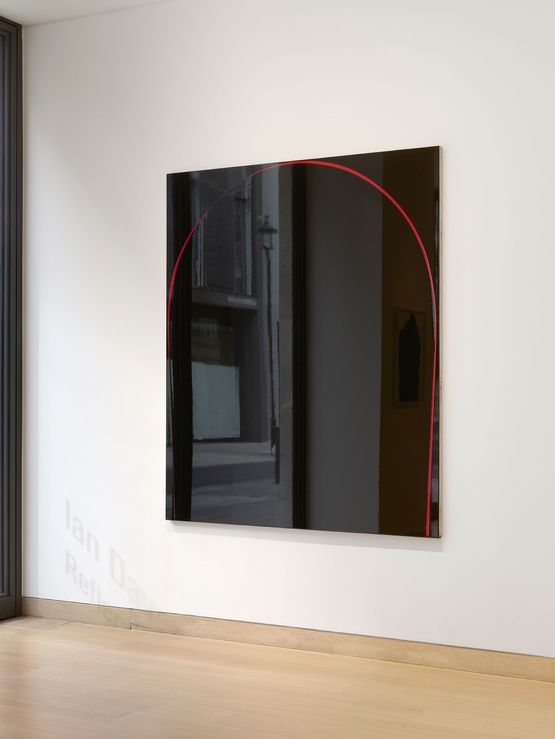
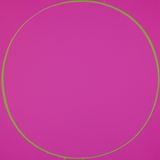
Building on his interest in physical, gesture-based approaches, Davenport produced arch and circle paintings, many dating to the late 1990s and early 2000s, such as ‘Black, Red, Black (Arch)’ (1998). By pouring paint from the centre of a panel, he worked with gravity, rotating panels to manipulate the flow. The resulting forms are smooth and geometric, haloed by a thin line of impactful colour.
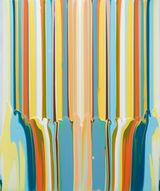
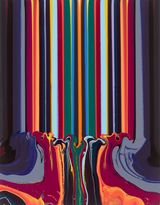
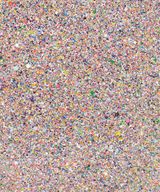
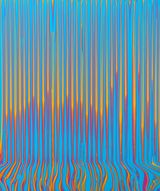
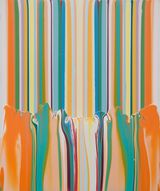
Reflections also traces the development of Davenport’s most iconic artistic method. Using syringes, he pours paint in precise colour sequences, delighting in the limitless potential of the compositions and the paradox between control and chance. In the exhibition, works like ‘Black Puddle’ (2010) and ‘Blossom’ (2023) showcase the artist’s mature style and mastery of colour relationships. It is these lines of colour that are synonymous with Davenport’s public installations, including ‘Poured Lines’, Southwark Bridge, London (2006), ‘Giardini Colourfall’ at the Venice Biennale (2017) and ‘Poured Staircase’ at the Chiostro del Bramante, Rome (2022). They are complemented by Davenport’s recent splatter paintings, which the artist sees as a counterpoint to the poured lines. The series is full of ‘ricochets and splinters of colour’, marked by a sense of playfulness and vitality.
The exhibition is accompanied by a new publication that offers a broader insight into the ideas that underpin Davenport’s practice. It features previously published texts, essays and reviews by leading critics and art historians, including Michael Bracewell, John Constable, Norman Rosenthal, Richard Shone, Michael Stanley, Jonathan Watkins and Sarah Whitfield. Alongside these contributions is a conversation between Ian and his brother, the writer Philip Davenport, as well as the artist’s personal reflections, bringing a more informal and intimate perspective to his practice. All texts are interwoven with images of artworks, studio photographs and archival material. The catalogue is available to purchase on our website.
Ian Davenport (b. 1966, Sidcup, Kent) is an abstract painter recognised for his complex colour compositions and whose work is informed by a deep understanding and enjoyment of paint. Since graduating from Goldsmiths’ College of Art in 1988, Ian Davenport has experimented with everyday tools such as watering cans, electric fans and nails, designed to exercise and limit his manipulation of paint. His various means of execution are driven by a desire to investigate the paradox between control and chance. It has led him to emphasise the action of painting as his subject matter, observing that ‘the how to paint became the what to paint’. He is well-known for using hypodermic syringes to pour liquid household paint onto surfaces. In 2008, Davenport noticed that the poured paint pooled into puddles on the floor; this visual contradiction between controlled, precise lines that then merged freely, autonomous and self-determining, embodied the paradox between control and chance. He has incorporated the puddles into his recent Puddle Paintings, which demonstrates Davenport’s process-led approach. He contemplates the colour harmonies of each composition, each possessed of their own visual sense of timing, rhythm, interval and accent.
Waddington Custot was formed through the partnership of French art dealer Stephane Custot and long-time London art dealer Leslie Waddington, in 2010. Located in Cork Street since 1958, formerly as Waddington Galleries, the gallery has a rich heritage and an international reputation for quality and expertise in works by modern and contemporary masters, with a particular focus on monumental sculpture.

A respected voice in contemporary art discourse.
Focusing on ambitious storytelling and insightful art-world commentary. Ocula Magazine publishes in-depth interviews, critical essays and timely analysis on the artists, exhibitions and ideas driving the global art world.
Learn more about Ocula Magazine
Showcasing the best of the art world.
Ocula partners with galleries from around the world to highlight their artists, artworks and exhibitions. Gallery membership is by application and invitation, with each member vetted by an independent panel.
Learn more about Ocula Membership

Specialises in the sale of major artworks.
Led by a team with deep ties to the world’s leading auction houses, galleries and collectors. Ocula’s advisory team offers bespoke services to high-net-worth clients from around the world who are looking to acquire the best of contemporary and modern art.
Learn more about our team and services