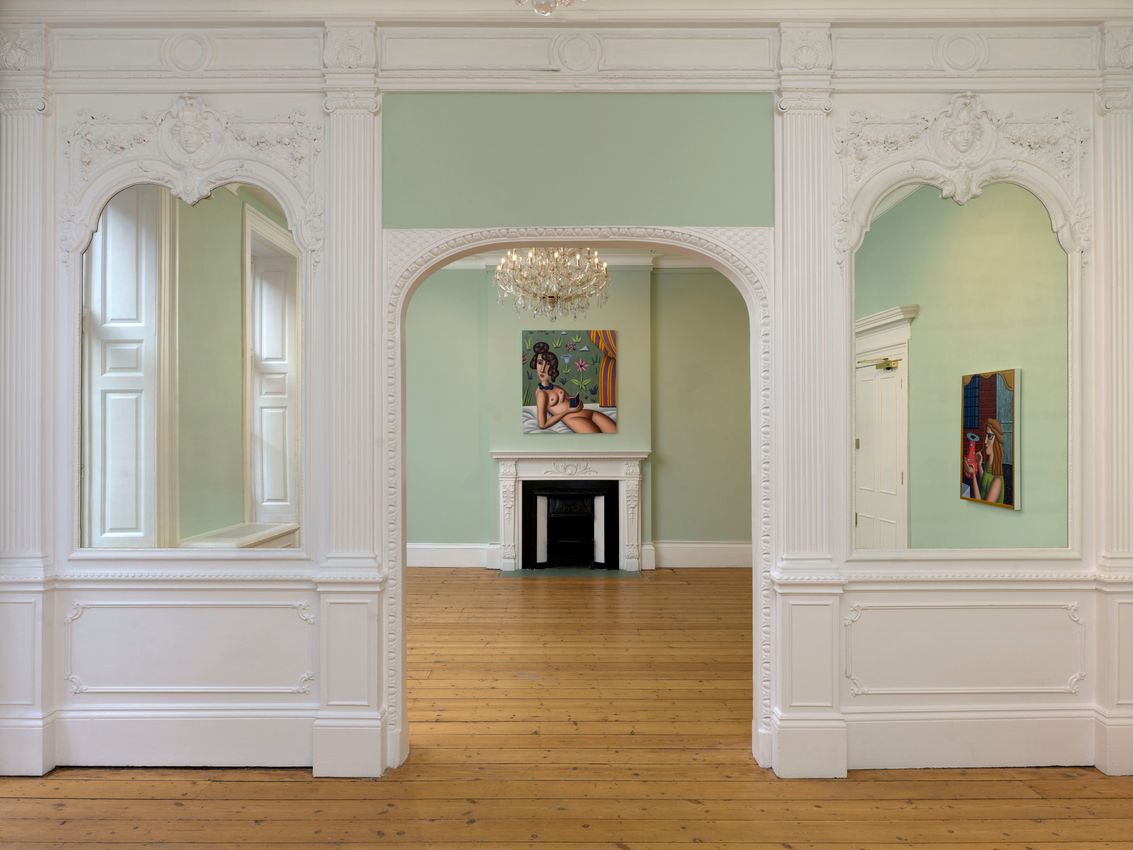
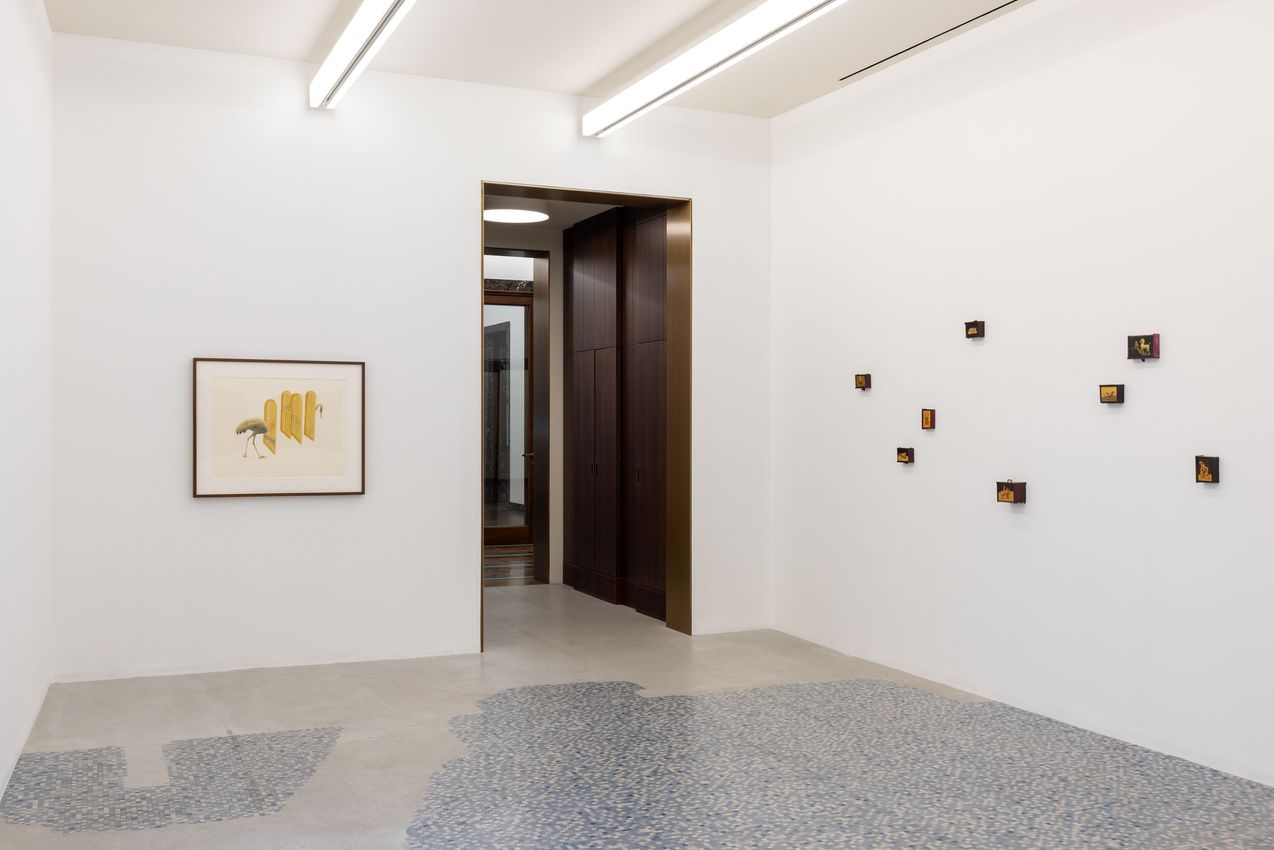
MASSIMODECARLO is pleased to present The Trace of Things, the first solo exhibition in Italy by Dominique Fung, a Canadian artist of Chinese descent. The exhibition brings together a new body of work – paintings, jewellery boxes, and, shown for the first time, her drawings. A trace is what remains after the thing itself is gone: the imprint of a leaf in stone, the outline of a wing, the mark a hand leaves on a page. Each of these works is, in its own way, a trace.
The exhibition is, in the artist’s own words, “a continuation of everything” – a deepening of her long study of how history is mediated and mythologised, traced through Chinese antiquities, from Shang dynasty bronzes to Tang dynasty objects. Fung paints these as subjects rather than props, recalling the writer Anne Anlin Cheng’s observation that “personhood might be indebted to objects,” the point where a thing and a being become hard to tell apart. Following that thought, she looks further back, past recorded history, to the earliest creatures ever preserved: “the first plants that were categorised and fossilised,” one of the first fossilised butterflies, strange fossilised fish. What she notices is a rhyme between what nature kept and what people made – antiquities on one side, insects crystallised in rock and lava on the other, all of them “stuck in time.”
And yet the work brims with living things. The butterfly returns from canvas to canvas; cranes rise from the same bronzes once buried among the terracotta warriors; birds gather at the edges of the paintings. What was preserved begins, here, to move. And as it does, a landscape opens around it: Fung sets her objects into open ground and weather rather than onto a table, so that a painting reads at once as a scene and as a study of things. She wants to “bleed those two things together” – to let still life and landscape become versions of each other, the object as alive as its setting, the setting as composed as any arrangement.
The drawings work differently. If painting lets her blend and revise, drawing allows neither: “your mistakes are your mistakes,” and the paper is unforgiving. A painting can hold many thoughts at once; a drawing is closer to “a single thought” – more direct, a way of finding “the source of where my ideas come from” before it grows into something larger.
Fung’s attention to objects reaches the foo dogs, too – guardian figures that have long stood at the thresholds of homes, temples and palaces, set to protect a household and turn harm away. Like the bronzes and the fossils, they are old things still charged with a role, and there is a rightness to meeting them in a building that was once a private Milanese home: guardians of a house, returned to one.
Where a thing belongs is, in its way, Fung’s real subject – how objects are arranged, written about, “categorised in history,” how a timeline decides what sits where. Her jewellery boxes press on exactly that. A box is a small machine of classification: it keeps and it sorts, deciding what is worth storing and what stays out of sight. To bring these boxes into the room is to turn that sorting over – to loosen the categories objects are usually given, and to let these ones claim, at last, “a category of their own.”


Dominique Fung (born 1987, works in New York) is a Canadian artist with ancestry in Hong Kong and Shanghai, whose practice explores the subliminal liminal territory in which tradition, memory and legacy seep through our collective subconsciousness. Through her interest in casting light on overlooked or forgotten stories and her use of specific historical artifacts she infuses with living qualities and complex non-linear narrative paths, she models a new, broader, alternative space of belonging.


MASSIMODECARLO gallery was founded in 1987. It switfly stood out on the international artistic scene for its bold, counter-current choices: the gallery focused on lesser-known artists in Italy such as John Armleder, Olivier Mosset, Steven Parrino and Carsten Höller. In the following years, the gallery program expanded to include prominent young artists of the time such as Alighiero Boetti, Cady Noland, Rudolf Stingel, and Felix Gonzalez-Torres.

A respected voice in contemporary art discourse.
Focusing on ambitious storytelling and insightful art-world commentary. Ocula Magazine publishes in-depth interviews, critical essays and timely analysis on the artists, exhibitions and ideas driving the global art world.
Learn more about Ocula Magazine
Showcasing the best of the art world.
Ocula partners with galleries from around the world to highlight their artists, artworks and exhibitions. Gallery membership is by application and invitation, with each member vetted by an independent panel.
Learn more about Ocula Membership

Specialises in the sale of major artworks.
Led by a team with deep ties to the world’s leading auction houses, galleries and collectors. Ocula’s advisory team offers bespoke services to high-net-worth clients from around the world who are looking to acquire the best of contemporary and modern art.
Learn more about our team and services