


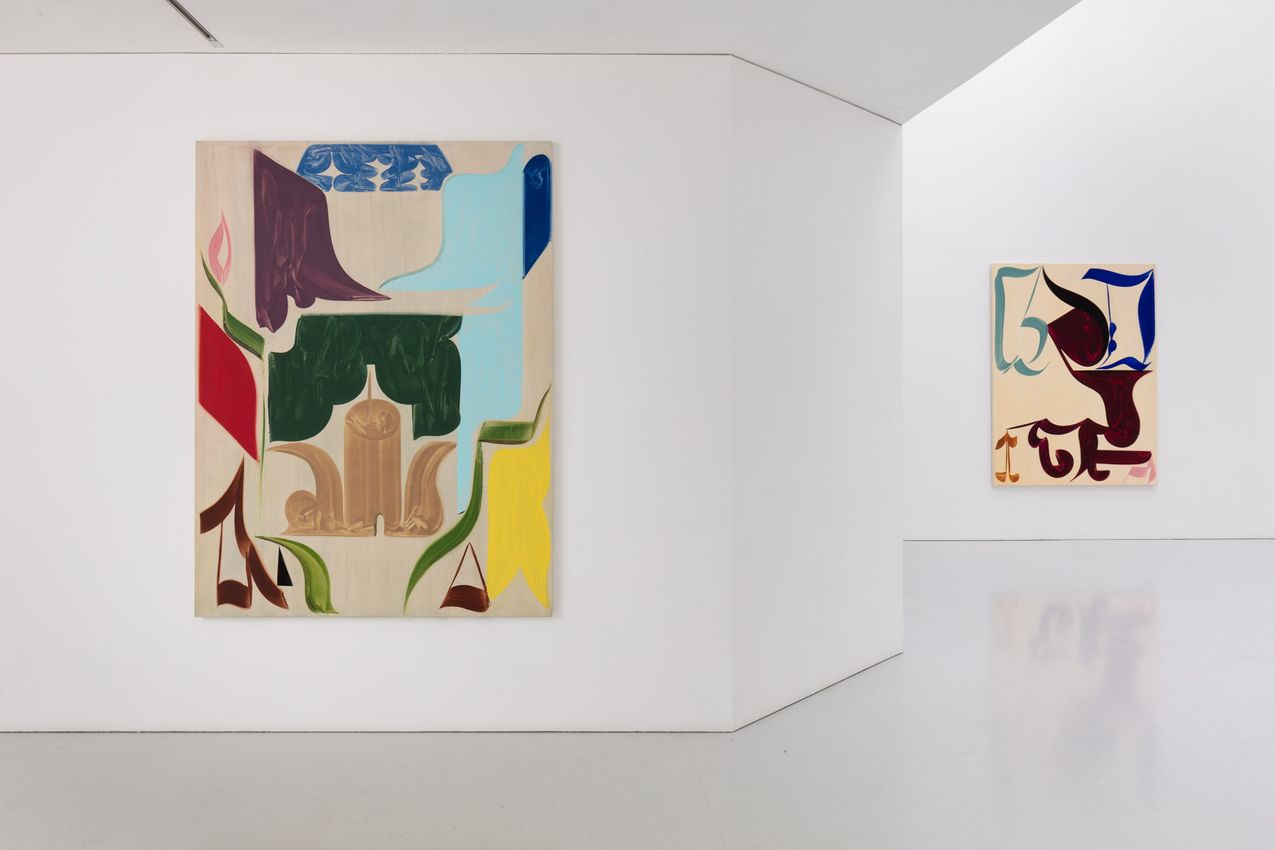
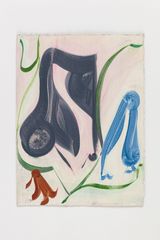
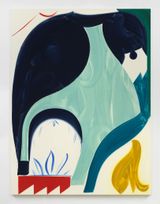
Patricia Treib works at an immersive scale, one that feels closer to the size of a bed than a door. Nearly all her paintings are executed in the span of a single day. Working quickly but deliberately, Treib lays the canvas on the floor and then uses wide hake brushes to sweep paint over the surface, wiping out a gesture and repeating it until each trace is both immediate and precise. The mobility of these gestures determines the mobility of the forms themselves. A velvety skein of colour can be flipped and pleated like a ribbon; a giant blue blot can be broken by the fluttering motion of a brush weaving through it. Treib thins her paints slightly so that they appear saturated yet translucent, and this gives her forms neither the solidity of still-life nor the atmospherics of landscape. Instead of manipulating these figures or transporting yourself into their ambiance, you are enjoined to follow the movements that produced them—a hand that puckered or smoothed the shape, just as a body might sculpt a bed sheet.
The sheets invoked and directly referenced by Treib’s paintings, however, belong not to beds, but to sketchbooks. Their off-white grounds suggest the small rectangles of paper on which Treib first works out her compositions, developing them sometimes over the course of years. The same composition can serve numerous works, which as a result share a sibling relationship, differing in their colouring, the subtle inflections of their features, or the expression of their elements. Because she rarely hangs paintings that share the same source close to one another, these resemblances might initially elude the viewer. An apparent automatism at the level of production persists as an automatism at the level of reception. In this mode, paintings appear like echoing phrases or, as the artist suggests, like afterimages, their tones inverted and vibrating on a new surface.
Like the afterimage, the execution of the painting is a contraction of time: namely, the time of preparation, from the first sketch on paper (made perhaps years before the large painting) to the day the canvas was laid out on the floor. The legibility of the painting’s production is another: namely, the brushstrokes, through which one can imaginatively reconstruct Treib’s movements over the canvas, each one as fluid and particular as the way someone picks up a glass or ascends a staircase.
‘Three Items’, by Joanna Fiduccia, is an essay from the forthcoming monograph, Patricia Treib, to be released in 2020. Joanna Fiduccia is an art historian and critic. She lives in New Haven where she is Assistant Professor of Modern European and American Art at Yale University.
Patricia Treib was born in 1979 in Saginaw, Michigan, and lives and works in Brooklyn, New York. Limbs is her second solo exhibition at the gallery. Recent solo exhibitions have been held at Galerie Nordenhake, Stockholm (2018); Bureau, New York (2017); Galería Marta Cervera, Madrid (2016); and Crown Point Press, San Francisco (2018). She has participated in residencies at the American Academy in Rome (2017), the Dora Maar House (2014), The MacDowell Colony (2013), and is a recipient of the 2017 Artadia Award. Treib’s monograph will be published next year and features Joanna Fiduccia’s essay and an interview conducted by poet and novelist, Ben Lerner.
Press release courtesy Kate MacGarry. Excerpt from 'Three Items' by Joanna Fiduccia.
The gallery was founded by Kate MacGarry in 2002 on Redchurch Street, London, where some of its represented artists, including Goshka Macuga (Poland), Francis Upritchard (New Zealand), Ben Rivers (UK) and Dr Lakra (Mexico) had their first commercial gallery exhibition. The current gallery space, originally designed by architect Tony Fretton, is on Old Nichol Street where they present six exhibitions a year. The gallery participates in international art fairs including Art Basel and Frieze London where they have presented solo projects since 2010. The gallery represents 25 emerging and established artists; most recently adding Dawn Ng, Rio Kobayashi and Mark Corfield-Moore to the roster.

A respected voice in contemporary art discourse.
Focusing on ambitious storytelling and insightful art-world commentary. Ocula Magazine publishes in-depth interviews, critical essays and timely analysis on the artists, exhibitions and ideas driving the global art world.
Learn more about Ocula Magazine
Showcasing the best of the art world.
Ocula partners with galleries from around the world to highlight their artists, artworks and exhibitions. Gallery membership is by application and invitation, with each member vetted by an independent panel.
Learn more about Ocula Membership

Specialises in the sale of major artworks.
Led by a team with deep ties to the world’s leading auction houses, galleries and collectors. Ocula’s advisory team offers bespoke services to high-net-worth clients from around the world who are looking to acquire the best of contemporary and modern art.
Learn more about our team and services