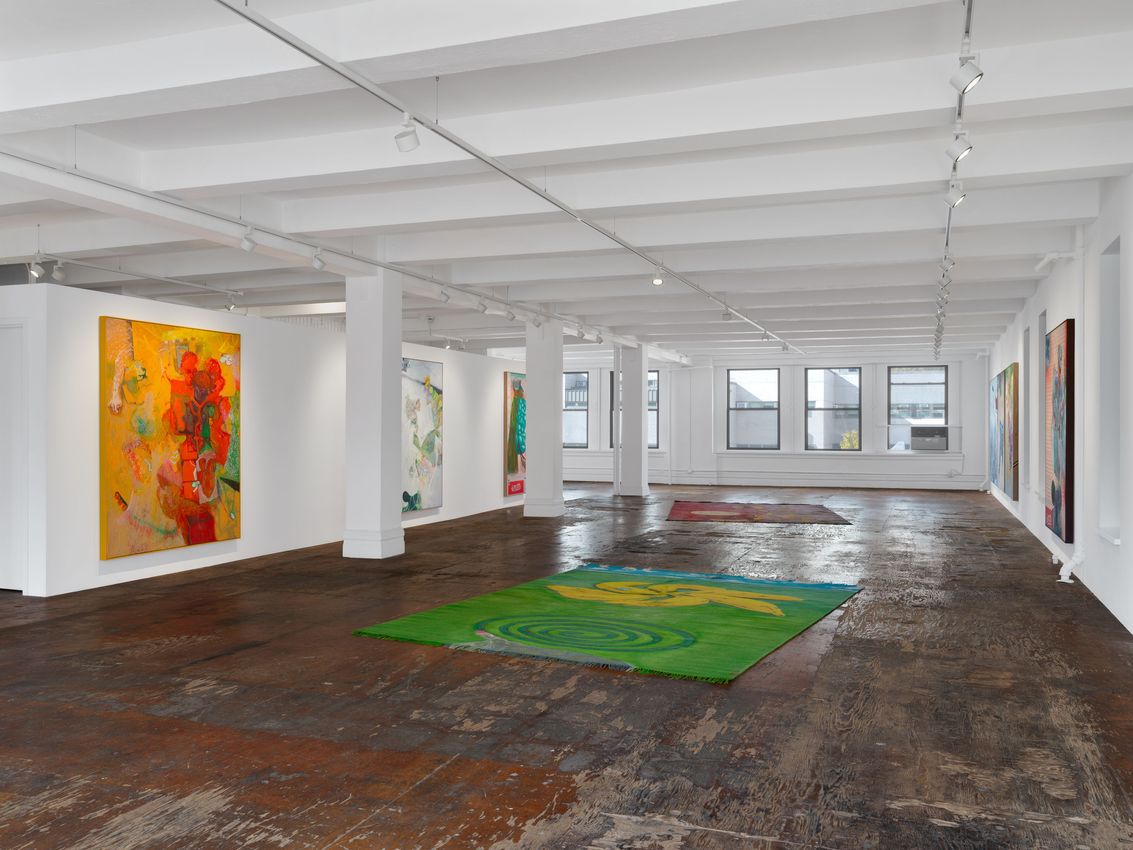
Kiang Malingue is pleased to present Spasm, Kaifan Wang’s first solo exhibition with the gallery at its Hong Kong location. Wang has created more than a dozen paintings in 2026 that confront the physical, psychological and artistic dimensions of losing control—allowing spastic forces to reshape agency itself, divesting it of subjectivity, stability and semblance of autonomy.
Born in Hohhot in 1996 and based in Berlin, Wang works with overflowing paint through smearing, spilling, and erasing. His surfaces resemble chromatic reactions—bubbly, volatile—or intricate remains touched by natural forces such as wind, sand, and time. In large-scale works, he builds and layers mostly with sponges, only to later erase the marks, creating space as Chinese calligraphic compositions do: through nuanced absence. For Wang, this process of building and erasure is itself a form of narration—a way of threading together memory, history, and immediate bodily sensation.
In 2026, Wang returned to his own physical body through exercise. Physical practice became a site of relearning: the body revealing its own logic—muscles failing intention, tendons compensating, spasms erupting as the body asserts its own rhythm against the will’s demands. From this bodily knowledge, a new artistic method emerges. Where his earlier painting practice articulated and controlled surfaces, he now pursues forced suspension, imbalance, precipitation, and the re-assimilation of the precarious human body into nature. Control itself becomes the subject he dismantles—not through abandonment, but through deliberate interference with his own mastery.
Le Déjeuner sur l’herbe (The Picnic) (2026) exemplifies this shift. The title references Manet’s masterpiece, which itself had already stripped the sacred from Raphael’s The Judgment of Paris, secularising myth into modern leisure. Wang moves one step further: he abandons the coherence that Manet’s composition maintains. Where Manet’s figures still possess form and presence, Wang’s tempestuous forms fracture and intertwine—contorted, interlocking—surrendered not to social discomfort but to spasm itself. The twisted, tilted figures are no longer metaphors for modern consciousness wrestling with desire; they are bodies overwhelmed by forces that exceed representation entirely. The work suspends these contorted bodies in golden light, caught in a moment where agency has already been compromised, transforming a picnic into a space of physical disruption.
Hurled headlong flaming from the ethereal sky (2026) takes its title from Milton’s Paradise Lost, describing the fall of the angels cast from heaven. Wang’s work captures the instant of expulsion: the body torn from its position, involuntary, subject to forces that are both compulsive and dangerous. Pale, rounded forms are inundated by a maelstrom of colour: ochres bleeding into reds, greens and blues streaking across the canvas in violent, turbulent marks. The figures are neither strictly active nor passive, but bodies surrendering to momentum they did not author. Unlike classical representations where the fall is tragic but comprehensible, Wang renders this moment as pure spasm—limbs commandeered by spastic accidents that exceed the body’s capacity to resist or comprehend. The painting tips the viewer into the space of that descent, moving alongside the figures in their fervid flight.
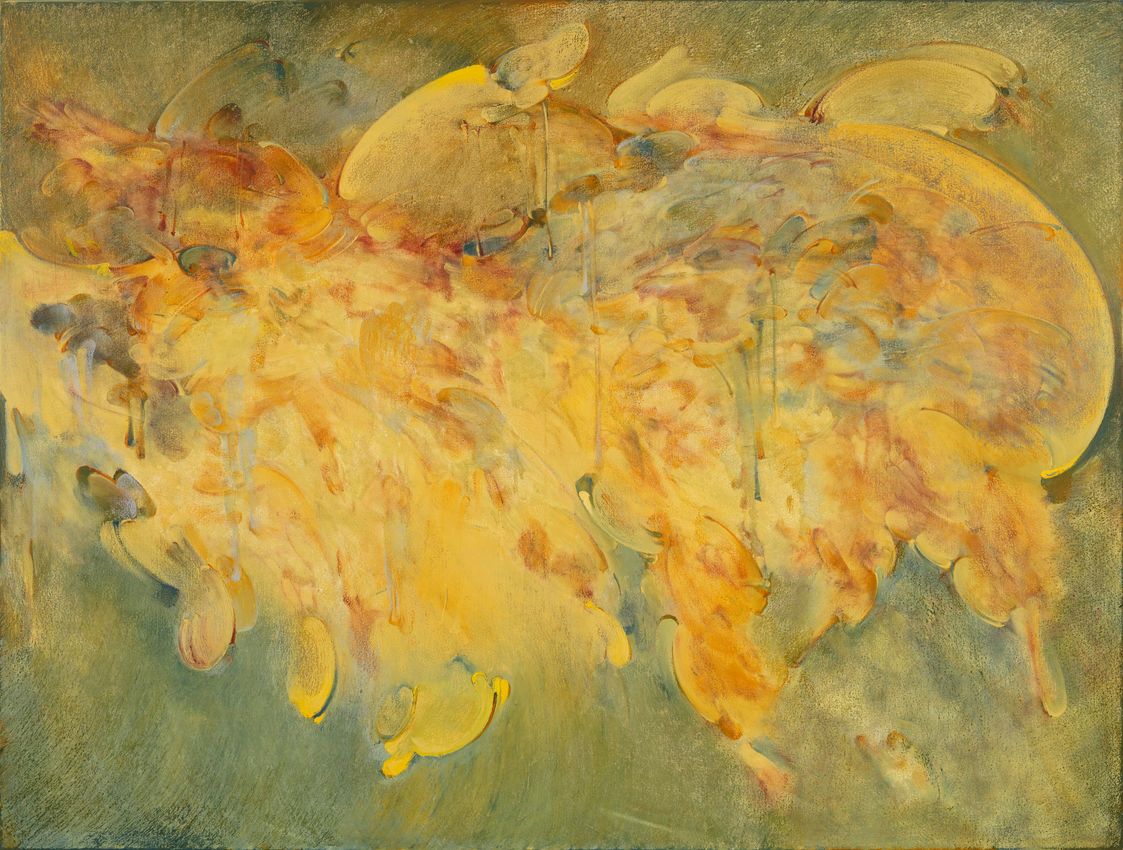
As I lay with my head in your lap (2026) shifts the register of spasm toward intimacy and interdependence. The title evokes Whitman’s Leaves of Grass, where the body is not isolated but continuously connected to grass, earth, plants, desire—boundaries between self and nature dissolving. Here, two figures rest in an embrace: one transfers the weight of their body to the other, a gesture of trust and relinquishment. The canvas unfolds in soft, ochred tones—ochres, browns, creams—with touches of red and green woven through layered, gestural marks. The bodies are suggested rather than explicit, intimate yet turbulent. Informed by Bacon’s chaos—painting that breaks down torsos and limbs—Wang creates a space where vulnerability becomes a shared state, where one body’s spasm is anchored, paradoxically, by another’s presence.
Pulling myself cautiously up (2026) shifts focus to proprioception—the body’s knowledge of itself without sight. The canvas is similarly rendered in luminous, warm tones: creams, golds, ochres suffusing reds and browns. Dripping, gestural marks suggest limbs and bodies pulling upward, clinging, grasping; the composition hovers between the botanical and the anatomical, echoing the Whitmanesque motifs present throughout the exhibition. What distinguishes this work is Wang’s deliberate interruption of clarity: Wang refuses both the viewer’s and his own impulse to name and recognise. Our consciousness habitually and instantly names: we see and we identify. But Wang erases, covers, introduces unpremeditated marks to destroy the formed image, leaving instead primal perceptions of texture, direction, density, and weight. In this cascading disruption beyond control, spasm becomes a method: chaos not as spontaneous release, but as the necessary breaking of cognitive order to access more intimate, embodied knowing of the impossible.
Across these works, Wang charts a singular trajectory: from the collapse of classical order into bodily chaos, through the moment of expulsion—violent, weighted, subject to forces that bear down—toward the discovery that vulnerability can be shared, and finally to the recognition that the body’s own proprioceptive, primal knowledge that is resistant to naming offers a way to think of one’s self as a project that is out of control.

A respected voice in contemporary art discourse.
Focusing on ambitious storytelling and insightful art-world commentary. Ocula Magazine publishes in-depth interviews, critical essays and timely analysis on the artists, exhibitions and ideas driving the global art world.
Learn more about Ocula Magazine
Showcasing the best of the art world.
Ocula partners with galleries from around the world to highlight their artists, artworks and exhibitions. Gallery membership is by application and invitation, with each member vetted by an independent panel.
Learn more about Ocula Membership

Specialises in the sale of major artworks.
Led by a team with deep ties to the world’s leading auction houses, galleries and collectors. Ocula’s advisory team offers bespoke services to high-net-worth clients from around the world who are looking to acquire the best of contemporary and modern art.
Learn more about our team and services