



****Lehmann Maupin is pleased to present Astral Sea, an exhibition of new work by New York-based artist Teresita Fernández. Featuring a series of glazed ceramic pieces and new sculptural paper panels, Astral Sea extends the artist’s interests in the confluence points of the cosmos, land, and water, as seen through the lens of an embodied sculptural landscape. Astral Sea will inaugurate Lehmann Maupin’s temporary location at No.9 Cork Street, located in the heart of Mayfair, while the gallery’s permanent space at Cromwell Place undergoes renovation this fall. Concurrent to the exhibition, Fernández’s work is on view at SITE Santa Fe in the two-artist exhibition Teresita Fernández / Robert Smithson. Co-curated by Fernández, the exhibition features over 30 of her works and marks the first time Robert Smithson’s oeuvre has been placed in conversation with an artist working today.
Throughout her practice, Fernández has concerned herself with the ambulatory viewer, situating her work so that it is brought to life by the individual’s movement around the gallery. With these shifting vantage points, people’s reflections move across the surfaces of the work; depending on one’s location, the artist’s materials either reveal or conceal themselves from view. This physical engagement is akin to how we wayfind in or navigate the world around us, making evident our connectivity to the universe—the stars, tides, and slow time of geology. In this way, Fernández’s works embody the phrase: ‘Nothing rests; Everything moves; Everything vibrates.’
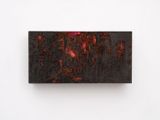
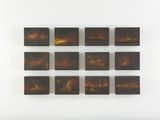
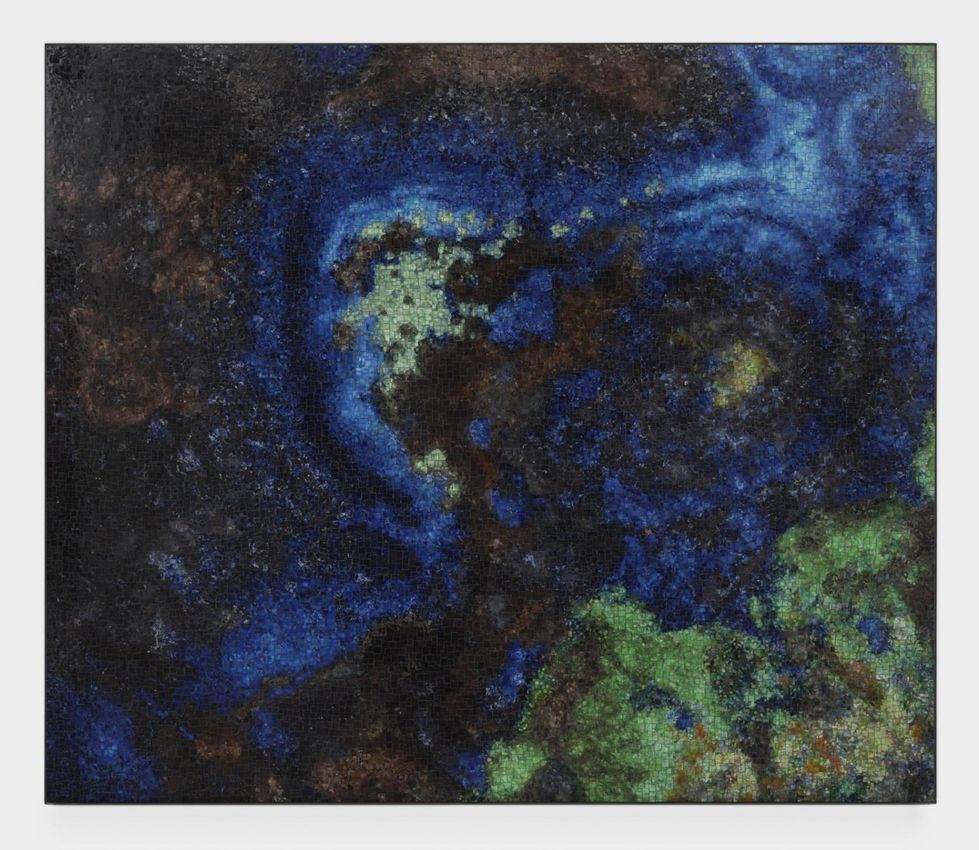
This continuous, flowing movement is the starting point for Astral Sea—a phrase that Fernández feels speaks to the ephemerality of both the sky and water. Visible from the gallery’s windows are two new glazed ceramic works: Astral Sea 1 and Astral Sea 2, made from thousands of tiny glazed ceramic tesserae, with imagery that is at once deeply familiar yet ambiguous. The saturated blues suggest a flowing river connecting the two panels, earthen copper/brown hints at land masses, and deep greens become blooming organic matter. At the same time, these works could depict a galaxy, creating an ‘as above, so below’ vertiginous topography that refuses to ground the viewer in a single recognisable location. The ceramic pieces are placed in the path of the sun, causing shifting light to add dynamism to the glossy surface of the tiles. As the viewer approaches the works, their silhouettes move across the variegated surface, activating the shimmering minerality of the glazes. These works are never still; they vibrate. As a result, Astral Sea 1 and 2 exist on both macro and micro registers. The individual tiles coalesce to form a whole, transforming the intimately microscopic into the immensely vast.
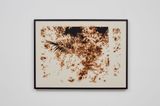
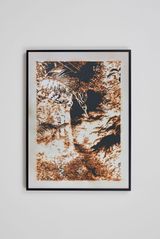
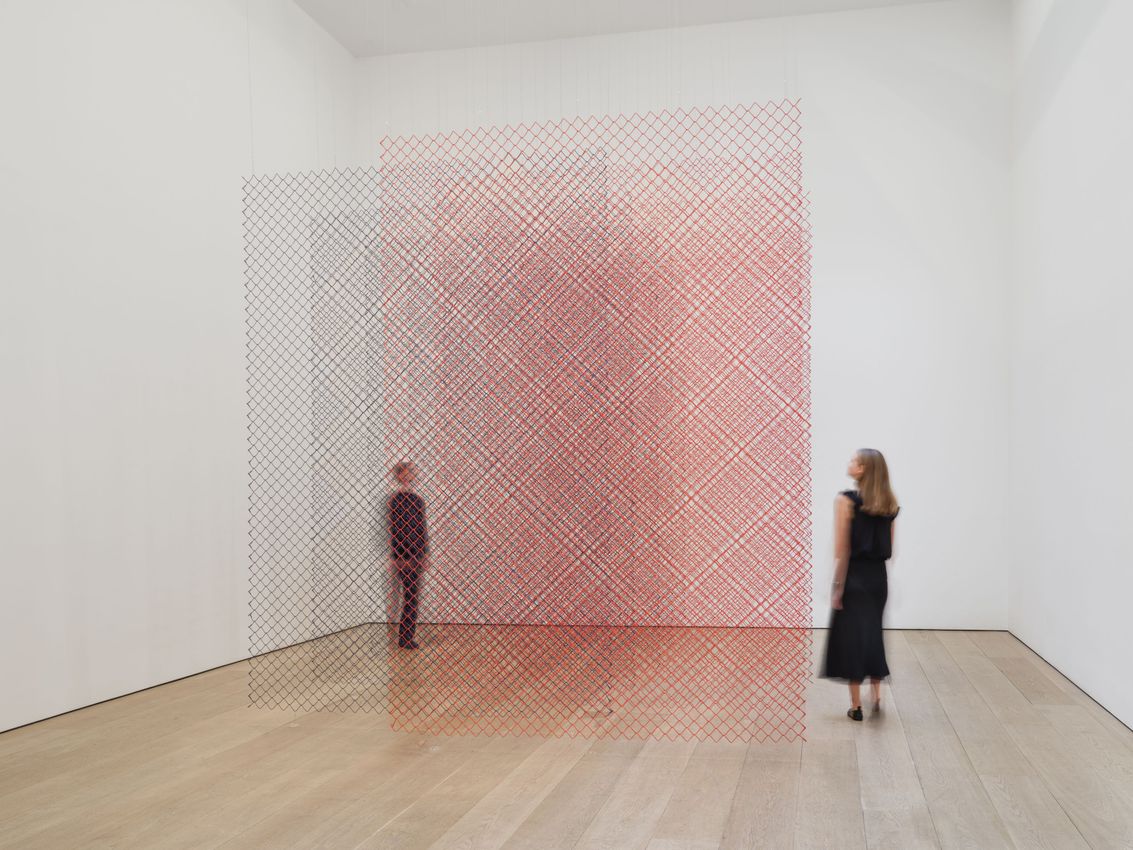
Another reference point for the exhibition is the phrase Stella Maris, which translates to ‘star of the sea’ and speaks to the feminine qualities universally associated with water. This ‘star of the sea’ is evident in a series of new sculptural paper panels titled Stella Maris (Net). While the glazed ceramic panels open onto vast worlds, these sculptural paper panels conceal something, creating liminal spaces between what can and cannot be known. Created through an accumulation of paper pulp and pigments, each work becomes a palimpsest where multiple layers are hidden from view, like invisible geologies. Networks of airy white lines and points (possible stars, galaxies, or wave breaks) unfold atop blue-gray grounds, and upon close inspection, the ink seeps into the crevices of the paper, turning the works into physical, sculptural objects. Atop the paper are handwoven nets made from Kozo fibres, which are tethered to fixed points, draping over the surface to create veils obscuring sections of the imagery below. The patterns in the paper and the weave of the nets intersect, prompting the viewers’ eyes to remain in motion. This active looking reinforces the fact that nothing is simultaneously accessible. The viewer’s eye is kept in perpetual motion as the works slowly unravel rather than immediately reveal themselves.
The net motif reappears in the freestanding sculpture Tether(Flotsam and Jetsam), which anchors the exhibition, grounding the ephemerality of the accompanying works. A concrete geometric form sits on the floor, recalling a monumental and faceted dark gray gemstone. The surface exposes fragments of white sand that have been cast into the dark concrete, suggesting infinite constellations. The base of the sculpture is tilted to reveal that it is not entirely resting on the floor, but rather being pulled upward towards the ceiling by a directional rope. On the opposite end of the rope are suspended nets that seemingly hover, yet remain tethered. The base functions like a mooring anchor, while the nets’ buoyancy allows them to float up to the surface of an imagined water line. Additionally, the nets are laden with rock-like crystalline minerals, including azurite and malachite. Glistening like suspended points of light, these elements unify the bodies of work across the exhibition, merging the colour and minerality of Astral Sea 1 and _2_and the nets of Stella Maris (Nets). Tether (Flotsam and Jetsam) somatically places viewers in the space between land, sea, and sky.
As in much of Fernández’s practice, the sociopolitical underpinnings of Astral Sea are important yet subtle. Here, the artist’s choice of the terms flotsam (lightweight buoyant material) and jetsam (castoff heavy material) is deliberate, referencing colonial conquest and greed. These violent trajectories are also associated with water, and the forced and brutal migration imposed on human beings and the displacement of materials across bodies of water. By presenting and then pausing this ensnarement, Fernández suspends us for a moment, making space to consider what is historically valued/hoarded and what is devalued/discarded.
Astral Sea invites viewers to reflect on their own sense of scale, place, and ambulation, prompting recognition of the buoyancy and weight of both history and the elements. As novelist Carlos Fuentes states, ‘The sky is neither high nor low. It’s over us and under us at the same time.’ Fernández’s works tumble; they simultaneously float above and tether us to the ground, reminding us of the constant state of flow and flux at the place where sky, land, and sea converge on the same astral plane.
Teresita Fernández (b. 1968, Miami, FL, lives and works in Brooklyn, NY) is best known for her prominent public installations and experiential large-scale sculptures that evoke striking landscapes. Her work, often inspired by natural wonders—meteor showers, the aurora borealis, cloud formations, fire, and the night sky—invites an individualised experience of the work and the space it occupies. Fernández places particular importance in her choice of medium, playing with the limitations of materials and employing those such as gold, graphite, and other minerals that have complicated histories often tied to colonialism. All of her work, from her immersive installations to her small graphite panels, is characterised by an interest in perception and the psychology of looking. In 2015, Fernández installed her largest public art project to date, Fata Morgana, in New York’s Madison Square Park. The work was composed of six mirrored canopies suspended above the park’s central lawn, and its title refers to the visible yet illusory line that hovers right above the horizon. In using metal to achieve the effect of a natural floating apparition, Fernández challenges the inherent characteristics of the material.


Rachel Lehmann and David Maupin founded Lehmann Maupin in 1996. The gallery represents a diverse range of American artists, as well as artists and estates from across Europe, Asia, Africa, South America, and the Middle East. It has been instrumental in introducing numerous artists from around the world in their first New York exhibitions.
A respected voice in contemporary art discourse.
Focusing on ambitious storytelling and insightful art-world commentary. Ocula Magazine publishes in-depth interviews, critical essays and timely analysis on the artists, exhibitions and ideas driving the global art world.
Learn more about Ocula Magazine
Showcasing the best of the art world.
Ocula partners with galleries from around the world to highlight their artists, artworks and exhibitions. Gallery membership is by application and invitation, with each member vetted by an independent panel.
Learn more about Ocula Membership

Specialises in the sale of major artworks.
Led by a team with deep ties to the world’s leading auction houses, galleries and collectors. Ocula’s advisory team offers bespoke services to high-net-worth clients from around the world who are looking to acquire the best of contemporary and modern art.
Learn more about our team and services