

The art world in focus
Subscribe to our newsletter for news and insights on artists, galleries and exhibitions.

Jean-Michel Basquiat, Andy Warhol, and Keith Haring photographed by Roxanne Lowit, 1985. Courtesy Opera Gallery.
As the art world migrates from London to a turbulent Paris, a new exhibition in the French capital explores the conviction that united three ubiquitous pop art icons: Andy Warhol, Jean-Michel Basquiat and Keith Haring.
Titled Warhol, Basquiat and Haring. Une amitié artistique (An artistic friendship) and hosted by Opera Gallery, the show brings together a selection of paintings and works on paper that embody the artists’ shared ambition to challenge the boundaries between performance and painting, and between low and high art. It traces the street culture from which the trio emerged and explores how the art world came to embrace them.
As Marion Petitdidier, director of Opera Gallery Paris told Ocula, Warhol, Basquiat and Haring “came from different generations and backgrounds, and their artistic languages remained very distinct”. “But,” she continued, “they recognised in one another a similar ambition: to capture the energy of their time without compromising their individuality.”
With his career well established by the late 1970s, Warhol turned a keen eye on the emerging figures of New York City’s downtown galleries, clubs and street scene. It was there, in 1979, that an 18-year-old Basquiat is thought to have first approached the pop art icon, selling him one of his postcard collages for $1.
The relationship that followed, as Petitdidier explained, went far beyond that of a master and his successor. “Warhol brought his understanding of celebrity, media, and the art world,” she said, “while Basquiat challenged him with a raw pictorial energy that renewed his interest in painting.”
While the relationship between Warhol and Basquiat became well known—think Michael Halsband’s iconic boxing glove portrait of the pair, or Fondation Louis Vuitton’s 2023 blockbuster exhibition Basquiat x Warhol. Painting four hands—Opera Gallery sets out to foreground Haring’s significance, both in shaping the dialogue between the two and as an influential force in his own right.
Warhol met Haring a few years after Basquiat, and their friendship became equally instructive. “His kindness and generosity helped Haring imagine what it meant to be a public artist, reaching audiences beyond the traditional art world,” Petitdidier said.
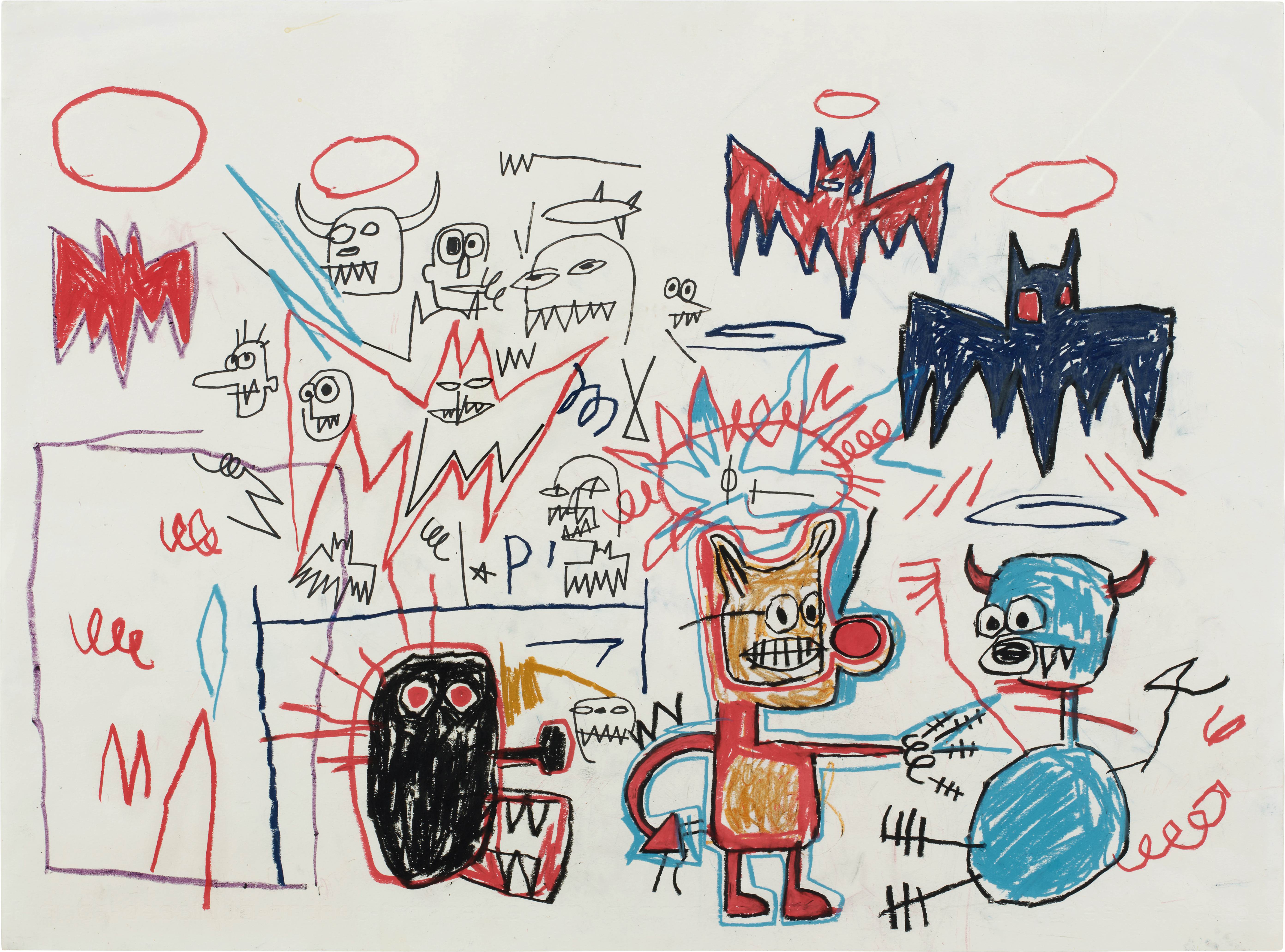
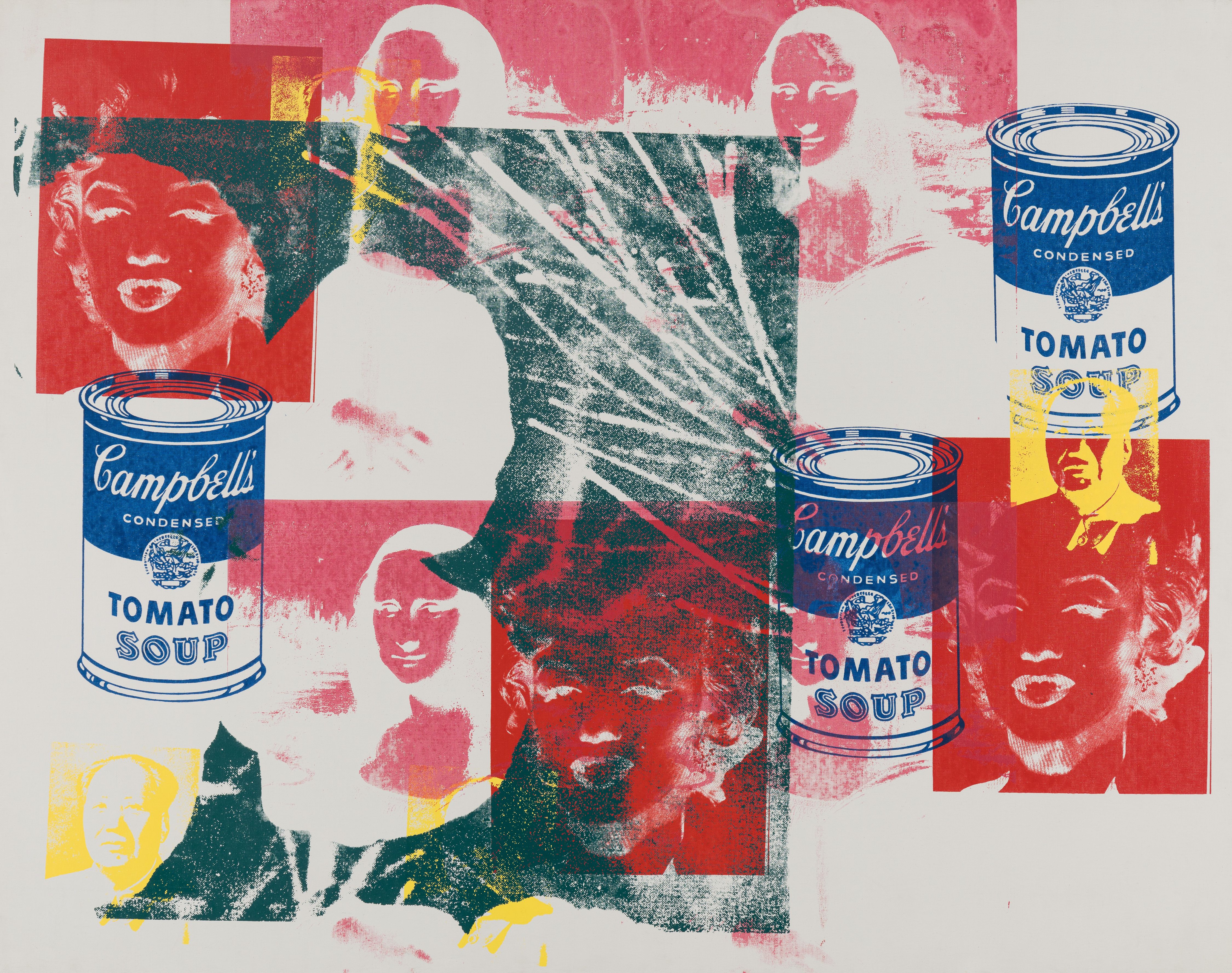
Addressing form, the exhibition hones in on all three artists’ use of signs and symbols. This shared interest is perhaps most evident in works such as Basquiat’s Batman (1983), an untitled Mickey Mouse sketch by Haring (1981–82) and Warhol’s Multicolored Retrospective (Reversal series) (1979)—a merging of three of his most recognisable motifs: the Campbell Soup can, the Mona Lisa and Marilyn Monroe.
The latter work exemplifies, as Petitdidier explained, “how familiar imagery can be transformed through repetition and reversal”. She added: “This resonates with the ways Basquiat and Haring reimagined the visual language of the street, media, and popular culture.”
A photograph of the three artists, taken in 1985, adorns the cover of the exhibition’s catalogue. There’s an awkward air to the snapshot. Standing stiffly upright, smiles fixed towards the camera, it looks like a somewhat forced encounter.
Though they made an unlikely trio, Warhol, Basquiat and Haring’s connection would give rise to one of the most significant artistic exchanges in late 20th-century art. By placing their works side by side, Opera Gallery hopes to bring new connections and perspectives on this exchange into view—no mean feat when exhibiting some of the most widely shown artists in the world.
For Petitdidier, this is the exhibition’s central paradox. She explained: “Three artists who explored the circulation of images created works that continue to resist being merely consumed.”
A respected voice in contemporary art discourse.
Focusing on ambitious storytelling and insightful art-world commentary. Ocula Magazine publishes in-depth interviews, critical essays and timely analysis on the artists, exhibitions and ideas driving the global art world.
Learn more about Ocula Magazine
Showcasing the best of the art world.
Ocula partners with galleries from around the world to highlight their artists, artworks and exhibitions. Gallery membership is by application and invitation, with each member vetted by an independent panel.
Learn more about Ocula Membership
Specialises in the sale of major artworks.
Led by a team with deep ties to the world’s leading auction houses, galleries and collectors. Ocula’s advisory team offers bespoke services to high-net-worth clients from around the world who are looking to acquire the best of contemporary and modern art.
Learn more about our team and services