Press Release

For Frieze London 2026, Lisson is pleased to present a solo booth byDalton Paula, the acclaimed Brazilian artist, researcher and educatorknown for his powerful engagement with Afro-Brazilian traditions.Working across painting, photography, film, collage, ceramics andtextiles, Paula brings visibility to individuals and communities thathave been overlooked or excluded from official narratives, reclaimingand re-centring Black histories as spaces of joy, memory, resilienceand cultural continuity. The presentation includes both portraiture –typically vivid, narrative-filled compositions that depict moments ofplay, ritual, celebration and communal life – as well as still lifes thathonour ancestral ways of living and resisting. Education is at the coreof Dalton’s practice: in 2021, he founded Sertão Negro in Goiás, amulti-disciplinary centre for artistic education, residency programmes,environmental care and collective learning. This emancipatory projectis modeled after the tradition of quilombos – communities formed byescaped enslaved peoples – and rooted in Afro-Brazilian knowledgesystems, ecological stewardship and intergenerational learning.Alongside the 2026 Frieze presentation, the artist’s work is also thesubject of a major, ongoing solo exhibition at Inhotim, Brazil.

For Frieze London, Paula asks the question “Who nourishesfreedom?”. The booth comprises six paintings on canvas, alongside anew work from hisRetrato Silenciado (Silenced Portrait)series, in whichhe paints directly onto the covers of books, encyclopedias and medicaltexts. At the centre of Paula’s Frieze presentation is the Brazilian lawyer,writer and abolitionist Luiz Gonzaga Pinto da Gama (1830–1882), whoused his legal expertise to challenge slavery and secure the freedom ofapproximately 500 enslaved people. Luis Gama’s connection to Xangô,theorisha(spirit or deity) of divine justice in the Yoruba religion andAfro-diasporic traditions like Candomblé and Umbanda, inspiredPaula to reconsider Luis Gama’s legacy in relation to ritual, educationand the continued efforts of emancipation. A central reference for thepresentation isamalá, a dish dedicated to Xangô and offered duringrituals; traditionally made with okra, shrimp and onions, this offeringconnects remembrance with collective responsibility, highlighting LuisGama’s fight for freedom as an unfinished process.

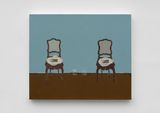
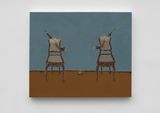
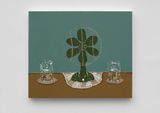
Throughout the canvases, Paula brings together objects associatedwith nourishment and spirituality. Chairs appear as both extensions ofthe body and makeshift altars: spaces where food, objects and gesturesof care intersect. In one composition, okra is placed across the bladesof a fan, the circulation of air suggesting the possibility of movementand renewed action, alongside water and stones as counterpoints ofpermanence and stability.

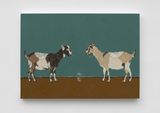
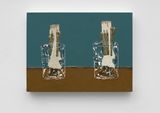
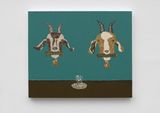
Other works consider the transmission of knowledge andresponsibility through objects associated with communication andlabour. A goat horn, traditionally used to guide, warn and gather,becomes an instrument of announcement and a call to collectiveaction, with two chairs suggesting the shoulders of a body supportingit. Crochet invokes domesticity, family knowledge and traditions,while also recalling the complex history of cotton and its relationshipto agriculture, forced labour and slavery. Elsewhere, bells summoncommunity, while pencils placed inside the mouths of goat headsconnect language, writing and education to the power of the word.Together, these works position knowledge and spirituality as intertwinedforms of emancipation.

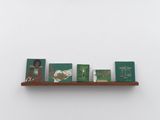
Also included is a work from Paula’s ongoing Retrato Silenciado(Silenced Portrait) series, expanding the focus into questions ofmemory and representation. By painting directly onto book covers,Paula encourages a dialogue between the subjects he depicts and the historical texts they have been omitted from. Despite the title, theimages across the books are not traditional portraits; rather, theycelebrate the presence of the individual through a still life or ritual.One volume features a portrait of Luis Gama’s mother, Luiza Mahin,a figure rarely represented in historical accounts and an importantpolitical and symbolic influence on Luis Gama’s formation. Othercovers directly connect to the wider themes of welcome and careon display – the gentle washing of feet; a still life incorporating theingredients of amalá – all weaving together essential concepts fromancestry and education to healing and belonging.

Across this new body of work, Paula approaches emancipation asboth a social and spiritual progression, sustained through practicesand the transmission of stories across generations. Bringing togetherhistorical figures with everyday objects and acts of care, Paula asksus to consider how the past can remain active in the present, as wellas the need to continue to explore new ways of engaging with sharedhistories.

Courtesy Lisson Gallery

Read More

Also Exhibiting at Lisson Gallery

The art world in focus