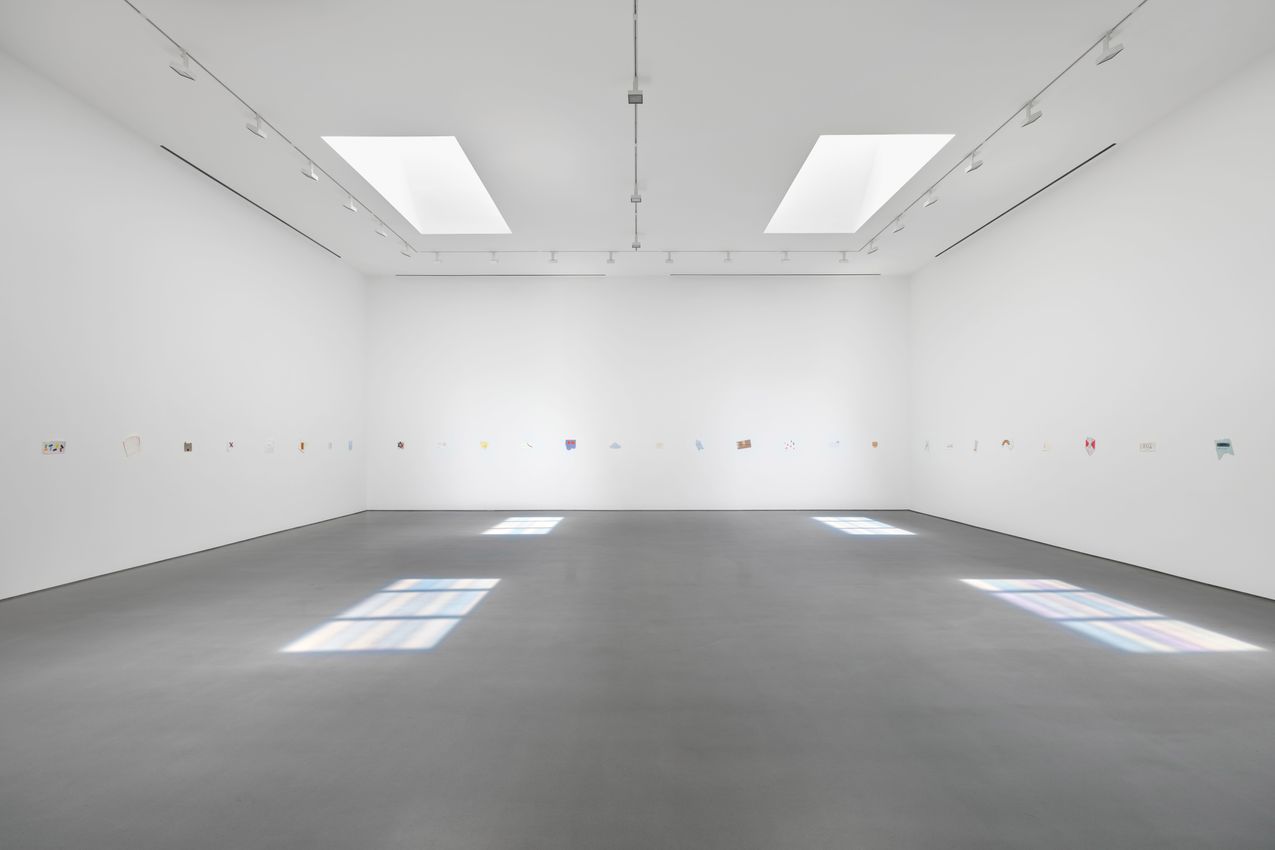
From 1948 to 1953, Carmen Herrera lived in Paris, immersing herself in the city’s dynamic postwar artistic community while frequently traveling to New York and Havana. This period marked a decisive shift in her practice, as she moved from biomorphic forms and fevered, gestural compositions to the rigorous geometric abstraction that would define her career for the next seven decades. A new exhibition at Lisson New York, Carmen Herrera: The Paris Years: 1948 - 1953—the most comprehensive presentation of her work from this period to-date— examines a young artist deep in experimentation, subsuming the seismic influences of many colliding midcentury art movements, in order to develop her own breakthrough language of painting.
Herrera’s years in Paris were a time of creative freedom and intellectual exchange, particularly through her participation in exhibitions such as the Salon des Réalités Nouvelles, where she exhibited alongside prominent figures such as Theo van Doesburg, Max Bill, and Piet Mondrian, as well as younger artists associated with Venezuela’s Los Disidentes, Brazil’s Concretists, and Argentina’s Grupo Madi. The city exposed her to key modernist movements such as Bauhaus and Russian Suprematism, which deeply influenced the shift toward her own uniquely minimal language. During her time in Paris, Herrera began employing shaped canvases while also becoming a pioneer in solvent-based acrylics, a material still novel in postwar Europe. Notably, an important work from this period, Iberic (1949), is currently the oldest work in the permanent collection of the Metropolitan Museum of Art to use this particular medium, a fact that was discovered through scientific analysis by the museum in 2021.
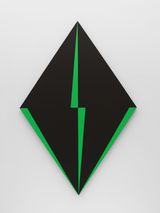
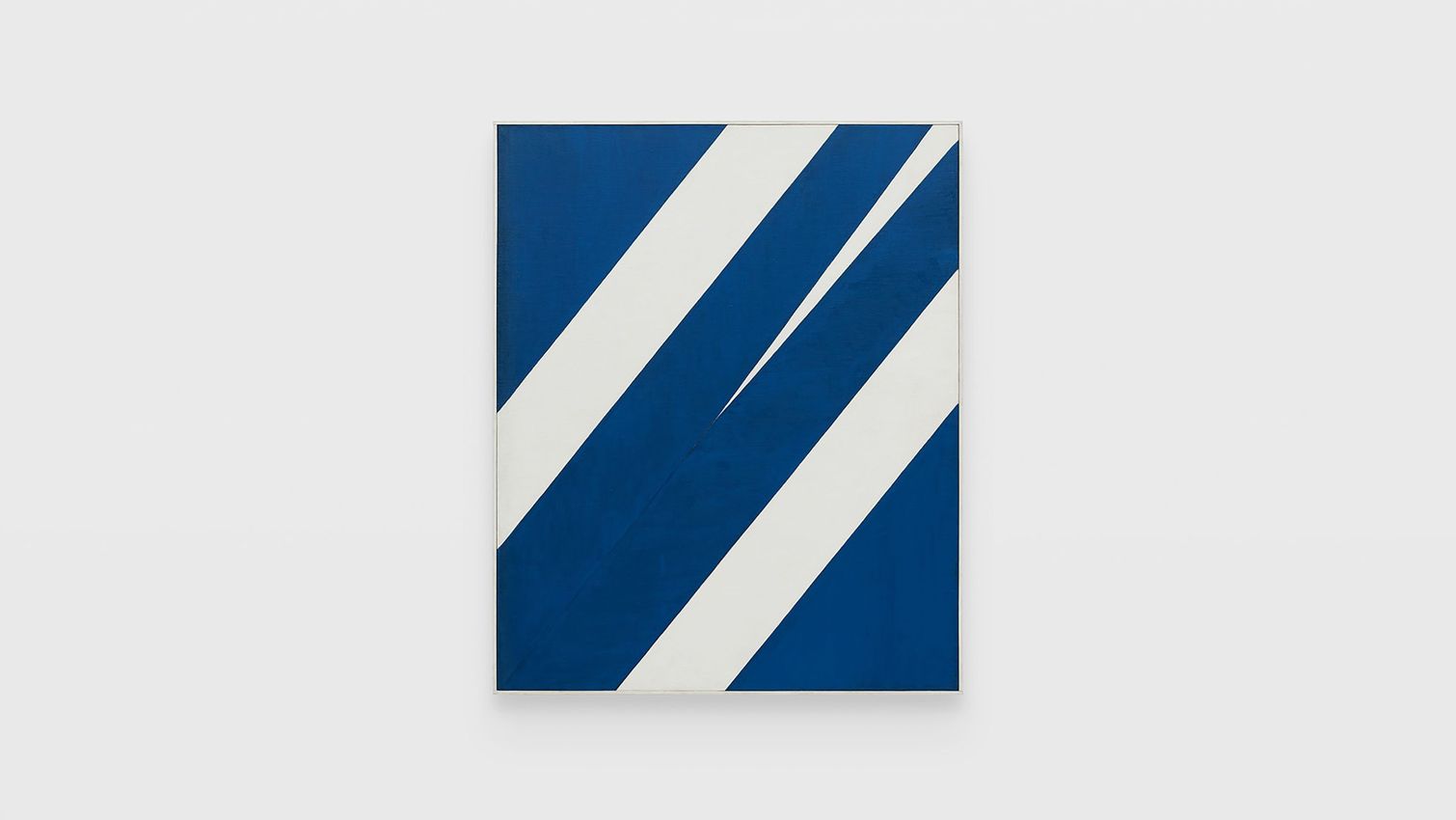
Key works on view include Way (1950), an early example of the hard-edged, dichromatic abstraction that would later become her signature. The painting’s four symmetrical ochre-colored triangles against a black background prefigure later masterpieces such as Black and White (1952) in the permanent collection of the Museum of Modern Art. Another major work from this period, Thrust (1950), exemplifies Herrera’s precision and spatial tension, featuring a striking white dart slashing across a cobalt blue ground. The work, both in its palette and bold linear composition, foreshadows Herrera’s future direction while also underscoring her approach to painting as object. This idea is further emphasized by the use of an artist-made frame, which was intended to prevent a buyer from re-framing the work. This concept evolves in subsequent pieces where she allowed her compositions to wrap about the edges, transforming them into fully three-dimensional forms.
Herrera’s Habana Series marks a pivotal moment in the artist’s development, showcasing her experimentation with gestural abstraction and Informalism during a brief stay in New York in 1950, as argued by Roxane Ilias in her essay, “Carmen Herrera and the Paris School.” Created in response to transnational developments in Abstract Expressionism, these works contrast with the structured geometric compositions of her Paris paintings. Like others from this series, Conquete de l’air (1950) features spontaneous brushstrokes, unruly lines, amorphous forms, and vibrant colors applied without Herrera’s typical preparatory sketches. Modest in scale, the paintings emphasize a tactile graphic quality with thick, rough surfaces. Named after her first solo exhibition at Havana’s Lyceum and Lawn Tennis Club (December 1950 - January 1951), the series reflects Herrera’s synthesis of Tachisme and Expressionism, blending the gestural techniques of Hans Hartung with those of Jackson Pollock.
The exhibition also features Early Dynasty (1953), the largest painting from this period, which demonstrates Herrera’s ambition and evolving style. In this work, she layers multiple colors and geometric forms, referencing motifs from earlier paintings to create a composition in constant motion. The deep blue, mushroom-like form at the top left echoes a similar shape in other canvasses from this period including Logique Coloree No. 5 (1949) and The King in Jail (1948) both on view in this exhibition. This tendency to revisit and refine geometric forms would become a hallmark of her later work, reinforcing her relentless pursuit of visual clarity and balance.
Herrera’s move back to New York in September 1953 presented challenges, as the art world’s gender and racial biases delayed her recognition. However, the radical developments of her Paris period laid the foundation for the rigorously precise, minimalist works that would define her later career. This exhibition builds on recent institutional recognition of Herrera’s artistic contributions during this period, including her inclusion in Women in Abstraction (Centre Pompidou, 2021–22) and Americans in Paris (Grey Art Museum, 2024). It also precedes Both Sides of the Line: Carmen Herrera and Leon Polk Smith, a major touring museum show curated by Dana Miller, who also curated Carmen Herrera: Lines of Sight at the Whitney Museum of American Art in 2016.
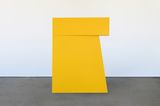
Core to Carmen Herrera’s painting is a drive for formal simplicity and a striking sense of colour: “My quest”, she says, “is for the simplest of pictorial resolutions” (2012). A master of crisp lines and contrasting chromatic planes, Herrera creates symmetry, asymmetry and an infinite variety of movement, rhythm and spatial tension across the canvas with the most unobtrusive application of paint. As she moved towards pure, geometric abstraction in the post-war years in Paris, she exhibited alongside Theo van Doesburg, Max Bill and Piet Mondrian and a younger generation of Latin American artists, such as members of the Venezuelan Los Disidentes, Brazilian Concretists and the Argentinian Grupo Madi. Her work also chimed with painters from the US school such as Barnett Newman, Leon Polk Smith and Ellsworth Kelly. Reflecting on this period, she says, “I began a lifelong process of purification, a process of taking away what isn’t essential” (2005). While allied with Latin American non-representational concrete painting, Herrera’s body of work has established, quietly but steadily, a cross-cultural dialogue within the international history of modernist abstraction.


A respected voice in contemporary art discourse.
Focusing on ambitious storytelling and insightful art-world commentary. Ocula Magazine publishes in-depth interviews, critical essays and timely analysis on the artists, exhibitions and ideas driving the global art world.
Learn more about Ocula Magazine
Showcasing the best of the art world.
Ocula partners with galleries from around the world to highlight their artists, artworks and exhibitions. Gallery membership is by application and invitation, with each member vetted by an independent panel.
Learn more about Ocula Membership

Specialises in the sale of major artworks.
Led by a team with deep ties to the world’s leading auction houses, galleries and collectors. Ocula’s advisory team offers bespoke services to high-net-worth clients from around the world who are looking to acquire the best of contemporary and modern art.
Learn more about our team and services