‘There are so many contradictions to the technological pursuit of sustainable energy. The irony of the Dyson Sphere is that if we want to advance as a civilization to the point where we could truly harness the power of the sun, we would end up blocking out our own natural light and heat, consuming much of our natural resources and have to start colonizing other planets in the process.’
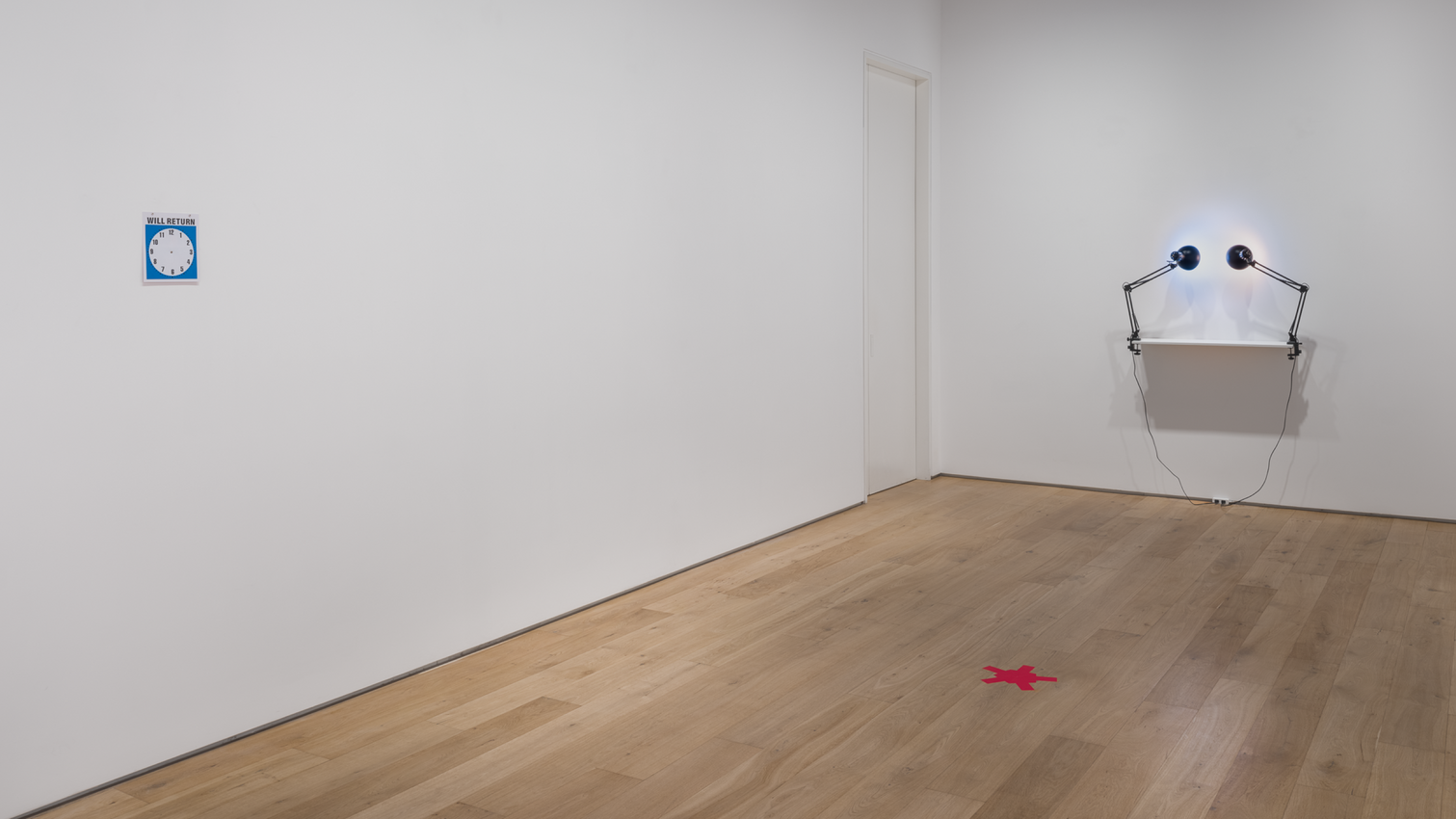
Haroon Mirza is known for creating self-powering and autonomous works of art, employing electrical signals, sound, photovoltaic panels and complex circuitry or systems of exchange that result in dynamic, audio-visual events. For his latest major project, Dyson Sphere, which will premiere in UTOPIA, the 6th edition of lille3000, Mirza experiments with the notion that humans might one day be able to encompass a star with a swarm of electric panels in order to exploit and gather its enormous reserves of solar power. In his exhibition at Lisson New York, For a Dyson Sphere, an iteration of this hypothesis, Mirza researches concepts of sustainability, viability and ecology at its core, for the survival of the human race. The London-based artist’s second solo exhibition in New York features a proposal to surround our sun with an orbital, energy-capture device that first appeared in a little-known British science fiction novel by Olaf Stapledon in 1937, entitled Starmaker. The proposition was popularised and given its name by English-American physicist Freeman Dyson in 1960.
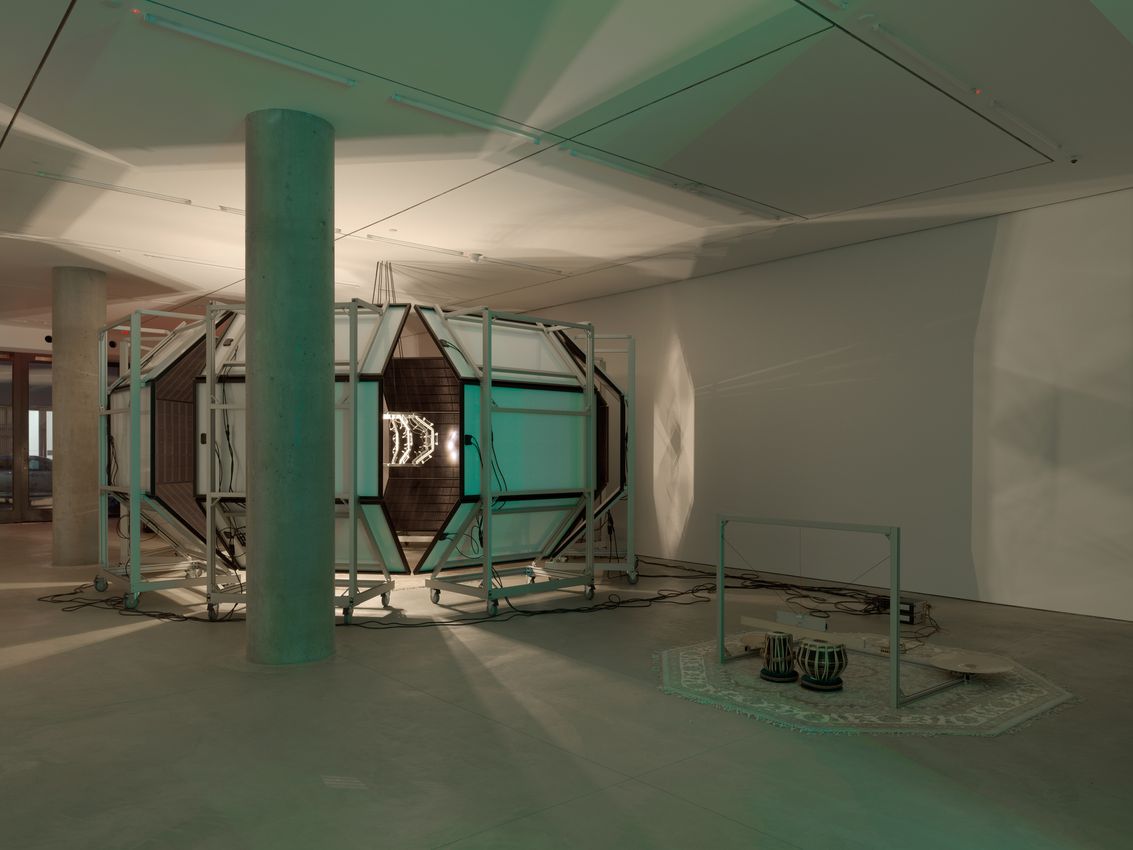
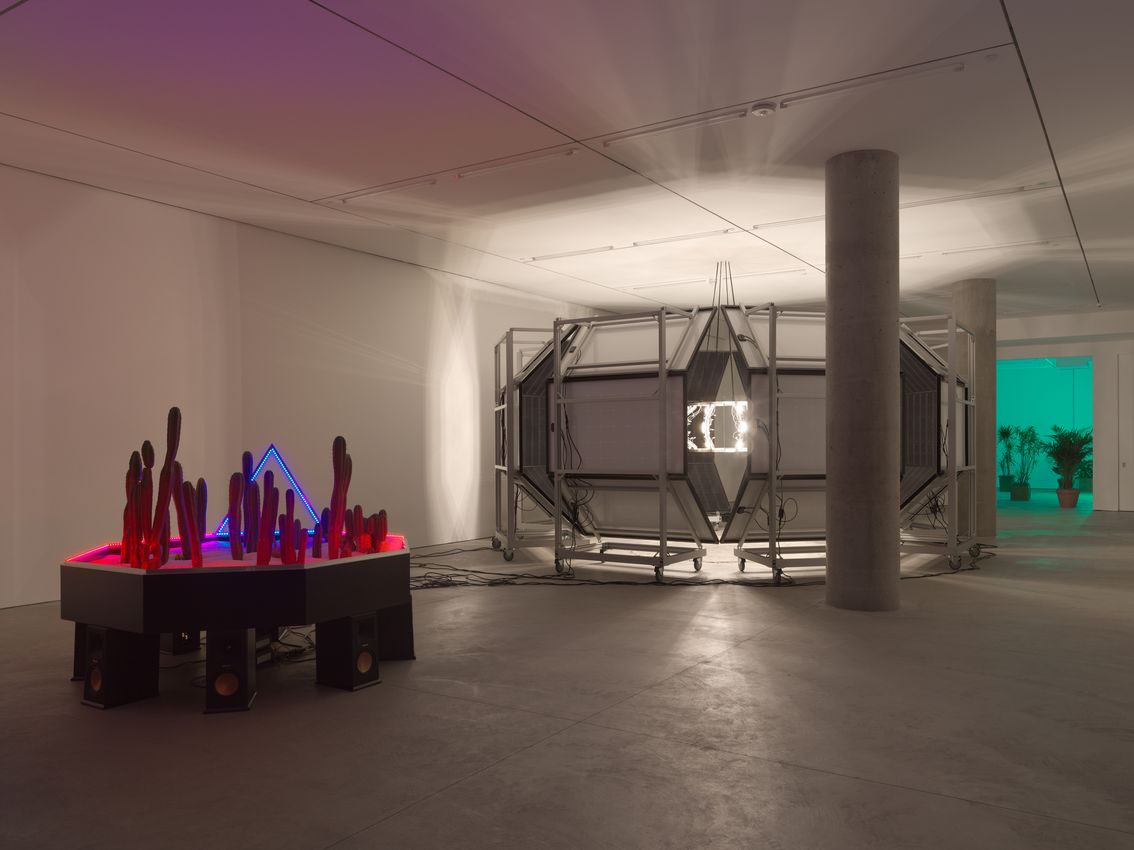
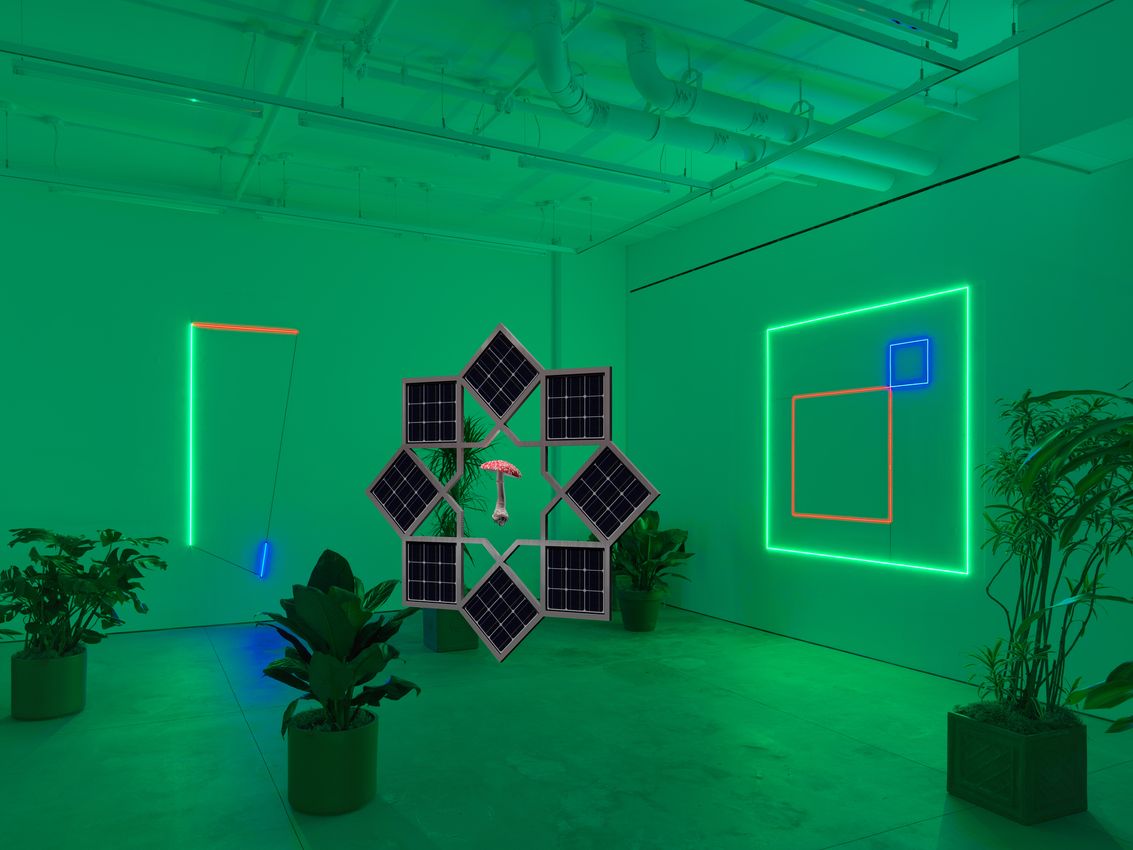
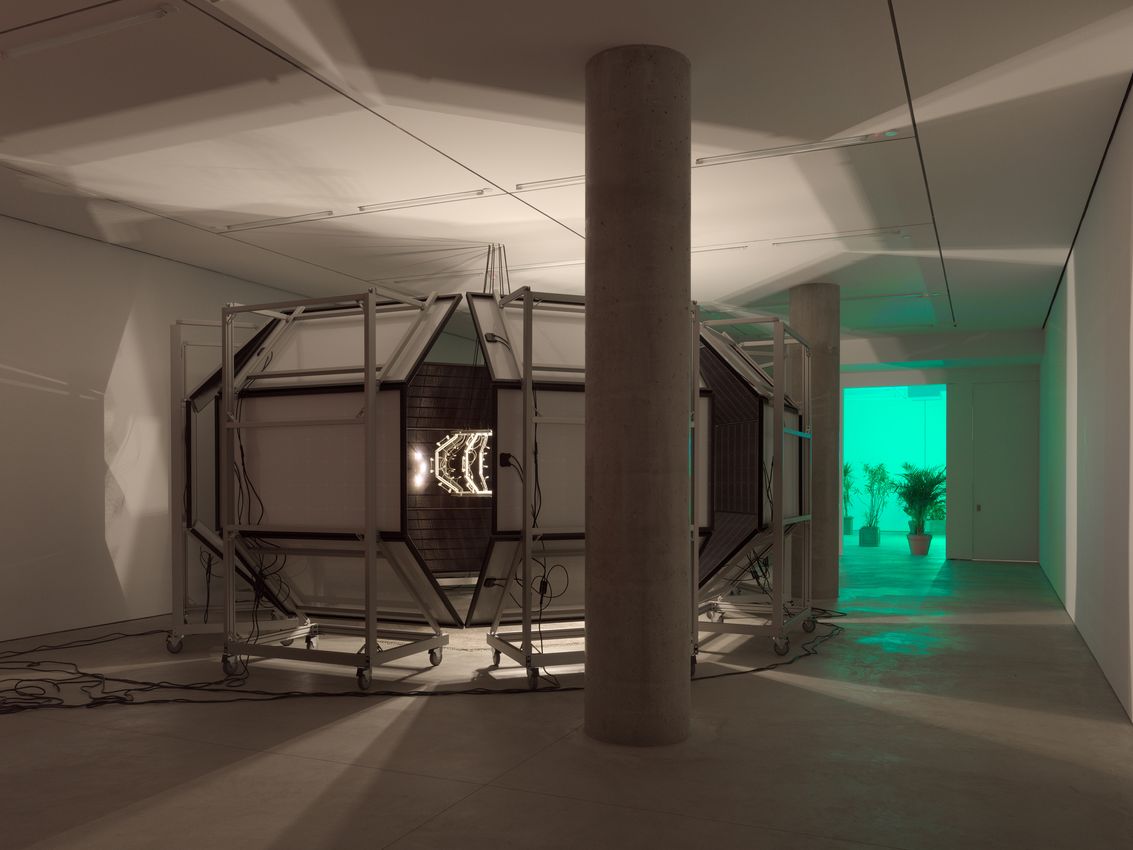
Haroon Mirza’s earthbound version of this hypothetical megastructure inhabits Lisson Gallery New York, centred on a blindingly brilliant tungsten light, encased within a carapace of photovoltaic panels. With each rotation of the bright bulbs, Mirza is giving light to this new technological dawn and through a series of cables the wattage produced flows around the space, powering a symphonic ecosystem created by the artist.
Through the planning of this exhibition Mirza explored the contradictions in the technological pursuit of sustainable energy. The question of whether such a radical proposal as the Dyson Sphere would ever be truly ecologically viable—even if colonising and mining other planets could be avoided—is put into question by the paradoxical reality of attempting to envelop and harvest the life-giving energy of an extra-terrestrial body, before reserving and limiting our increasingly finite local resources.
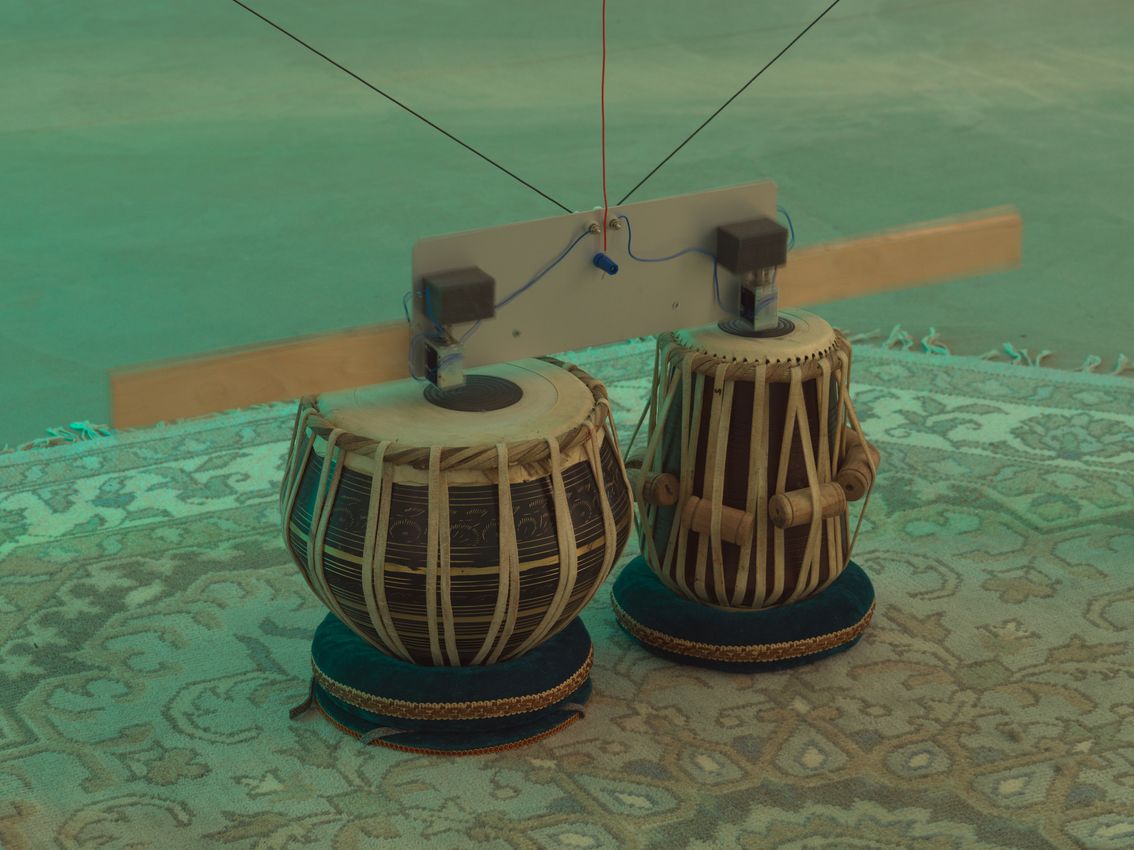
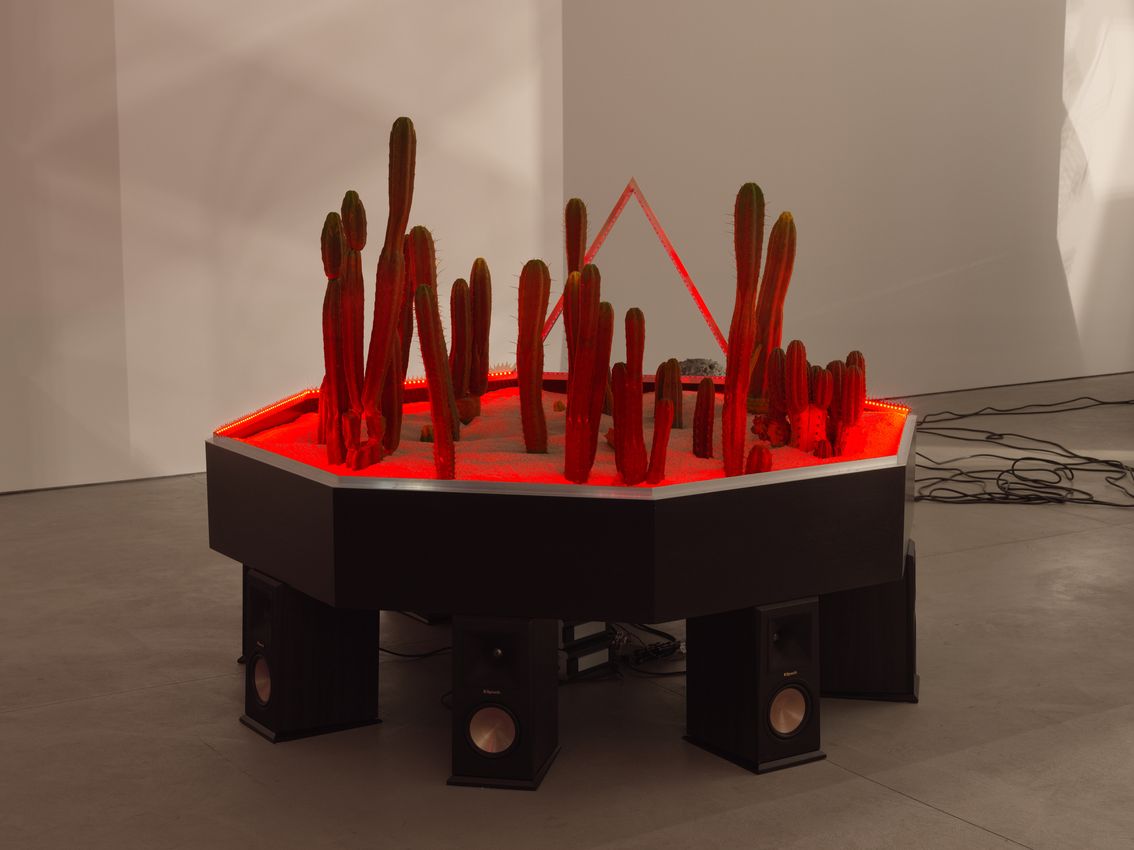
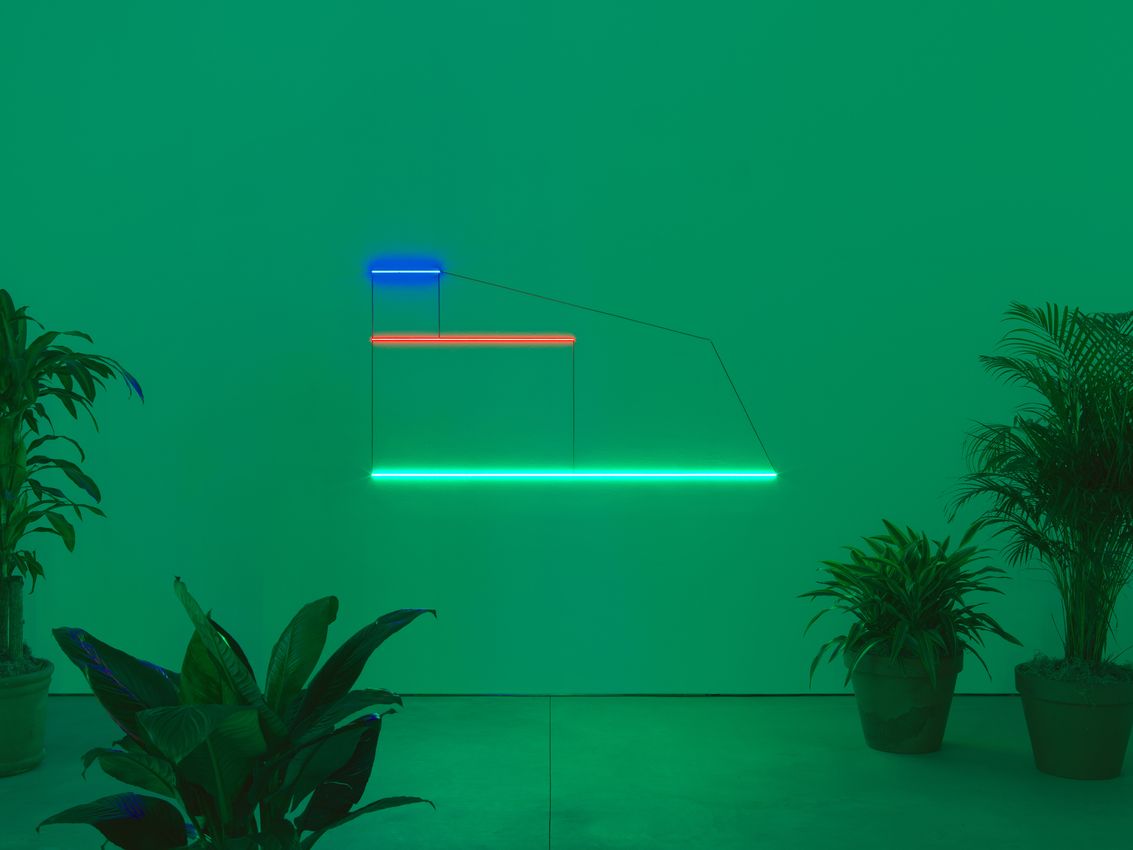
Mirza first used solar panels for an ambitious installation throughout Le Corbusier’s famous Villa Savoye in Paris, titled Light Hours in 2014. They were initially used to circumvent the lack of power he encountered in the carefully conserved interiors. As was the case in Light Hours, a galaxy of subsidiary works in For A Dyson Sphere surround and receive sustenance from the central power source, their individual LEDs flickering into life or sonic bursts resonating as the light strikes each corresponding solar panel. The other energy-hungry ecosystems in this mini planetarium incorporate plant life—including species of hallucinogenic succulents and fungi, disconnected from their mycological network in the outside work—again exploring whether any attempts to power our inexorable progress will ultimately be to the benefit or detriment of the natural world.
Haroon Mirza’s ambitious installation Dyson Sphere for lille3000 opens 14 May to 2 October 2022 in Gare Saint Sauveur, Lille and is proudly supported by Maison Ruinart.
Haroon Mirza has won international acclaim for installations that test the interplay and friction between sound and light waves and electric current. He devises kinetic sculptures, performances and immersive installations, such as The National Apavillion of Then and Now, 2011 – an anechoic chamber with a circle of light that grows brighter in response to increasing drone, and completely dark when there is silence. An advocate of interference (in the sense of electro-acoustic or radio disruption), he creates situations that purposefully cross wires. He describes his role as a composer, manipulating electricity, a live, invisible and volatile phenomenon, to make it dance to a different tune and calling on instruments as varied as household electronics, vinyl and turntables, LEDs, furniture, video footage and existing artworks to behave differently. Processes are left exposed and sounds occupy space in an unruly way, testing codes of conduct and charging the atmosphere. Mirza asks us to reconsider the perceptual distinctions between noise, sound and music, and draws into question the categorisation of cultural forms. “All music is organised sound or organised noise,” he says. “So as long as you’re organising acoustic material, it’s just the perception and the context that defines it as music or noise or sound or just a nuisance” (2013).


Established in 1967 in London, Lisson Gallery is one of the most well-known galleries operating globally. Boasting an influential and continuing legacy, including playing a pivotal role in the careers of many pioneers of historically important art movements, the gallery works with some of the most significant contemporary artists today.

A respected voice in contemporary art discourse.
Focusing on ambitious storytelling and insightful art-world commentary. Ocula Magazine publishes in-depth interviews, critical essays and timely analysis on the artists, exhibitions and ideas driving the global art world.
Learn more about Ocula Magazine
Showcasing the best of the art world.
Ocula partners with galleries from around the world to highlight their artists, artworks and exhibitions. Gallery membership is by application and invitation, with each member vetted by an independent panel.
Learn more about Ocula Membership

Specialises in the sale of major artworks.
Led by a team with deep ties to the world’s leading auction houses, galleries and collectors. Ocula’s advisory team offers bespoke services to high-net-worth clients from around the world who are looking to acquire the best of contemporary and modern art.
Learn more about our team and services